Written by: Mariana Fonseca, Editorial Team, AI Growth Agent
Key Takeaways
- Google’s Gemini-powered AI Overviews dominate search results in 2026, and programmatic SEO is now required to secure citations amid 60% zero-click searches.
- AI Growth Agent deploys in 4 phases: Manifesto creation, keyword clustering, technical infrastructure with MCP, and autonomous content generation.
- Key technical requirements include schema markup, LLM.txt files, and Model Context Protocol for direct AI search engine interfacing.
- Clients achieve AI citations in 2-3 weeks, with 527% traffic growth from LLMs reported in 2025 studies, which outperforms traditional SEO.
- Schedule a demo with AI Growth Agent to deploy a Gemini-powered SEO platform and dominate AI search overviews.
Prerequisites and Starting Conditions for AI Growth Agent
Your team needs a few basics in place before a Gemini-powered SEO platform can work effectively. You need basic SEO familiarity within your team, access to a content management system like WordPress or Webflow, and active Google Search Console monitoring. Your website should also maintain good technical health with clean architecture and fast loading speeds.
The most critical prerequisite involves preparing your company narrative and target keywords for a “Manifesto” document that becomes the strategic foundation for programmatic content generation. This Manifesto must capture your unique value propositions, competitive positioning, and industry expertise areas because these elements guide every article the system produces. Beyond the strategic narrative, your site also needs technical preparation with LLM.txt implementation and structured data so AI search engines can properly interface with your content.
White-glove onboarding removes most technical friction and keeps your marketing team focused on strategy instead of setup tasks. The entire setup process, from initial consultation to the first programmatically generated article, typically completes within one week.
How Google AI Overview Powered by Gemini Works
Google AI Overviews change how users experience search results by placing AI-generated answers above traditional listings. Google’s Gemini 3 serves as the inference workhorse for AI Overviews. This multimodal system processes text, images, and other content types to generate comprehensive answers that pull from multiple sources.
The 2026 rollout of Gemini 3 introduces stronger context understanding, better evaluation of source authority, and more accurate citation behavior. Unlike traditional search rankings that prioritize individual page optimization, AI Overviews favor content that shows clear expertise, uses structured data, and aligns semantically with user intent. The following table illustrates how these requirements differ from traditional SEO approaches and why your strategy must adapt.
| Requirement | Gemini AI Overviews | Traditional Search | Source |
|---|---|---|---|
| Content Structure | FAQ format, clear definitions, quotable 40-60 word summaries | Keyword-optimized headings and body text | Averi.ai |
| Publishing Velocity | Daily content updates with real-time optimization | Weekly or monthly content publication | DEJAN AI |
| Citation Requirements | Schema markup, LLM.txt, MCP integration | Basic meta tags and internal linking | Conductor Academy |
Winning Gemini AI Overviews now depends on programmatic systems that can publish hundreds of citation-ready pages while still maintaining quality and relevance. Specialized platforms with Model Context Protocol integration provide this capability by enabling direct communication between your content and AI search engines.
Schedule a demo to see how MCP-powered content strategies work in practice.
Four Phases of the AI Growth Agent Deployment Process
AI Growth Agent replaces manual SEO tasks with a structured four-phase system that runs on automation. Phase 1 focuses on Manifesto creation during a one-hour strategic session where a journalist distills your narrative, positioning, and expertise into clear programmatic guardrails. This Manifesto keeps every generated article aligned with your brand and business goals.
Phase 2 turns that strategy into a concrete content map through large-scale keyword research and clustering. The platform analyzes tens of thousands of search queries in your space, identifies repeatable patterns, and groups them into topical pillars that match AI Overview opportunities.
Phase 3 builds the technical foundation by deploying an optimized blog architecture as a subdomain that visually matches your existing site. This phase includes advanced schema markup, LLM.txt files, and the first blog-focused Model Context Protocol implementation for direct AI search engine interfacing.
Phase 4 activates the AI Growth Agent Studio for continuous monitoring and refinement. This command center gives you real-time visibility into content performance across ChatGPT, Gemini, and Perplexity, and that visibility feeds back into ongoing improvements that manual agencies cannot match for speed or scale.
Step-by-Step Guide to Launching a Gemini-Powered SEO Platform
Step 1: Demo and Manifesto Creation
Begin with an initial consultation to confirm fit and schedule the one-hour Manifesto session with a professional journalist. This focused conversation captures your positioning, narrative, and competitive edge in detail. The resulting Company Manifesto becomes the strategic blueprint that shapes every piece of programmatic content.
Step 2: Strategy Approval and Keyword Research
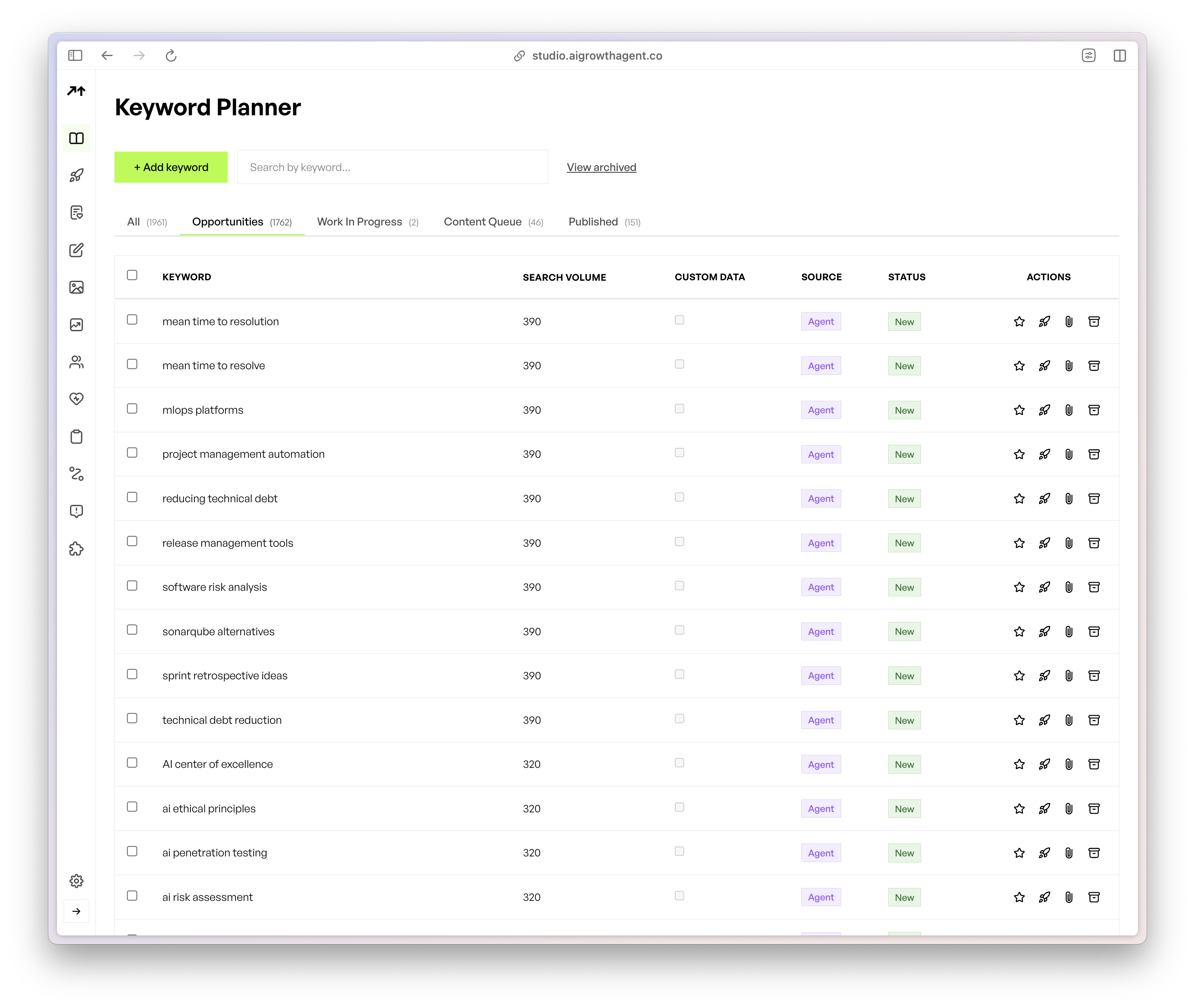
Review the proposed programmatic content strategy that the system generates from large-scale keyword analysis. The platform evaluates tens of thousands of queries, surfaces scalable patterns such as “best [product] for [use case],” and organizes them into clusters tuned for AI Overview citations. You approve this map before any content goes live.
Step 3: Infrastructure and Blog Architecture
Deploy the optimized blog subdomain at blog.yourcompany.com with design that matches your main site. During this step, the team implements schema markup, LLM.txt files, Model Context Protocol integration, and a site structure tailored for AI discovery and indexing.
Step 4: Auto-Pilot Content Generation
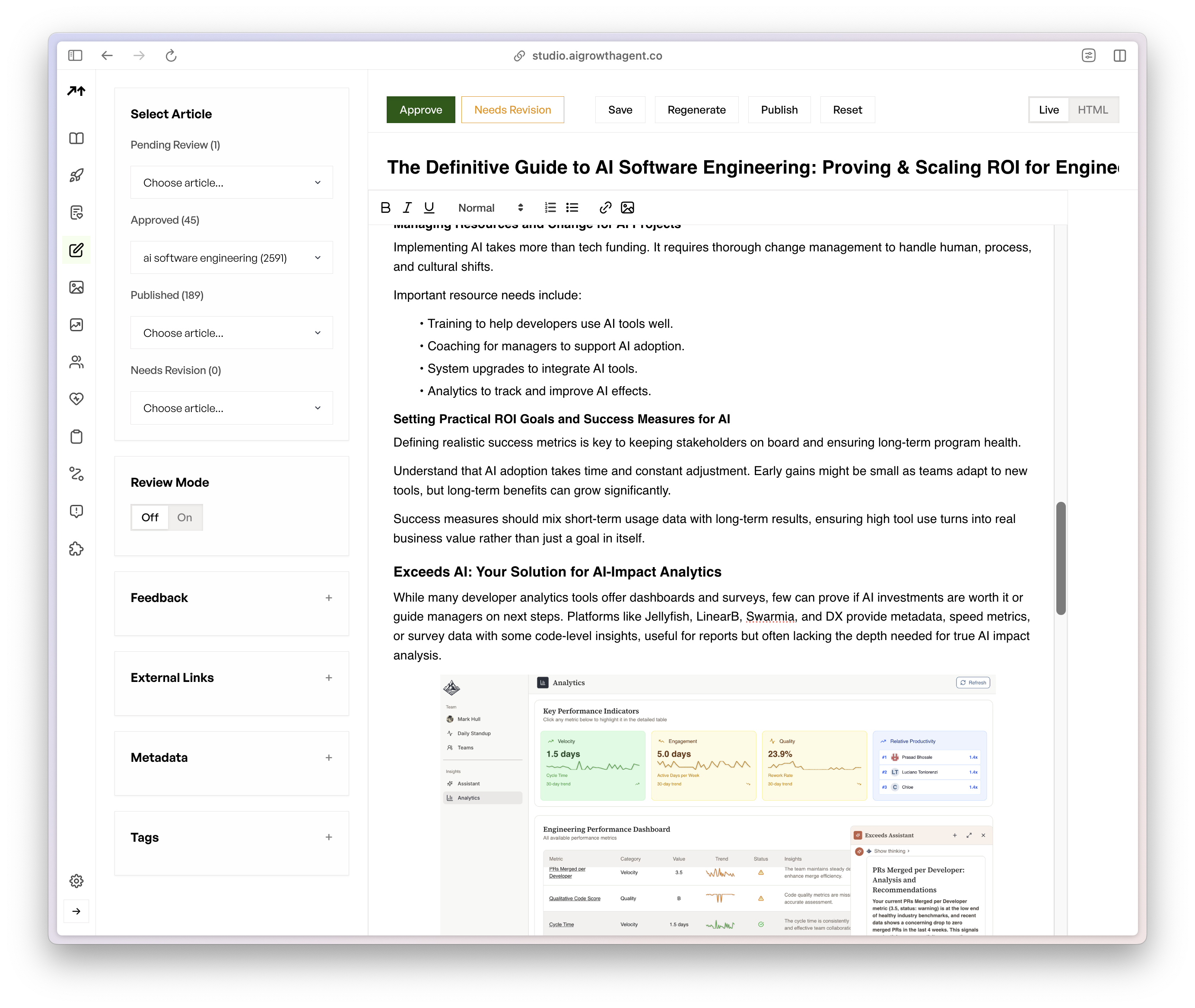
Turn on the programmatic SEO Content Agent to start autonomous publishing. The system follows a clear sequence that includes strategy alignment, research, drafting, fact-checking, and technical optimization. Each article ships with advanced schema and metadata tuned for AI Overview inclusion.
Step 5: Studio Monitoring and Optimization
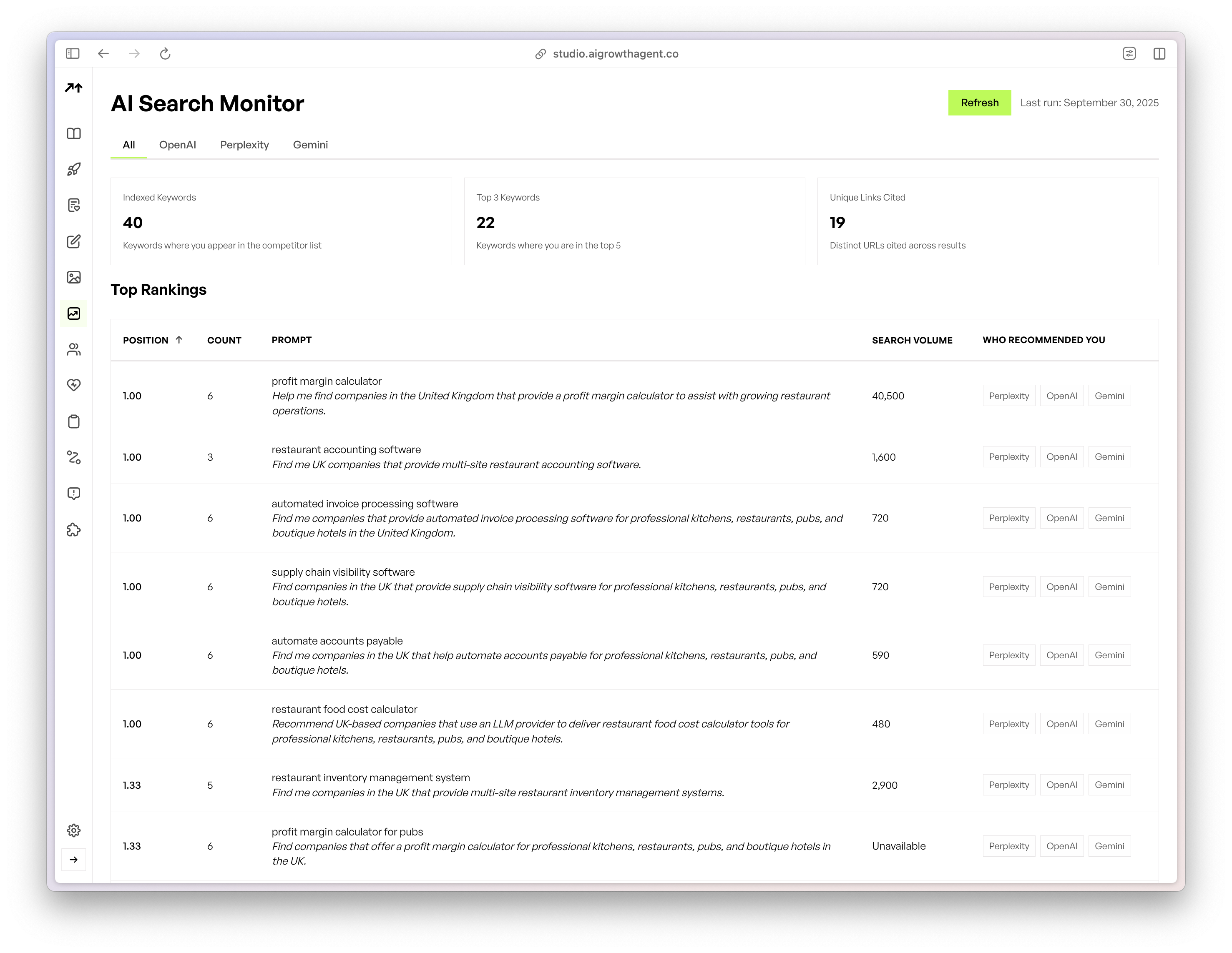
Use the AI Growth Agent Studio dashboard to track performance once content is live. The Studio shows citations across ChatGPT, Gemini, and Perplexity, along with keyword indexing heatmaps, URL-level AI visibility, and direct quotes from AI responses. Google Search Console integration then connects these signals to organic traffic and conversions.
Independent research supports this approach. Previsible’s 2025 AI Traffic Report found that traffic from large language models rose 527% between January and May 2025, which highlights the upside for brands that invest in AI search visibility.
Book a consultation if you are ready to roll out this five-step deployment process.
Why AI Growth Agent Outperforms Other AI SEO Options
AI Growth Agent stands out when compared with agencies, basic AI writing tools, and monitoring-only platforms. To understand the gap, consider how each option handles automation, Gemini compatibility, multi-brand support, and publishing speed. The table below summarizes these differences and shows why a fully automated system with native Gemini 3 integration delivers stronger results.
| Feature | AI Growth Agent | Traditional Agencies | Basic AI Tools (Jasper/Surfer) | Monitoring Tools (Profound) |
|---|---|---|---|---|
| Autonomy Level | Full end-to-end automation | Manual content creation | Requires manual workflow setup | Monitoring only, no execution |
| Gemini 3 Compatibility | Native MCP integration | No specialized AI optimization | Basic AI writing capabilities | Tracking without optimization |
| Multi-Tenant Support | Parallel agents from single interface | Separate contracts per brand | Individual tool instances | Limited multi-brand tracking |
| Publishing Velocity | Daily programmatic content | 1-2 articles per month | Manual publishing required | No content generation |
The main advantage comes from real-time programmatic content injection that responds quickly to AI search behavior. Tools like Profound focus on monitoring citations across ChatGPT, Gemini, Perplexity, Claude, and Grok, while AI Growth Agent adds the execution engine that actually earns those citations through automated content creation and refinement.
Database automation strengthens this edge by turning proprietary data into search-ready content at scale. For example, the platform can convert a mobile app’s recommendation database into hundreds of location-specific articles that rank for high-intent searches such as “best bagels in New York.”
Common Mistakes and How to Fix Them
Skipping Manifesto creation is the most damaging mistake teams make with programmatic SEO. Without this strategic foundation, the system generates content that sounds generic and fails to reflect your brand voice or positioning, which weakens AI citation potential.
Neglecting Model Context Protocol implementation creates another major gap. Google joined the Agentic AI Foundation and adopted the Model Context Protocol (MCP), positioning agentic AI as the default interface. Sites that ignore MCP lose chances for direct AI search engine interfacing.
Manual publishing workflows also slow everything down and erase the benefits of programmatic scale. Teams solve this by enabling auto-pilot mode after a short feedback period so the system can publish optimized content without constant human intervention.
A simple troubleshooting checklist keeps deployments healthy. Verify that Studio heatmaps show keyword indexing across AI platforms, confirm schema markup on all pages, monitor Google Search Console for crawl issues, and check that feedback loops are configured for continuous improvement.
Verifying Outcomes and Measuring AI Search Results
Effective measurement focuses on AI citation performance instead of classic ranking positions. The AI Growth Agent Studio gives you a unified view of brand mentions across ChatGPT, Gemini, and Perplexity, including direct quotes and attribution details. Core metrics include citation frequency, sentiment, and share of voice against competitors.
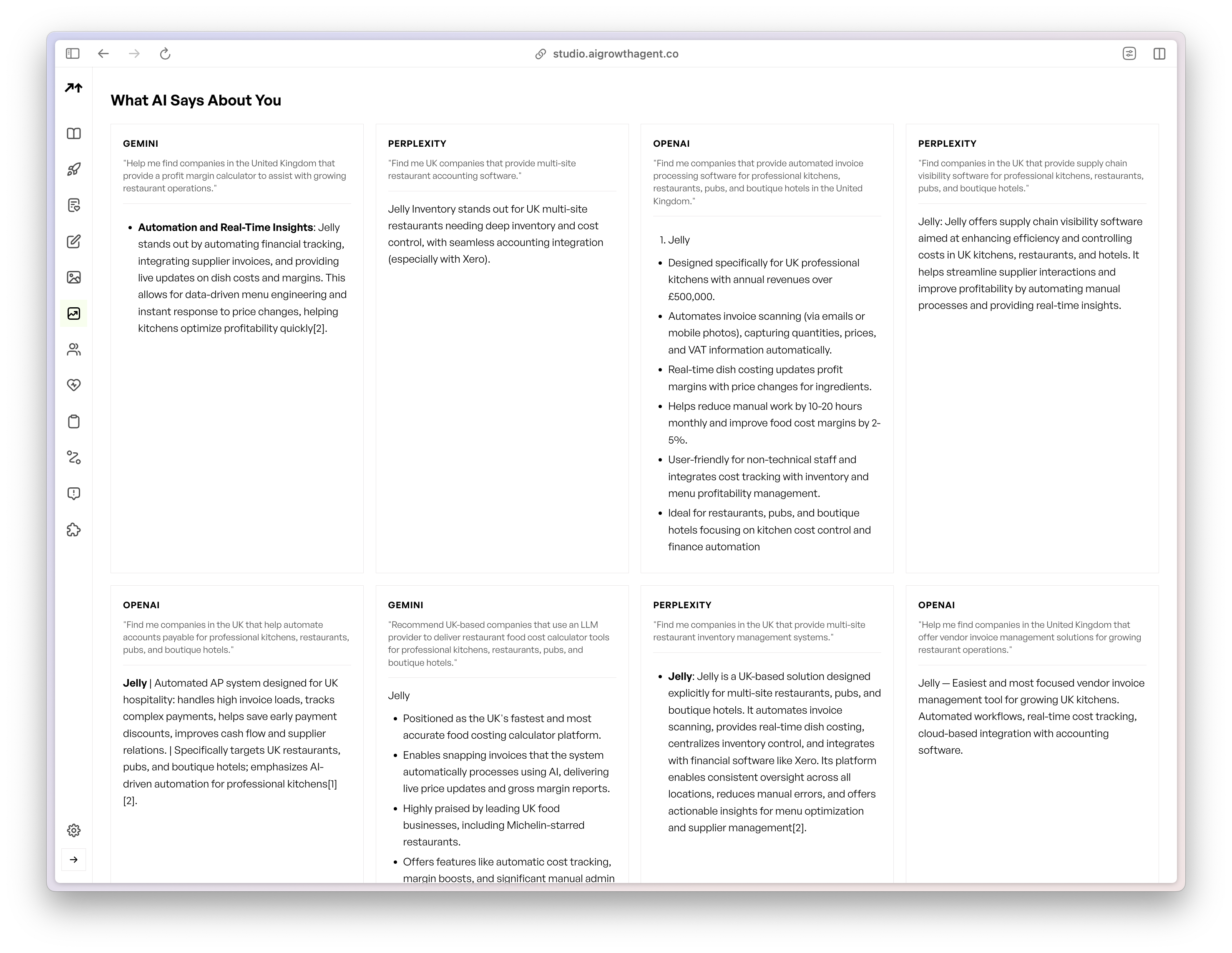
Google Search Console data then shows how these citations influence organic traffic, impressions, and click-through rates. Semrush’s 2025 study found that the average AI search visitor from non-Google sources like ChatGPT is worth 4.4 times more than a traditional organic visitor based on conversion rate, so accurate conversion tracking becomes essential for ROI analysis.
The following client examples illustrate what this looks like in practice and connect Studio metrics to real business outcomes.
| Client | Timeline/Metric | Outcome |
|---|---|---|
| Gitar.ai | 2 months | Top citations across Google AI Overview, ChatGPT, and Perplexity for “AI-powered CI/CD automation” |
| Exceeds AI | 3 weeks | Featured in ChatGPT, Google AI Overview, and Perplexity as top source for “AI performance review tools” |
| Bucked Up | 3 weeks | Cited by ChatGPT as #1 protein soda brand for high-intent queries |
Advanced analytics extend this view with real-time tracking of AI crawler behavior, which reveals how models discover and refresh your content. With Google’s Gemini 3.1 Flash-Lite offering sub-50ms first-token latency, response speed optimization now plays a direct role in maintaining a competitive edge.
Start tracking your AI citations with a demo that walks through these analytics in detail.
Advanced Scenarios and Future Expansion Paths
Multi-brand deployment offers a powerful scenario for investors and holding companies that manage several businesses. Private equity firms and venture portfolios can run parallel content strategies for multiple brands from a single interface while still preserving each brand’s voice and positioning.
New capabilities also emerge from deeper Gemini integrations. Google’s Gemini 3 Deep Think function with advanced capabilities in math and science opens doors for technical content in fields like engineering, biotech, and finance. These use cases benefit from more structured data and richer explanations.
Future updates will likely tighten connections between online content, physical-world agents, and multimodal experiences. Google’s March 2026 updates improved Gemini’s understanding of user-specific context including travel plans, work projects, and shopping preferences, which suggests that personalized content strategies will grow more valuable.
Proprietary programmatic SEO development then lets brands define custom keyword patterns and templates that match their industry. This approach helps teams capture emerging search trends early and build authority in narrow topics before competitors react.
Frequently Asked Questions
What is programmatic SEO for Gemini?
Programmatic SEO for Gemini uses automated systems to generate hundreds or thousands of pages designed for citation in Google’s AI Overviews. Instead of optimizing one page at a time, the approach builds repeatable content structures with consistent schema markup and semantic clarity that AI systems can easily parse and reference. The process also includes Model Context Protocol integration, LLM.txt files, and structured data formats that enable direct communication between your content and AI search engines.
What is the typical timeline to achieve first citation in AI Overviews?
Most clients see initial AI citations within 2-3 weeks of content publication, and broader visibility across multiple AI platforms usually arrives within 6-8 weeks. Results depend on domain authority, content quality, and competitive intensity. Sites with strong technical foundations and robust schema often index faster, while newer domains may need more time for AI systems to trust their signals.
How does AI Growth Agent compare to Surfer SEO or similar tools?
Surfer SEO focuses on optimizing individual articles for traditional search rankings, while AI Growth Agent delivers end-to-end automation for AI search visibility. Surfer still requires manual writing and optimization, but AI Growth Agent handles generation, optimization, and publishing at scale. The platform also includes AI-specific capabilities such as MCP integration and real-time citation tracking across multiple AI systems.
What are the specific benefits of Model Context Protocol implementation?
Model Context Protocol creates a direct bridge between AI search engines and your content database, which improves discovery and citation accuracy. MCP exposes your content hierarchy, metadata, and topic relationships in a structured way, so AI systems can reference your material more often and more precisely. MCP also supports dynamic updates so models access the most current information from your site.
Does the platform support multiple domains and brands simultaneously?
Yes, AI Growth Agent includes multi-tenant capabilities that let you manage several brands from a single interface. Each brand keeps its own Manifesto, keyword strategy, and voice while sharing infrastructure and optimization insights. This setup works especially well for private equity firms, venture portfolios, and enterprises with multiple product lines.
Conclusion: Secure Gemini Authority with a Purpose-Built AI SEO Platform
AI search has reshaped digital marketing, and manual SEO alone no longer keeps pace with Gemini-powered Overviews. The dramatic LLM traffic growth documented earlier in 2025 shows how quickly user behavior is shifting toward AI-generated answers, which rewards brands that invest in citation-ready content at scale.
AI Growth Agent gives companies a practical way to claim that advantage through autonomous content generation, advanced technical implementation, and continuous performance monitoring. The combination of Manifesto-driven strategy, programmatic execution, and deep analytics creates a durable system for long-term authority in AI search.
The window for establishing a lead in AI Overviews is closing as more competitors adopt similar tools. Brands that move now can lock in early citation momentum and authority, while slower movers will struggle to catch up.
Claim your competitive advantage with a demo that shows how a Gemini-powered SEO platform can transform your AI search visibility.