Written by: Mariana Fonseca, Editorial Team, AI Growth Agent
Key Takeaways
- Audit and unify brand data across platforms to remove inconsistencies that block AI citations and create a reliable foundation.
- Deploy schema markup, LLM.txt, and MCP protocols so AI engines receive clear, structured data they can cite frequently.
- Publish deep niche content at daily velocity so AI assistants favor your fresh, authoritative resources over outdated material.
- Build third-party trust through scaled PR and community activity on platforms like Reddit, which drive nearly half of top AI citations.
- Monitor citations in real time and refine continuously; book a working session with AI Growth Agent to launch an autonomous SEO agent that delivers results in weeks.
How to Get Your Company Cited by AI Assistants in 2026: 7 Programmatic Steps
This playbook shows how to earn AI citations and dominate ChatGPT, Perplexity, and Google AI Overviews through scalable, automated execution.
1. Audit & Unify Brand Data
2. Deploy Schema & LLM.txt/MCP
3. Engineer Deep Niche Content at Velocity
4. Build Third-Party Trust Programmatically
5. Monitor & Optimize Citations
6. Prove Impact with Case Studies
7. Onboard a Programmatic SEO Agent
Step 1: Audit & Unify Brand Data for Clear Signals
Consistent NAP (Name, Address, Phone) data and unified Wikipedia signals create the base layer for AI citation eligibility. The “30% content rule” myth suggests volume limitations, but citation data reveals the opposite pattern. BrightEdge analysis shows 82.5% of citations target deep pages, not homepages, which proves scaled, structured coverage beats arbitrary content caps.
Brand data inconsistencies flag spam signals to AI crawlers because variations in company descriptions, contact information, or positioning statements across platforms create confusion that reduces citation probability. This is why AI Growth Agent’s Manifesto programming unifies brand messaging across all content assets. Consistent signals build authority instead of diluting it.
The audit process surfaces gaps in structured data, inconsistent messaging, and technical barriers that block AI indexation. OtterlyAI found 73% of sites have technical barriers including robots.txt blocks and JavaScript rendering issues blocking AI crawlers like GPTBot and PerplexityBot. Manual audits often miss these details, while automated systems detect and document them at scale.
Once brand data and access issues are mapped, the next step focuses on the technical structure that makes this information easy for AI engines to consume.
Step 2: Deploy Schema, LLM.txt, and MCP for Structured Access
Technical infrastructure turns unified brand data into content AI engines can reliably parse and cite. FAQ schema and Organization schema provide structured fields that AI systems prioritize. LLM.txt files guide AI crawlers to your most valuable content, and Model Context Protocol (MCP) extends this by enabling direct database access, a world-first capability in AI Growth Agent’s stack.
Schema markup creates machine-readable content structures that AI engines process efficiently. OtterlyAI’s research shows schema-tagged pages receive 3-5x more AI citations than unstructured content. Manual schema implementation consumes developer time and needs constant upkeep. Automated injection applies consistent technical enhancements across every page.
Beyond standard schema markup, the most advanced approach involves Model Context Protocol. MCP represents the cutting edge of AI-content integration and allows AI engines to interface directly with content databases instead of relying only on crawled text. This deeper access improves context and accuracy for AI responses, which raises citation probability significantly.
With this infrastructure in place, your site becomes technically ready for AI. The next priority is feeding that infrastructure with a steady stream of fresh, specialized content.
See these technical protocols in a live demo and review how they apply to your stack.
Step 3: Publish Deep Niche Content at Daily Velocity
High publishing velocity directly influences how often AI assistants cite your brand. Seer Interactive’s analysis shows 65% of AI citations target content published within the past year, with Perplexity citing 50% from 2025 content alone. Daily publishing now functions as a baseline for staying visible in competitive spaces.
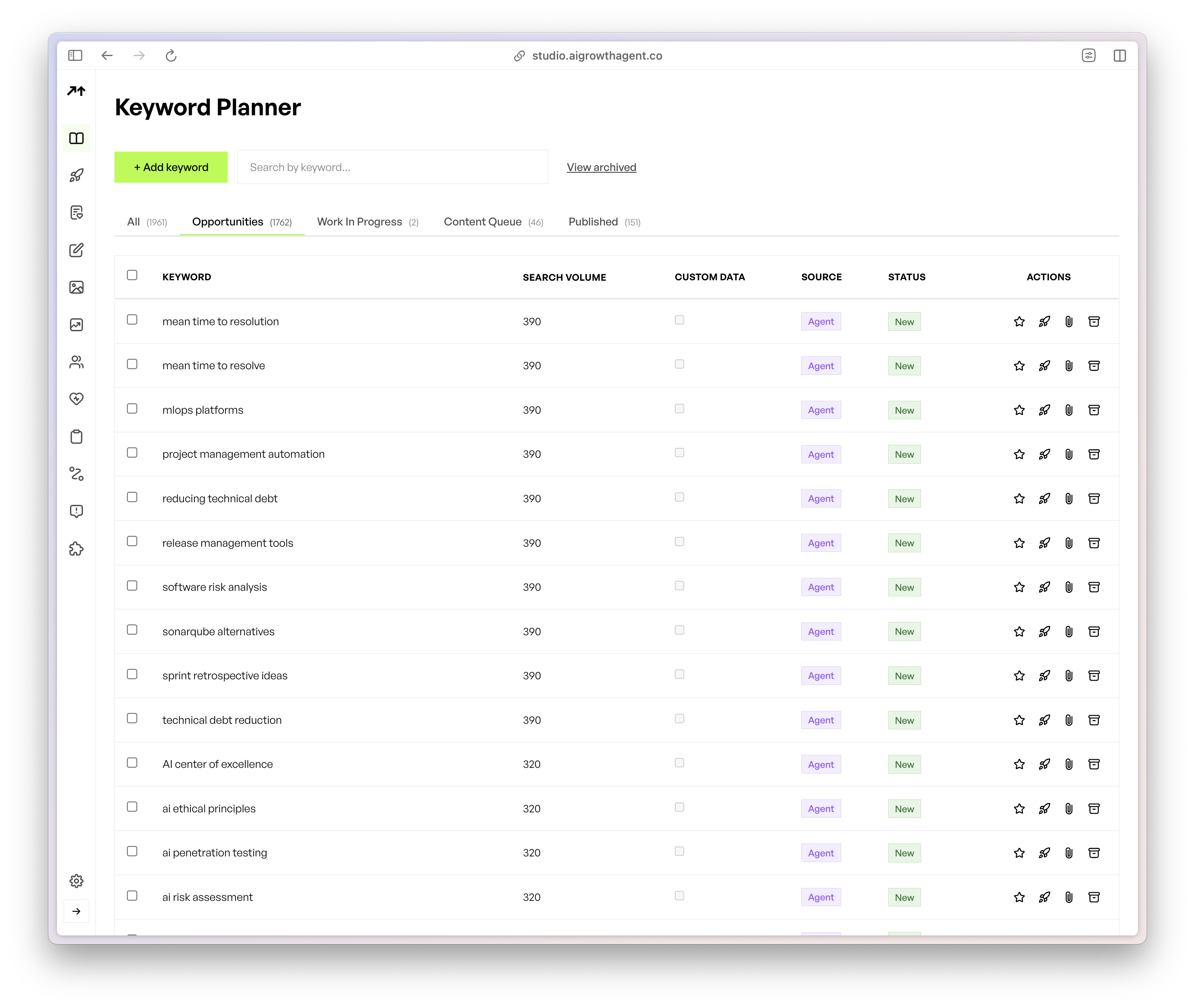
Manual content creation cannot reach the scale required for consistent AI citations. The gap is stark: traditional agencies deliver 1-2 articles monthly while AI engines reward fresh, comprehensive coverage of niche topics. AI Growth Agent’s autonomous content engine produces technically precise articles every day, each mapped to specific citation opportunities.
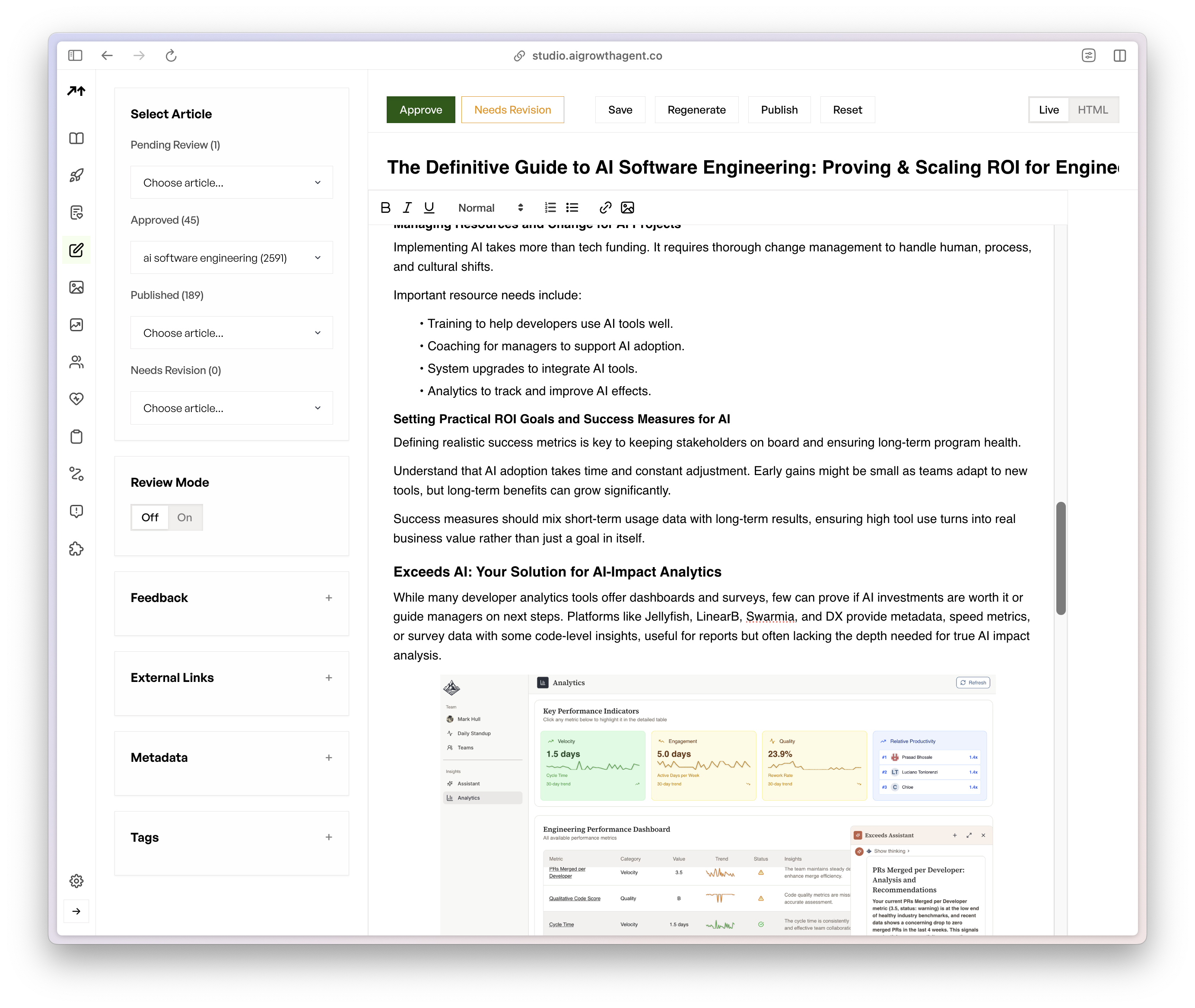
Deep niche coverage establishes topical authority that AI engines recognize and cite repeatedly. Instead of broad, generic articles, automated systems pinpoint knowledge gaps and create comprehensive resources that become definitive references. This focused approach builds citation momentum as AI assistants return to the same trusted sources.
With content velocity in place, the strategy expands beyond your own site to the external signals AI systems use to judge credibility.
Step 4: Build Third-Party Trust with Scaled PR
Third-party validation heavily influences AI citation decisions. ReSO’s analysis shows Reddit accounts for 46% of Perplexity’s top citations, while AirOps research found 85% of brand mentions in AI answers came from third-party pages, not owned domains.
Scaled PR and community engagement expand third-party mentions far beyond what manual outreach can achieve. Automated workflows seed and support conversations that create the external validation signals AI engines rely on for credible answers.
Community platforms such as Reddit, Quora, and industry forums act as high-value citation sources that AI systems trust. Manual community participation rarely maintains the volume and consistency needed for reliable citation generation. Automated programs sustain presence across many platforms at once and reinforce your authority.
Once third-party trust signals grow, monitoring how AI engines actually reference your brand becomes the next critical layer.
Step 5: Monitor and Refine AI Citations in Real Time
Real-time citation monitoring creates feedback loops that steadily improve AI visibility. SE Visible and similar tools track brand appearances across Google AI Mode, ChatGPT, and Perplexity with 90% of brands appearing in Google AI Mode responses, but tracking without follow-through produces data without impact.
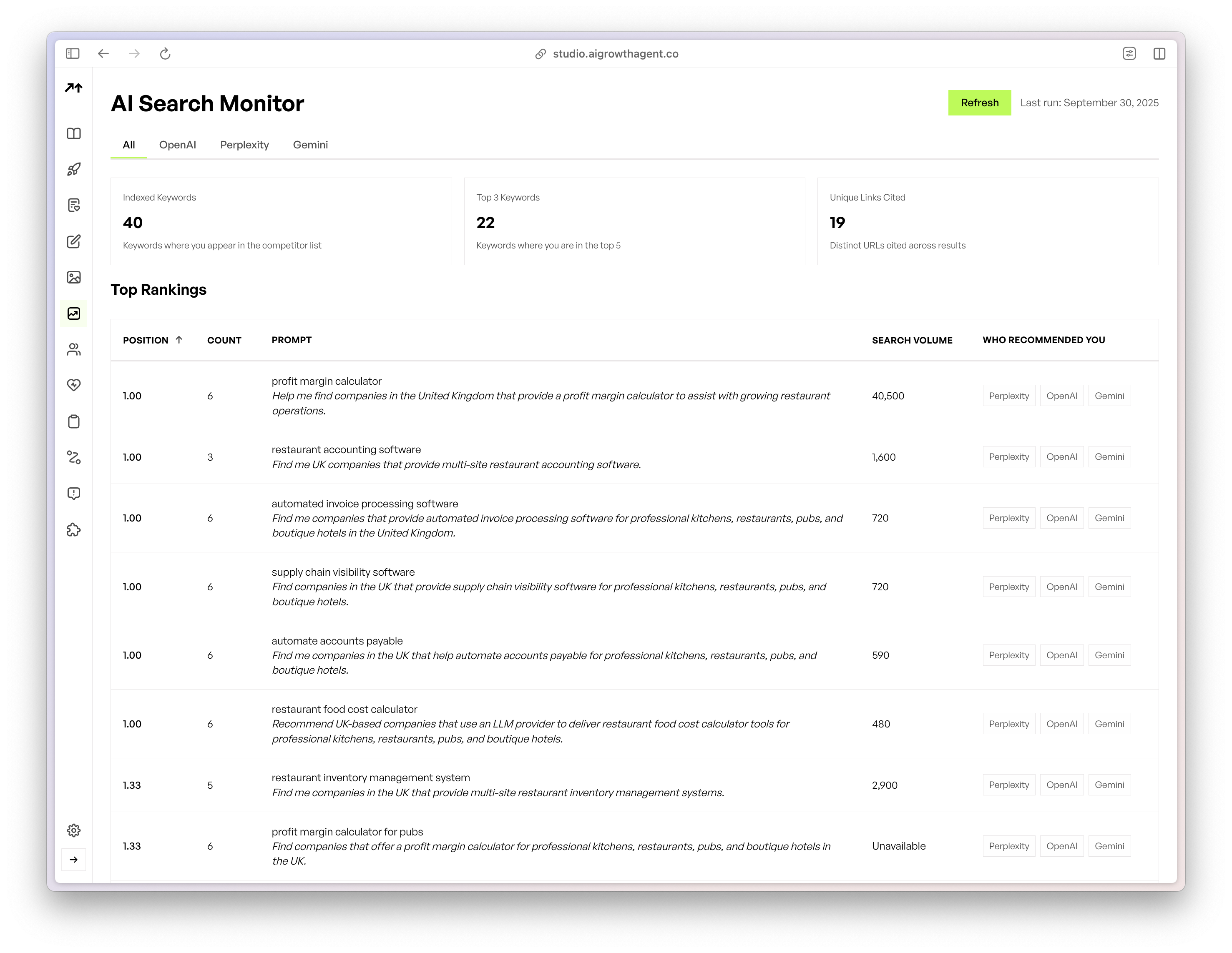
AI Growth Agent’s Studio adds decision-ready insight through heatmap visualizations that show citation patterns across AI engines, sentiment analysis, and competitive benchmarking. These views guide content and technical adjustments that lift citation frequency and improve placement within AI answers.
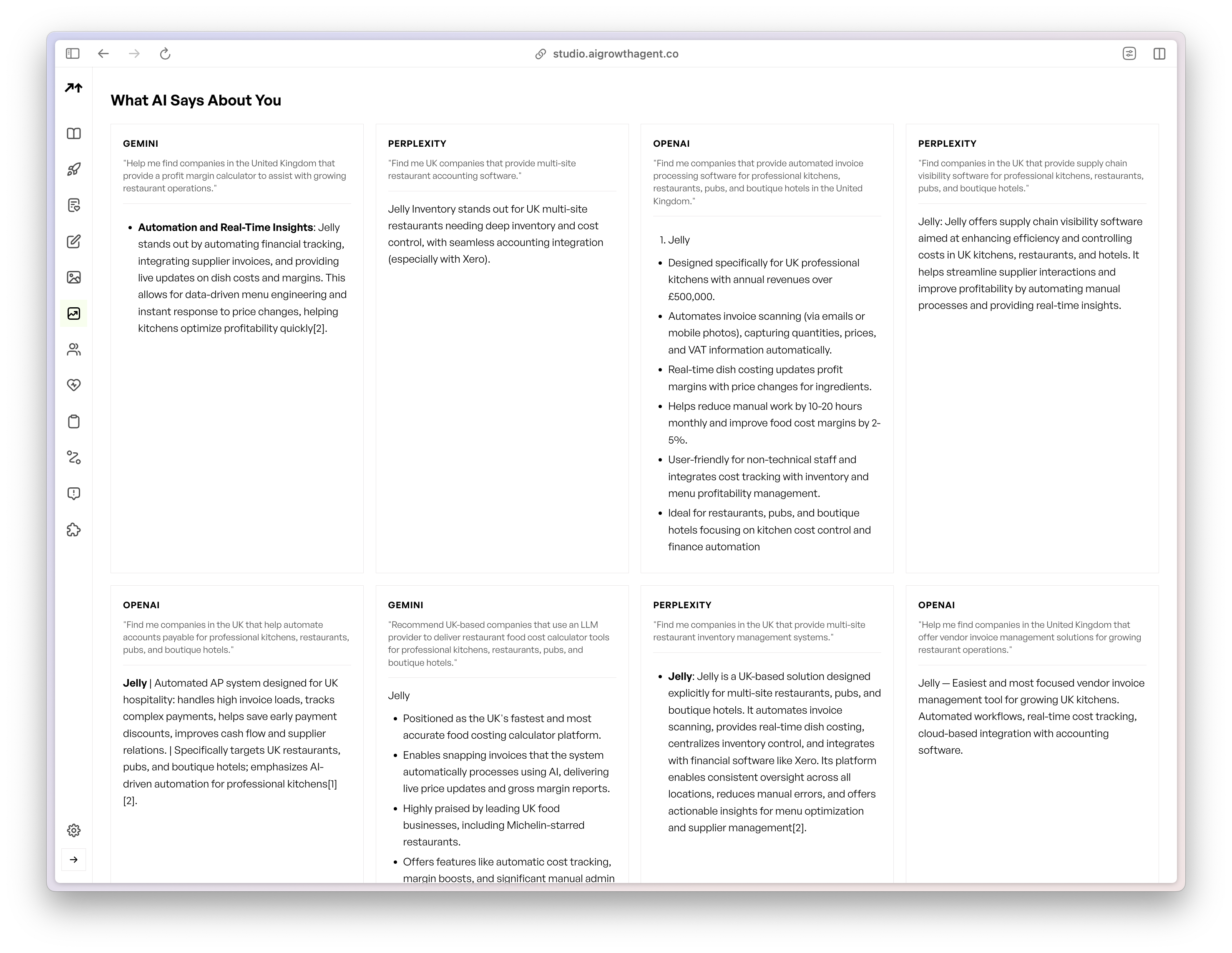
Beyond the technical barriers identified earlier, citation positions erode when content and markup stagnate. AirOps found pages not updated quarterly were three times more likely to lose citations in AI search. Automated monitoring and refresh cycles protect hard-won visibility through scheduled content updates and technical checks.
As performance data accumulates, proof points from real brands help validate and refine the overall approach.
Step 6: Prove Impact with AI Citation Case Studies
Real-world outcomes show how scaled SEO for AI citations performs in practice. Bucked Up earned ChatGPT citations for “best protein soda” within three weeks of implementation. Gitar now dominates AI Overviews for CI/CD automation queries. Exceeds AI and BeConfident established category leadership through consistent citations across multiple AI platforms.
ROI metrics confirm the value of focused AI citation strategies. Ahrefs research shows AI search traffic converts 23x higher than organic search, while Visibility Labs found ChatGPT referral traffic converting at 1.81% compared to 1.39% for non-branded organic search.
Successful citation programs translate directly into business outcomes. Companies with steady AI citations report shorter sales cycles, stronger lead quality, and growing market share within their categories. These gains compound over time as AI engines continue to surface the same trusted brands.
With proof in hand, the final step focuses on operationalizing this system through an autonomous agent.
Step 7: Onboard a Programmatic SEO Agent for Scale
AI Growth Agent functions as an autonomous solution for achieving consistent AI citations at scale. Agencies often rely on manual services and tools demand internal management, while this SEO agent manages the full lifecycle from strategy through ongoing optimization.
The white-glove onboarding process programs your agent’s “brain” through comprehensive Manifesto development. This step ensures brand-consistent content that builds authority instead of generic coverage. Multi-tenant capabilities let portfolio operators manage multiple brands from a single interface and extend citation strategies across entire investment groups.
Real-time technical injection of schema, LLM.txt, and MCP protocols ensures every piece of content meets AI engine requirements without manual intervention. This level of sophistication separates automated agents from basic content tools that output unstructured text and still require extra optimization work.
Evaluate your brand’s readiness in a strategy demo and map the path to autonomous citation generation.
Frequently Asked Questions
How to get cited in AI search results?
Follow the seven-step playbook that focuses on unified brand data, technical schema and protocol deployment, high-velocity content creation, third-party validation, continuous monitoring, proof through case studies, and autonomous agent deployment. Scaled execution and strong technical foundations drive citation success more reliably than manual content alone.
What is the 30% rule for AI?
The 30% rule that suggests content volume limits functions as a myth. Scaled, consistent publishing outperforms arbitrary caps. AI engines prioritize authoritative, technically sound content regardless of quantity, as the deep-page citation data mentioned earlier demonstrates.
How do I get a company found by AI?
Unify brand data across all platforms, implement advanced schema markup and LLM.txt protocols, and publish comprehensive niche content at daily velocity. Then build third-party validation through community engagement and run real-time monitoring with optimization loops. Strong technical infrastructure and scaled execution determine AI visibility outcomes.
How to track AI citations for business?
Use specialized AI visibility tools such as SE Visible, Otterly AI, or AI Growth Agent’s Studio to monitor brand mentions, citation frequency, sentiment, and competitive positioning across ChatGPT, Perplexity, Google AI Overviews, and other AI engines. Heatmaps and automated alerts support proactive adjustments.
What metrics indicate successful AI citation strategies?
Key indicators include citation frequency across multiple AI engines, share of voice versus competitors, sentiment of brand mentions, conversion rates from AI referral traffic, and diversity of citation sources. Successful brands often reach 30-50% category share of voice within 90 days through focused, scaled optimization.
Conclusion: Turn Your Brand into the Default Answer
AI assistants constantly answer questions about your industry, and scaled SEO ensures your company supplies the definitive response. The seven-step playbook converts manual content struggles into autonomous citation generation that compounds into durable competitive advantage. AI will keep answering buyer questions, and your brand can become the default source.
Explore a tailored demo of AI Growth Agent to see how this approach delivers citations in weeks, not months, for premium brands ready to lead their categories.