


Written by: Mariana Fonseca, Editorial Team, AI Growth Agent
Key Takeaways
- ChatGPT citations overlap 67% with Google’s top 10 results, so strong Google SEO foundations come first before AI-specific tactics.
- Implement JSON-LD schema markup such as FAQPage and Article schemas, and allow AI crawlers in robots.txt, because 73% of sites block them unintentionally.
- Build authority through brand mentions, Reddit and Quora engagement, and query clusters that cover hubs, comparisons, and alternatives for full topical coverage.
- Track citations with tools like Ahrefs Brand Radar and server logs, then scale using programmatic SEO for high-volume, technically sound content creation.
- Automate this 7-step blueprint with AI Growth Agent to earn ChatGPT citations quickly and dominate AI search visibility.
7-Step Blueprint to Get Cited by ChatGPT
Step 1: Build Google SEO Foundations
ChatGPT relies heavily on Google’s index for source selection. 76.1% of URLs cited in Google AI Overviews also rank in Google’s top 10 organic results, which means AI systems draw from the same quality signals Google uses. Your technical foundation must be flawless before you pursue AI citations.
Essential Technical Checklist:
- Core Web Vitals under 2 seconds load time
- Mobile-responsive design with proper viewport settings
- Clean URL structure with keyword-rich paths
- Clear, compelling title tags and meta descriptions
- Proper heading hierarchy (H1–H3 without skips)
The following table shows specific targets, impact, and fix priorities for each technical metric so you can focus on the highest-value improvements first.
| Metric | Target | Impact | Fix Priority |
|---|---|---|---|
| Page Speed | <2s | High | Critical |
| Mobile Score | 95+ | High | Critical |
| HTTPS | 100% | Medium | Required |
| Crawlability | 100% | Critical | Immediate |
AI Growth Agent’s Studio automatically improves these technical foundations and removes engineering friction from your programmatic SEO deployment.
Step 2: Implement AI-Friendly Structure
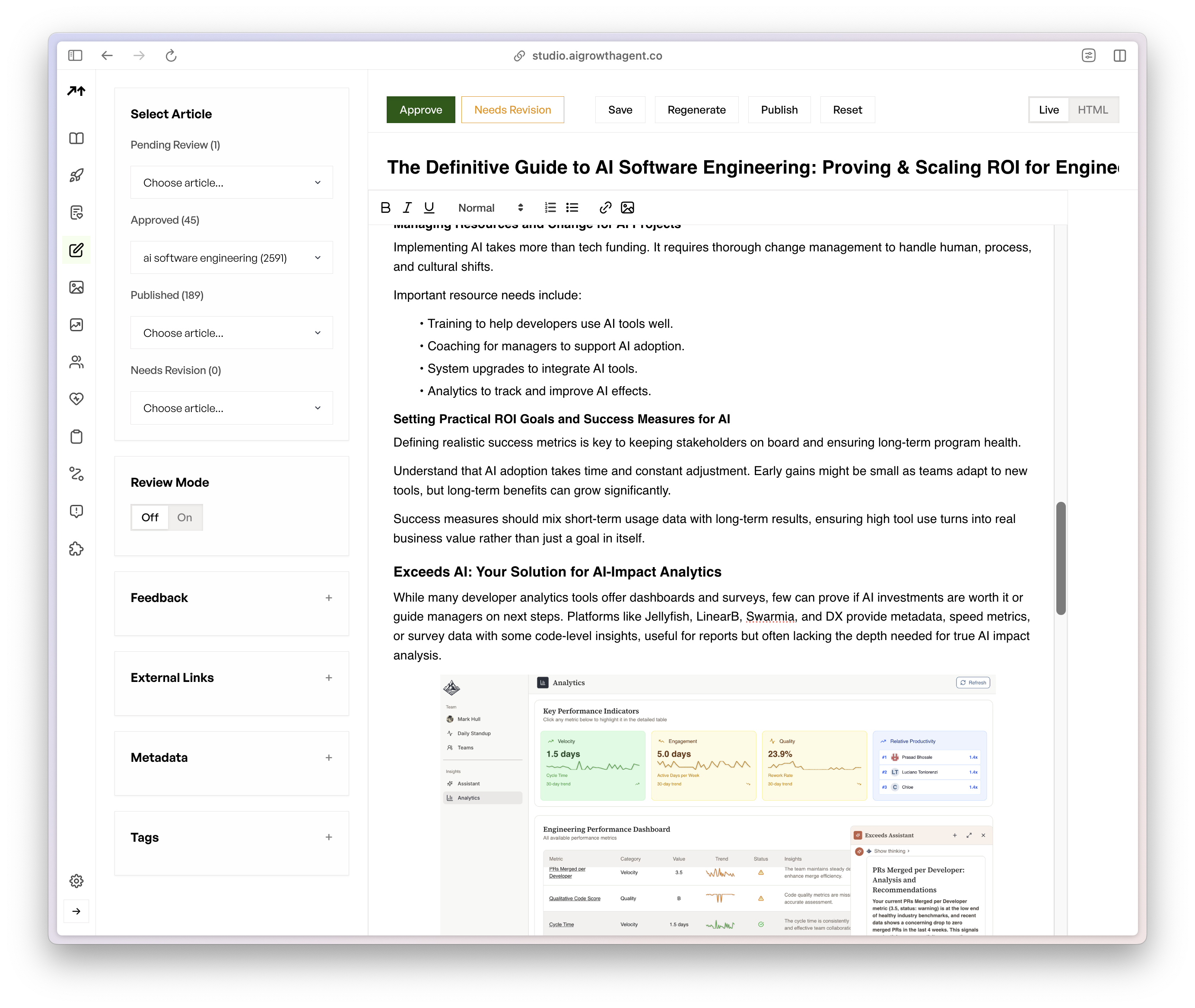
Google and Microsoft publicly stated in March 2025 that they use Schema Markup for their Generative AI features. Structured data helps AI systems interpret your content accurately and extract answers with confidence.
Critical Schema Implementation:
- JSON-LD FAQPage schema for Q&A content
- Article schema with author and datePublished properties
- Organization schema with sameAs links
- BreadcrumbList for clear navigation paths
Example FAQPage Schema:
<script type="application/ld+json"> { "@context": "https://schema.org", "@type": "FAQPage", "mainEntity": [{ "@type": "Question", "name": "How to track ChatGPT citations?", "acceptedAnswer": { "@type": "Answer", "text": "Use AI Growth Agent Studio heatmaps to monitor real-time ChatGPT and Perplexity citations with URL-level tracking." } }] } </script>Chunked, quotable pages with schema markup receive 3–5x more citations from AI systems. AI Growth Agent injects advanced schema markup autonomously across all programmatically generated content.
Step 3: Engineer Authority Signals
Brand Web Mentions have the strongest correlation (0.664) with AI visibility, three times stronger than traditional backlinks. Authority signals now include digital PR, expert identity, and community presence, not just link counts.
Authority Building Checklist:
- Author bylines with LinkedIn profiles and clear credentials
- Wikipedia articles for brands that meet notability guidelines
- Reddit contributions in relevant communities
- Quora expert-level answers in your domain
- LinkedIn article publishing for social proof
Reddit accounts for 46.7% of Perplexity citations and 1.8% of ChatGPT citations, so active participation on community platforms becomes a core driver of AI visibility.
AI Growth Agent’s Manifesto programming strengthens authority through systematic content distribution and repeatable community engagement playbooks.
Step 4: Create Query Clusters
AI answer engines decompose user queries into multiple sub-queries, a process known as query fan-out. Single hero pages cannot cover every angle of these related searches, so you need structured clusters that match how AI breaks down intent.
Query Cluster Strategy:
- Hub pages targeting primary keywords
- Supporting pages for “Best X for Y” variations
- Comparison pages for “X vs Y” queries
- Alternative pages for “Alternatives to X”
- Pricing and implementation guides
BrightEdge’s analysis found 82.5% of citations went to deep pages, not homepages, and 86% appeared for only a single keyword. These findings show why comprehensive topical coverage beats single-page optimization.
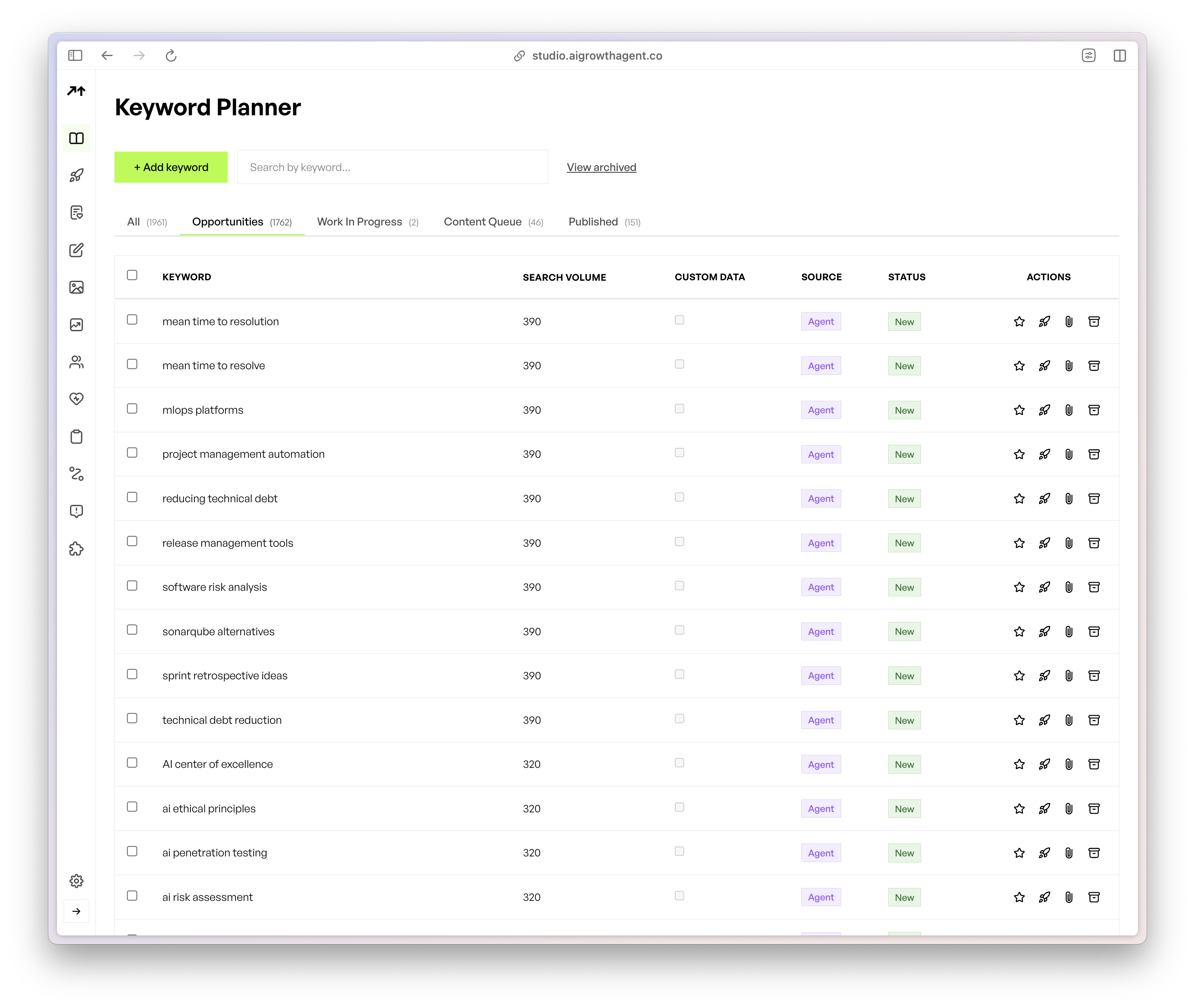
AI Growth Agent’s keyword research engine clusters related queries automatically and generates supporting content that captures query fan-out opportunities.
Step 5: Ensure Crawlability
73% of websites block AI crawlers via robots.txt, CDN rules, or JavaScript rendering issues, which silently removes them from AI citation pools. Proper crawler access therefore becomes a baseline requirement for any AI visibility strategy.
AI Crawler Optimization:
- Allow GPTBot, OAI-Searchbot, and ChatGPT-User in robots.txt
- Permit PerplexityBot and Perplexity-User access
- Enable ClaudeBot and Claude-Searchbot crawling
- Use server-side rendering for JavaScript content
- Create comprehensive XML sitemaps
Example robots.txt Configuration:
User-agent: GPTBot Allow: / User-agent: ChatGPT-User Allow: / User-agent: PerplexityBot Allow: / User-agent: ClaudeBot Allow: /AI Growth Agent implements the world’s first blog Model Context Protocol (MCP), which lets AI search engines interface directly with your content database for deeper understanding and stronger citation potential.
Get a crawlability audit showing exactly which AI bots can access your content.
Step 6: Track and Monitor Citations
Specialized tracking shows how AI systems reference your brand, which goes far beyond standard SEO metrics. Ahrefs Brand Radar tracks ChatGPT visibility across 13M+ prompts, including mentions, citations, and AI Share of Voice.
Citation Monitoring Tools:
- Ahrefs Brand Radar for broad AI visibility tracking
- OtterlyAI for cross-platform citation analysis
- Semrush AI Visibility Index for brand mention tracking
- Google Search Console for organic traffic correlation
- Server log analysis for AI crawler activity
Reddit is the #1 most cited domain across ChatGPT, Perplexity, and Google AI Overviews, so monitoring community platforms alongside your own properties becomes essential.
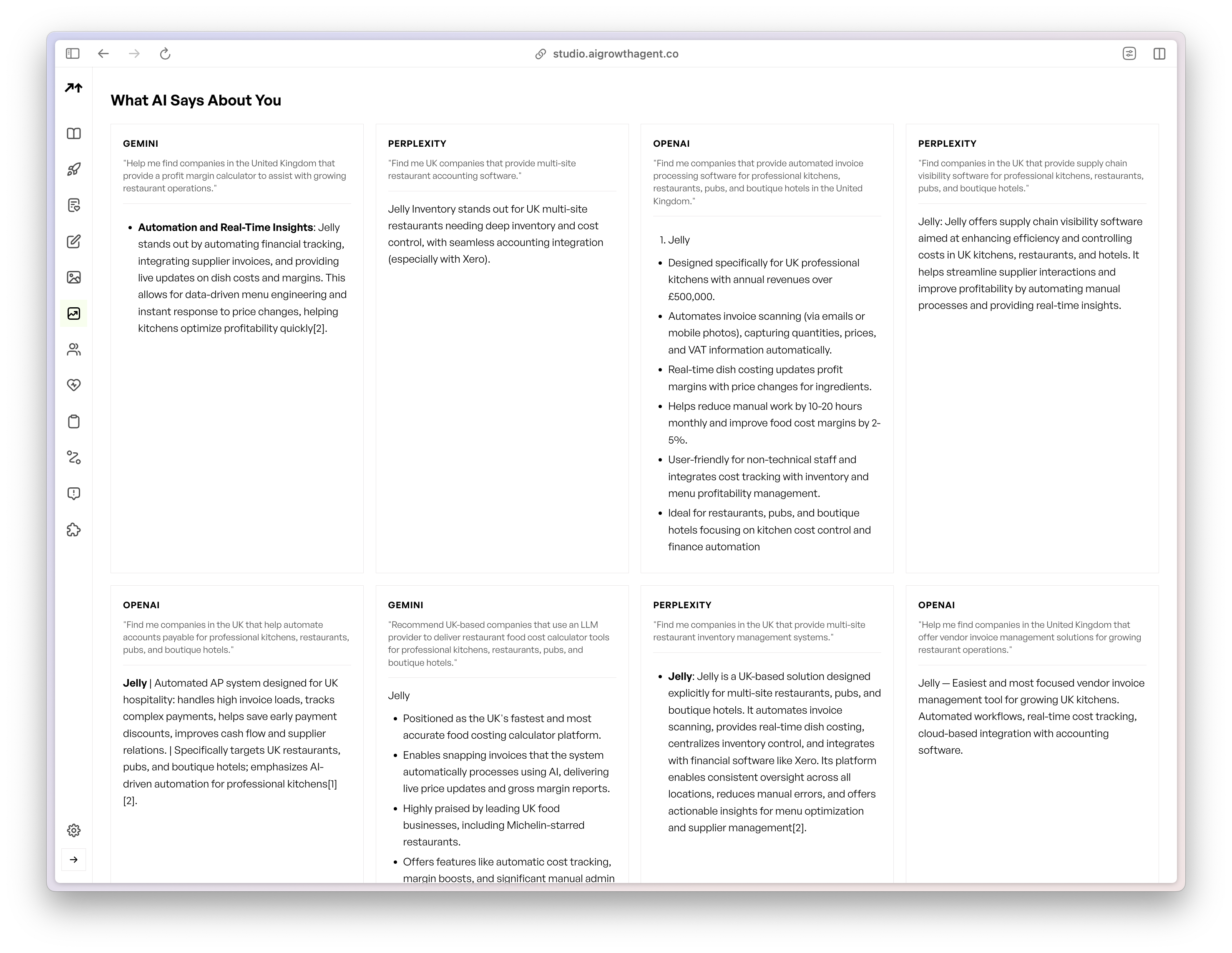
AI Growth Agent Studio displays real-time heatmaps of citation performance across ChatGPT, Gemini, and Perplexity, with URL-level tracking and competitor comparisons.
Step 7: Scale with Programmatic SEO
Wise generates over 260,000 programmatic pages and drives more than 60 million monthly organic visits through automated content creation and tight technical control. Manual content production cannot match this scale or speed.
Programmatic SEO Components:
- Database-driven content generation
- Template-based page creation
- Automated schema injection
- Dynamic internal linking
- Real-time content updates
Successful programmatic SEO campaigns see 40–60% of published pages earn organic traffic within 6 months, with top categories reaching 80%+ indexation rates.
AI Growth Agent’s multi-tenant programmatic deployment runs parallel content strategies across multiple domains from a single interface while preserving unique brand voices and keyword plans.
Watch a live demonstration of programmatic SEO generating 1,000+ optimized pages in minutes.
Common Pitfalls: Why Manual Tactics Fail in 2026
Manual “craftsman” SEO models cannot keep pace with AI citation demands. AI-cited content is 25.7% fresher on average than content cited in traditional organic Google results, so brands need consistent publishing velocity to stay visible.
Generic AI content tools output unstructured text without technical SEO support. They skip schema, ignore heading hierarchies, and lack the systematic approach required for AI citation success, which leaves strategy, formatting, and publishing work on internal teams.
Most marketing teams do not have the engineering capacity to build and maintain programmatic SEO systems. They struggle to embed advanced metadata, deploy Model Context Protocols, and manage the infrastructure needed for AI-focused optimization at scale.
Reddit-Proven Tactics from Top Threads
Given these limits of traditional approaches, community-tested tactics offer a practical roadmap. Community platforms like Reddit and Quora capture 52.5% of citations across ChatGPT, Perplexity, and Google AI Overviews versus 47.5% for brand domains. Reddit discussions consistently highlight structured content, clear headings, and dense factual sections as key drivers of AI citations.
Top-performing Reddit threads stress that no direct submission route exists for AI systems. Citations flow from content structure, authority signals, and technical readiness rather than manual outreach. The consensus favors schema markup, fresh publishing, and extractable answer formats as the most reliable strategies.
Technical Deep Dive: LLM.txt and Model Context Protocol (MCP)
LLMs.txt is a proposed structured file that helps LLMs understand websites and has been adopted by major AI players, including Perplexity, as of August 2025. This emerging standard gives AI systems explicit guidance for content ingestion and interpretation.
AI Growth Agent implements the world’s first blog Model Context Protocol, which enables direct AI access to your content database. This capability helps AI engines understand content relationships, entity connections, and topical authority with far greater clarity.
The MCP implementation exposes your content hierarchy in a structured way, which supports more accurate citations and a stronger representation of your expertise across topics.
Real-World Outcomes: Client Success Stories
Bucked Up reached the #1 ChatGPT citation for “best protein soda” within 3 weeks using programmatic SEO. The sports nutrition brand now appears as the top citation alongside competitors like Feisty Drinks and Clean Simple Eats.
Gitar.ai became the reference brand for AI-powered CI/CD automation in less than two months. The company now leads conversations across Google AI Overview, ChatGPT, and Perplexity for queries such as “fix broken CI builds automatically” and “best AI reviewer for CI failures.”
These outcomes show how systematic programmatic SEO, paired with AI-specific optimization, drives reliable citation wins with AI Growth Agent.
Beyond Basics: Multi-LLM Strategy for Gemini and Perplexity
ChatGPT averages 3.86 citations per response, while Perplexity averages 7.42 and Google AI Overviews typically use six to eight sources. Each AI system follows distinct citation patterns, so you need tailored strategies for each one.
Perplexity favors community-generated content and discussion-heavy sources. Perplexity’s median query length is 10–11 words versus 2–3 words on Google Search, which signals more complex information needs and rewards comprehensive coverage.
AI Growth Agent’s database automation injects content in real time across multiple AI systems and adapts structure and formatting to each platform’s citation preferences.
Frequently Asked Questions
How to get cited by AI?
AI citation success depends on technical readiness, clear structure, and strong authority signals. Implement JSON-LD schema markup, write answer-first content with clear headings, allow AI crawler access through robots.txt, and build authority through community engagement and expert bylines. Consistent, systematic execution matters more than one-off manual tactics.
How to track ChatGPT citations?
Track ChatGPT citations with tools such as Ahrefs Brand Radar, OtterlyAI, or Semrush AI Visibility Index. Monitor server logs for GPTBot and OAI-Searchbot activity, set up Google Analytics custom channel groupings for AI referral traffic, and run manual prompt audits using your target keywords. Maintain a weekly monitoring cadence for reliable trend data.
Can you make ChatGPT cite sources?
You cannot push content directly into ChatGPT, but you can influence citation choices through technical SEO, content structure, and authority building. ChatGPT selects sources based on relevance, authority, freshness, and access. Focus on extractable answer formats, robust schema markup, and open crawler access instead of seeking direct submission paths.
What content structure works best for AI citations?
AI systems favor content with answer capsules of 40–60 words, question-based headings, structured data markup, high entity density, and minimal linking inside answer sections. Place key information early, use clear and definitive language, include original data and statistics, and maintain clean heading hierarchies to increase citation potential.
How long does it take to get cited by AI systems?
New content usually enters ChatGPT citation pools within 3–14 days after publication when it is indexed and accessible to AI crawlers. Building consistent citation authority typically takes 3–6 months of steady content creation, technical refinement, and authority work. Programmatic SEO shortens this timeline through higher volume and consistent structure.
Conclusion: Scale Now or Get Buried
The 2026 AI content surge requires programmatic approaches to stay visible. Manual SEO tactics cannot match the speed and volume needed for AI citation success. With AI search visitors converting at dramatically higher rates, as noted earlier, citation status now acts as a decisive competitive advantage.
This 7-step blueprint outlines the technical framework for AI citation success, yet full execution demands advanced automation and engineering resources that most teams lack. That is where AI Growth Agent removes complexity through autonomous programmatic SEO deployment, schema implementation, and real-time citation monitoring.
Premium brands risk losing ground if they delay while competitors secure AI citation dominance. The window for early-mover benefits continues to narrow as more organizations prioritize AI search visibility.
