


Written by: Mariana Fonseca, Editorial Team, AI Growth Agent
Key Takeaways
- Growth marketing budgets in 2026 should tie directly to revenue, typically 5-25%, and up to 50% for early growth. Maintain LTV:CAC ratios above 3:1 and CAC payback under 12 months.
- Apply the 70/20/10 allocation framework. Invest 70% in proven channels, 20% in emerging opportunities, and 10% in experiments, then adjust by growth stage.
- AI search visibility depends on consistent, programmatic content production that can compete with AI-generated results in ChatGPT, Perplexity, and Google AI Overview.
- Track metrics such as organic CAC reduction, AI citation frequency, and channel-specific LTV:CAC to guide data-driven budget decisions and scaling.
- AI Growth Agent’s programmatic SEO system autonomously builds content authority and AI search presence. Schedule a demo today to translate your budget into predictable growth.
Core Budget Math for 2026 Growth Plans
Growth marketing budgets function as revenue-tied investments in acquisition and scaling, separate from brand marketing. Effective budget sizing rests on three metrics: Customer Acquisition Cost (CAC), Lifetime Value (LTV), and burn rate management.
Customer Acquisition Cost equals total sales and marketing expenses divided by new customers acquired. This metric becomes useful when compared with customer lifetime value. Target LTV:CAC ratios of at least 3:1, with CAC payback benchmarks of 8-12 months for SMB SaaS and 14-18 months for mid-market SaaS. Ratios below 3:1 create weak unit economics, while ratios above 6:1 often signal missed growth opportunities.
These unit economics guide how much revenue you can safely allocate to marketing. Revenue percentage allocations vary significantly by growth stage. Early-stage startups often allocate 12-20% of gross revenue to marketing because they lack brand recognition and must build awareness from zero. Venture-backed growth-stage startups frequently spend 30-50% of revenue on sales and marketing when lifetime value supports aggressive acquisition.
The core formula for sustainable scaling is simple. If Channel CAC × 3 is less than LTV and payback period stays under 12 months, scale that channel aggressively. This mathematical framework replaces emotional budget allocation and keeps every dollar tied to measurable growth. For many companies, organic content becomes the channel with the strongest long-term economics under this formula, provided you can reach the content volume AI search now demands. See how AI Growth Agent models your unit economics and designs programmatic content strategies that lower organic CAC while building authority.
2026 Benchmarks by Stage and Industry
2026 marketing budget benchmarks reflect AI-driven customer acquisition dynamics. Marketing budgets remained flat at 7.7% of company revenue in 2025, matching 2024 levels, even as expectations for AI search visibility increased. With your core metrics defined, you can compare your planned allocation to these benchmarks to validate your approach.
The following table shows how budget allocation typically scales with company growth. Early-stage companies invest more heavily to penetrate the market, while mature companies prioritize efficiency.
| Growth Stage | Revenue % Range | Typical ARR | Primary Focus |
|---|---|---|---|
| Seed Stage | 10-20% | $500K-$2M | Product-market fit validation |
| Series A | 15-30% | $2M-$5M | Scaling proven channels |
| Early Growth | 30-50% (sales & marketing) | $1M-$10M | Market penetration |
| Scaling | 7-12% | $5M-$25M | Efficiency optimization |
Industry context further shapes these ranges. SaaS and technology companies often allocate 15-25% of revenue to marketing. Professional services firms typically spend 7-10% of revenue on marketing to support client acquisition and retention.
Ignoring AI search visibility now represents the most costly budgeting mistake. Companies that fund campaigns without accounting for programmatic content requirements see their digital footprint shrink as AI-generated content fills results. Explore AI Growth Agent’s autonomous content engine to maintain visibility across ChatGPT, Perplexity, and Google AI Overview.
70/20/10 Allocation Rules for Modern Growth
The 70/20/10 framework offers a practical structure for growth marketing budget allocation. This approach assigns 70% to proven channels with CAC below 3x average order value and MER above 3.0, 20% to emerging opportunities with early traction, and 10% to experiments.
The table below illustrates how this framework adapts across business models. The percentage split stays consistent, while specific channels in each bucket change based on how your customers buy.
| Allocation Framework | Proven Channels (70%) | Growth Opportunities (20%) | Experiments (10%) |
|---|---|---|---|
| B2B SaaS | Content/SEO, Paid Search, Email | LinkedIn Ads, Webinars | Podcasts, communities, interactive tools |
| E-commerce | Google Shopping, Facebook/Instagram, Email | TikTok Ads, Influencers | Live shopping, AR try-ons, new marketplaces |
| Professional Services | Referral systems, Content/SEO, Email | Paid Search, LinkedIn | Podcasts, speaking, partnerships |
Stage-specific adjustments refine this framework. Startups under $1M revenue can use a 50/30/20 split to discover efficient channels, while companies under cash pressure that require profitability within 6 months can shift to 85/10/5.
The experimental budget becomes especially valuable in the AI era. Companies using AI Growth Agent’s programmatic SEO can direct experimental spend toward content volume tests, keyword cluster validation, and AI citation improvements without adding manual workload.
Key Evaluation Factors for Budget Quality
Successful growth marketing budgets require systematic evaluation across eight critical factors: LTV:CAC ratios, CAC payback periods, team capacity, budget caps, programmatic scalability, attribution modeling, channel saturation, and competitive positioning. Companies should maintain the 3:1 minimum ratio discussed earlier, with healthy ranges extending to 5:1 for capital efficiency. Focus on keeping CAC payback under 12 months as your primary operational constraint.
Team capacity evaluation prevents budgets that exceed execution capability. Traditional agencies rely on manual work that cannot reach the content volume AI search now rewards. Internal teams usually lack the engineering depth required for robust programmatic SEO.
Beyond capacity limits, you also need clear spending boundaries. Budget caps provide essential guardrails against overspend. Marketing budgets should not exceed 30% of revenue without board approval and strong LTV justification. Poor forecasting can drain marketing budgets early and push companies into deficit spending.
Programmatic scalability now represents the most important evaluation factor. Manual content creation cannot match AI-generated volume. Companies need autonomous content systems to maintain search visibility and steadily reduce organic CAC. Map programmatic SEO into your evaluation framework and see how AI Growth Agent’s approach scores against your LTV:CAC and payback requirements.
Budget Templates and Real-World Examples
Practical allocation decisions become easier with concrete templates and examples. A Series B company with $10M ARR that allocates 20% to marketing ($2M annually) can direct 40% toward acquisition channels, 35% toward retention and expansion, and 25% toward brand building and experiments.
Monthly breakdowns create operational clarity. For $1M ARR startups, an 8% marketing budget equals $80K per year. A practical split assigns 50% to content and SEO, 20% to paid amplification, 10% to email marketing, and 20% to tools and infrastructure.
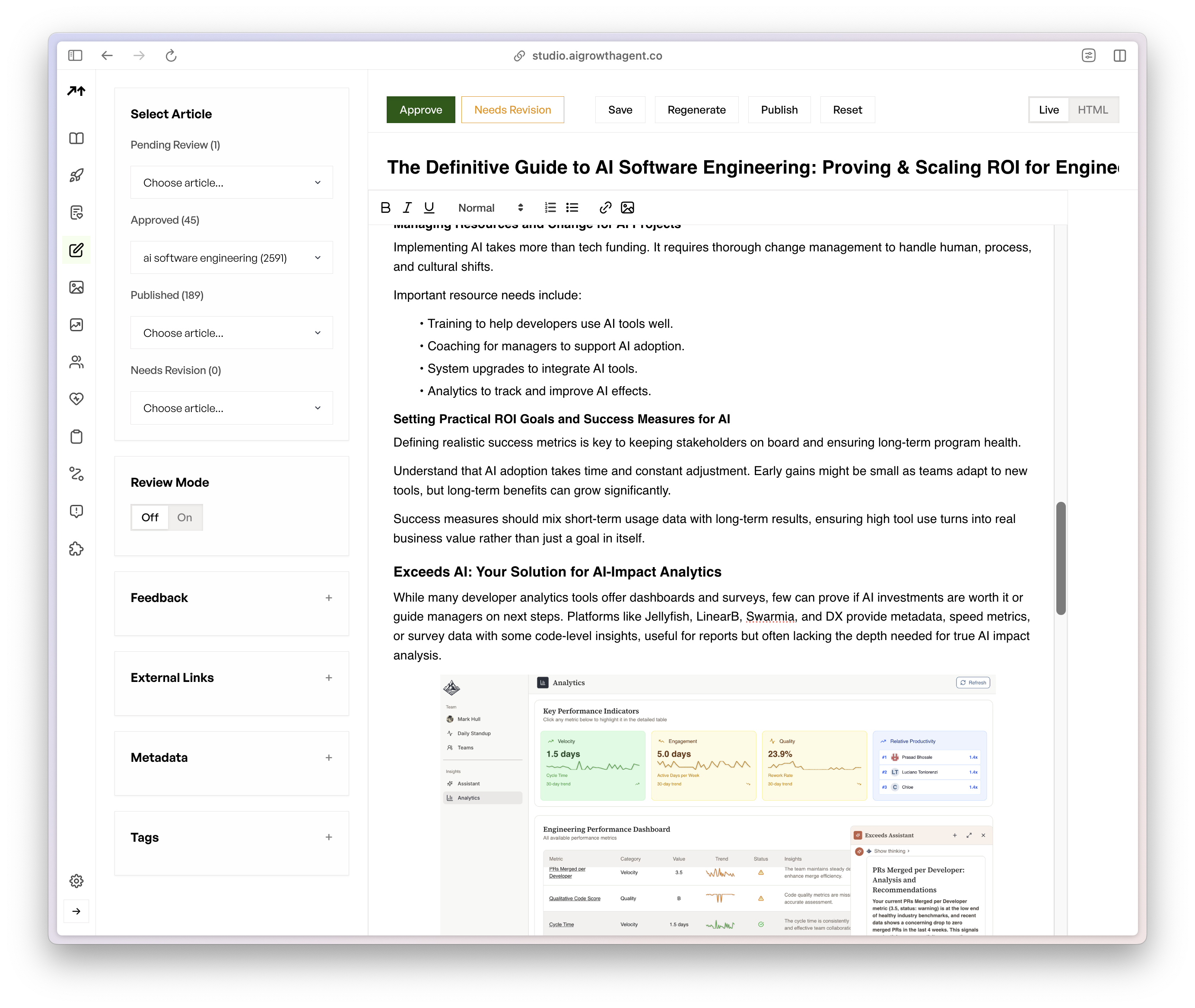
Real outcomes show how these choices play out. Exceeds AI reached Perplexity recommendations as the top alternative to competitors within 2 weeks and secured ChatGPT citations as a top source for “AI performance review tools for engineers” using programmatic content. Their budget favored autonomous content generation instead of traditional agency retainers, which concentrated spend on the highest-impact motion.
Planning tools support these decisions. Revenue calculators and allocation spreadsheets help teams model scenarios across different growth rates, CAC assumptions, and channel performance to stress-test budget durability. AI Growth Agent’s Studio dashboard then closes the loop with real-time content ROI tracking, AI citation monitoring, and organic traffic attribution so you can confirm that your budget works as modeled.
Ongoing Management, Measurement, and Scaling
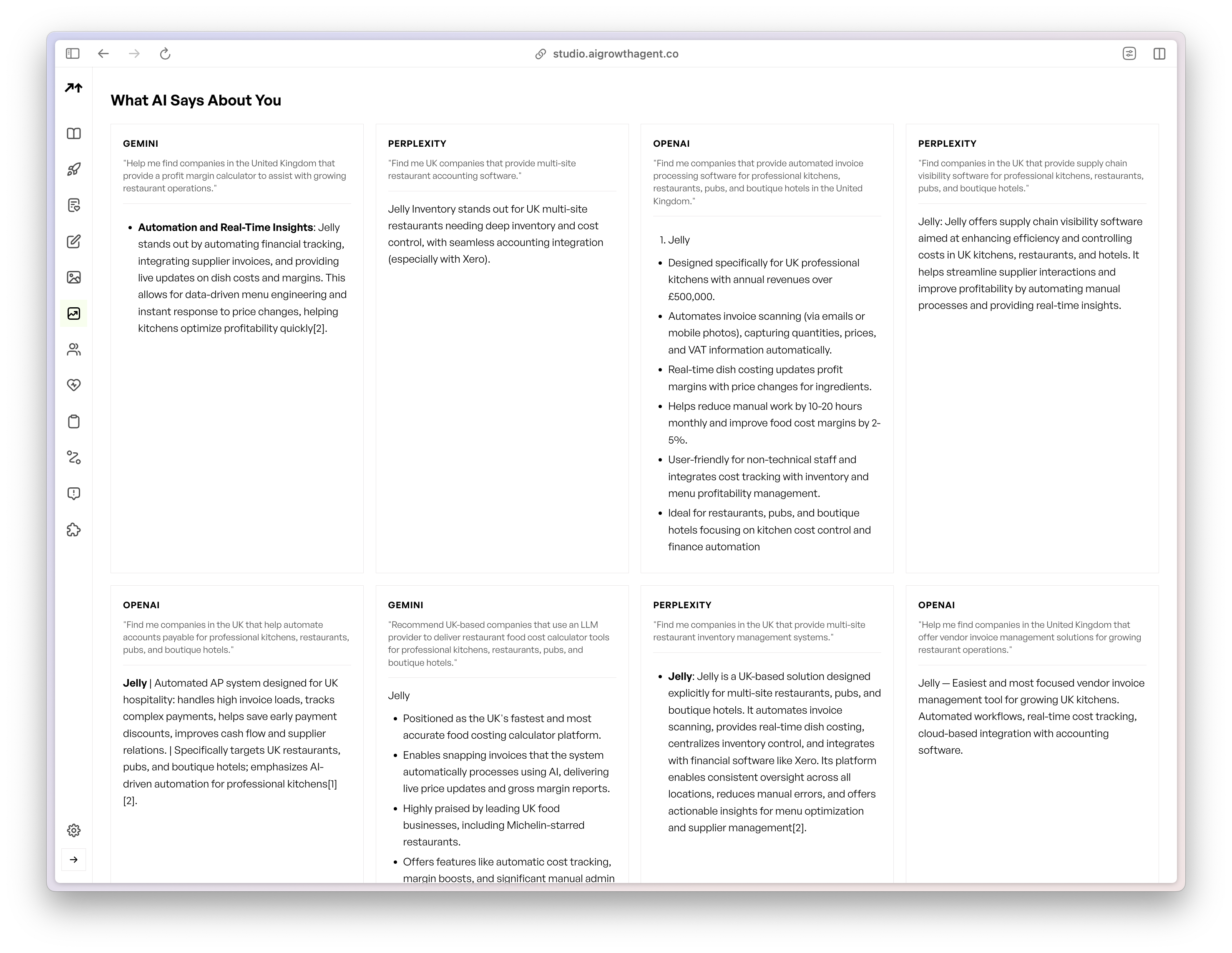
Effective budget management depends on integrated dashboards that combine Google Search Console data with AI citation monitoring. Companies should track organic CAC trends, AI search visibility, and content production volume to refine allocation continuously.
Key performance indicators need to emphasize leading indicators of sustainable growth. Monitor cost per qualified lead by channel, LTV:CAC ratios by acquisition source, and AI citation frequency for priority keywords. Your attribution model directly affects how you measure these metrics. Avoid last-click attribution models that assign 100% credit to final touchpoints, because they distort channel-level LTV:CAC calculations and underfund top-of-funnel work.
Structured iteration loops enable rapid optimization. Run monthly budget reviews with quarterly strategic adjustments. Scale channels that hit your CAC and payback targets, and cut underperforming spend quickly. AI Growth Agent’s feedback module learns from performance data and adjusts content strategy autonomously, which compounds gains over time.
Manual budget management introduces a major risk through human resource limits. Traditional SEO and content programs require constant oversight and cannot scale with AI-era demand. Programmatic approaches remove these bottlenecks and provide stronger measurement and optimization capabilities.
Risks, Pitfalls, and 2026 Shifts
Ignoring AI search optimization now ranks as the most dangerous pitfall in growth marketing. Attribution errors skew budget allocation, with last-touch models underfunding high-performing top-of-funnel activities. Teams that focus only on traditional search metrics overlook the growing influence of ChatGPT, Perplexity, and Google AI Overview on discovery.
Budget allocation without templates and clear frameworks often devolves into emotional decision-making. Marketing teams that emphasize activity metrics instead of business impact lose credibility with CFOs and face budget cuts.
2026 updates highlight the rapid move toward programmatic marketing. Many marketers now prioritize content tailored for AI-generated answers, and 94% of more than 250 surveyed digital leaders plan to increase their AEO investments in 2026. As discussed earlier, companies that cling to manual content strategies accept a growing competitive disadvantage.
Mitigation requires programmatic solutions paired with strong quality controls. AI Growth Agent delivers autonomous content generation combined with technical SEO optimization, so companies can reach required content volume without sacrificing authority or brand consistency.
Summary and Next Steps
Growth marketing budgets in 2026 work best when they combine revenue-based sizing, clear allocation rules, and programmatic execution. Most companies fall between 5-25% of revenue, with hypergrowth scenarios reaching 30%, while applying 70/20/10 allocation and protecting LTV:CAC ratios above 3:1.
The competitive edge now belongs to companies that adopt programmatic SEO to reduce organic CAC and build durable content authority. As outlined in the risks section, programmatic solutions outperform manual content approaches that cannot keep pace with AI search. Ready to maximize your growth marketing ROI? Book your AI Growth Agent demo to see autonomous content generation in action and calculate your projected organic CAC reduction.
FAQ
What percentage of revenue should a growing company spend on marketing?
Growing companies should allocate 5-25% of revenue to marketing, depending on growth stage and funding status. Early-stage companies often allocate higher percentages to sales and marketing, while mature companies spend 5-10%. The key is maintaining LTV:CAC ratios above 3:1 with payback periods under 12 months.
What is the 70/20/10 rule for marketing budgets?
The 70/20/10 rule allocates 70% of marketing budget to proven channels with established ROI, 20% to emerging opportunities with growth potential, and 10% to experimental initiatives. This framework balances stable revenue generation with innovation testing while preventing over-investment in unproven channels.
How do you calculate customer acquisition cost (CAC)?
Calculate CAC by dividing total sales and marketing expenses by the number of new customers acquired in the same period. Include all costs: ad spend, salaries, software tools, and events. For example, $50,000 in expenses divided by 200 new customers equals $250 CAC. Monitor CAC by channel to improve budget allocation.
What LTV:CAC ratio should SaaS companies target?
SaaS companies should target LTV:CAC ratios between 3:1 and 5:1. Ratios below 3:1 indicate unsustainable unit economics, while ratios above 6:1 suggest under-investment in growth opportunities. This range provides sufficient return on acquisition while still supporting aggressive scaling.
How can companies reduce customer acquisition costs in 2026?
Companies can reduce CAC with programmatic SEO strategies that build organic authority and AI search visibility. Focus on content volume, technical optimization, and AI citation monitoring. Organic channels often achieve lower CAC than paid channels while compounding over time. Programmatic approaches scale content production without proportional cost increases.


