


Key Takeaways
- AI Overviews reduce organic CTR by 61%, so programmatic SEO now protects your traffic and secures AI citations.
- Program a detailed brand manifesto to guide consistent, authoritative content generation at scale.
- Use autonomous keyword clustering to target long-tail queries and build deep topical authority.
- Implement advanced schema, LLM.txt, and high-performance infrastructure to increase AI crawler visibility and citation odds.
- Track AI citations across ChatGPT and Perplexity, and schedule a demo with AI Growth Agent to start earning citations within weeks.
Strategy 1: Turn Your Brand Manifesto Into an AI Content Brain
AI search engines reward brands that sound consistent, credible, and confident across every page. Your programmatic SEO system starts with a Company Manifesto that encodes your positioning, voice, and expertise as clear rules for content creation.
This manifesto functions as the brain of your programmatic agent. It keeps every article on-message, reinforces authority, and maintains brand consistency across thousands of pieces. Generic AI tools spit out disconnected posts, while a manifesto-driven system builds a recognizable content architecture that AI search engines treat as authoritative.
Implementation checklist:
- Run a deep brand positioning session with a professional journalist
- Document unique value propositions and competitive differentiators
- Define content guardrails for tone, expertise areas, and messaging
- Create a living manifesto that evolves with business strategy
- Program the manifesto into your autonomous content generation system
Strategy 2: Use Autonomous Keyword Clusters to Own Your Topics
Manual keyword research cannot keep pace with AI-era search volume. Almost 80% of keywords triggering AI Overviews have 0%-40% keyword difficulty, which opens a wide lane for long-tail, information-rich content at scale.
Autonomous keyword clustering scans tens of thousands of relevant queries and groups them into clear content pillars. These pillars cover your domain from every angle and build the topical depth that AI systems look for when choosing citation sources.
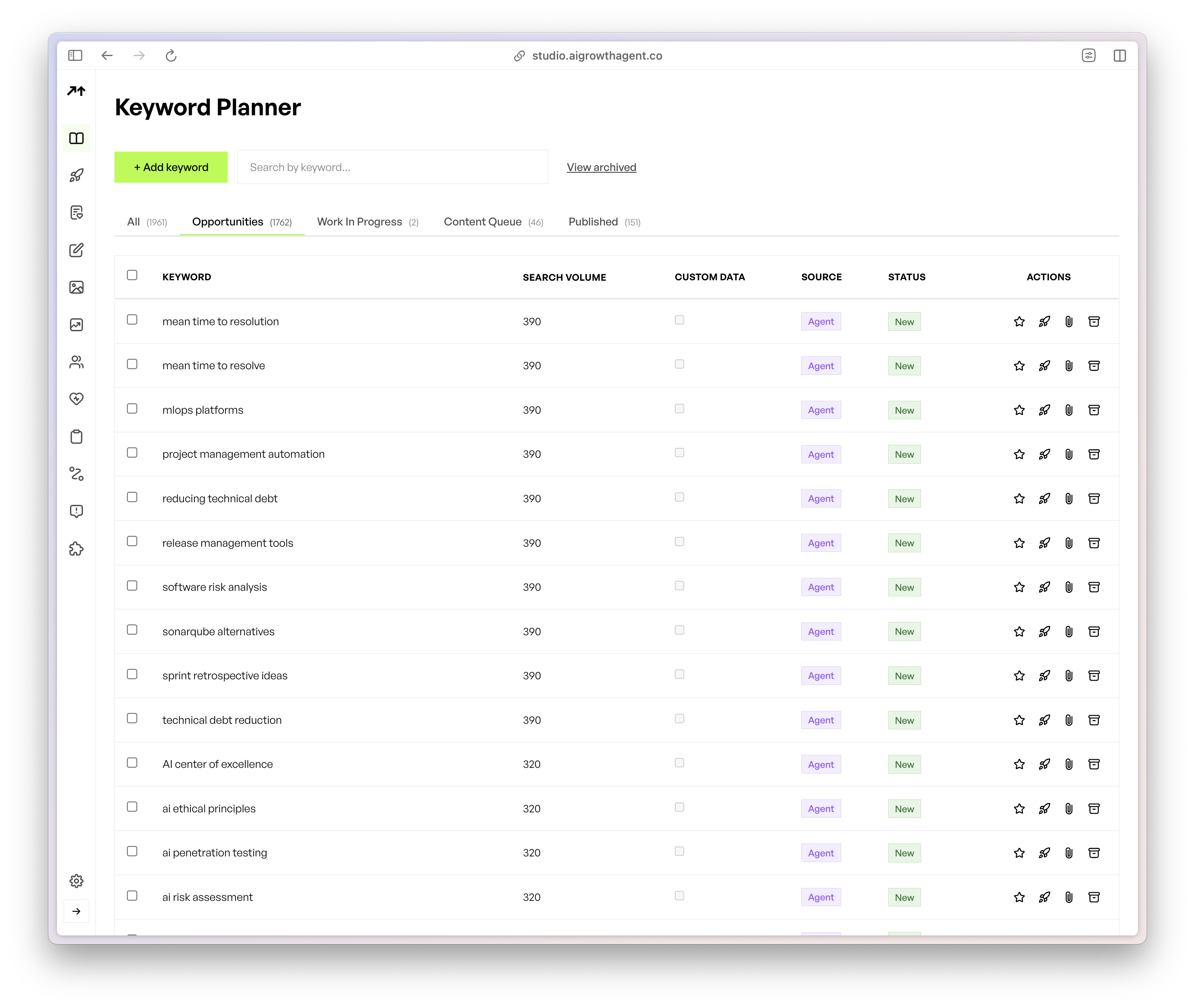
Implementation checklist:
- Deploy an AI agent to analyze competitor content gaps
- Generate comprehensive keyword clusters by topic and intent
- Map each content pillar to business objectives and expertise areas
- Build an automated content calendar based on search opportunity
- Set feedback loops for continuous keyword discovery and refinement
Strategy 3: Build a Scalable Blog Infrastructure for Programmatic SEO
Technical infrastructure decides whether your programmatic content gets crawled, indexed, and cited. Clean architecture, fast pages, and efficient crawl paths are now table stakes for AI crawlers.
Autonomous blog infrastructure removes engineering friction by launching an optimized subdomain that matches your brand and supports high-volume publishing. Integrations with WordPress, Hashnode, Webflow, Framer, Sanity, and HubSpot remain available, yet a hosted, purpose-built stack usually delivers cleaner performance and fewer bottlenecks.
Implementation checklist:
- Launch an optimized subdomain blog architecture (blog.yourcompany.com)
- Enable automated schema markup and metadata injection
- Configure advanced technical SEO elements for AI crawlers
- Set automated image compression and asset management
- Match typography, colors, and layout to your main site for brand consistency
Schedule a consultation to see how autonomous infrastructure deployment can compress your programmatic SEO setup from months to weeks.
Strategy 4: Use Advanced Schema and LLM.txt to Guide AI Systems
Schema markup now helps AI understand product details, pricing, reviews, and expert credentials. Modern technical SEO extends that foundation with Model Context Protocol (MCP) and LLM.txt so AI agents can read and interpret your content more directly.
These elements create a technical moat around your content. While competitors wrestle with basic schema, your system can inject rich, structured data at scale and increase the odds that AI engines pull your pages as trusted sources.
Implementation checklist:
- Activate automated schema markup for every content type
- Publish LLM.txt files to guide AI search engine access
- Configure Model Context Protocol for database-level AI integration
- Automate metadata enrichment for images and downloadable assets
- Set up structured data validation and ongoing monitoring
Strategy 5: Run a Human-AI Content Studio With Clear Feedback Loops
Hybrid SEO workflows pair AI scale with human judgment, experience, and editorial control. The strongest results come from systems where humans steer strategy and AI handles the heavy lifting.
A Content Studio interface gives your team visibility into every programmatic action. Marketers can review drafts, adjust tone, refine outlines, and approve or automate publishing while still benefiting from daily output.
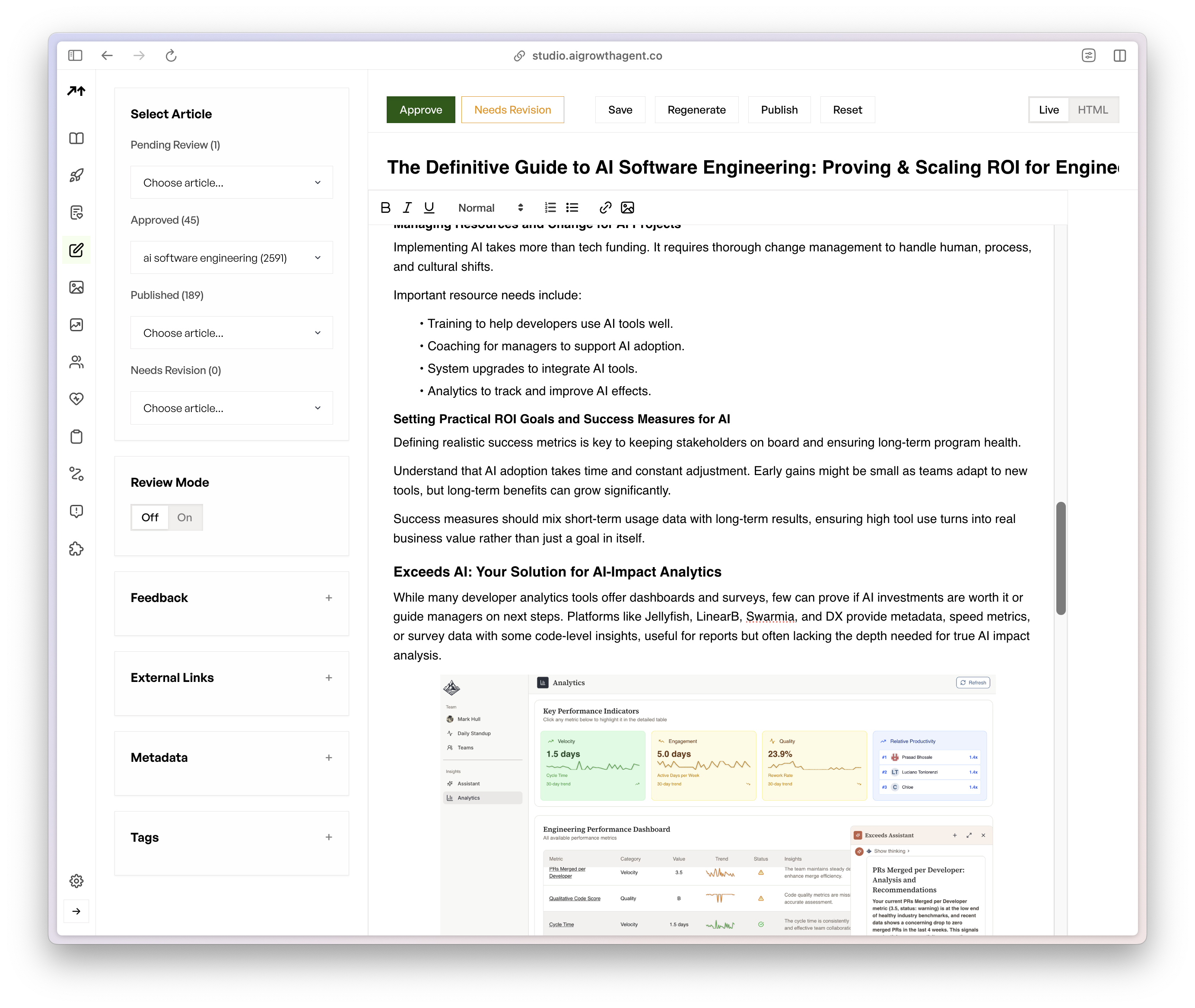
Implementation checklist:
- Deploy a unified content management dashboard for programmatic output
- Set feedback channels that feed human edits back into AI learning
- Define approval workflows for manual review or auto-pilot publishing
- Use a real-time editor for on-page revisions before launch
- Connect performance analytics and improvement recommendations
Strategy 6: Capture Trending Topics With Real-Time Content Injection
AI search engines favor fresh content that responds quickly to new questions and breaking stories. Real-time content injection lets your system publish relevant articles within minutes of a trend appearing.
This capability turns proprietary data, internal insights, and industry news into search-ready content automatically. Your brand stays visible while slower competitors wait for writers, approvals, and production cycles.
Implementation checklist:
- Configure automated trend monitoring and content triggers
- Connect proprietary data sources for unique content angles
- Enable instant content generation for breaking industry updates
- Monitor social media and news feeds through automated pipelines
- Build rapid publishing workflows for time-sensitive topics
Strategy 7: Track AI Citations and Measure Conversion Lift
AI-era SEO success depends on visibility across AI platforms, not only classic SERPs. AI-referred traffic converts at 14.2% compared with 2.8% for Google organic, which creates a powerful conversion advantage for brands that win citations.
Advanced monitoring tools track where and how often AI engines mention your brand. These systems reveal which pages drive citations in ChatGPT, Google AI Overviews, and Perplexity, then tie that visibility back to traffic and revenue.
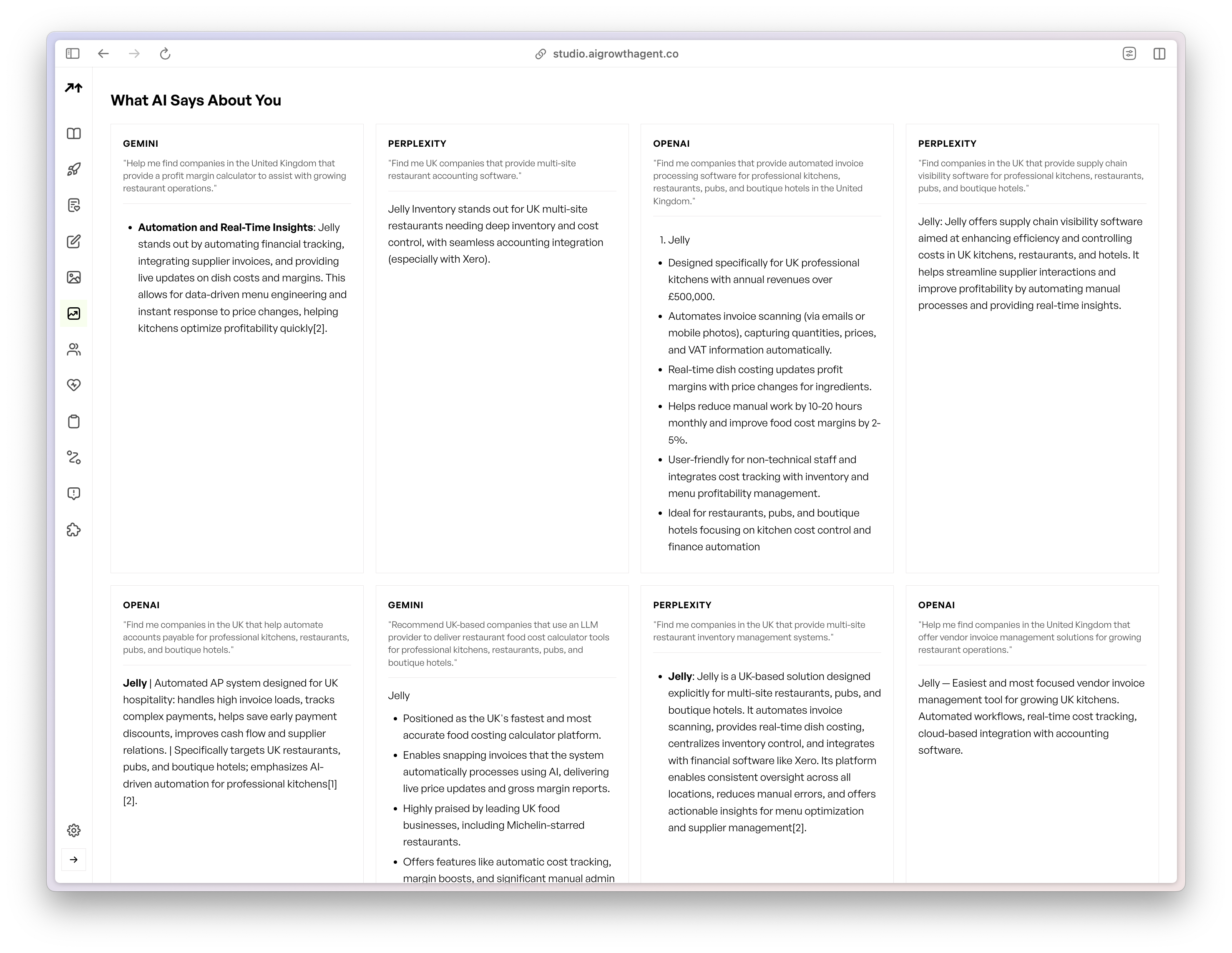
Implementation checklist:
- Deploy AI search monitoring across all major AI platforms
- Track citations, snippets, and answer placements by URL
- Automate reporting on traffic, conversions, and assisted revenue
- Build competitive dashboards that compare AI visibility by brand
- Refine content strategy based on real AI search performance data
|
Client |
Weeks to Citation |
AI Engines |
Key Achievement |
|
Exceeds AI |
2-3 |
Perplexity, Google AI Overview/Gemini, ChatGPT |
Top alternative recommendation |
|
BeConfident |
<4 |
Google AI Overview/Gemini (Brazil #1) |
#1 English learning app in Brazil |
|
Bucked Up |
3 |
ChatGPT (#1 “best protein soda”) |
Top protein soda brand citation |
|
Gitar |
<8 |
Google AI Overview/Gemini, ChatGPT, Perplexity |
Leading AI CI/CD automation brand |
Schedule a demo to apply these strategies and position your brand as the go-to AI citation source within weeks.
AI Content Flood Defense: 4-Week Implementation Playbook
This implementation playbook shifts your growth marketing from manual production to autonomous authority building. The rollout starts in week one and moves quickly from setup to scale.
Week 1: Foundation Setup
- Complete a brand manifesto programming session
- Deploy the optimized blog infrastructure
- Configure advanced technical SEO and structured data
- Establish keyword clusters and content pillars
Weeks 2-4: Content Production and Refinement
- Launch autonomous content creation workflows
- Layer in human feedback loops and editorial refinements
- Monitor early AI citations and traffic signals
- Adjust topics and templates based on performance data
Month 2+: Scale, Trends, and New Markets
- Move toward auto-pilot publishing for consistent volume
- Expand content pillars based on winning themes
- Activate real-time content injection for trending topics
- Scale the model across new product lines or regions
|
Approach |
Scale |
Technical Capability |
ROI Timeline |
|
Traditional Agencies |
Manual, slow |
Basic SEO |
6-12 months |
|
Generic AI Tools |
Unstructured |
Content generation only |
High spam risk |
|
AI Growth Agent |
Autonomous, daily |
MCP/LLM.txt, advanced schema |
Citations in weeks |
Frequently Asked Questions
What is programmatic SEO for the AI era?
Programmatic SEO for the AI era uses autonomous systems to generate, refine, and publish high-authority content at scale for AI citations. Traditional SEO focuses on ranking individual pages, while AI-era SEO builds dense topical coverage that AI engines recognize as definitive.
How do you build E-E-A-T against AI content floods?
Brands build E-E-A-T by proving real experience and expertise across a structured content ecosystem. This proof includes advanced schema markup, fresh and updated articles, and clear authorship that separates your work from generic AI text.
What is the best human-AI workflow for scalable content?
The strongest workflow assigns strategy, voice, and quality control to humans while AI handles research, clustering, drafting, and technical tasks. Humans program the brand manifesto, review samples, and guide improvements, while AI maintains the publishing pace required for AI-era SEO.
Which tools are essential for AI citation tracking?
Effective AI citation tracking combines platform-level monitoring for ChatGPT, Google AI Overviews, and Perplexity with search console data. Advanced tools surface citation snippets, keyword coverage, and performance trends so you can adjust content based on real AI behavior.
What case studies demonstrate AI SEO success?
Successful AI SEO programs consistently earn citations within 2-8 weeks of launch and see conversion rates about 5x higher than standard organic traffic. BeConfident reached #1 in Brazil for English learning via Google AI Overview, and Bucked Up became the top-cited protein soda brand in ChatGPT within three weeks.
Conclusion
AI content floods have reshaped growth marketing and made programmatic SEO a survival requirement. These seven strategies give you a clear path to build autonomous authority and outpace slower, manual competitors.
AI Growth Agent delivers this system as a managed, autonomous engine that turns your content strategy from reactive to proactive. Schedule a demo today to position your brand as the definitive authority in your category within weeks.
