Written by: Mariana Fonseca, Editorial Team, AI Growth Agent
Key Takeaways
- Growth marketing uses data-driven experiments across the full AAARRR framework to drive scalable growth beyond traditional channel silos.
- AI search engines like ChatGPT and Perplexity reward brands that publish programmatic content at high velocity and depth.
- Core components include A/B testing, cross-functional teams, automation, and a focus on unit economics such as LTV:CAC ratios.
- Real-world wins like Dropbox’s 3900% growth and Bucked Up’s #1 ChatGPT citation show the impact of systematic growth systems.
- Teams can implement AI-powered growth marketing with AI Growth Agent’s demo, which delivers autonomous programmatic SEO and full-funnel automation.
AAARRR: The Growth Framework Behind Modern Marketing
Growth marketing in 2026 runs on the evolved AAARRR framework. This model adds Awareness as a distinct stage before Acquisition to separate brand, PR, and content from performance marketing. The six stages give teams clear metrics and ownership.
- Awareness: Brand visibility and content authority (brand search volume, AI citations)
- Acquisition: Turning awareness into engaged prospects (cost per engaged visit, signup rates)
- Activation: Delivering immediate “Aha!” moments (time-to-first-value, activation rate)
- Retention: Sustaining long-term engagement (D30 retention, churn rate)
- Referral: Creating viral growth loops (K-factor, referral conversion)
- Revenue: Improving monetization (ARPU, LTV:CAC ratio)
This framework replaces traditional siloed marketing with an interconnected system. Improvements in one stage compound results across the rest of the funnel. Because the stages connect, teams can design experiments that influence multiple steps at once, which increases experiment velocity and speeds up revenue gains.
AI Growth Agent automates this AAARRR process through its Manifesto-driven programmatic SEO agent. Brands build authority at scale while competitors rely on slow, manual content creation. See how AI Growth Agent automates the full AAARRR framework and supports autonomous growth marketing.
How Growth Marketing Compares to Other Approaches
Growth marketing differs from traditional, digital, and performance marketing by focusing on full-funnel systems instead of isolated campaigns. These differences shape which approach delivers durable results in 2026’s AI-driven environment. The table below shows how growth marketing’s full-funnel focus and programmatic scalability create advantages that other models cannot match.
| Aspect | Growth Marketing | Traditional Marketing | Performance Marketing |
|---|---|---|---|
| Funnel Focus | Full-funnel experimental optimization | Siloed brand awareness campaigns | Channel-specific conversion optimization |
| Scalability | Programmatic loops and system-level growth | Fixed campaign structures | Paid scale with rising costs |
| 2026 AI Edge | Programmatic content for AI citations | Low-velocity manual content | Attribution limitations in AI search |
| Measurement | LTV:CAC, retention rates, viral coefficients | Brand awareness, reach, impressions | ROAS, CPA, conversion rates |
Growth and performance marketing work together. Growth marketing uncovers opportunities and removes friction across the journey, while performance marketing scales the highest-converting areas. In 2026, programmatic content velocity has become the main driver of sustainable growth because AI search engines favor deep, consistent coverage.
Discover if programmatic growth marketing fits your business and see how AI Growth Agent blends growth strategy with performance execution.
Seven Building Blocks of a Growth Marketing System
Modern growth marketing relies on seven core components. Together they form the operating system that replaces one-off campaigns with repeatable growth.
- Data Analytics: Mature analytics practices reduce CAC and reveal profitable segments compared to guesswork-driven teams.
- A/B Testing: Structured experiments across every touchpoint using statistical significance and clear hypotheses.
- Full-Funnel Optimization: Coordinated improvements across awareness, acquisition, activation, retention, referral, and revenue.
- Cross-Functional Collaboration: Integrated teams across marketing, product, engineering, and customer success.
- Automation and AI Integration: Programmatic systems for content creation, testing, and measurement.
- Growth Loop Engineering: Self-reinforcing systems where user actions trigger additional growth.
- Unit Economics Focus: Attention to LTV:CAC ratios, payback periods, and sustainable margins.
Programmatic content creation now acts as a core capability rather than a nice-to-have. Organizations in the top quartile of AI analytics adoption report 3.2x higher marketing ROI compared to non-adopters, which shows how AI-integrated systems widen the performance gap.
AI Growth Agent’s Manifesto-driven approach automates these components through its programmatic SEO agent. Brands implement advanced growth strategies without building large technical teams. Explore how AI Growth Agent operationalizes these seven components with autonomous growth marketing.
Real-World Growth Systems in Action
The seven components can feel abstract until you see them in practice. Leading companies combine these elements into systems that compound over time. Notice how each example below uses a different mechanism, yet all rely on scalable systems instead of isolated campaigns.
| Company | Strategy | Key Metric | Outcome |
|---|---|---|---|
| Dropbox | Referral program with storage rewards | Viral coefficient | 3900% growth in 15 months |
| Airbnb | Dynamic pricing optimization | Booking conversion rate | 13% increase in host earnings |
| Bucked Up | AI Growth Agent programmatic SEO | ChatGPT citations | #1 citation for “best protein soda” in 3 weeks |
| Exceeds AI | AI Growth Agent content automation | Perplexity rankings | Top alternative recommendation in 2 weeks |
Additional examples show the same pattern.
- Netflix: Personalized recommendations drive about 80% of content consumption.
- HubSpot: Reduced onboarding time-to-value by 30% with Arrows.
- Gitar AI: Programmatic content strategy reached leadership in AI-powered CI/CD automation citations across ChatGPT, Google AI Overview, and Perplexity within two months.
These examples show how systematic testing, automation, and growth loops create durable advantages. Review a live walkthrough of similar programmatic growth systems and see what this approach could look like for your brand.
Four Core Strategies Behind Growth Marketing Wins
Four high-level strategies bring the earlier components together into cohesive growth systems.
Product-Led Growth
Product-led growth builds acquisition and expansion into the product itself. Collaboration features, freemium tiers, and in-product upgrade prompts encourage users to invite teammates and expand usage after they experience value.
Viral Loop Engineering
Viral loop engineering designs self-reinforcing flows where user actions attract more users. Dropbox rewarded referrals with extra storage, and Airbnb used double-sided invite rewards. Each new user created more invitations, which compounded growth.
Programmatic SEO and Content
Programmatic SEO has become a critical strategy for AI search visibility in 2026. Brands that publish structured, high-quality content at scale earn more citations from AI search engines while manual teams fall behind. AI Growth Agent provides an autonomous programmatic SEO system that designs high-authority content architectures tailored for AI citations.
Systematic Experimentation
Systematic experimentation applies structured testing frameworks across every customer touchpoint. When teams run these experiments across the AAARRR funnel, they see compound gains. Better activation improves retention, stronger retention improves unit economics, and healthier unit economics shorten payback periods.
Get a tailored plan for programmatic SEO and experimentation and see how AI Growth Agent can automate content creation while protecting quality and brand voice.
Implementing Growth Marketing for the AI Era
Teams that succeed with growth marketing follow a clear four-stage implementation process tuned for AI search.
Research and Strategy Development
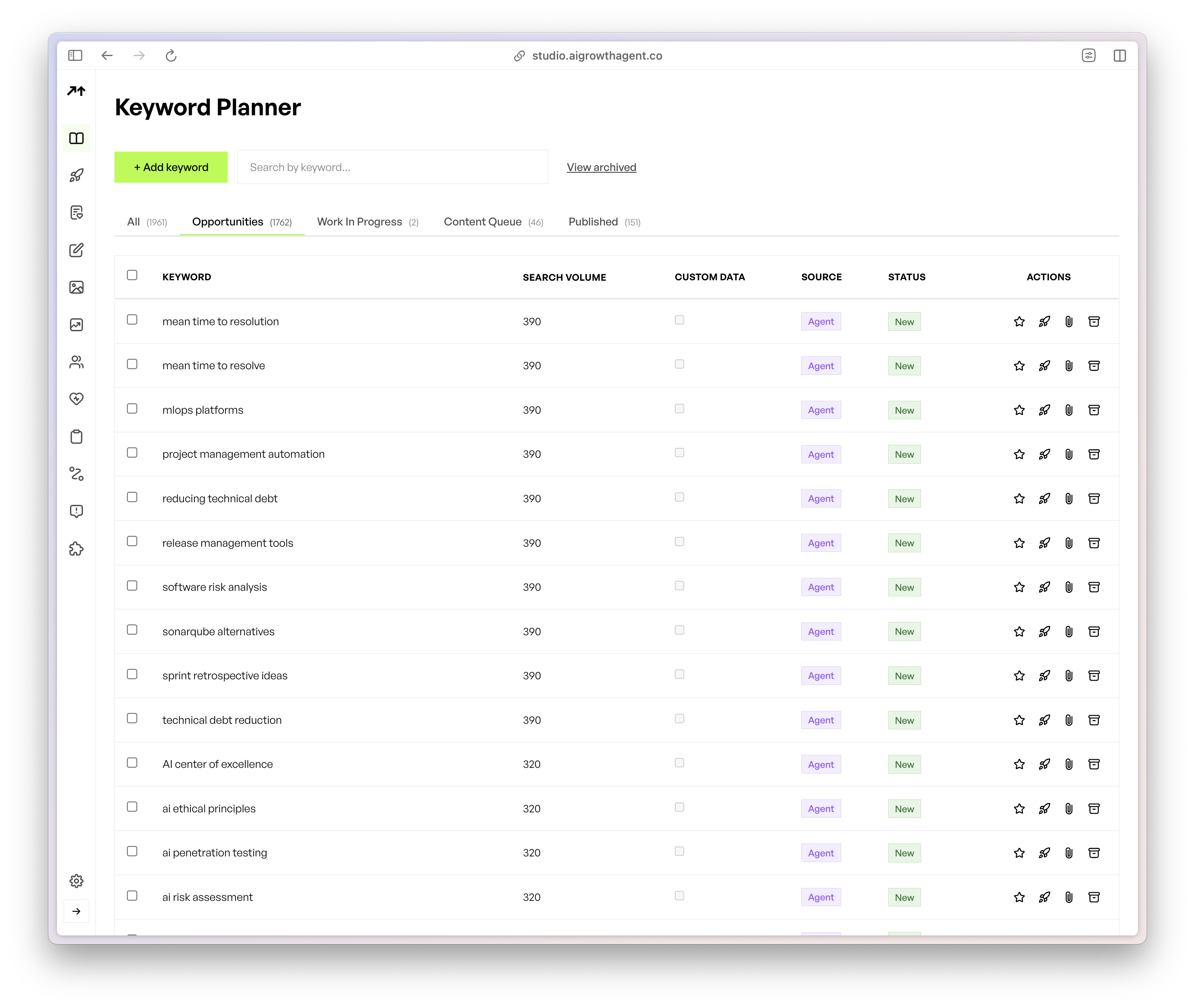
Teams start with deep keyword clustering and competitive analysis to uncover programmatic content opportunities. A first-pass AAARRR implementation often completes in 2–4 weeks when analytics and CRM foundations already exist.
Technical Infrastructure Setup
Next, teams configure blog architectures and content management systems for programmatic publishing and clean AI indexing. This foundation supports high-volume, structured content.
Autonomous Content Execution
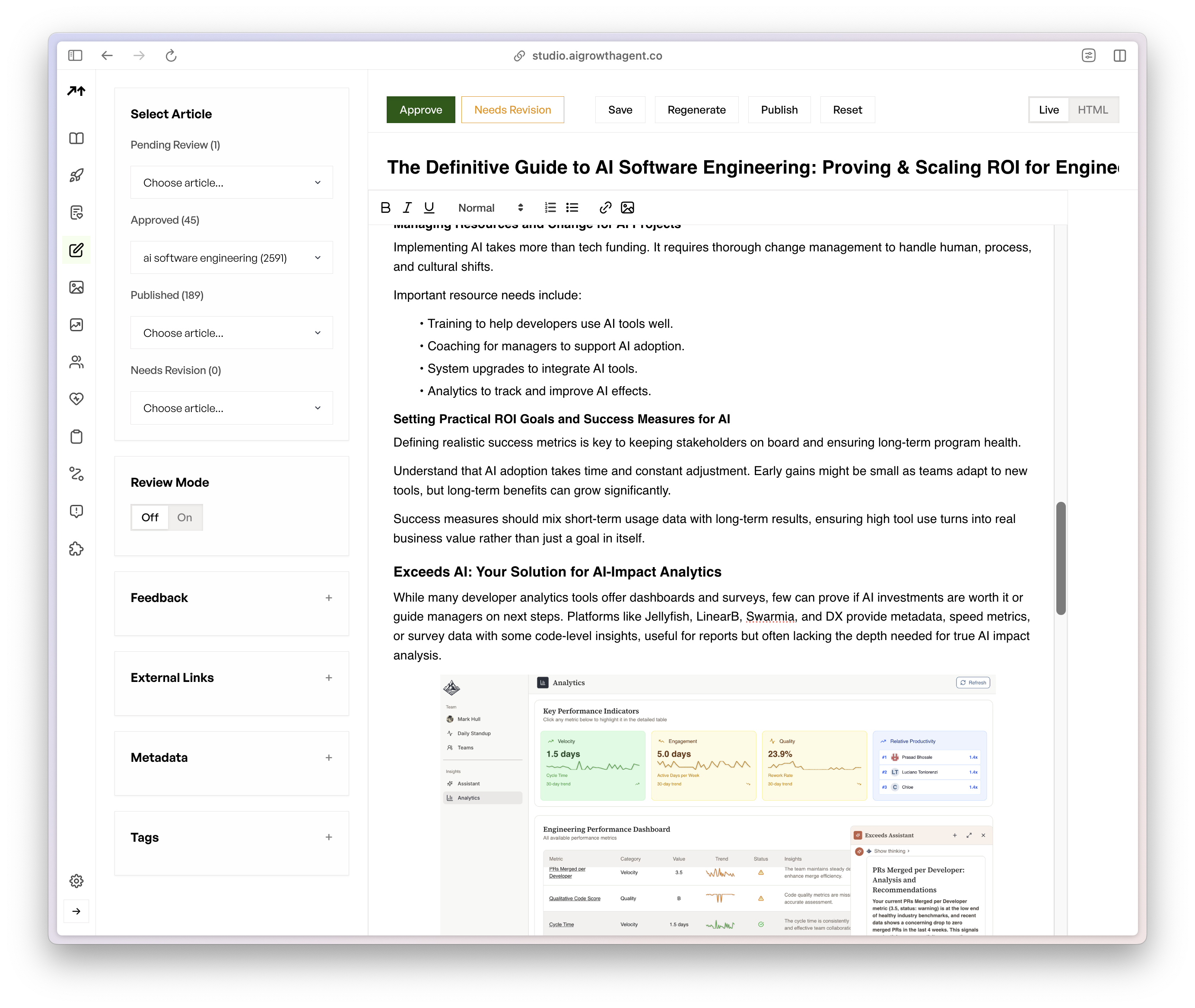
AI-powered content agents then create, refine, and publish articles at scale. These agents follow brand guidelines and technical SEO standards so teams gain volume without sacrificing quality.
Real-Time Monitoring and Optimization
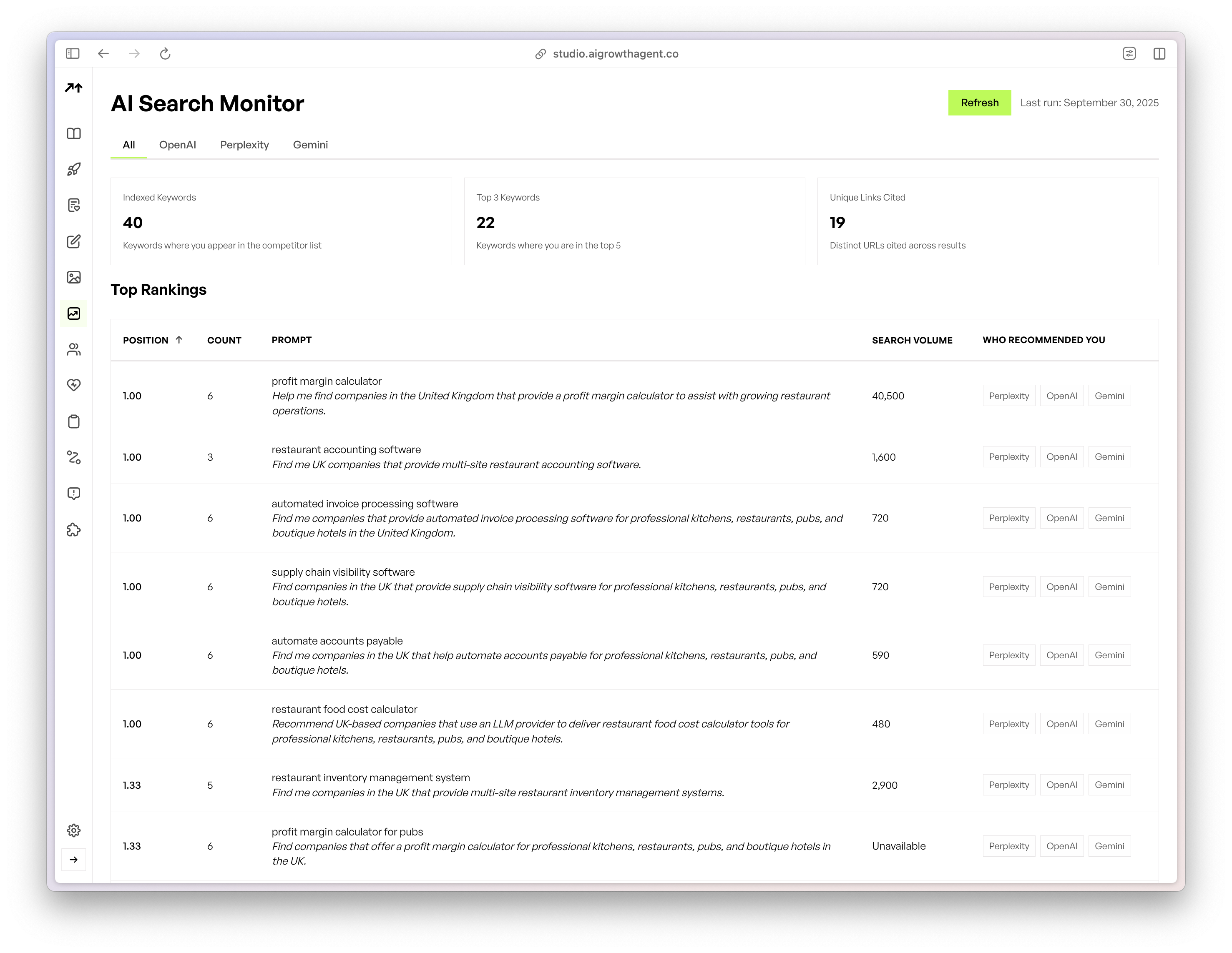
Finally, teams track AI citations, organic traffic, and conversion metrics in real time. Automated feedback loops feed insights back into content and experimentation plans.
AI Growth Agent streamlines this entire lifecycle with white-glove onboarding, the AI Growth Agent Studio interface, and real-time AI Search Monitor. The programmatic SEO agent covers keyword research, content generation, and technical optimization so teams can focus on strategy.
Get a personalized implementation roadmap for AI Growth Agent’s growth marketing automation platform.
Measuring and Improving Growth Marketing Performance
Effective growth marketing relies on metrics that reflect long-term economics, not just channel-level conversions. Key indicators include:
- LTV:CAC Ratio: Organizations with mature analytics are 2.7x more likely to exceed revenue targets.
- Viral Coefficient: Rate of organic growth from referrals and word-of-mouth.
- Activation Rate: Share of new users who reach their first “Aha!” moment.
- Retention Cohorts: Long-term engagement and churn patterns by signup period.
- AI Citation Tracking: Visibility across ChatGPT, Google AI Overview, and Perplexity.
- Programmatic Content Performance: Organic traffic growth and keyword rankings across clusters.
Teams typically rely on Google Search Console for organic performance, product analytics tools like Mixpanel or Amplitude for behavior tracking, and dedicated AI search monitoring.
AI Growth Agent’s AI Search Monitor tracks brand performance across major AI search engines, including citation frequency, ranking, and crawl behavior. These insights guide ongoing adjustments to programmatic content strategies.
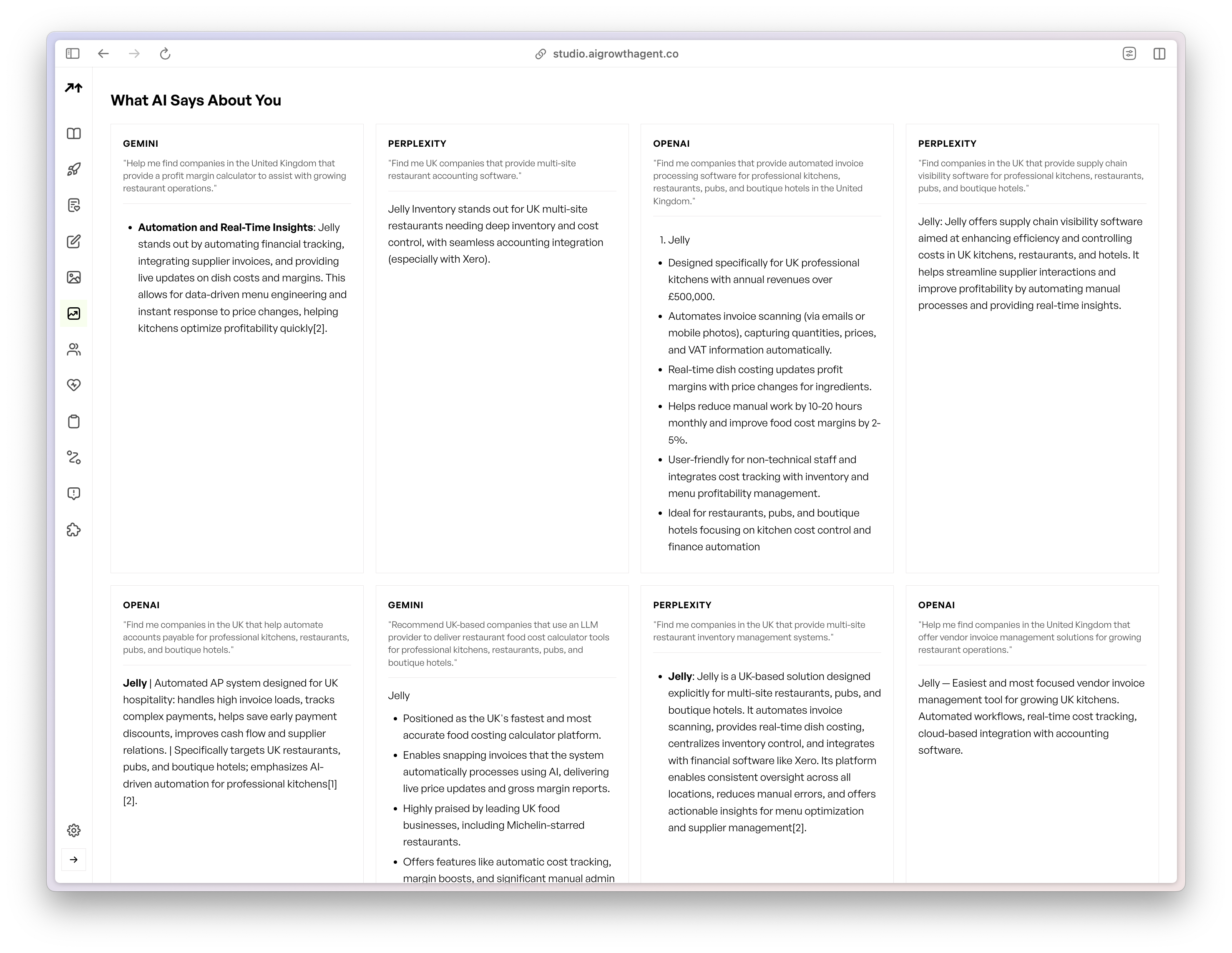
Request a demo of AI Search Monitor and growth reporting to see these metrics in action.
Risks, Limits, and Common Growth Marketing Mistakes
Growth marketing can stall when teams overlook a few recurring issues. These pitfalls often connect and compound each other.
- Siloed Team Structure: Rigid departments block the cross-functional collaboration that growth systems require.
- Manual Scale Limitations: Human-only content teams cannot keep pace with AI search’s demand for depth and freshness.
- Generic AI Tool Dependency: Basic AI writers without programmatic strategy or technical rigor produce shallow, inconsistent content.
- Short-Term Metric Focus: Overemphasis on quick conversions undermines retention and long-term unit economics.
- Weak Technical Infrastructure: Missing engineering support for programmatic content and analytics limits experimentation.
Teams reduce these risks through clear strategy, cross-functional pods, and investment in specialized automation. AI Growth Agent addresses many of these challenges with a complete programmatic SEO solution that manages technical complexity while preserving quality and brand consistency.
Traditional agencies rely on manual workflows, and generic AI tools demand heavy configuration. AI Growth Agent instead delivers autonomous growth marketing with guided onboarding and continuous optimization.
Talk with our team about de-risking your growth marketing using AI Growth Agent’s automation platform.
Summary and Decision Support
Growth marketing in 2026 replaces campaign-first thinking with data-driven experimentation across the AAARRR funnel. AI-powered automation, especially programmatic SEO, now acts as a requirement for brands that want visibility in AI search results.
Key points to remember include:
- Growth marketing treats the customer journey as one connected system that needs cross-functional ownership.
- The evolved AAARRR framework gives teams clear metrics and accountability at every stage.
- Programmatic content creation has become mandatory for AI search citations and durable organic growth.
- Systematic experimentation and automation create compounding competitive advantages.
Success stories such as Bucked Up’s #1 ChatGPT citation and Exceeds AI’s Perplexity dominance highlight the impact of programmatic growth systems. As noted earlier, top-quartile AI analytics adopters see 3.2x higher marketing ROI, and that gap will widen as AI search gains more influence.
AI Growth Agent offers an autonomous programmatic SEO solution that unites growth strategy with technical execution so brands can scale authority while manual teams fall behind. Talk to our team about your growth marketing goals and explore what AI-powered growth could look like for your organization.
Frequently Asked Questions
What is growth marketing?
Growth marketing is a data-driven approach to full-funnel improvement that uses rapid experimentation across the AAARRR framework for scalable, sustainable growth. It treats the customer journey as a connected system and relies on systematic testing and cross-functional collaboration.
How does growth marketing differ from digital marketing?
Growth marketing focuses on full-funnel experiments and growth loops, while digital marketing often centers on channel campaigns and awareness. Growth teams track unit economics such as LTV:CAC and retention, whereas digital teams usually emphasize traffic, engagement, and reach. Growth marketing also depends on close collaboration between marketing, product, and engineering.
What are examples of successful growth marketing strategies?
Examples include Dropbox’s referral program that produced 3900% growth in 15 months, Netflix’s personalized recommendations that drive most viewing, and programmatic SEO strategies like Bucked Up’s #1 ChatGPT citation for “best protein soda” within three weeks. Each example combines experimentation with scalable automation.
How does the AAARRR framework work in practice?
The AAARRR framework breaks the journey into six stages: Awareness, Acquisition, Activation, Retention, Referral, and Revenue. Teams assign owners, define KPIs, and run experiments at each stage. They then review results across the funnel to understand how changes in one stage affect the others.
What is the most important growth marketing strategy for 2026?
Programmatic SEO and AI-powered content creation represent the most critical strategy for 2026. As AI search engines like ChatGPT, Google AI Overview, and Perplexity shape discovery, brands must publish high-authority content at scale to earn citations and recommendations. This requires autonomous systems that can design, write, and optimize content programmatically while preserving quality.
How does AI Growth Agent implement growth marketing strategies?
AI Growth Agent automates growth marketing through a programmatic SEO agent that manages the entire content lifecycle. The platform covers keyword research, Company Manifesto development, autonomous content creation, technical SEO, and AI search monitoring. White-glove onboarding and the AI Growth Agent Studio give teams control and feedback loops.
What timeline should companies expect for growth marketing results?
Timelines vary by strategy and execution quality. Programmatic SEO can produce initial AI citations within 2–3 weeks, as seen with Exceeds AI and Bucked Up. Full AAARRR implementation often shows measurable gains within a quarter, and compound returns typically build over 6–12 months of disciplined experimentation.
How do you measure growth marketing ROI?
Teams measure growth marketing ROI through unit economics and full-funnel metrics rather than isolated channel KPIs. Core measures include LTV:CAC, CAC trends, retention improvements, viral coefficients, and revenue growth. Advanced tracking adds AI citation visibility, organic traffic growth, and programmatic content performance across search engines.
Explore AI Growth Agent’s growth marketing automation in a live demo and see how it can support your next stage of growth.