Written by: Mariana Fonseca, Editorial Team, AI Growth Agent
Headless Marketing Playbook: What You Need To Know
-
Headless marketing separates content from any single frontend so brands can control the narrative on AI surfaces where zero-click answers now dominate.
-
Google AI Mode has surpassed 1 billion monthly users while AI Overviews correlate with a 58% drop in clickthrough rates, so citation context now functions as the core performance metric.
-
The seven-step headless rollout of universe mapping, Content Topology, robot-first site, living content, agentic technical SEO, bot tracking, and incremental visibility reporting replaces legacy agency and DIY approaches.
-
AI Growth Agent clients average more than 12,000 additional AI citations, 100,000+ bot visits, and a 20%+ lift in impressions within the first twelve weeks.
-
Schedule a consultation to see how AI Growth Agent maps your universe and delivers your first article within a week.
Core Concepts For Headless AI Visibility
The universe is the full set of queries and prompts that describe a brand’s market, head terms and long tail together. Most brands track a handful of head terms and lose the rest of the conversation by default. Seed terms are the strategic anchor topics that organize the universe, and each one spawns dozens of long-tail queries underneath it.
The long tail is the vast majority of the queries the customer actually asks, and this is precisely where robots focus their search behavior. Because robots prioritize the long tail, brands that only optimize for head terms are blind to most of their own market. When a brand does capture long-tail queries, success is no longer measured by traditional rankings, and citation context replaces the old idea of a ranking number. Citation context is where the brand appears in an AI answer, who it is grouped with, and what claim it is cited for.
Living content is content that updates and self-heals over time so the brand’s presence does not decay as the world changes. Incremental visibility is reporting that isolates the visibility a new effort actually generated, separate from the visibility the brand already had.
Agentic technical SEO makes content accessible not just to traditional crawlers but also to AI agents acting on a user’s behalf. Technical requirements for AI agent accessibility include configuring robots.txt to avoid blocking AI crawlers, implementing agent-responsive design, and maintaining an up-to-date llms.txt file. Effective AI visibility also requires authoritative, well-structured content using clear headings, schema markup, and FAQs so models can easily interpret and cite it.
Content Topology is the structured map of seed terms and long-tail queries, built from real-time data, that tells a brand where to produce content and in what order. This strategic layer separates headless marketing from generic content production.
AI Search Market And Headless Ecosystem In 2026
73% of businesses now operate on headless architecture, representing a 14% increase from 2021 and nearly 40% growth since 2019, according to The State of Headless 2024 report. Among organizations not currently using headless architecture, 98% plan to evaluate it within the next 12 months. This shift reflects a structural change in how digital experiences are built, not a passing trend.
The legacy model cannot keep pace. A traditional agency RFP runs about three months, then three more to produce the first assets. It is close to a year before anything is in motion, and the whole time is spent briefing, onboarding, and chasing. By the time the first article ships, the AI surfaces have already indexed whatever was sitting on the open web, and a competitor’s narrative is already being trained into the next generation of models.
The do-it-yourself path breaks in different ways. One company produced roughly 300 articles using a chatbot. Not one was cited, and the articles were full of errors and gaps. Producing one good article is possible. Producing the second means running the entire process again, with quality that drifts from one piece to the next and no system behind it.
By the end of Q4 2025, ChatGPT commanded an estimated 17% of digital queries compared to Google’s 78%, which created a fragmented search landscape that forces brands to pursue citation across multiple AI platforms at the same time. The headless model is the only architecture built to serve all of them at once, and the competitive advantage is measurable.
80% of organizations using headless architecture report feeling ahead of competitors in delivering new digital experiences. The brands establishing authoritative content now are training the next generation of models with their own narrative. The brands that wait are training the next generation with whatever happens to be sitting on the open web.
Comparing Six Paths To AI Search Visibility
Six categories of solution exist for brands trying to win AI search visibility, and each covers a different slice of the problem. None of the first five delivers a complete system that maps the universe, publishes at scale, and maintains living content over time.
DIY chatbots (Claude, Claude Code) can draft a single article. They provide no universe map, no topology, no publishing, no schema, no monitoring, and no self-healing. Every step beyond drafting is left to the client, and consistency breaks down at scale.
AI content writers (Jasper and similar tools) generate article text on demand. There is no results dashboard, no technical SEO, and no publishing infrastructure. The client still assembles and runs everything around them.
GEO and AI search monitors (Profound, Athena, Peec AI, Scrunch AI) track whether a brand appears for a capped set of prompts. Monitoring is not action. These tools identify the problem and leave the client to solve it.
Traditional SEO suites (Semrush, Ahrefs) sell keyword and rank data. Data is not action. They do not produce AI search content, do not publish, and do not self-heal what is live.
SEO agencies are slow, expensive, and operate at a smaller scale. An RFP takes months. The first assets take months more. The client often does not even own the site the agency manages.
The headless engine (AI Growth Agent) maps the full universe, produces authoritative living content, stands up an owned site in week one, ships the full agentic technical SEO stack automatically, and reports incremental visibility week over week. Across the first twelve weeks, clients average more than 12,000 additional AI citations and mentions, over 100,000 additional bot visits, and a 20%+ lift in impressions. One engine replaces the SEO agency, the content tool, the web agency, the GEO monitor, the schema plugin, the analytics stack, and the PR firm.
How To Evaluate Headless Marketing Solutions
Team capacity. Headless architecture requires dedicated time and resources to develop frontend infrastructure, define content models, and configure integrations with existing tech stacks. This requirement creates a fundamental mismatch, because the internal marketing team at most mid-market and enterprise brands is non-technical, yet traditional headless implementations demand engineering expertise. Any approach that requires schema work, plugin configuration, or engineering hours from the client side will stall. The right solution handles all of it automatically and closes that resource gap.
Data quality. Effective AI content creation requires human oversight and editorial refinement, industry expertise and topical depth, structured formatting for readability and AI parsing, and adherence to E-E-A-T principles. Content produced without validated primary sources will not earn citations. Anti-hallucination controls and claim verification function as table stakes, not optional features.
Integration. The only integration step a brand should need to manage is a reverse proxy rewrite connecting the blog to a subdirectory under its domain. Everything else, including the full technical and agentic SEO stack, should be included and automatic.
Governance. In headless architectures, governance can regress because built-in roles, capabilities, workflow plugins, and publishing controls often fail to translate cleanly to the decoupled frontend and must be recreated manually. A solution that enforces brand voice, legal disclaimers, and deny lists through persistent memory removes this risk without requiring manual oversight on every article.
Scalability. Prompt count should never be a billed metric. A solution that caps the number of tracked queries forces the brand to choose which slice of its market to see, leaving the rest of the conversation to competitors. The full universe, refreshed weekly, is the only defensible position.
Typical Implementation Stages For AI Growth Agent
Week one: kickoff. A professional journalist interviews the client to build the brand manifesto. This material feeds the keyword topology and the first articles. By the end of the week, the engine has learned brand voice, factual references, deny lists, and the personalization needed to make content compliant by default. The first article is typically live within a week of kickoff, with content indexing in as little as ten days.
Content Topology mapping. AI Growth Agent ingests the manifesto and any unstructured material the client provides, then maps the client’s entire market. The result is a hierarchy of seed terms, each backed by real-time Google and ChatGPT data, with dozens of long-tail queries beneath it. A new account typically starts with three to four hundred queries and expands as it goes after more of the universe. Mature clients reach universes of 1,600+ queries.
Site setup via reverse proxy. AI Growth Agent stands up a fully optimized blog styled to match the client’s own pages, connected through a reverse proxy rewrite under a subdirectory or subdomain. The client owns the property outright. Nothing in the existing site structure changes.
Full technical and agentic SEO stack. Every article ships with highly structured HTML, full metadata, rich schema markup across the complete schema suite, internal linking, sanitized external linking, proper sitemaps, automated web stories, real-time bot tracking, instant indexing, autoredirects, and 404 tracking. On top of that, every site ships with Blog MCP, OpenAI discovery and Agent Card guidance via /.well-known/, natural language query parameters, Markdown served to agent crawlers, and llms.txt and llms-full.txt. None of it requires action from the client, and every package includes the full stack.

Ongoing Management And Measurement Framework
Content stays in motion instead of shipping once and going stale. When the year turns, every article in a sector is refreshed automatically. Every article’s relationships, performance, and bot and Search Console data are centralized so authority keeps compounding instead of decaying. Stale articles are refreshed in response to Google Search Console signals and bot-traffic awareness.
Bot tracking covers every bot that touches the blog, including the bot ChatGPT uses to cite sources. This layer is invisible to most monitoring tools. Without per-article bot tracking, a brand cannot tell whether AI training agents are reading its content at all, let alone which articles earn citations.
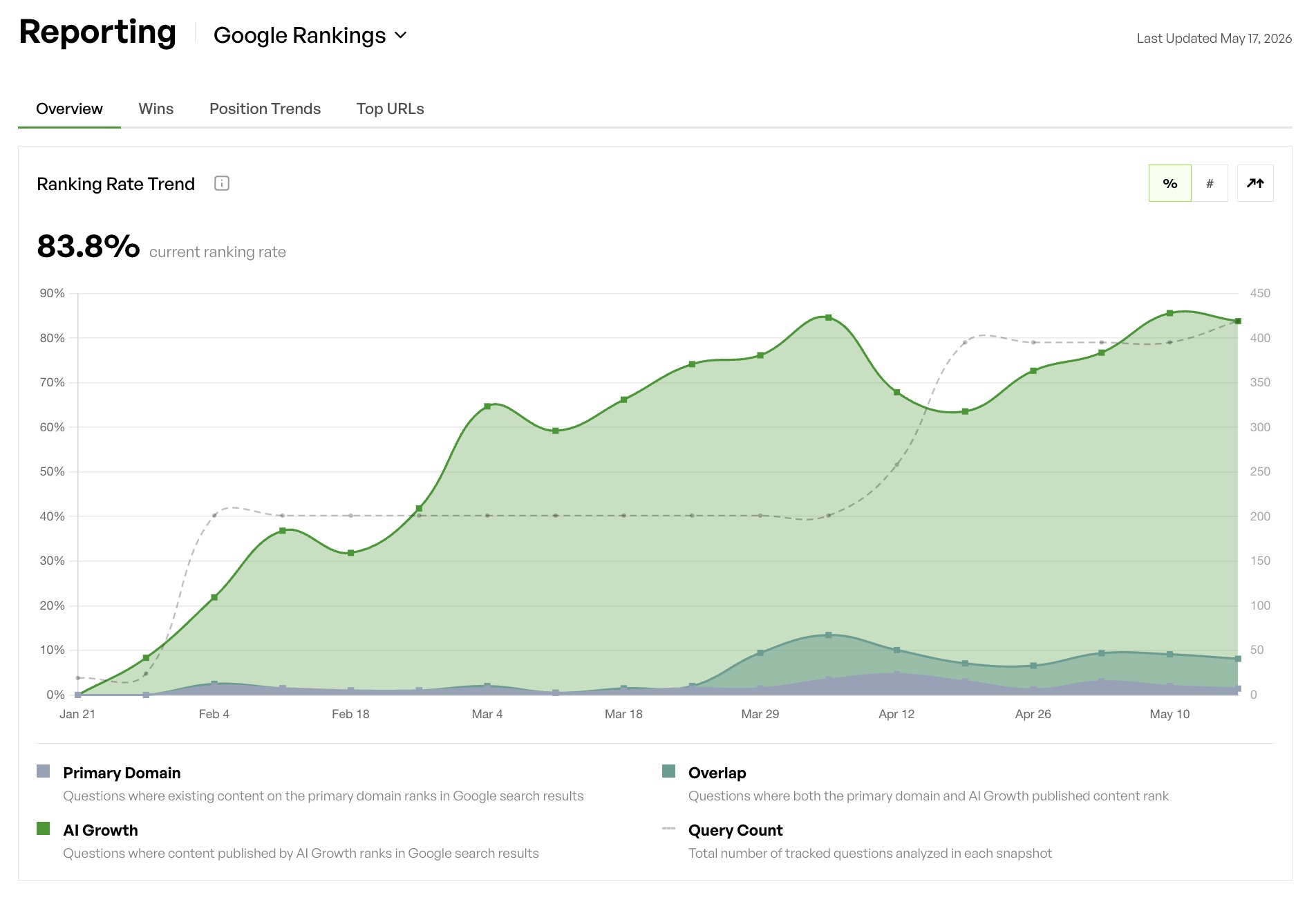
Incremental visibility reporting isolates exactly what the engine generated, week over week, by cross-referencing bot traffic, Google Search Console, and citation data. The four pillars that power this reporting are:
-
Search Intelligence: a complete portrait of the traditional search landscape, covering positioning, competition, and search volume, taken from raw situation to actionable diagnosis.
-
AI Analytics: brand value and consumer behavior across the whole journey, from external touchpoints like Google and AI-tool queries through content consumption, demographics, and sentiment.
-
Bot Tracking: every bot interaction, traditional crawlers and AI training agents alike, including every crawl, citation, and training sweep.
-
AI Ranking: order of mention and citation context as the new leaderboard, tracked week over week against the content plan.
Client results show what this system produces at scale. Breadless grew from 387,000 to 12.3 million Google Search Console impressions over six months, a roughly 30x lift, with ChatGPT citing eatbreadless.com over 45,000 times per month. Leva Sleep closed $40,000 to $50,000 in deals in under three weeks from buyers who discovered the brand through AI Growth Agent content.
Risks, Limitations, And Common Pitfalls
Content staleness. Moving from a monolith to headless architecture can produce shadow content silos and duplicated content across channels, creating inconsistency and governance problems that undermine a single source of truth. Any headless marketing system that does not self-heal content will produce a brand presence that decays the day it ships. Living content functions as the minimum viable architecture, not a bonus feature.
Hallucination. Low-quality AI content alone can damage rankings. Content produced without validated primary sources, claim re-extraction, and anti-hallucination cascades will not earn citations from AI surfaces that apply their own quality filters. Every claim, source, and quote must be verified against evidence found online before anything ships.
Agency dependency. Tracking, tagging, and A/B testing become harder in headless setups because pixels, tags, and event instrumentation must be reimplemented in the custom frontend, increasing the risk of inconsistency across channels. Brands that do not own their own site and data remain dependent on whoever controls the infrastructure. The client must own the site, the content, and the relationship with the AI surfaces outright.
Capped prompt monitoring. GEO monitors that cap clients at a small set of tracked prompts create a false sense of coverage. A brand tracking 20 prompts is seeing a fraction of its market. Brands tracking fewer than 20 core prompts often miss critical visibility opportunities, and the real universe of queries a customer might ask runs into the hundreds. Prompt count must never be a billed or capped metric.
Operational complexity without the right system. For businesses with under approximately $20M in online revenue, the cost and complexity of headless implementations often destroy ROI when assembled manually. The answer is not to avoid headless marketing. The answer is to use a single engine that absorbs all of that complexity rather than assembling it from parts.
Frequently Asked Questions
What is headless marketing and how does it differ from headless CMS?
Headless CMS decouples content storage from content presentation, giving developers freedom to build any frontend. Headless marketing goes further and decouples the entire marketing operation from human headcount and legacy agency stacks, engineering content specifically for the robots, crawlers, and AI surfaces that now decide what customers find. The brand keeps its curated main site. The headless marketing engine runs a separate, fully optimized property behind it, producing living content, managing technical and agentic SEO, and reporting incremental visibility, all without requiring a content team, an SEO agency, or a web agency on the brand’s side.
How long does it take to see results from a headless marketing implementation?
With AI Growth Agent, the first article is typically live within one week of kickoff, and content often begins indexing within the first two weeks. The standard engagement is a three-month pilot because indexing timelines vary by industry, but clients consistently see movement early. These results match the client averages cited earlier, including significant gains in AI citations, bot visits, and impressions. Jota saw a 190%+ traffic increase from generated content over three months, with daily average impressions rising 52% in the first three weeks alone.
Do we need a technical team to implement and run headless marketing?
No. The point of headless marketing is the removal of that dependency. AI Growth Agent provisions schema, the WordPress plugin, robots.txt, sitemaps, automatic web stories, Blog MCP, agent discovery via /.well-known/, llms.txt and llms-full.txt, instant indexing, autoredirects, and 404 tracking automatically. The only integration step on the client’s side is the reverse proxy rewrite that connects the blog to a subdirectory under their domain. The internal team gives feedback in plain language, the engine learns, and every future generation reflects those rules without re-briefing.
How is incremental visibility measured in a headless marketing system?
AI Growth Agent publishes into a separate environment so it can take credit only for the visibility it actually generates, never for visibility the brand already had. It reports week over week where content is indexing, where the engine is driving new visibility, and where the two overlap. The four pillars of Search Intelligence, AI Analytics, Bot Tracking, and AI Ranking feed this reporting. Google Search Console serves as an independent audit. Bot analytics track every bot that touches the blog, including the bot ChatGPT uses to cite sources, so the brand can see exactly when and where citations are occurring at the article level.
What happens to content quality when production scales to hundreds of articles per month?
Quality is enforced by the system, not by headcount. AI Growth Agent uses a multi-agent orchestration across every major AI provider, selected by task and by language, with a cascade of anti-hallucination checks at every stage. Every claim is re-extracted after drafting and verified against product pages, the manifesto, primary sources, and verified external sources before the article moves further down the pipeline. Style memories carry brand voice rules and apply them to every generation. A journalist with 10+ years of experience on the founding team shapes how the work is done. The engine produces between 2 and 50 articles per day per client, up to roughly 500 per month, at consistent quality that would otherwise require an editor, an SEO specialist, a researcher, and a PR firm working in coordination.
Conclusion: Owning AI Search With Headless Marketing
Headless marketing best practices in 2026 converge on a single requirement: engineer content for the robots, crawlers, and AI agents that now decide what customers find, and do it at a scale and speed that no agency or internal team can match manually. The seven-step rollout, from universe mapping through Content Topology, robot-first site setup, living content production, agentic technical SEO, bot tracking, and incremental visibility reporting, forms the architecture that replaces the legacy stack without adding headcount.
Traditional marketing stacks were built for a world where humans clicked blue links, and that world is being rewritten. With nearly three-quarters of businesses already on headless architecture, the brands establishing authoritative AI search presence now are training the next generation of models with their own narrative. As noted earlier, the choice is binary: control the narrative that trains tomorrow’s models, or cede that narrative to whatever competitors publish first.
AI Growth Agent is the single engine that delivers headless marketing best practices without an agency, without a technical team, and without a year-long ramp. The timeline from kickoff to indexed content is measured in days, not months, and the client results detailed earlier demonstrate the system’s effectiveness. The leaderboard is being written this year.