


Key Takeaways
- AI search engines now act as primary discovery channels and favor brands with consistent, structured, and authoritative content at scale.
- Traditional SEO teams, agencies, and basic AI tools cannot match the speed, volume, and technical precision required for modern AI indexing.
- AI Growth Agent builds a tailored Company Manifesto, programmatic keyword roadmap, and hosted technical infrastructure so your brand can compete effectively in AI search.
- A dedicated content agent, visual editor, and control Studio manage the full content lifecycle, from research and drafting to publishing and ongoing optimization.
- AI Search Monitor, multi-tenant management, real-time topic response, and database-to-content automation help complex organizations capture and defend category authority.
- Autonomous AI agents work alongside your marketing team, handling repetitive and technical SEO tasks so your team can focus on strategy, positioning, and creative work.
The AI Search Revolution: Why Traditional SEO Falls Short
Protecting Your Digital Footprint As AI Content Volume Grows
AI tools now generate massive amounts of new content every day, so your company’s voice competes with far more noise than before. Brands that lack a programmatic strategy to publish structured, useful content at volume become difficult for AI indexers to notice and reference.
Scale is the core challenge. Human teams might publish one or two strong articles each month. Meanwhile, AI-generated content floods search engines with thousands of new pages daily. Your carefully crafted work becomes a drop in a large pool of similar content, which makes it harder for AI search engines to identify and cite your brand as a clear authority.
Keeping Pace With Programmatic Velocity In SEO
Modern search engines and large language models update their understanding of the web continuously. They reward content that combines recency, depth, and consistent structure. Slow, manual production processes struggle to keep up with that pace.
Publishing one or two manually crafted posts per month rarely maintains technical relevance. AI search systems expect a steady stream of authoritative, technically optimized content that shows ongoing expertise and active participation in your market.
Defining Your Brand Before Competitors Do In AI Search
Low content volume has become a strategic risk. When a brand does not provide enough clear, structured information, AI systems turn to other sources, often direct competitors. Those competitors then receive the citations, recommendations, and narrative ownership that shape how AI search engines describe the category.
This pattern creates a feedback loop. Brands that show up often in AI search keep gaining visibility and authority, while quieter brands become increasingly hard to surface, even for relevant queries.
Why Current SEO Solutions Struggle In The AI Era
Why Traditional SEO Agencies Struggle With Programmatic Scale
Most agencies operate on a manual, craftsman-style model that is slow and expensive. They often lack the engineering resources needed to design and maintain programmatic SEO systems. An agency might deliver a few excellent articles per month, but that pace rarely matches the structured data volume required to compete in AI-driven search. The billable-hours model breaks when daily, technically consistent content is necessary.
Where Internal Marketing Teams Hit Technical Limits
Internal marketing teams often focus on campaigns, messaging, and creative work. They seldom have the engineering capacity to build and run a full programmatic SEO stack. Tasks like advanced schema, robots.txt management, and LLM.txt implementation require specialized skills and time that many teams do not have. As a result, content may sound strong but lack the technical structure needed for optimal AI indexing at scale.
Why Basic AI Content Tools Fall Short Of Programmatic SEO
Basic AI tools, such as generic chatbots or prompt templates, generate unstructured text rather than fully engineered web pages. Teams that rely on these tools still need to define the strategy, enforce formatting standards, inject schema, and handle publishing workflows. This approach shifts the burden back to your team and often produces inconsistent, lightly optimized content that struggles to earn citations in AI search.
Marketing leaders who want to move beyond these limits and implement a true programmatic SEO system can schedule a consultation to see how autonomous AI agents can improve their SEO strategy.
How AI Growth Agent Builds A Programmatic SEO Engine For Your Brand
Onboarding And Company Manifesto: Programming Your Agent’s Brain
The engagement starts with a one-hour kickoff session with a professional journalist who specializes in your category. This working session captures your positioning, audience, product details, and non-negotiable brand rules. The outcome is a Company Manifesto, a living reference that guides your programmatic SEO agent.
The manifesto acts as the agent’s strategic foundation. It shapes every content decision so that large-scale output maintains your voice, messaging, and quality standards.
Programmatic Keyword And Content Research: Building A High-Authority Roadmap
After the manifesto is in place, the agent begins comprehensive research. It ingests your company context, reviews tens of thousands of relevant search queries, and maps opportunities into a structured programmatic content strategy. This strategy organizes topics into pillars and clusters specifically tuned for AI-powered search engines.
Each piece of content targets clear ranking and citation opportunities while contributing to a broader topical authority map that AI systems can easily recognize.
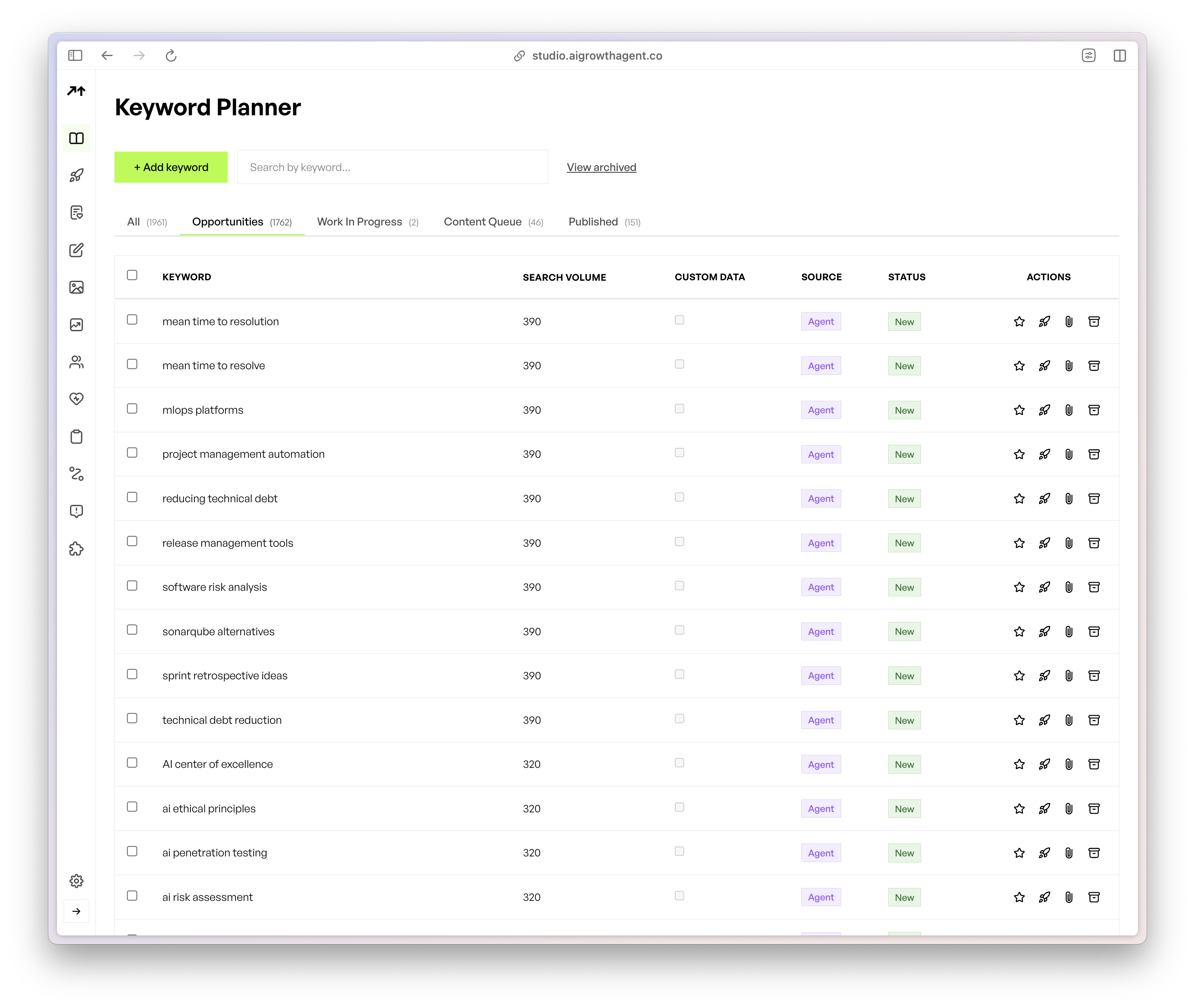
Autonomous Technical Infrastructure: Launching An SEO-Ready Blog Fast
AI Growth Agent removes engineering friction by deploying a dedicated, optimized blog architecture as a subdomain of your site, for example, blog.yourcompany.com. The design matches your existing brand so the experience feels consistent, while giving you a clean technical slate purpose-built for programmatic SEO.
The platform also supports integrations with existing CMS tools such as WordPress, Hashnode, Webflow, Framer, Sanity, and HubSpot. Many clients choose the hosted option because it provides consistent performance, clean code, and faster iteration for programmatic content.
The Programmatic SEO Content Agent: End-To-End Content Engineering
The content agent manages the full content lifecycle. It handles strategy execution, briefing, research, drafting, fact-checking, and the technical engineering work that connects each article to AI search systems. Every post receives advanced technical SEO, including rich schema markup, metadata optimization, structured headings, image tags, LLM.txt configuration, and Model Context Protocol integration so AI agents can read your content database more effectively.
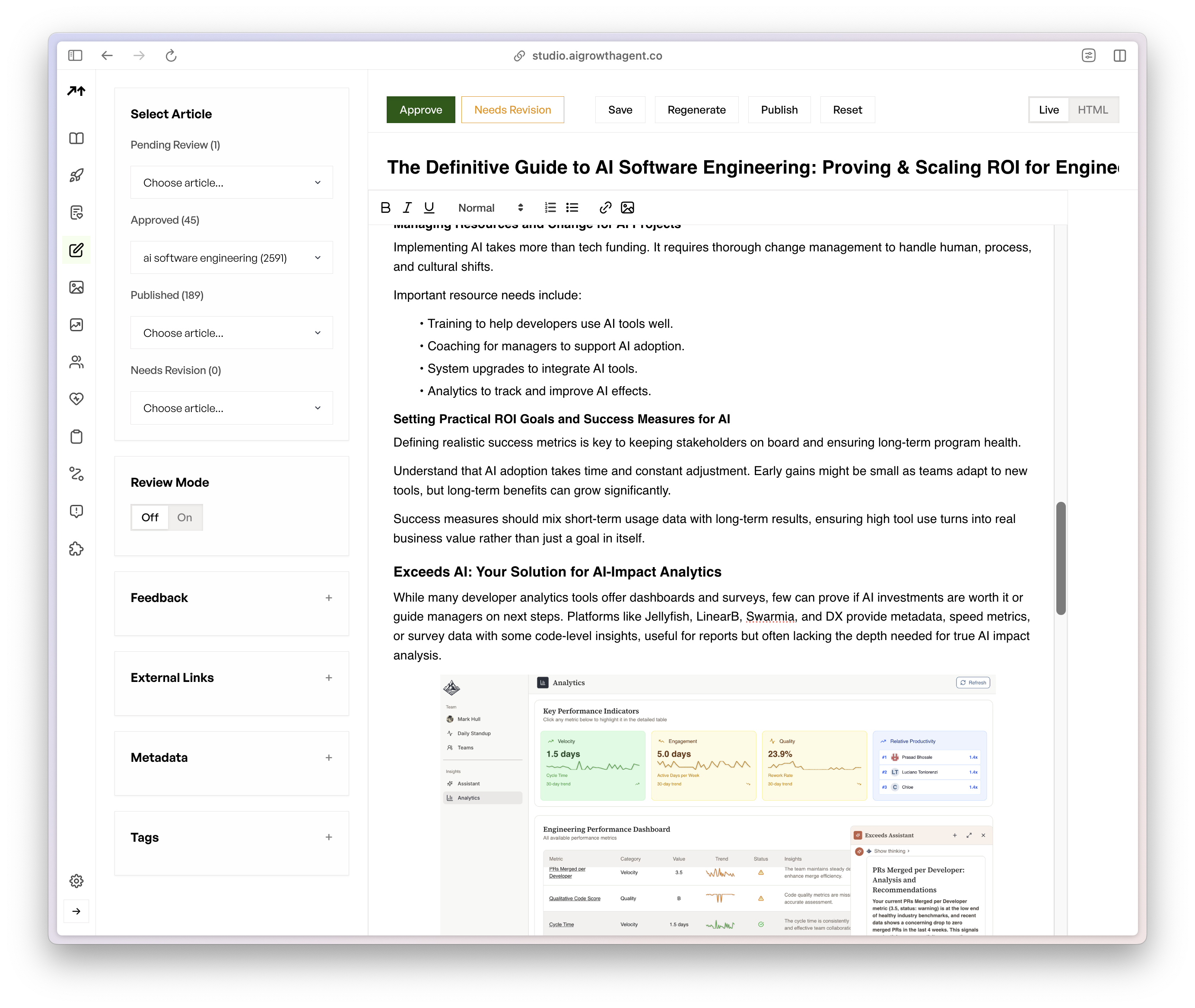
Your team can review and refine drafts in a rich text editor before publishing or move to higher automation levels once trust is established.
The AI Growth Agent Studio: Central Control For Programmatic SEO
The AI Growth Agent Studio gives you clear oversight of your programmatic operations. In this control panel, your team can review content pipelines, adjust strategy, provide feedback on drafts, and manage approval workflows. You can also enable an Auto-Pilot mode for more autonomous execution once quality and alignment meet your standards.
The system supports progressive learning. As you give feedback, the agent updates its internal models so that future content better matches your preferences without adding workload to your team.
AI Search Monitor And Feedback Loop: Measuring Real Authority
The AI Search Monitor tracks how your brand appears in AI search environments such as ChatGPT, Gemini, and Perplexity. It surfaces keyword indexing, URL visibility, citations within AI responses, and near real-time crawl activity so you can see where your content is gaining traction.
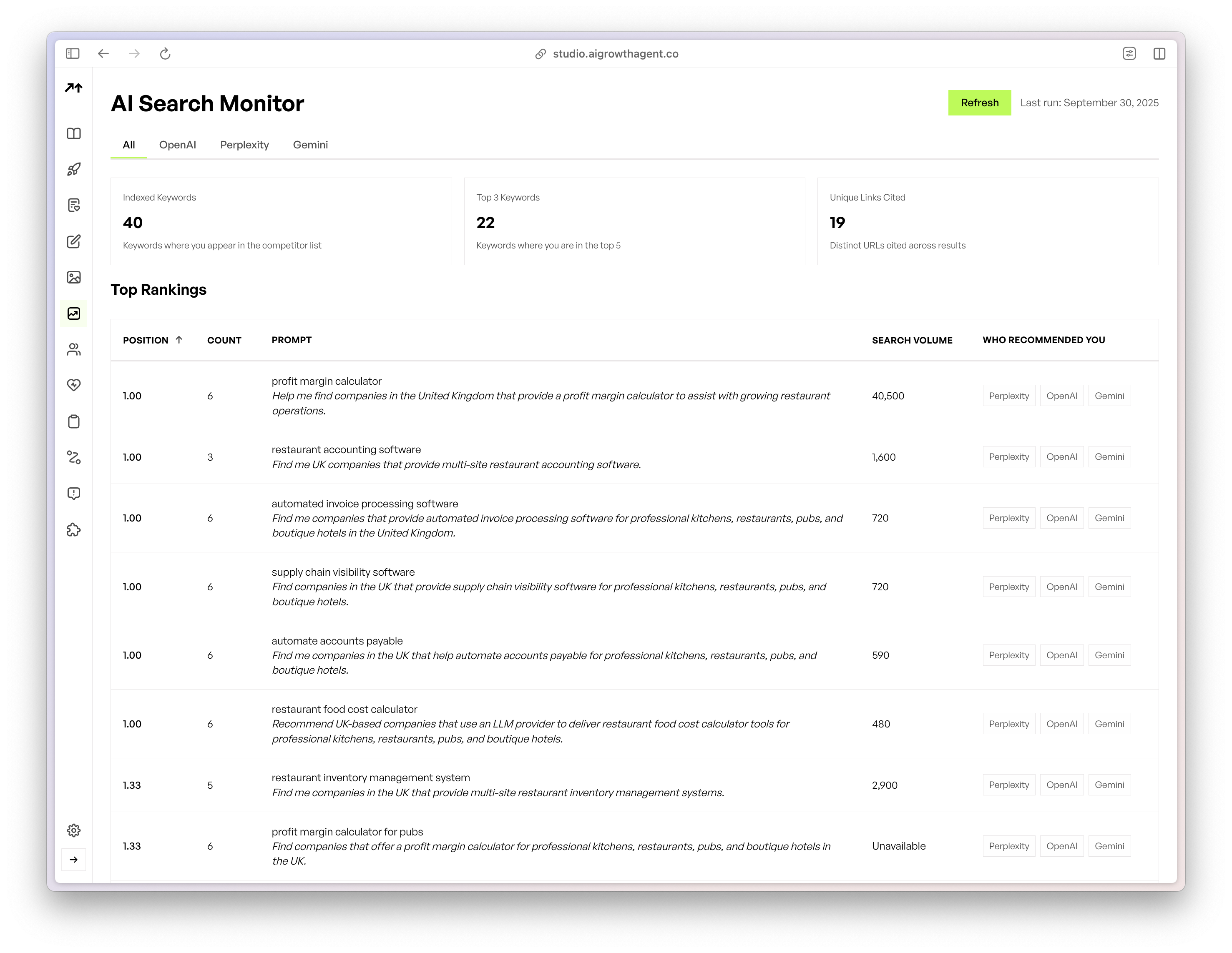
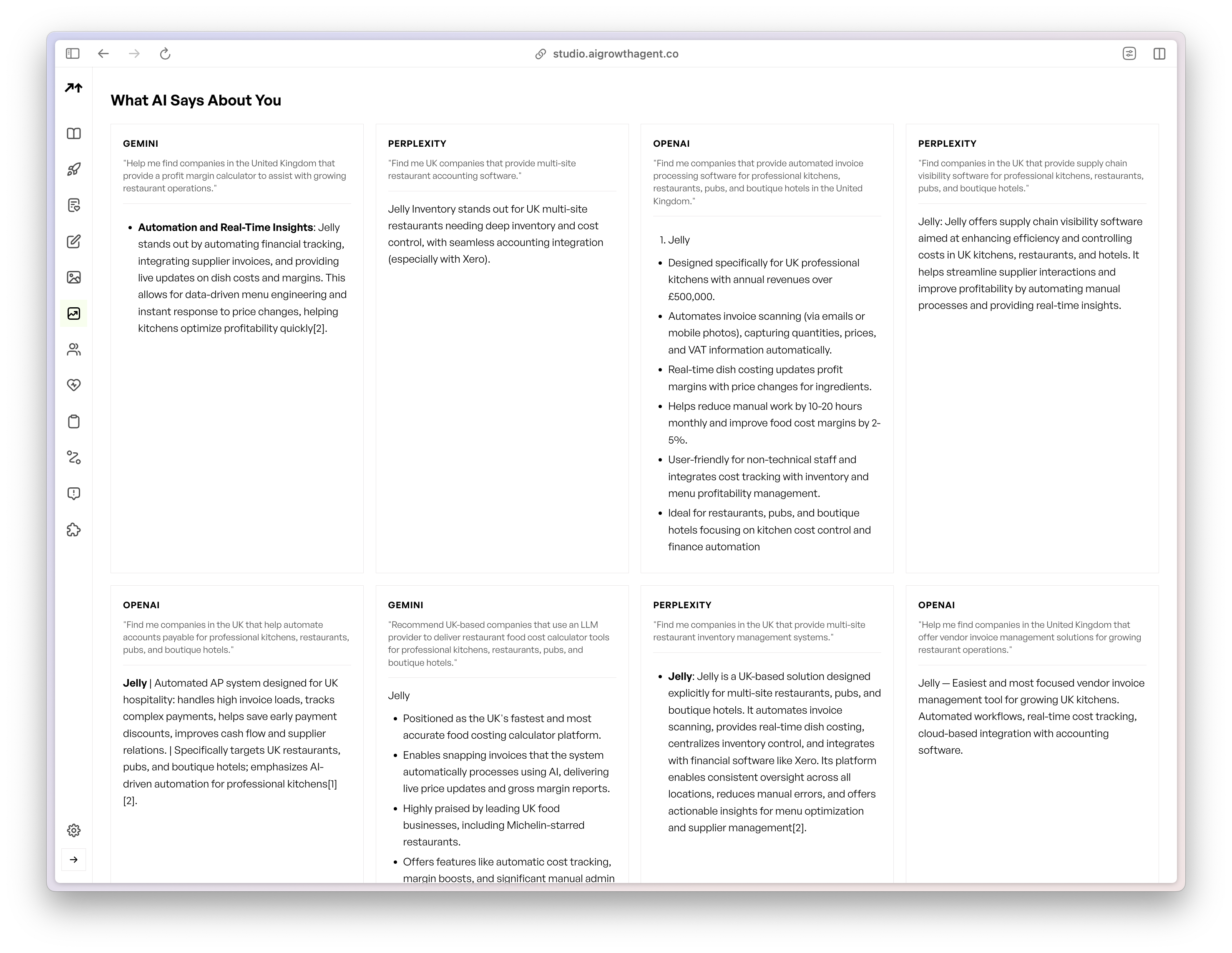
Integration with Google Search Console adds traditional SEO metrics, such as impressions, clicks, and query data. Together, these views show how programmatic content drives organic traffic and AI citations so you can measure ROI at both page and portfolio levels.
Key Capabilities Of AI Growth Agent For Programmatic Scale
Managing Complex Brand Portfolios With Multi-Tenant Deployment
AI Growth Agent includes a multi-tenant system that lets you run parallel programmatic SEO agents from a single interface. Each tenant maintains its own Company Manifesto, keyword strategy, and brand voice while sharing central oversight.
This structure works well for private equity firms, venture portfolios, holding companies, and enterprises with multiple product lines. A small central team can coordinate strategy while each brand receives content and technical SEO tailored to its market.
Responding To Trending Topics In Real Time
AI Growth Agent can publish timely, SEO-optimized articles that reflect your brand’s point of view on breaking news or emerging topics. The system identifies relevant trends and produces structured articles that capture search volume within minutes rather than days or weeks.
This capability helps your company show up in early searches around new themes, which strengthens both short-term visibility and long-term topical authority.
Turning Proprietary Databases Into SEO Content
Many organizations hold valuable data in internal tools or offline systems that never reach search engines. AI Growth Agent connects to these data sources and converts them into structured, indexable content at scale.
For example, a company with a food recommendation database can generate hundreds or thousands of location-specific, SEO-rich articles that answer real user queries and capture long-tail traffic that competitors might overlook.
Improving Visual SEO With Intelligent Image And Asset Placement
AI Growth Agent evaluates where images, charts, and other assets will add clarity and value, then inserts them with appropriate alt text and metadata. This approach supports both human readers and search engines and improves the chances that visual content appears in image-focused results.
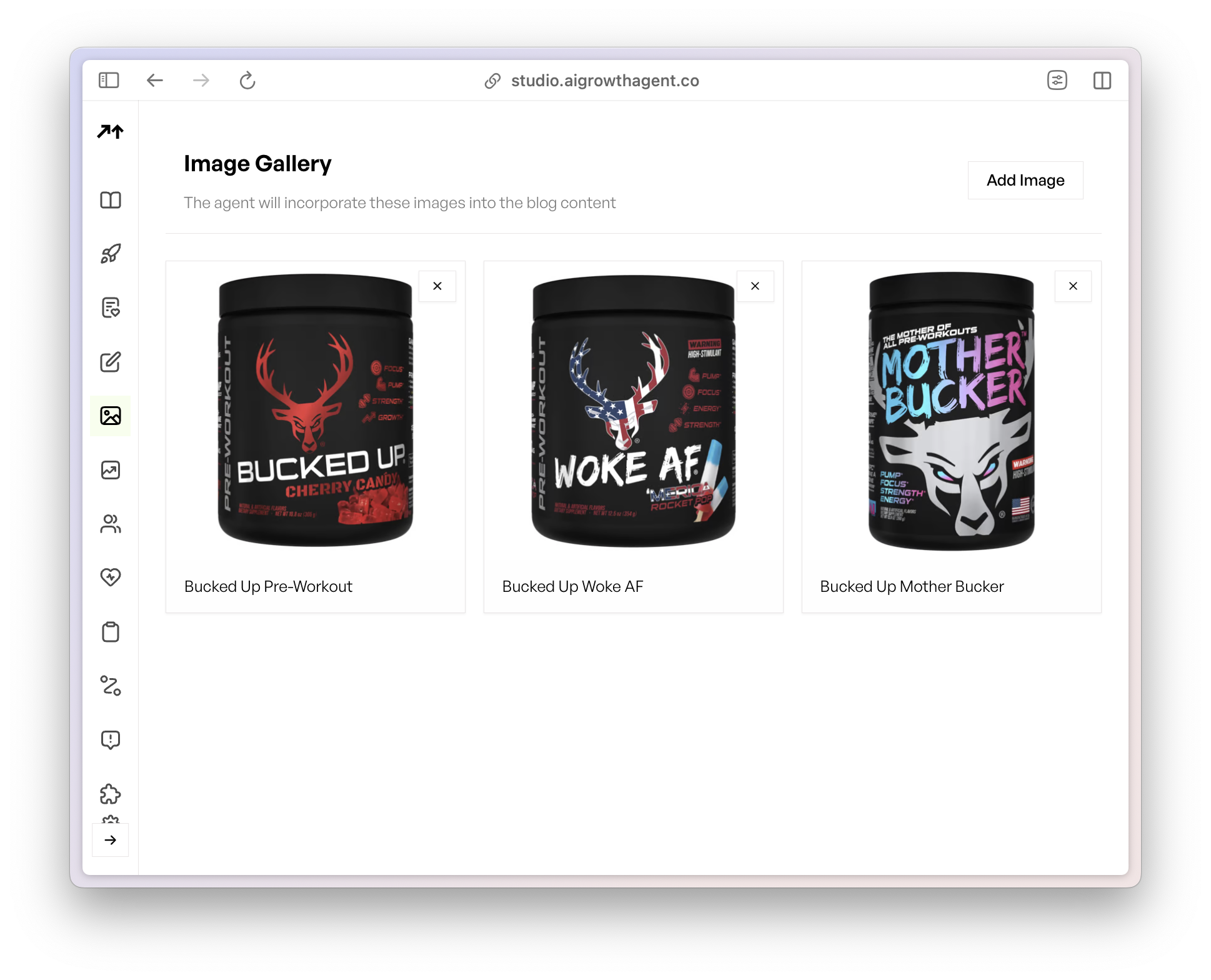
Teams that document and upload their visual assets once can then rely on the agent to reuse them intelligently across future content, saving time while maintaining consistency.
Marketing leaders who want to see these capabilities in action can schedule a demo to see how autonomous AI agents can support a programmatic SEO strategy.
How AI Growth Agent Compares To Other SEO Options
AI Growth Agent vs. SEO Agencies: Technology-Based Scale Instead Of Headcount
Traditional agencies rely on human labor for research, writing, and optimization, which limits how much they can produce and how fast they can adapt. AI Growth Agent uses autonomous systems and engineering to deliver consistent, structured content at far greater scale.
Agencies excel at bespoke, one-off projects and creative campaigns. AI Growth Agent focuses on building authority through repeatable, always-on content operations that run around the clock and integrate directly with AI search systems.
AI Growth Agent vs. Self-Service AI Content Tools: Closing Strategy And Quality Gaps
Many self-service AI tools generate drafts but require your team to supply prompts, define strategy, enforce formatting, and handle publishing. They may not connect the full workflow from keyword research to technical optimization and monitoring.
AI Growth Agent manages that end-to-end pipeline. It performs autonomous research and clustering, engineers schema-rich pages, enforces consistent structure, and routes content through your review process. The result is content designed from the start for both human readers and AI citation potential.
AI Growth Agent vs. AI Search Monitors: Execution Instead Of Only Diagnosis
AI search monitoring tools help you understand how your content currently appears in search and where gaps exist. They surface useful diagnostics but leave the work of fixing issues and creating new content to your team.
AI Growth Agent includes monitoring but also acts as the execution engine. When you identify an opportunity or gap, the agent can research, draft, optimize, and publish content programmatically, turning insights into action.
Success Stories: Real-World Impact Of AI Growth Agent
Exceeds AI: Performance Reviews For Engineers
Within two weeks of programmatic publishing, Exceeds AI became a top alternative to established competitors in Perplexity recommendations. By week three, the brand appeared in Google AI Overview and Gemini for core keywords. Today, Exceeds AI is featured across ChatGPT, Google AI Overview and Gemini, and Perplexity as a leading source for queries about AI performance review tools for engineers.
BeConfident: English Learning On WhatsApp
BeConfident was indexed shortly after programmatic content went live. Within weeks, it became the top recommended app in Brazil for learning English through Google AI Overview and Gemini, supported by a wide footprint of structured, localized content.
Bucked Up: Sports Nutrition Brand
After three weeks of ongoing publishing, Bucked Up began appearing as a cited source in ChatGPT for protein soda–related searches. The brand now frequently shows as the top citation for terms like best protein soda in relevant AI search contexts.
Gitar: Supercharging CI With AI
Within two months, Gitar emerged as a reference brand for AI-powered CI and CD automation. The company appears as a top-cited tool across Google AI Overview and Gemini, ChatGPT, and Perplexity for searches such as fix broken CI builds automatically, best AI reviewer that comments on CI failures, and best self-healing software for developers.
Frequently Asked Questions About Autonomous AI Agents For SEO
How do autonomous AI agents for SEO adapt to new algorithm updates?
Agents like AI Growth Agent track performance across AI search engines and feed that information back into their strategies. Through the AI Growth Agent Studio, clients can see real-time data on indexing, citations, and traffic, then adjust tone, topics, and technical settings so content stays aligned with current search behavior and standards.
Can autonomous AI agents truly generate high-quality, authoritative content at scale?
Yes, sophisticated agents like AI Growth Agent use the Company Manifesto as a guide to maintain voice, positioning, and quality. Content passes through structured research, drafting, and fact-checking steps, and each article receives technical optimization. This approach enables high-volume publishing without sacrificing relevance or brand consistency.
What kind of technical SEO issues can an AI agent automatically fix?
Autonomous AI agents such as AI Growth Agent can apply rich schema markup, optimize title tags and meta descriptions, organize headings, and handle intelligent image tagging. They also manage advanced elements like LLM.txt and Model Context Protocol implementation, which improve site health and compatibility with AI search engines.
How do autonomous AI agents ensure ethical content creation and avoid over-optimization?
Agents like AI Growth Agent operate within clear guardrails defined in the Company Manifesto. They prioritize accurate, helpful content and use built-in fact-checking workflows to reduce errors. Marketing leaders maintain strategic control through the Studio, which lets them set quality standards and ensure optimization efforts focus on user value rather than shortcuts.
Is an autonomous AI agent a replacement for an entire SEO team or an enhancement?
Autonomous AI agents like AI Growth Agent are designed to enhance, not replace, human teams. They automate labor-intensive tasks such as keyword research, clustering, technical optimization, and large-scale content generation. Your internal team can then focus on strategy, creative direction, partnerships, and campaigns that benefit from human insight.
Conclusion: Competing Effectively In AI Search With Autonomous SEO
AI-powered search has shifted the requirements for effective SEO. Brands that rely only on manual production and traditional tactics struggle to keep pace with the volume, structure, and speed that modern search systems expect. Autonomous AI agents, including AI Growth Agent, provide the technical capabilities and scale needed to build and maintain high-authority content architectures.
In an environment where AI-generated content grows every day and large language models reward recency, depth, and structure, marketing leaders who invest in programmatic SEO gain a durable advantage. Their brands become easier for AI systems to understand, cite, and recommend, while competitors that remain dependent on manual methods risk declining visibility.
Organizations with strong products and clear positioning that want to compete more effectively in AI search can schedule a demo with AI Growth Agent. The session will show how autonomous content and ranking technology can support long-term category authority in AI-driven discovery.
