


Key Takeaways
- AI-driven search now evaluates topical authority, E-E-A-T signals, and extractable snippets, not just classic domain metrics and backlinks.
- Structured content architecture, including topic clusters and schema markup, helps AI systems understand, extract, and cite your content accurately.
- Programmatic SEO (pSEO) at scale is becoming necessary to keep pace with AI-generated content volume and maintain visibility.
- Brand-specific guardrails such as an AI manifesto and a company-wide content framework keep large-scale content consistent and on voice.
- Ongoing AI search monitoring and feedback loops allow teams to refine content strategy based on how often and where AI tools cite their brand.
The Shifting Sands of Authority: Why Old SEO Tactics Fail in the AI Era
AI-focused search has reshaped how authority is measured, which makes legacy SEO playbooks less effective on their own. Manual content production and traditional domain authority metrics struggle to keep up with AI-generated volume and new ranking signals.
AI search engines in 2025 use a “query fan-out” method, issuing multiple related queries across topics to gather comprehensive answers, which changes how content is discovered and cited. These systems place more weight on E-E-A-T (Experience, Expertise, Authoritativeness, Trustworthiness), relevance, engagement, and content freshness than on traditional ranking factors alone.
The impact is significant. Traditional domain authority still matters, but AI Overviews now include sources that do not rank in the top 10 organically, signaling a shift toward topical authority and answer-level quality.
Many brands see their digital footprint shrink as AI multiplies content volume on the internet. Without a programmatic content strategy, a company’s voice becomes harder to detect in AI indexes. Publishing one or two manual posts per month rarely provides enough coverage or freshness to stay relevant in AI-driven discovery.
Step 1: Re-establish Expertise with Enhanced E-E-A-T and Topical Authority
1.1 Clarify E-E-A-T Signals for AI Search
Clear E-E-A-T signals help AI identify trustworthy sources. Signals such as author credentials, company authority, and transparent sourcing now play a central role in AI search results. Brands that want to maintain authority need visible expertise cues baked into every page.
Use these practical E-E-A-T optimizations:
- Author authority: Display author bylines with credentials and short expertise statements for every article.
- Company credibility: Build detailed About pages, company history, and team profiles that highlight experience.
- Source transparency: Cite reputable sources and give clear attribution for data and claims.
- Contact information: Provide accurate, easy-to-find business and support information.
Digital PR, high-quality backlinks, and frequent brand mentions now contribute meaningfully to how AI systems assess authority. Focus outreach on platforms that AI models already treat as reliable references.
1.2 Build Topical Authority with Content Clusters
Structured content clusters help AI understand where your brand has deep expertise. Topic clustering uses pillar pages that cover broad themes and sub-pages that answer specific queries, which signals topical authority across an entire subject instead of for isolated keywords.
Apply this clustering approach:
- Identify pillar topics: Select three to five broad themes at the center of your business expertise.
- Create pillar pages: Publish in-depth pages of roughly 2,000 words or more that cover each pillar comprehensively.
- Develop cluster content: Produce 10–15 supporting articles per pillar that address specific questions, use cases, and subtopics.
- Implement strategic linking: Link cluster content back to the pillar page and across related cluster articles.
Avoid fragmented content that targets single keywords without connecting to a broader theme. Disconnected posts dilute authority and make it harder for AI systems to map your true expertise.
AI Growth Agent can automate clustering with programmatic keyword research and content strategy development so each article supports a defined authority structure rather than existing as a standalone piece.
Step 2: Technical Content Engineering for AI Readability and Extraction
2.1 Use Structured Data (Schema Markup) to Support AI Parsing
Structured data helps AI break down pages into understandable and reusable units. Modern AI ranking involves parsing web content into smaller structured elements and scoring each piece for authority and relevance. Schema markup gives AI clearer signals about what each element represents.
Prioritize these schema types:
- Article schema: Defines headlines, authors, dates, and article body structure.
- FAQPage schema: Structures Q&A content for direct use in AI-generated answers.
- Organization schema: Shares core business details, brand information, and contact data.
- Author schema: Describes author credentials and areas of expertise.
- BreadcrumbList schema: Clarifies how pages relate within your site hierarchy.
AI Growth Agent decorates every published article with schema markup, including an LLM.txt implementation and a blog-focused Model Context Protocol (MCP) configuration that helps AI search engines interface directly with your content database.
2.2 Format Content for AI Summarization and Featured Snippets
Clear structure improves how often AI cites your content. AI systems tend to favor content that opens with concise answers and lives inside strong topic clusters, because that structure supports fast extraction and reliable summarization.
Use these formatting practices:
- Lead with TL;DR summaries: Open articles with a short section that answers the core question directly.
- Use question-focused headings: Turn real audience questions into H2 or H3 headings that segment your content.
- Add bullet points and lists: Break complex explanations into clear, skimmable elements.
- Create definition callouts: Provide direct definitions of key terms and concepts in plain language.
- Include step-by-step instructions: Format how-to sections as numbered, actionable sequences.
AI answers now rely less on entire pages and more on small, extractable snippets. Well-structured sections increase the chance that models will pull your content into multi-source responses.
2.3 Strengthen Technical SEO for AI Crawlability
Solid technical SEO ensures that AI crawlers can reach, understand, and reuse your content. Page speed and structured data are necessary, yet content also needs to be easy for AI to segment and synthesize.
Focus on these foundational technical elements:
- Page speed: Aim for load times under three seconds on both desktop and mobile.
- Mobile optimization: Ensure responsive layout and smooth mobile navigation.
- Clean site architecture: Use logical URL structures and clear navigation paths.
- XML sitemaps: Keep sitemaps current so AI crawlers can find your most important pages.
- Robots.txt optimization: Direct crawlers toward priority content and away from low-value sections.
Marketing teams that want a programmatic content engineering approach to AI search can schedule a consultation session to see how AI Growth Agent automates much of this technical pipeline.
Step 3: Scaling Authority with Programmatic SEO (pSEO)
3.1 Define an “AI Manifesto” for Consistent Brand Content
Clear guidance for tone, perspective, and expertise keeps scaled content aligned with your brand. An AI manifesto creates those guardrails so programmatic content reflects your strategy instead of drifting off-message.
Shape your manifesto with these elements:
- Core expertise areas: List three to five primary topics where your brand aims to be a trusted authority.
- Unique value propositions: Clarify how your perspective or solution differs from competitors.
- Brand voice and tone: Describe how your brand communicates across channels and formats.
- Target audience personas: Document who you serve, their pain points, and their information needs.
- Competitive positioning: Capture the key messages that define your place in the market.
AI Growth Agent uses a white-glove onboarding process to convert interviews and existing assets into a detailed Company Manifesto. This document guides a dedicated Programmatic SEO Agent so every piece of content reflects your brand’s expertise and communication style.
3.2 Automate Programmatic Keyword and Content Strategy
Programmatic research helps brands keep pace with AI search behavior. AI models prioritize semantic relevance and user intent over simple keyword density, which means teams need broader query coverage across related topics and questions.
Build a programmatic keyword strategy by:
- Query clustering: Group related search terms into topic clusters mapped to your pillars.
- Intent mapping: Classify queries by intent, such as informational, navigational, or transactional.
- Competitive gap analysis: Identify questions and subtopics that competitors have not covered in depth.
- Long-tail expansion: Generate large sets of specific, lower-competition query variations.
- AI search optimization: Emphasize question-based queries that AI tools frequently answer directly.
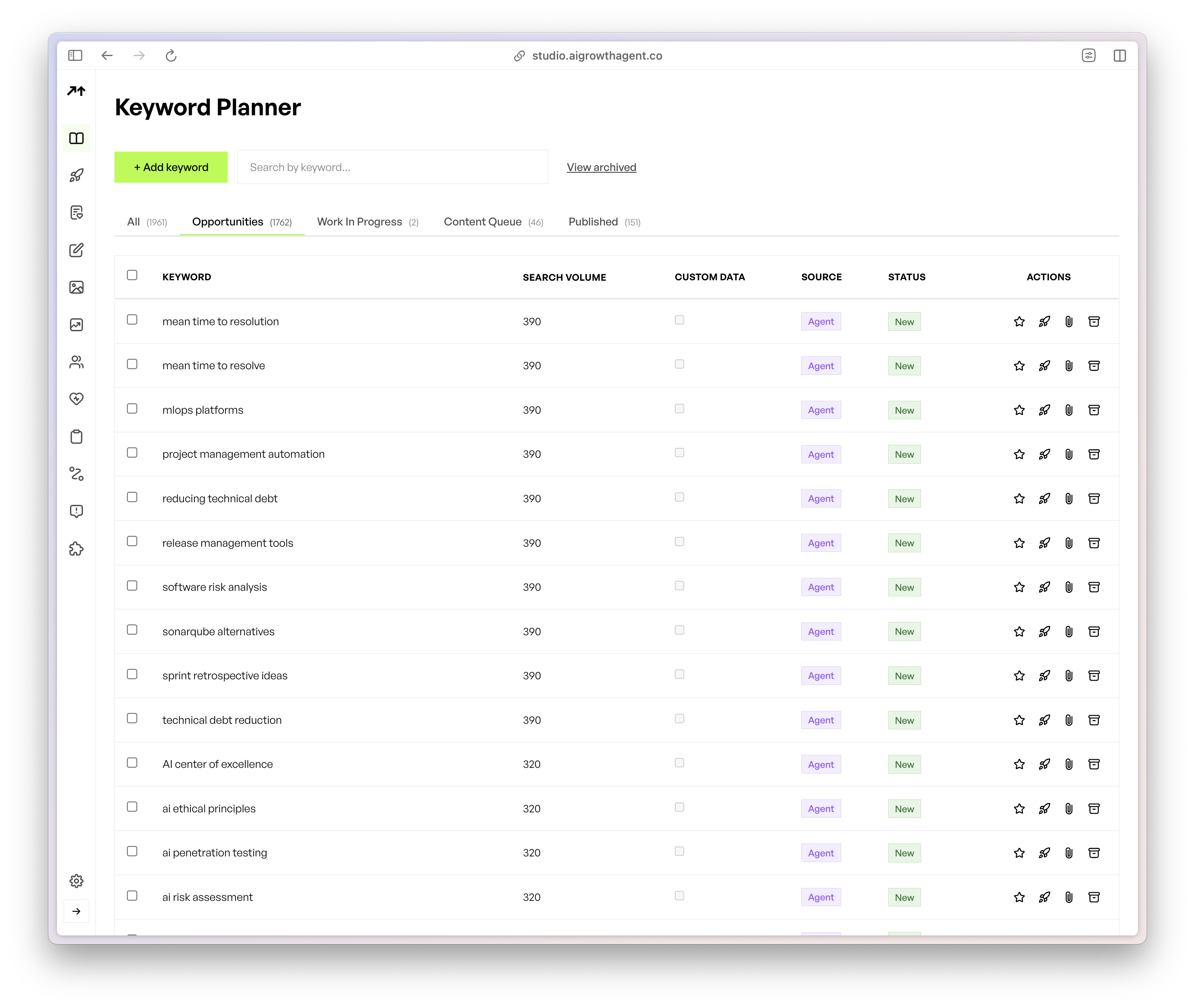
The Programmatic SEO Agent from AI Growth Agent evaluates tens of thousands of relevant search queries and converts them into an organized strategy of pillars and clusters tailored to AI-driven search patterns.
3.3 Use Autonomous Content Generation and Technical Execution
Scaling authority requires a balance of volume and quality. Programmatic content systems need to handle research, drafting, quality checks, and technical setup so teams can focus on strategy and review.
The pSEO Content Agent from AI Growth Agent manages the full content lifecycle:
- Strategy and briefing: Creates structured briefs for each asset based on clusters and user intent.
- Research: Draws from your Company Manifesto and vetted web sources to assemble accurate context.
- Drafting: Produces comprehensive content, from shorter tactical pieces to long-form pillar pages.
- Fact-checking: Cross-checks key points against multiple reputable references.
- Technical engineering: Applies schema markup, metadata, and other optimization steps to support AI indexing.
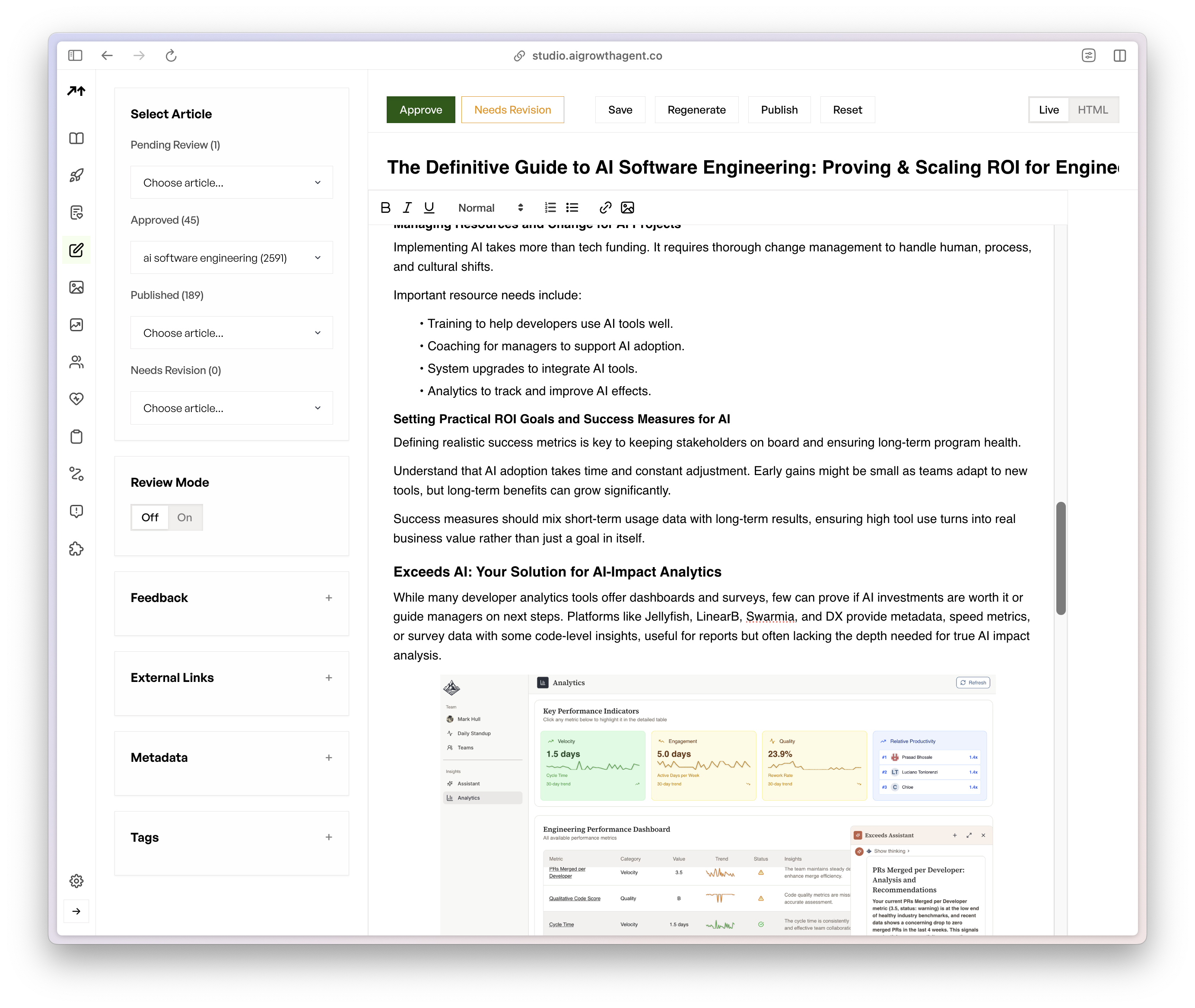
Teams can also enrich content with on-brand visuals. The agent accepts product images, diagrams, and other media and places them where they add context for readers.
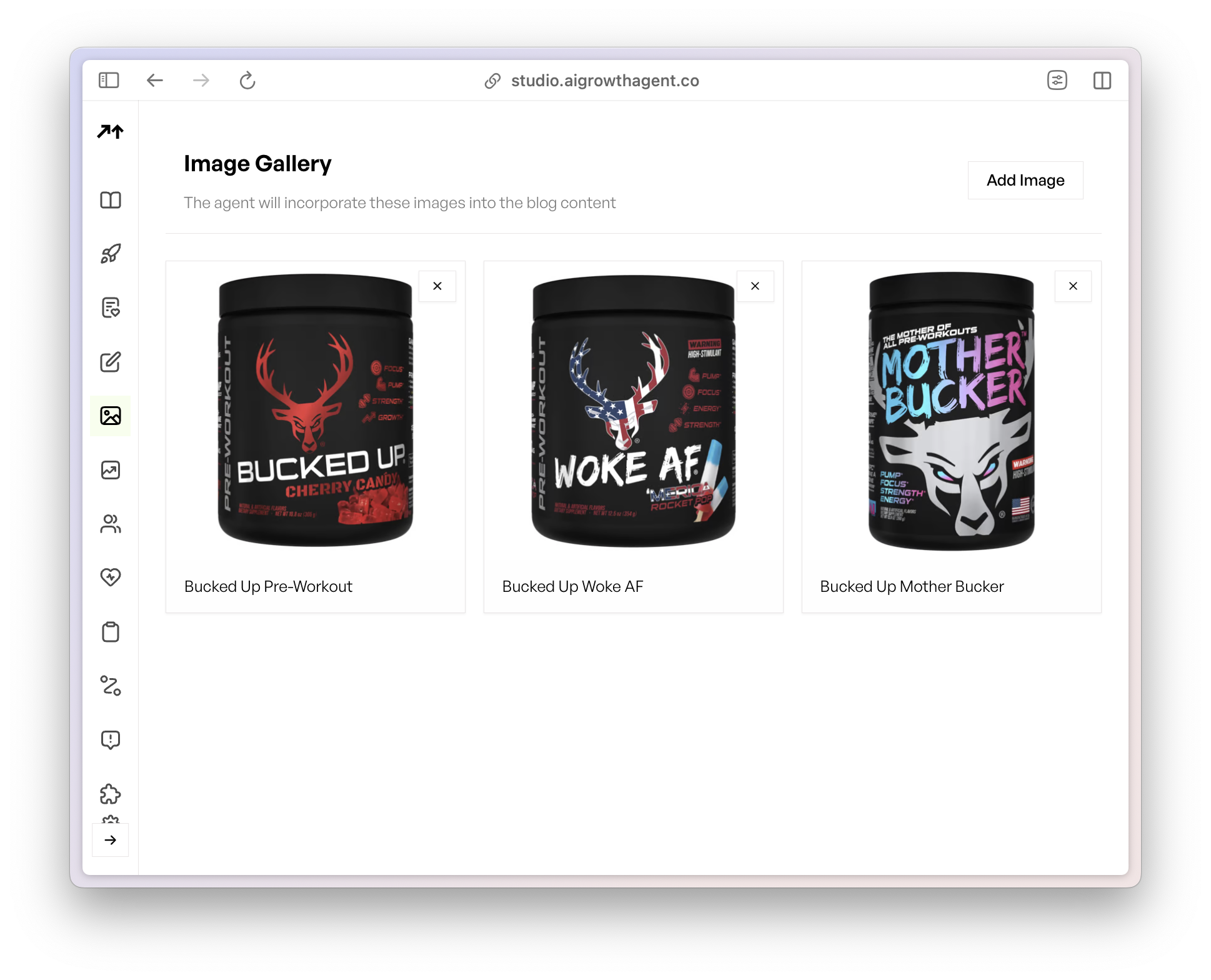
Additional capabilities include multi-tenant deployment for managing multiple brands, real-time content injection for emerging topics, and automation that converts structured data sources into content at scale.
Step 4: Monitoring and Adapting with AI Search Intelligence
4.1 Track AI Visibility and Citation Metrics
New performance metrics help teams understand how AI tools surface their content. Useful measures include frequency of AI Overview appearances, citation rates, and time-to-citation after publishing, along with cross-platform tracking of mentions.
Monitor these AI authority indicators:
- AI citation frequency: How often AI tools like ChatGPT, Gemini, and Perplexity cite your content.
- Featured snippet capture: How frequently your pages appear in AI-generated summaries.
- Time-to-citation: The typical time from publication to first AI reference.
- Brand mention tracking: How often your brand name appears in AI responses across tools.
- Query coverage: The share of priority queries where your content is present in AI results.
4.2 Build Feedback Loops for Continuous Optimization
Consistent monitoring supports iterative improvements to content strategy. AI search evolves quickly, so brands benefit from tools that highlight where they are visible, where they are missing, and which URLs drive the most AI engagement.
The AI Search Monitor from AI Growth Agent provides this type of intelligence through features such as:
- Real-time heatmaps: Visual dashboards that show how keywords index across AI platforms.
- Citation analytics: URL-level reporting on which pages receive the most citations and direct quotes.
- Crawl statistics: Logs of crawler activity from Google, ChatGPT, and Perplexity bots.
- Performance integration: Connections with Google Search Console to align AI visibility with traffic performance.
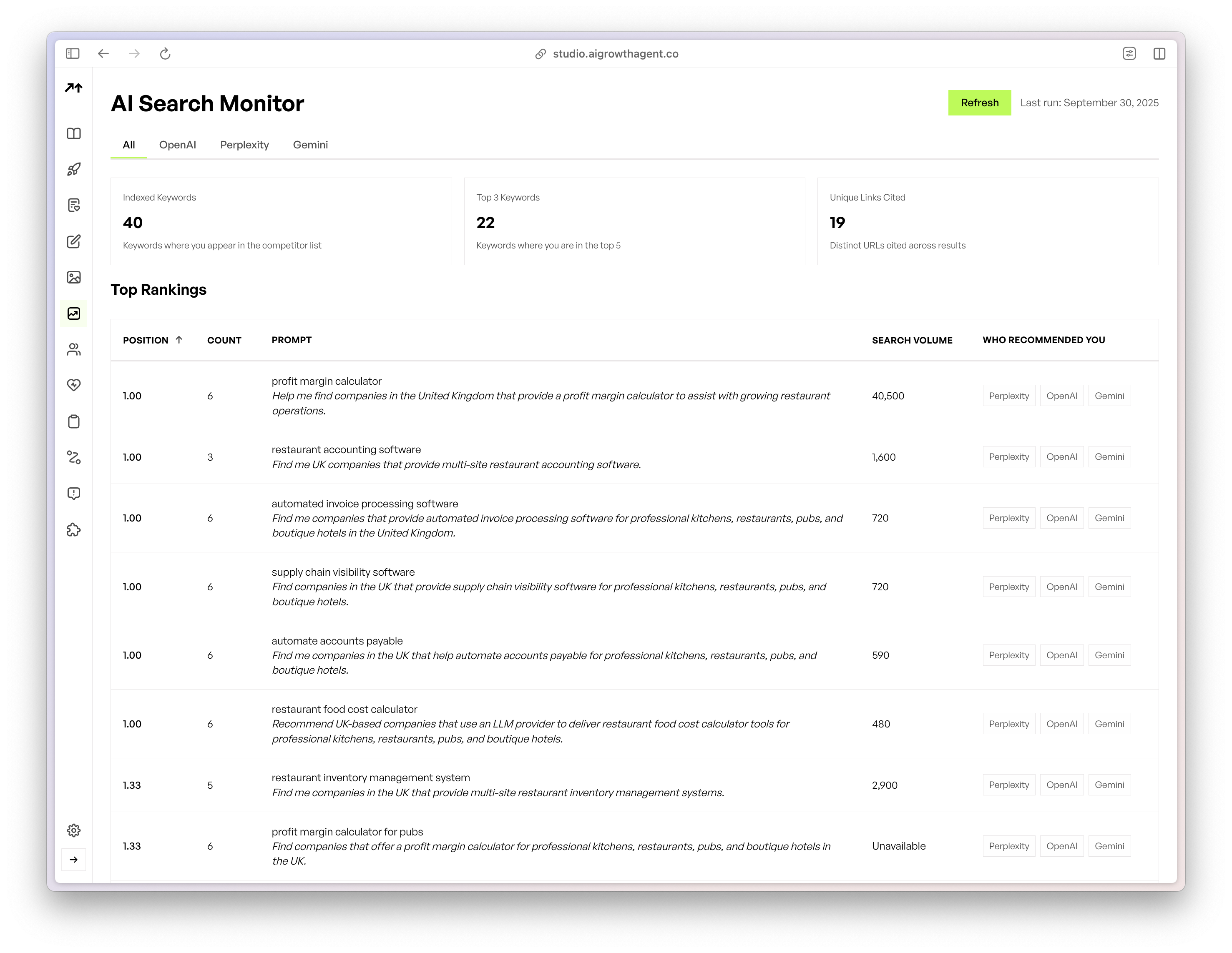
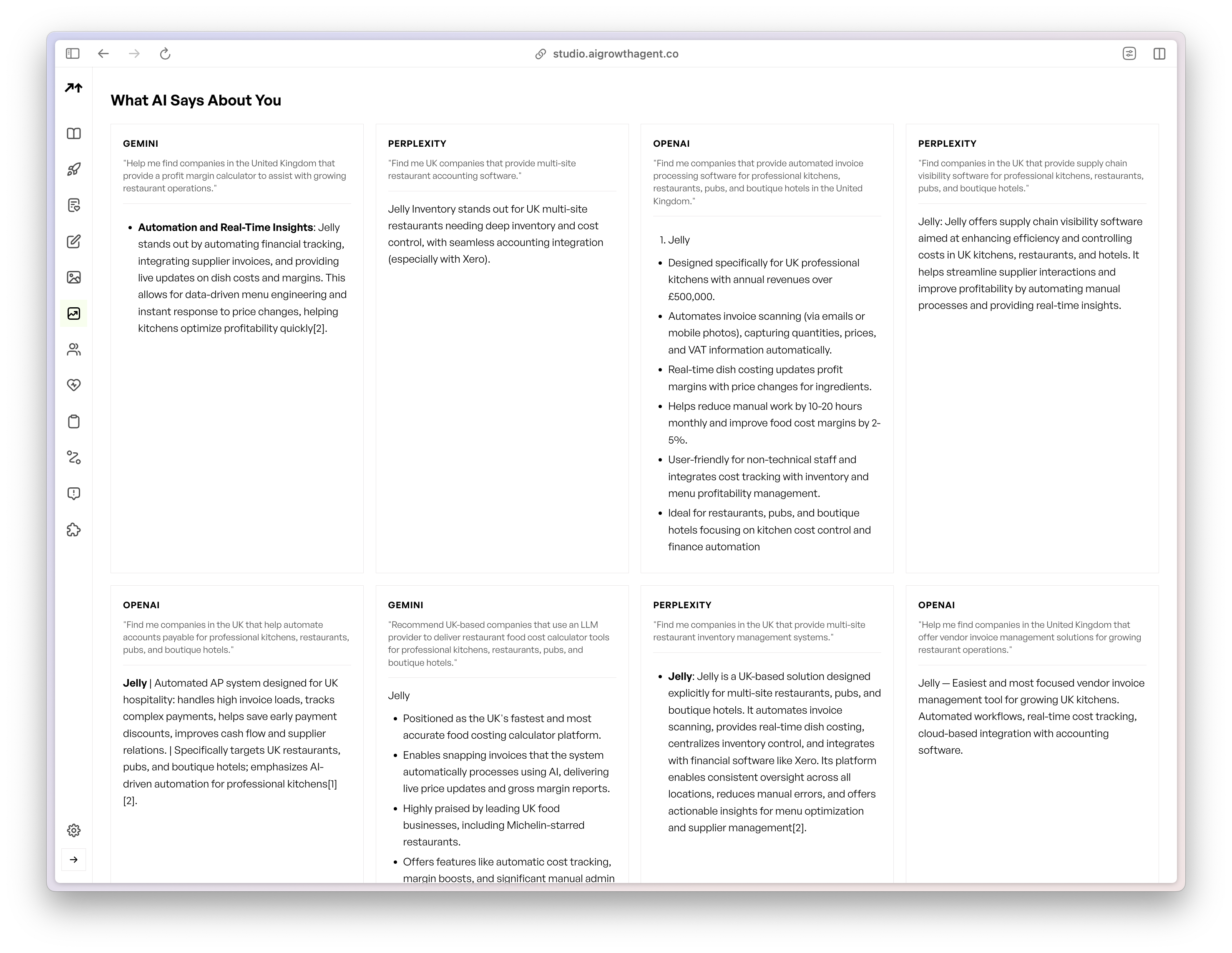
Marketing leaders who want a clearer view of AI-era authority can schedule a demo to see how this monitoring fits into their analytics stack.
Practical Applications and Success Stories: Real-World AI Authority
Programmatic SEO for AI authority already produces measurable outcomes for brands that adopt it. Teams that implement an AI-first content strategy often see improvements in citation rates, AI visibility, and organic traffic quality.
AI Growth Agent Success Stories
Exceeds AI: Within three weeks of launching programmatic content, Exceeds AI began appearing in Google AI Overview and Gemini snapshots for core keywords. They are now referenced across ChatGPT, Google AI Overview or Gemini, and Perplexity for queries related to AI performance review tools for engineers.
BeConfident: Competing in the English learning market, BeConfident saw programmatic content indexed quickly. Within weeks, Google AI Overview or Gemini highlighted the app as a recommended English learning solution in Brazil.
Bucked Up: Three weeks after publishing programmatic content, Bucked Up appeared as a cited protein soda brand in ChatGPT and emerged as a leading citation for high-intent searches such as “best protein soda.”
Gitar: In under two months, Gitar became a frequent reference for AI-powered CI or CD automation, with consistent citations for queries like “fix broken CI builds automatically” and “best self-healing software for developers.”
Advanced Considerations: Next-Level AI Authority Strategies
Mature AI content programs can pursue more advanced tactics to strengthen their position. These strategies require more technical depth but can create durable advantages in how AI tools perceive and cite a brand.
Multi-platform content syndication: Extend programmatic content into industry forums, professional networks, and specialized databases that AI systems often use as training or reference material.
Real-time trend capture: Set up workflows that generate expert commentary on breaking news and emerging topics so your content can capture new search interest quickly.
Proprietary data assets: Turn internal data, customer insights, and original research into long-form content and reference pages that provide unique signals for AI.
Cross-brand authority networks: For organizations with multiple products or portfolio companies, design interconnected content ecosystems that reinforce authority while preserving distinct brand identities.
Marketing leaders who plan to implement enterprise-level programmatic SEO can book a strategy session to explore how AI Growth Agent supports these more advanced use cases.
Frequently Asked Questions on AI-Era Domain Authority
What is Generative Engine Optimization (GEO) and how does it differ from traditional SEO for domain authority?
Generative Engine Optimization (GEO) is an approach focused on how AI tools extract, summarize, and cite content. Traditional SEO emphasizes keyword rankings and click-through rates in search results. GEO, by contrast, emphasizes structured, fact-rich content that AI systems can easily parse, segment, and recombine into direct answers. The focus shifts from broad domain metrics to answer-level quality and clarity.
How can smaller domains compete effectively for AI citations against larger, established websites?
Smaller domains can compete by narrowing their focus and pursuing deep topical authority within a defined niche. AI search engines evaluate the relevance and quality of content for a specific query, not only overall domain strength. Niche brands can win citations by addressing user intent more completely, building structured topic clusters, and optimizing content for AI readability and extraction.
Why are traditional SEO agencies and basic AI writing tools insufficient for maintaining domain authority in the AI era?
Traditional SEO agencies typically rely on manual production processes that do not scale to AI-era content demands. Producing only a few articles per month makes it difficult to cover the full range of queries that AI systems consider. Basic AI writing tools generate raw text but do not manage strategy, technical optimization, or AI-focused formatting. Neither approach alone delivers the schema, clustering, monitoring, and automation required to compete effectively for AI citations.
How does AI Growth Agent ensure content quality and brand voice consistency when generating content programmatically?
AI Growth Agent uses a Company Manifesto system to encode brand voice, positioning, and expertise. This manifesto is created during onboarding sessions with professional journalists and then applied as a reference for programmatic content. The pSEO Content Agent layers in research validation, fact-checking, and iterative refinement based on client feedback. The AI Growth Agent Studio gives editors full control to review, adjust, and approve content so the system learns the brand’s expectations over time.
Is it still important to build traditional backlinks for AI search ranking?
Backlinks continue to play a role in AI-era authority, but quality and relevance matter more than volume. AI models still use links and mentions as signals of credibility. Links from respected industry publications, academic institutions, and professional communities help strengthen those signals and support both traditional and AI-driven visibility.
Conclusion: Use Programmatic SEO to Secure AI-Era Authority
AI-driven search has changed how authority is built and maintained. Brands that rely only on manual content production and legacy domain metrics risk fading from view as AI-generated content volume grows.
Modern optimization focuses on structured, fact-rich, clearly sourced content that AI tools can extract and reuse. Effective strategies now combine E-E-A-T optimization, topic clustering, schema implementation, and AI-specific monitoring.
Manual methods alone struggle to deliver the coverage, freshness, and structure that AI systems look for when assembling answers. Brands that invest in programmatic architectures put themselves in a stronger position to earn consistent AI citations and maintain visible authority.
AI Growth Agent supports this shift with a Programmatic SEO Agent that automates research, clustering, content creation, and technical setup while preserving brand standards. The platform provides the infrastructure needed to manage pSEO at scale and to track performance across AI search environments.
Organizations that adapt early to AI-era search dynamics can shape how models perceive their expertise. Marketing leaders who want to strengthen their position in this environment can book a strategy session with AI Growth Agent and explore how autonomous content workflows can support their domain authority goals.
