This guide explains how Perplexity AI evaluates and cites content, and how marketing leaders can adjust SEO strategies for AI search. What you’ll learn in this article:
- AI search platforms like Perplexity, ChatGPT, and Google AI Overviews rely on source trustworthiness, semantic clarity, and freshness more than traditional keyword rankings.
- Perplexity can surface specialized, low-traffic sites when they provide clear, expert answers, but it concentrates citations on domains that publish consistently across topic clusters.
- Programmatic SEO is a practical way to meet AI search demands for scale, structure, and technical optimization that manual content workflows and basic AI tools rarely achieve.
- Brands that focus on structured, list-based, and data-rich content, supported by strong technical SEO and crawlability, improve their chances of Perplexity citations.
- Case studies from Exceeds AI, BeConfident, Bucked Up, and Gitar show how programmatic SEO can establish AI citation authority within weeks.
- Marketing leaders at established brands can use AI Growth Agent to engineer scalable, AI-ready content architectures and monitor how AI systems describe their company.
How AI search changes visibility beyond traditional Google indexing
AI search platforms are changing how brands earn visibility and authority. Traditional search engines relied on predictable rules: optimize for keywords, build backlinks, and climb rankings.
Perplexity AI follows a different model. Rather than only indexing and ranking static pages, Perplexity dynamically gathers and synthesizes details into natural language answers with real-time retrieval. This behavior means the system evaluates content through a different lens, with context, source reliability, and clear answers taking priority over simple keyword metrics.
The exponential growth of AI-generated content is compressing digital footprints. Millions of new pages appear each day, which dilutes the visibility of existing assets. For premium brands, publishing one or two manually crafted articles per month is rarely enough to stay visible in AI-driven discovery.
Competitive brands treat programmatic content velocity as a baseline. AI search engines reward recency, depth, and consistent structure at a scale that manual creation cannot sustain. Teams that will stand out are building content architectures that publish high-quality, authoritative material at machine-level speed while maintaining the technical quality needed for AI indexing.
The cost of inaction is material. If a brand does not provide enough clear, structured data points for AI search engines, these systems will favor other sources. In AI citations, absence does not only mean invisibility. Competitors gain the opportunity to define the narrative for your category.
Ready to adapt your strategy to the AI search era? Schedule a consultation session to learn how AI Growth Agent can help improve your Perplexity AI search presence.
How Perplexity AI evaluates, ranks, and cites content
Why source trustworthiness and authority drive AI citations
Perplexity AI’s citation behavior differs from traditional search engines. Google’s PageRank system weighs backlink quantity and domain authority heavily. Perplexity places more weight on source trustworthiness, original research, expert commentary, and authoritative third-party mentions.
The system evaluates authenticity and expertise, not only popularity. Sources that provide original data, quote recognized experts, or earn credible third-party references gain more citation opportunities. This shift reduces the dominance of raw domain authority and backlink size as stand-alone success factors.
Perplexity still shows more overlap with Google’s organic rankings than many other large language models, with roughly 25–30 percent domain overlap and 20 percent URL overlap. Core SEO fundamentals still matter, but Perplexity’s AI-driven synthesis introduces new layers that reward different content traits.
Many sources cited by Perplexity and ChatGPT are sites with few referring domains and relatively low traffic, unlike the broader distribution seen in Google and Bing. Highly relevant, specialized content can earn citations even with modest traditional SEO strength.
The distribution of citations is also more concentrated. Perplexity and ChatGPT rely more heavily on a limited set of domains, with the top three domains providing over 17 percent of Perplexity citations. Consistent citation therefore depends on both content quality and systematic, ongoing publishing across multiple related topics and keywords.
How semantic clarity and depth support LLM synthesis
Perplexity AI’s large language model favors content with semantic richness and complete coverage of a topic. Traditional search systems often weighed keyword density and on-page optimization most heavily. Perplexity evaluates the clarity and depth of the explanations that the content delivers.
The synthesis engine rewards content that provides direct, concrete answers. Perplexity focuses on synthesizing information for accuracy and clarity, with emphasis on context and source reliability rather than pure keyword and backlink metrics. Content needs to support AI comprehension and synthesis, not only human reading.
Clear structure improves the model’s ability to handle complex topics. Content that uses logical headings, orderly sections, and thorough coverage of related ideas tends to perform better. The AI favors content that it can parse easily and convert into coherent answers.
Technical depth also matters. Technical and scientific topics receive a boost in Perplexity’s ranking systems. Content that demonstrates genuine subject-matter expertise and accuracy gains more visibility than surface-level articles.
Why real-time retrieval and freshness influence visibility
Real-time retrieval and freshness are core traits of Perplexity AI. Traditional search engines rely more on cached indexes. Perplexity dynamically gathers and synthesizes information with live retrieval, which makes recent updates and new content especially important.
Perplexity’s handling of freshness includes several layers. Early clicks affect long-term visibility through “new post performance” metrics, and frequent updates slow down loss of visibility tied to “time decay” effects. Strong performance at launch and ongoing maintenance both matter.
Recently published or updated content gains a timing advantage. Fresh material can earn citations quickly, while older assets tend to lose ground unless brands maintain and improve them.
Marketing teams need to adjust their content life cycle to match this environment. Leaving evergreen content untouched for years is less effective for AI citation. Brands benefit from planned update cycles, regular refreshes, and version improvements to keep content relevant in Perplexity’s real-time system.
Discover how to keep your content fresh and authoritative for Perplexity AI. Schedule a demo with AI Growth Agent to enhance your Perplexity AI search presence.
Programmatic SEO for scalable authority in AI search
AI search requirements have outgrown traditional content production models. The scale, speed, and technical depth needed to earn consistent citations in Perplexity AI are difficult to reach with manual workflows, conventional SEO agencies, or basic AI writing tools. Programmatic SEO offers an engineered approach that can meet these demands at scale while preserving quality.
Programmatic SEO shifts focus from individual articles to content systems. Instead of drafting every piece manually, programmatic setups generate coordinated content ecosystems that build authority across complete topic clusters. This structure helps brands reach the content velocity and consistency that AI search engines tend to reward, while still reflecting brand voice and expertise.
Traditional SEO and content marketing methods often lack the throughput and technical rigor that AI search expects. Manual SEO teams may create strong individual pieces but struggle to cover hundreds of relevant subtopics. Many generic AI tools automate writing but do not apply the schemas, internal linking, and AI-oriented formatting that help with synthesis and citation.
AI Growth Agent is built to address these specific gaps as a Programmatic SEO Agent focused on AI search. The system treats content as an engineering problem, with automation for keyword clustering, content generation, internal linking, schema deployment, and publishing.

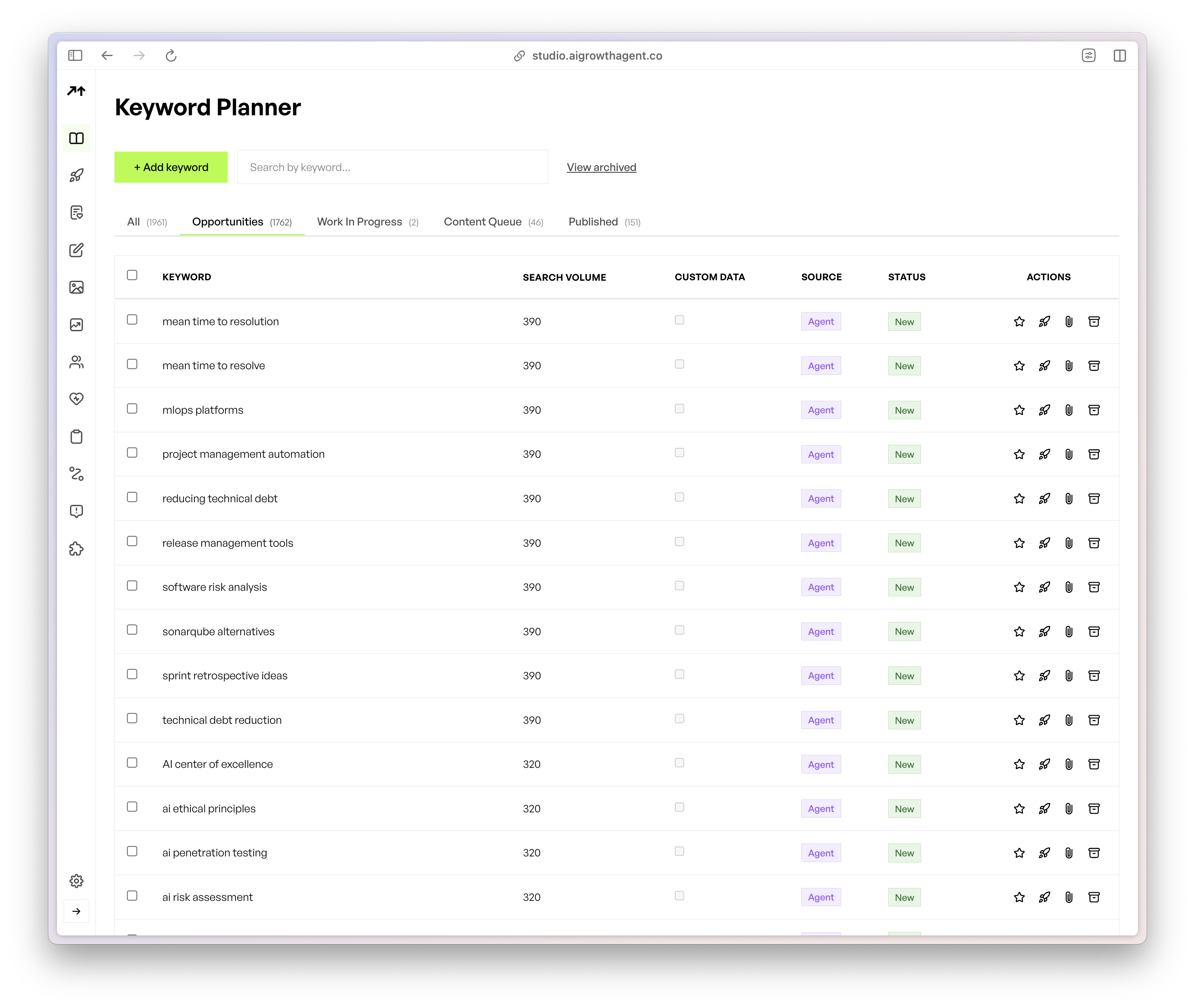
AI Growth Agent uses keyword planning and clustering to design full topic maps, then populates those maps with structured, AI-ready content.

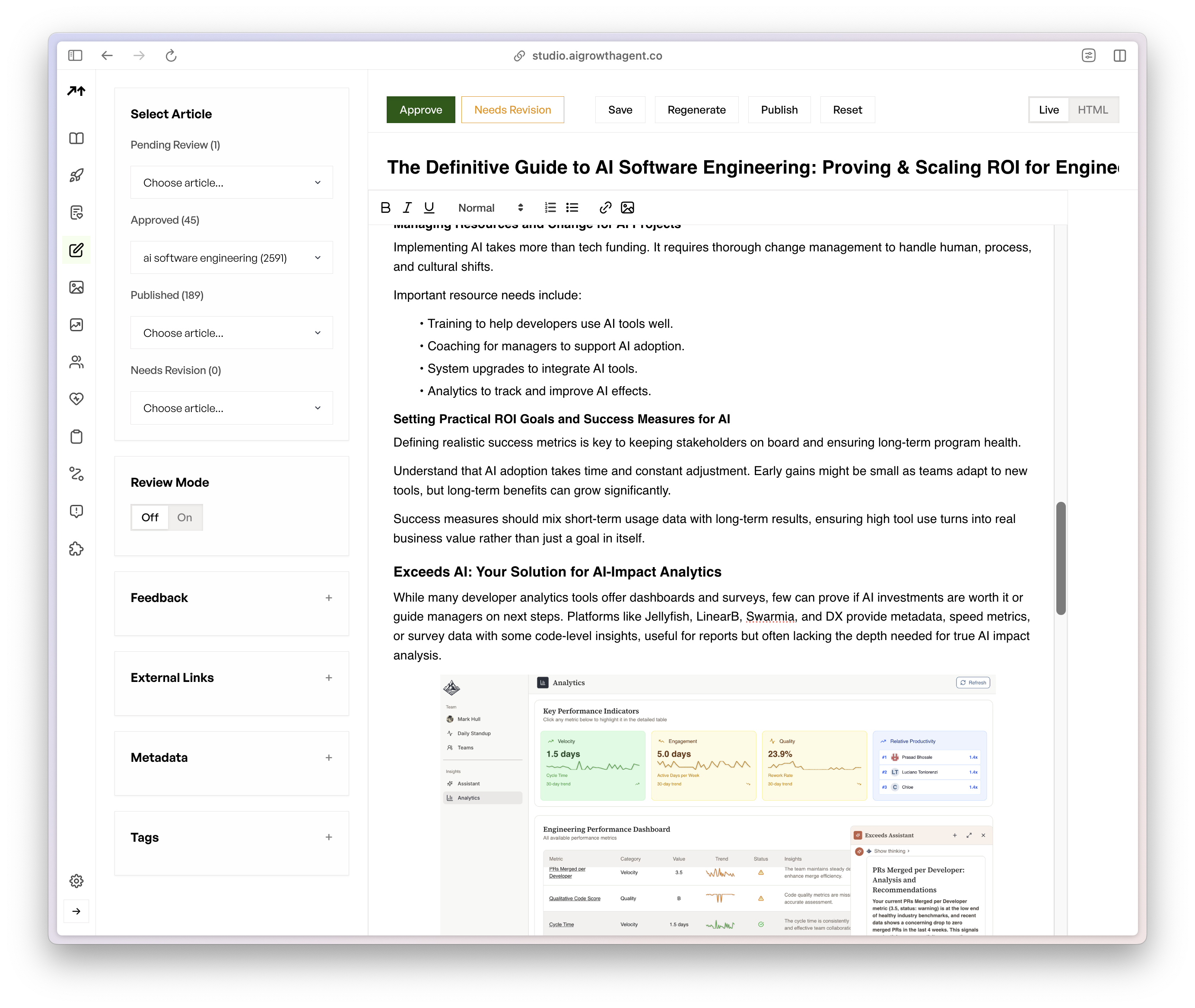
The platform also includes a rich text content editor to review, adjust, and approve programmatically generated drafts before publishing.
|
Feature |
AI Growth Agent (Programmatic SEO) |
Traditional SEO Agencies |
Basic AI Content Tools |
|
Content velocity |
High, daily publishing |
Limited, often monthly |
High, but unstructured |
|
Technical SEO integration |
Automated, advanced schema, LLM.txt support |
Manual, basic schema |
Minimal or none |
|
Authority and citation focus |
Designed for AI citation |
Primarily keyword focused |
Little or no citation focus |
|
Cost efficiency |
Scalable and automated |
High, billable hours |
Tool cost only, but manual effort still required |
|
Customization and brand voice |
Configured deeply via brand guidelines and manifesto |
Depends on individual writers |
Driven by short prompts |
Programmatic SEO aligns well with the technical standards of AI search engines. Perplexity AI and similar systems favor structured data, semantic clarity, and technical optimization. Perplexity uses its own crawler, PerplexityBot, plus unnamed third-party crawlers to source and index content, so content must work across several AI indexing systems at once.
AI Growth Agent addresses these needs through automation. The platform applies advanced schema markup, optimizes metadata for AI comprehension, and supports formats such as LLM.txt files and Model Context Protocol integrations so AI systems can access structured context from your content.
Scale requirements reinforce the need for an engineered approach. To build strong authority in AI search, brands often need coverage across hundreds or thousands of related keywords and topic clusters. Manual processes struggle with this level of scope. Many basic AI tools also fall short because they do not design coherent content architectures or maintain technical standards across large libraries.

AI Growth Agent can also work with brand images and visual assets so articles and landing pages stay aligned with design standards while scaling output.
See AI Growth Agent in action and review its capabilities. Schedule a demo today to improve your Perplexity AI search presence.
Practical tactics for earning Perplexity AI citations
Designing linkable, list-based content that AI can reuse
Perplexity AI favors content formats that are easy to parse and reuse in synthesized answers. Certain structures consistently raise citation likelihood, especially highly organized formats.
Brands that publish data-rich resources, infographics, or unique studies often see higher citation rates across both traditional and AI-powered search engines. Well-researched assets become reference points for a topic.
List-based formats are particularly effective in Perplexity. Perplexity gives strong weight to list content with clear rankings and minimal unnecessary narrative, similar to Google’s handling of featured snippets and top lists. This structure supports quick extraction and reformatting in answer summaries.
Brands see better results when they organize information into ranked lists, comparison tables, or step-by-step guides. These formats map well to common AI search intents, such as “best tools,” “top options,” or “how to evaluate” queries.
Placement within authoritative list articles and comparison tables, whether on your own site or on trusted third-party sites, raises the likelihood of Perplexity citations. Link-building and PR strategies that target high-quality lists can therefore support AI visibility along with traditional SEO.
Building domain and topical authority for AI visibility
Domain authority still influences Perplexity AI, but the platform looks at a broader set of authority signals than many legacy search engines. Important Perplexity ranking inputs include overall site authority from backlinks, online reputation from reviews and ratings, and existing organic search rankings.
The link between Google visibility and Perplexity citations creates a dual benefit. Raising Google domain authority and publishing SEO-oriented thought leadership on a regular schedule improves Perplexity visibility, because its AI often references high-ranking results and trusted domains.
Topical authority is just as important as domain strength. Perplexity values cluster-building through interlinked content and semantic relevance through depth and completeness. A single strong article is helpful, but clusters of interrelated content send a clearer authority signal.
Effective topical authority strategies focus on entire subject areas. Rather than chasing isolated keywords, successful teams plan pillars and supporting pieces that answer the full range of user needs in a domain. This approach gives Perplexity more context for synthesis and helps the system recognize your expertise.
Strengthening technical SEO and crawlability for AI bots
Technical SEO for AI search often goes beyond the baseline standards used for traditional search. Perplexity relies on its PerplexityBot crawler and additional third-party crawlers to discover and index content, so sites need to work well for multiple crawling systems.
Comprehensive schema markup is central for AI comprehension and synthesis. Traditional SEO might add basic schema for rich snippets. AI optimization tends to benefit from more complete structured data that clarifies entities, relationships, and context. Examples include article schema, FAQ schema, product schema, and structured markup for lists and comparisons.
LLM.txt files are an emerging tool tailored to AI crawlers. These files can communicate which sections of a site deserve priority, how often content changes, and how AI systems should interpret certain areas. AI Growth Agent includes LLM.txt implementation within its programmatic setup to help guide AI crawlers more directly.
Metadata optimization must also account for AI parsing behavior. Clear, descriptive title tags, meta descriptions, and heading structures help AI systems understand the main purpose of each page. Additional hints, such as section labels and consistent heading hierarchies, can improve how content appears in synthesized answers.
Underlying site performance remains important. Fast load times, mobile-friendly design, clean URL structures, and consistent internal linking all support efficient AI crawling. These elements matter even more in real-time systems where AI engines prefer quickly accessible, well-structured pages.


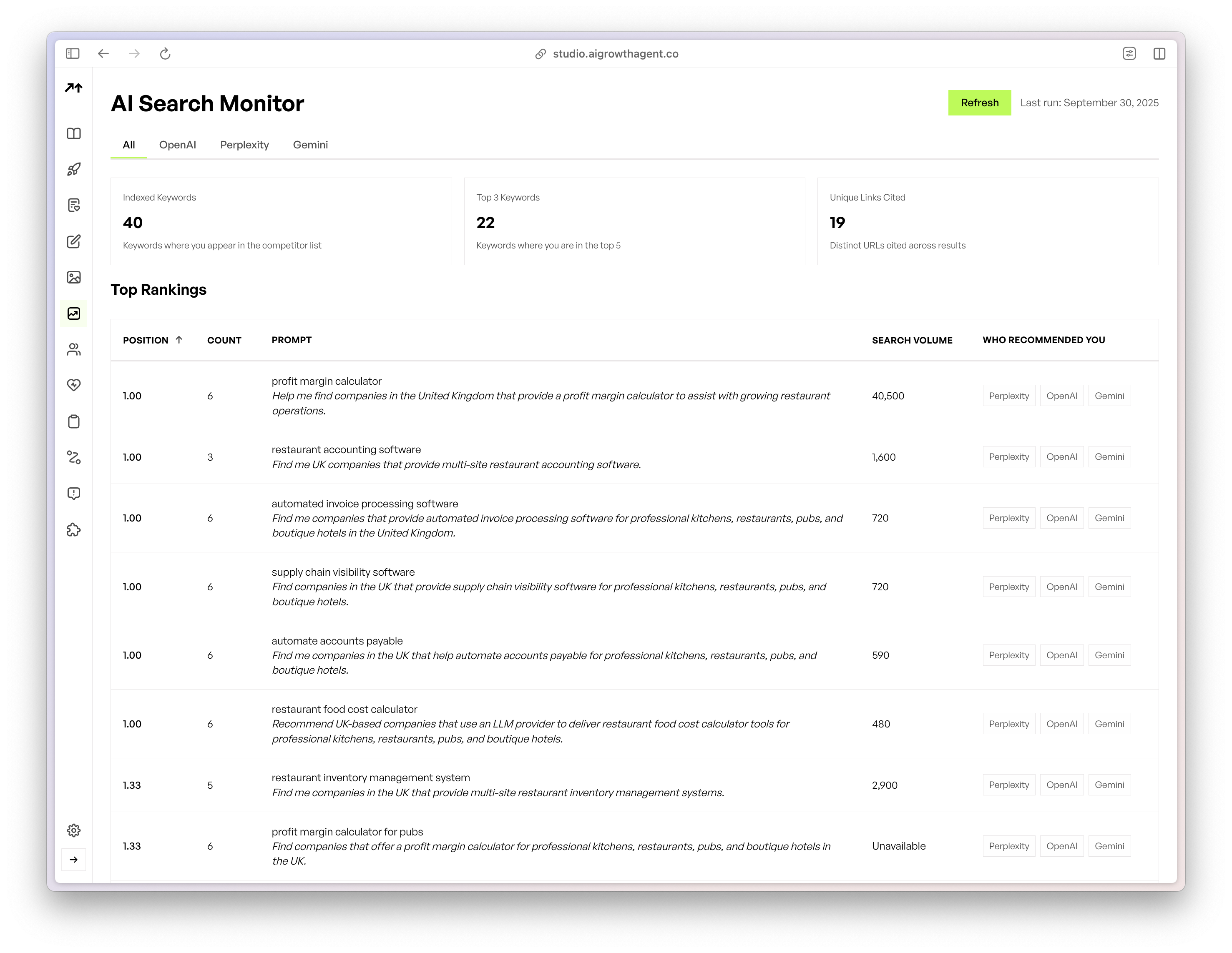
AI Growth Agent includes an AI Search Monitor that shows how tools like Perplexity, ChatGPT, and Gemini describe your brand, so teams can validate whether technical and content changes are influencing AI outputs.
Do not guess. Build a technical foundation that supports AI visibility. Schedule a consultation session to elevate your Perplexity AI search presence.
Programmatic SEO in practice: Examples of AI citation gains
Exceeds AI: Performance reviews for engineers
Exceeds AI operates in the performance management space for engineering teams. The company needed to compete with established tools that already had strong brand awareness.
Within two weeks of implementing AI Growth Agent’s programmatic SEO strategy, Exceeds AI was recommended by Perplexity as a top alternative for performance review tools focused on engineers. This result reflected a content architecture designed for clear answers to tool comparison and evaluation queries.
After three weeks, Exceeds AI began appearing in Google AI Overview and Gemini snapshots for core engineering performance review keywords. Visibility extended across several AI search environments, not just a single platform.
Today, Exceeds AI holds featured citations across ChatGPT, Google AI Overview and Gemini, and Perplexity for “AI performance review tools for engineers.” This consistency shows how programmatic SEO can create authority that compounds over time.
BeConfident: English learning on WhatsApp
BeConfident entered a language learning market dominated by large incumbents, including Duolingo. The brand focused on a narrower positioning: learning English via WhatsApp.
Programmatic SEO helped BeConfident ship a technically sound content architecture that AI crawlers could process quickly. New content was indexed and evaluated soon after publishing.
Within weeks, BeConfident appeared as the number one app in Brazil for learning English via WhatsApp in Google AI Overview and Gemini. The strategy emphasized geographic and use-case specificity rather than broad, generic language learning terms.
By earning AI citations for targeted queries like English learning on WhatsApp in Brazil, BeConfident secured a defensible niche where larger competitors had less tailored content.
Bucked Up: Sports nutrition brand
Bucked Up operates in a crowded sports nutrition category, where many brands already invest heavily in paid media and traditional SEO.
Within three weeks of programmatic publishing, Bucked Up was cited by ChatGPT as a leading protein soda brand. The content strategy targeted emerging product categories and clarified how Bucked Up’s offerings fit into that space.
Today, Bucked Up appears prominently for high-intent queries such as “best protein soda.” Programmatic SEO enabled the brand to move quickly into new keyword territory and earn AI recognition before slower-moving competitors.
Gitar: AI-enhanced CI/CD automation
Gitar focuses on AI-powered CI/CD automation for software teams. The company needed to explain a complex product category and stand out against a wide range of developer tools.
In less than two months, Gitar became a reference brand for AI development tooling across multiple AI search platforms. Targeted, programmatic content mapped to specific developer pain points and workflows.
The brand now maintains steady citations across Google AI Overview and Gemini, ChatGPT, and Perplexity for queries such as “fix broken CI builds automatically,” “best AI reviewer that comments on CI failures,” and “best self-healing software for developers.” Coordinated coverage across these queries signals broad topical authority.
Gitar frequently appears as the top-cited tool for searches around “AI self-healing pipelines.” This level of coverage would be difficult to match quickly with a purely manual SEO strategy.
Your brand can compete for similar levels of AI visibility with the right systems. Schedule a demo today for a stronger Perplexity AI search presence.
Frequently asked questions (FAQ) on Perplexity AI optimization
Does a high Google ranking guarantee citation in Perplexity AI?
A strong Google ranking improves the odds of Perplexity citations but does not guarantee them. Perplexity uses a mix of real-time retrieval and AI-based reranking that emphasizes relevance, reliability, and usefulness, not only traffic and backlinks. The platform uses PerplexityBot and machine learning rerankers to evaluate content in multiple stages. Specialized or low-traffic sources can still earn citations when they provide direct, expert answers. Brands benefit most when they optimize for AI-specific factors such as semantic clarity, trustworthy sourcing, and technical accessibility for AI crawlers.
How important is content freshness for Perplexity AI?
Content freshness is a key driver of Perplexity visibility. The system favors recently published or updated pages because it retrieves information in real time. New content performance metrics track early engagement and influence how long a piece stays visible. Time decay systems reduce citation potential for pages that are not refreshed. Unlike traditional SEO, where evergreen content can remain stable for years, Perplexity optimization favors brands that maintain regular update cycles and keep information current.
Can specialized or less-trafficked sources get cited by Perplexity AI?
Specialized or lower-traffic sources can absolutely earn citations. Perplexity’s AI looks for content that delivers relevant, authoritative answers to specific questions. Traditional signals, such as high traffic or large backlink profiles, help but are not mandatory. Niche publishers that demonstrate deep expertise in a narrow domain can receive citations over larger, more general sites. The key is to offer unique insight, clear explanations, and structured content that the AI can extract and reuse.
What technical infrastructure is required for Perplexity AI optimization?
Optimizing for Perplexity AI usually requires a more advanced technical setup than basic SEO. Sites need to support PerplexityBot and other AI crawlers with a clean architecture, logical internal linking, and fast performance. Advanced schema markup, LLM.txt files, and AI-aware metadata all help systems interpret content correctly. Clear heading hierarchies, mobile optimization, and straightforward URLs support real-time retrieval. Model Context Protocol integrations can add another layer by allowing AI tools to pull structured context directly from your systems.
How does programmatic SEO differ from traditional SEO for AI search optimization?
Programmatic SEO focuses on automated, system-driven content creation and optimization, while traditional SEO tends to rely on manual writing and individual page updates. For AI search, programmatic SEO helps brands reach higher content velocity and maintain a consistent structure across large topic clusters. Automated workflows can attach schema, update internal links, manage LLM.txt, and enforce AI-specific formatting rules at scale. Traditional SEO teams can still provide strategy and oversight, but programmatic systems handle much of the repetitive execution needed for AI citation success.
Get more answers about competing in AI search. Schedule a consultation session with AI Growth Agent to master Perplexity AI search.
Conclusion: Use programmatic SEO to secure authority in the AI era
AI-first search is changing the foundation of digital marketing. As Perplexity AI and other intelligent search tools reshape how people find and evaluate information, traditional visibility tactics lose some of their impact. Manual content workflows often struggle to reach the scale and technical maturity that AI citation now requires.
The ranking factors that guide Perplexity AI citations, including source trustworthiness, semantic clarity, real-time freshness, and AI-compatible technical structure, align naturally with a programmatic approach. These systems favor content that is comprehensive, structured, and regularly updated, which can be difficult to maintain solely with human processes.
AI Growth Agent provides a focused solution for this environment as a Programmatic SEO Agent aimed at AI citation success. It builds both the technical infrastructure and the content volume needed to establish authority across AI search platforms. The examples of Exceeds AI, BeConfident, Bucked Up, and Gitar illustrate how programmatic SEO can deliver speed, scale, and consistent quality.
Marketing leaders at established brands face a strategic decision. Teams that adapt to programmatic requirements for AI search can shape their category narrative. Teams that rely only on legacy approaches risk leaving that narrative to competitors that publish faster and more systematically.
The brands that will lead in AI search are those that combine engineered scale with authentic expertise. They deploy systems that identify opportunities, generate authoritative content, and optimize documentation for AI comprehension at pace.
AI systems will continue to generate answers about your category. AI Growth Agent helps your company become one of the main sources those systems rely on. If you are a premium brand with a strong foundation and want to improve your presence in Perplexity and other AI search tools, book a strategy session with us to improve your Perplexity AI search presence.