


Key Takeaways
- AI search and zero-click responses are reducing traditional organic traffic, so every visit that reaches your site has more impact on conversions.
- Brands without structured, authoritative content risk losing AI citations and share of voice to competitors in key discovery moments.
- Programmatic SEO helps you publish at the scale and depth AI systems need to confidently reference your site across many related queries.
- Technical elements such as schema markup, LLM.txt, and Model Context Protocol improve how AI systems parse, understand, and surface your content.
- AI Growth Agent automates this workflow end to end so you can grow AI-driven conversions in 2026; schedule a demo to see it in action.
The Looming Threat: Why AI Search is Shrinking Your Digital Footprint
The Reality of Zero-Click AI Overviews and Redefined Funnels
AI search usage is rising fast. Daily AI search usage in the US nearly doubled in 2025, moving from 14% in February to 29.2% in August, and reshaping how people discover products and services.
This shift changes funnels. Google’s zero-click AI responses now answer many queries directly, which can reduce your visibility if your brand is not cited, even though traditional results and other search features still drive traffic.
Users often split tasks across tools, using Google for transactions and ChatGPT for exploration, so paths to purchase fragment in ways that traditional SEO alone cannot fully cover.
The Limitations: Why Traditional SEO and Basic AI Tools Fail for AI Citation
Most traditional SEO agencies follow a manual model that does not match AI search scale. They are slower, more expensive, and rarely built to ship the volume of structured content AI systems now index. Most teams that publish one or two strong articles each month cannot compete with programmatic libraries that cover thousands of related queries.
General-purpose AI tools can draft text but often miss the structured data and formatting that support AI citation. Your team still has to design the strategy, apply schema, and manage publishing, which increases workload and leaves gaps that AI systems may not interpret correctly.
The Risk of an Invisible Brand: Losing AI Reputation & Share of Voice
AI-generated content grows every day. Your company’s voice becomes quieter in relative terms if you do not counter that volume with a structured, programmatic plan.
When your site lacks clear evidence for AI to reference, AI systems rely on competitor content instead. Their perspective can become the default answer your buyers see. In local and service searches, AI tools often highlight only 3 to 5 providers, so inclusion in that short list can strongly influence revenue.
The Solution: Programmatic SEO – Ensuring AI Citation for Growth
Programmatic SEO: Building Authority at AI Scale
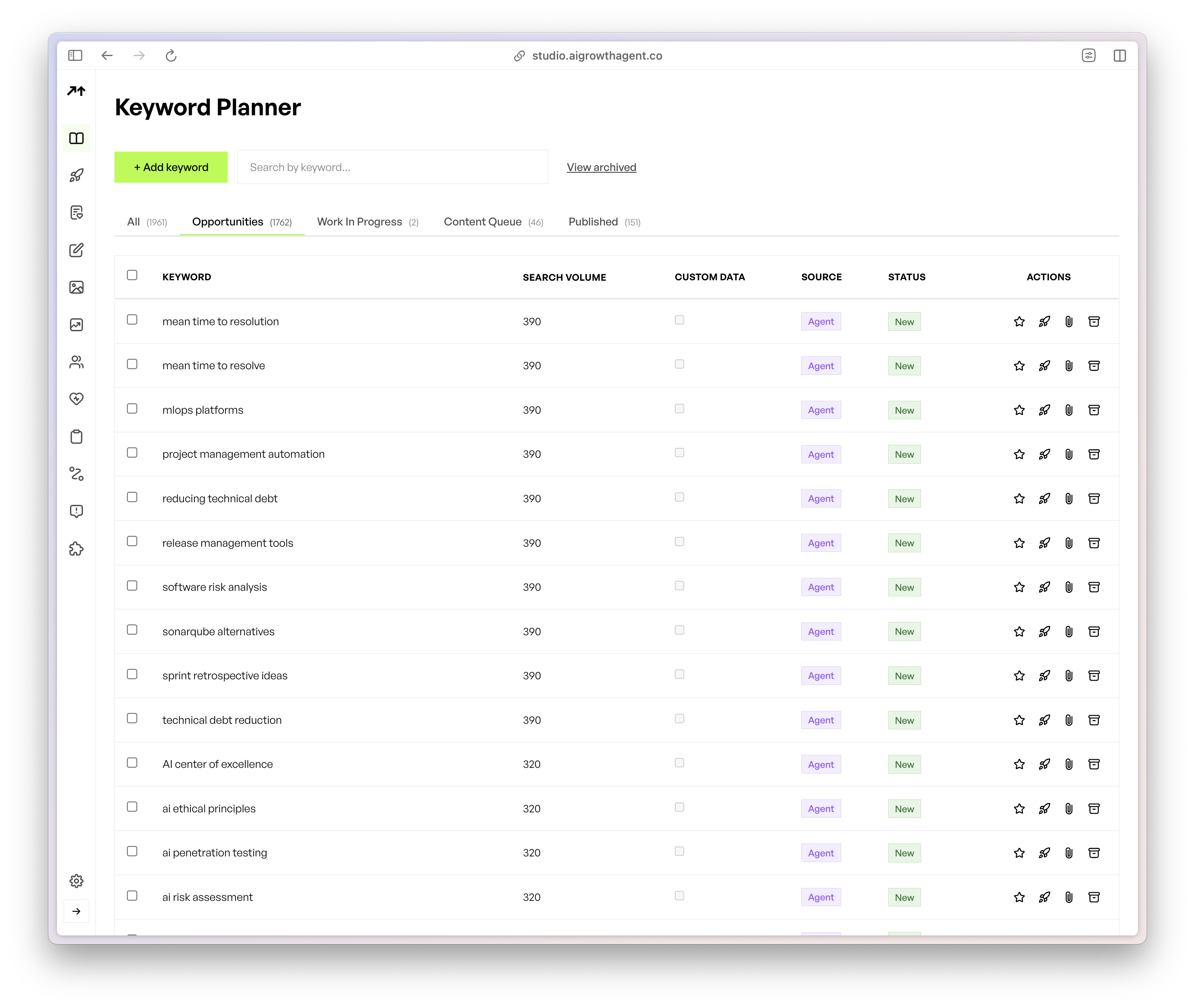
Programmatic SEO provides a scalable way to build content architectures that AI search engines can recognize and cite. Instead of manual one-off posts, pSEO automates research, content assembly, and technical optimization at the speed AI indexing now expects.
This method builds topical authority through interconnected pages that cover clusters of related questions. AI assistants can then reference your brand throughout a user’s decision journey, treating your site as a reliable category resource.
The Mechanism: Technical Scale for Multi-Platform AI Visibility
Technical scale supports visibility across Google AI, ChatGPT, Perplexity, and other systems. Each AI platform favors different content formats: Google AI often blends articles, video, and multimodal content; ChatGPT leans toward detailed, reference-style sources; Perplexity frequently highlights linked claims and community-driven discussions.
Agentic search now tailors results based on behavior and context. Brands that align content with clear intent signals and metadata give these agents stronger reasons to surface their pages in relevant situations.
To see how this applies in your market, book a consultation with AI Growth Agent.
AI Growth Agent: A Platform for Autonomous AI Search Optimization
AI Growth Agent focuses on implementing Programmatic SEO for AI search. The Programmatic SEO Agent manages the full technical SEO lifecycle, so your team can concentrate on offers, positioning, and sales while maintaining AI-ready content quality.
AI Growth Agent’s Unique Capabilities for Marketing Leaders
Key capabilities that support AI citation and conversions include:
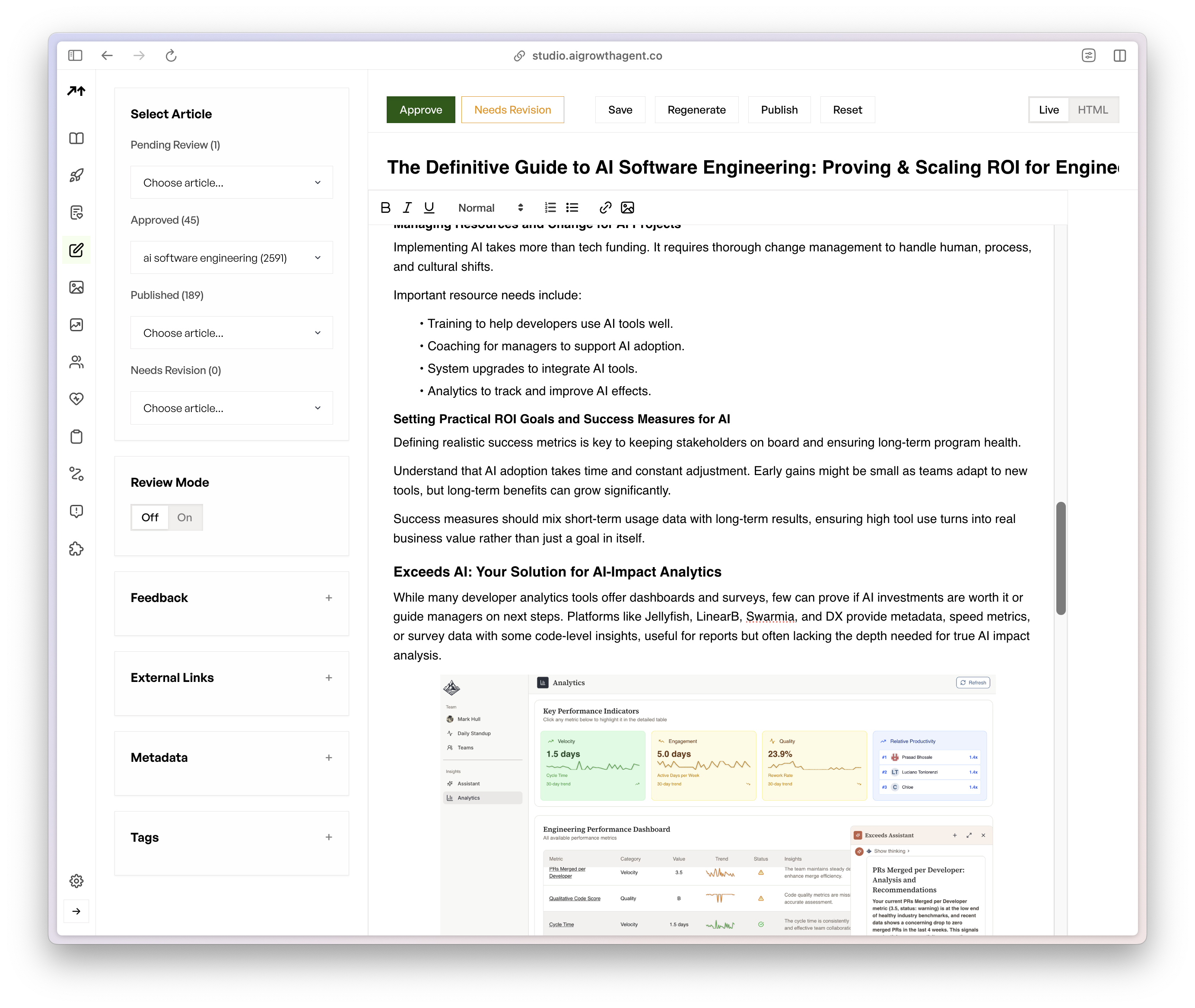
- Automated authority building: The agent turns your Company Manifesto and source material into comprehensive, unique content that reinforces a consistent point of view AI systems can recognize.
- Technical implementation for AI: The platform applies schema markup, LLM.txt files, and a blog Model Context Protocol (MCP) so AI search engines can read your content structure and attributes with higher precision.
- Scale and publishing velocity: The system can publish engineered articles daily, helping your site keep pace as content volume across the web increases.
- Multi-tenant deployment and real-time topics: Teams can manage multiple brands from one interface and generate SEO-optimized articles around trending subjects within minutes, capturing emerging search and AI query demand.
AI Growth Agent vs. The Status Quo: A Comparison
|
Feature / Service |
Traditional SEO Agencies |
Basic AI Content Tools |
AI Growth Agent |
|
Content Output Scale & Velocity |
Low (manual, slow) |
Medium (unstructured text) |
High (programmatic, daily engineered articles) |
|
Technical SEO for AI Citation |
Limited, manual implementation |
None (user responsibility) |
Advanced, automated schema, LLM.txt, MCP |
|
AI Citation & Authority Building |
Indirect, slow |
Low |
Direct, multi-platform |
|
Content Quality & Depth for AI |
Variable, bespoke |
Low (generic, lacks context) |
High (Manifesto-driven, research-based, unique) |
|
Full Lifecycle Automation |
Manual processes |
Manual integration and strategy required |
Fully automated, end-to-end (strategy to publish) |
AI Growth Agent combines strategy, content engineering, and technical SEO in one environment focused on AI citation and authority. Traditional agencies and basic AI tools can support parts of this process, but they usually require manual coordination across separate systems.
If AI search already affects your traffic mix, schedule a demo of AI Growth Agent to evaluate fit.
Conclusion: Dominate AI Search with Programmatic SEO
AI search now acts as a primary front door to the internet, with direct effects on how buyers discover and compare brands in 2026.
Programmatic SEO gives you a repeatable way to build structured, authoritative content that AI engines can surface and recommend. Manual-only approaches struggle to match the scale, structure, and update frequency that AI citation now requires.
Teams that adapt their search strategy for AI will shape more of the answers prospects see. To start that shift, schedule a demo with AI Growth Agent.
FAQs: Navigating AI Search for Better Visibility
How does AI search impact my brand’s visibility?
AI search compresses many interactions into shorter, more decisive moments. When AI-generated answers include your brand as a recommended option, you gain awareness and trust in a single step. Because total traffic may decline, each visit from AI-powered results tends to carry higher intent and closer proximity to a purchase decision.
What content drives AI citation?
Content that earns AI citations is structured, specific, and trustworthy. It should answer natural-language questions clearly, include supporting data, and maintain consistent messaging. Google AI often blends multimodal content, ChatGPT leans on detailed reference-style pages, and Perplexity frequently pulls from a wide range of web and community sources. Schema markup, clean headings, and descriptive metadata help AI systems parse and reuse your material.
How can I measure the impact of AI search optimization?
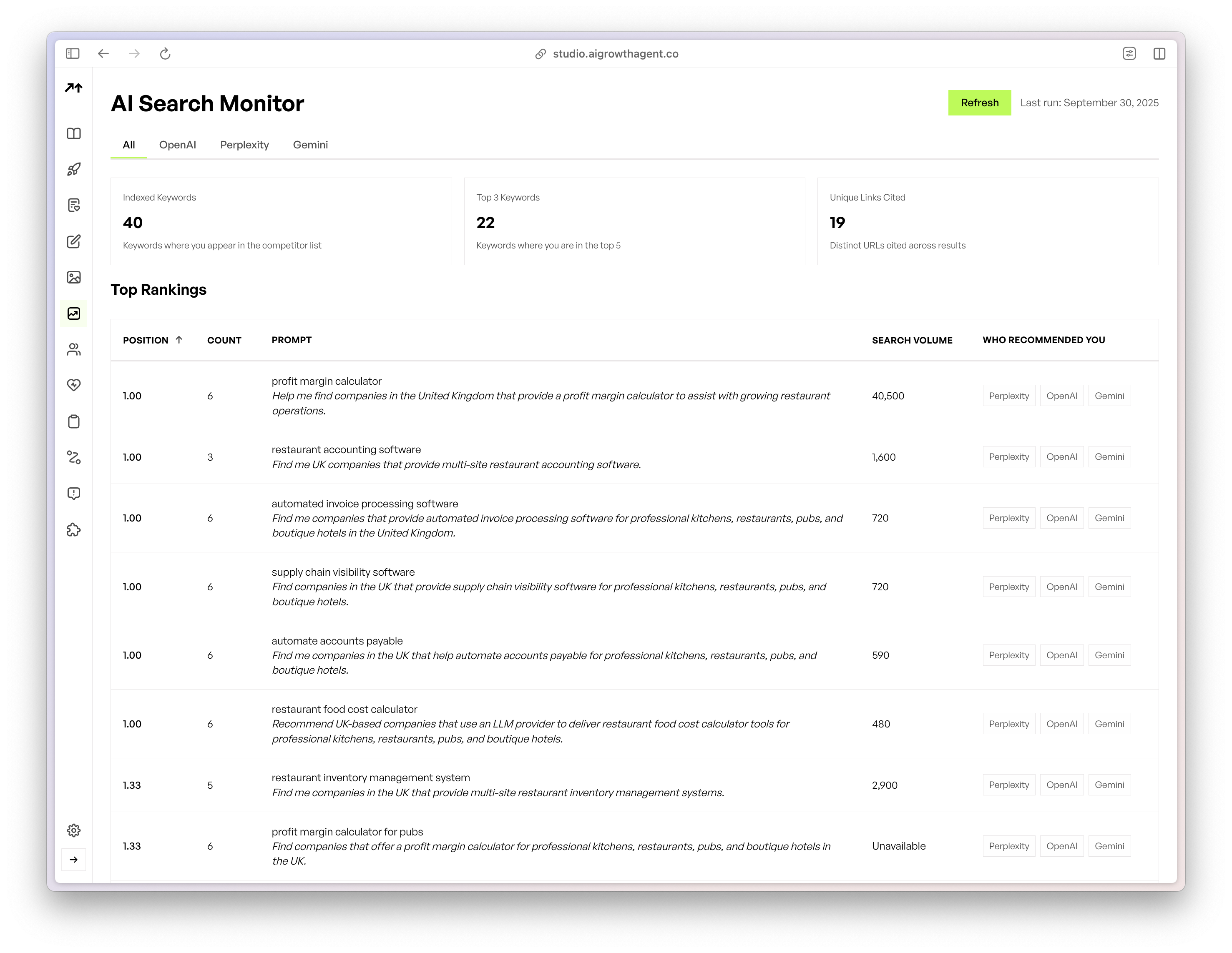
You can measure AI search impact with metrics such as AI Presence Rate (the share of target queries where your brand appears in AI answers), Citation Authority (how often and how prominently you are mentioned), and engagement quality from AI-referred visitors. Specialized tools can sample answers from Google AI Overviews and major assistants to show where and how your brand appears.
Why isn’t my existing content cited by AI models, despite strong SEO?
Many SEO-focused pages were written for human readers and classic ranking factors, not for AI citation. Common gaps include limited structured data, inconsistent brand entities, and shallow coverage of complex topics. AI models favor content that directly addresses the questions users ask, backed by clear evidence. If your pages do not map to those questions, they may rank in search results but still be skipped in AI-generated summaries.
What’s the difference between traditional SEO and programmatic SEO for AI search?
Traditional SEO targets individual keywords and pages through manual optimization. Programmatic SEO for AI search designs larger content systems that cover entire topic clusters at scale. These systems often use advanced schema and interfaces such as Model Context Protocols so AI assistants can query your content more directly and understand how pieces fit together.
