


Key Takeaways
- AI-first search shifts the goal from ranking for blue links to appearing inside AI-generated answers across platforms like Google AI Overviews, ChatGPT, Gemini, and Perplexity.
- Keyword search volume now acts as a signal for planning topic coverage and authority, not just forecasting organic traffic.
- Programmatic SEO uses automation to analyze large keyword datasets, build content clusters, and publish at scale for AI visibility.
- Technical structure, metadata, and continuous AI search monitoring are essential to stay visible as AI systems rewrite and summarize information.
- AI Growth Agent helps marketing teams turn keyword data into an autonomous content engine for AI visibility, and you can see how it works by scheduling a demo.
The AI Search Revolution: Why Traditional Keyword Research Is Falling Short
AI-first search changes how people discover information and brands. Google AI Overviews, Perplexity, and conversational tools like ChatGPT answer many queries directly, which reduces clicks to traditional results.
Keyword research that focuses only on ranking in blue links now misses a large part of real demand. Search volume still matters, but marketing leaders need to evaluate how often AI systems surface their brand in answers, not only how many visits a keyword might send.
Traffic potential from top organic positions is shrinking for many informational queries, while the value of high-intent visibility inside AI answers is increasing. Marketing leaders who adjust to this reality can direct resources toward authority, coverage, and presence in AI responses.
To update your keyword search volume strategy for the AI era, you can schedule a consultation session with AI Growth Agent.
Beyond Volume: New Metrics for AI-First Keyword Strategy
Monthly search volume is no longer a complete measure of opportunity. Many AI overviews and chat answers resolve the search without a click, which means keywords with strong AI coverage can influence buyers even when sessions do not appear in analytics.
Modern keyword evaluation benefits from metrics such as:
- AI visibility potential, or how likely a topic is to trigger AI overviews or conversational results
- Topic and brand authority, or how often AI systems cite, quote, or reference your content
- Coverage depth, or how fully your content addresses related questions, entities, and use cases
- Intent alignment, or how well your pages match the questions AI tools tend to answer around that topic
Marketing leaders who prioritize these signals guide AI systems to treat their content as a reliable reference and increase the odds of inclusion in generated responses.
Programmatic SEO: Building Content Architectures for AI Visibility at Scale
Programmatic SEO moves keyword strategy from manual selection to engineered architectures. Instead of handpicking a few target phrases, teams analyze tens of thousands of queries to define pillars, clusters, and templates that can scale.
AI search rewards this structured approach. Large Language Models rely on patterns, coverage, and consistent structure when selecting sources. Programmatic SEO helps you supply those signals at a level manual workflows cannot match.
Automation in Keyword Research for Deeper Insights
Automation helps teams process large keyword datasets that would be impractical to review by hand. Modern systems can:
- Cluster queries into topics, subtopics, and use cases
- Label intent, such as informational, commercial, or transactional
- Detect gaps where competitors or AI summaries already dominate
- Highlight long-tail queries that signal high intent but low coverage
These insights support programmatic content strategies that address real user questions in a structured, repeatable way.
The Need for Technical Scale and Authority
AI-generated answers tend to favor content that is clear, well-structured, and technically optimized. Manual content operations rarely keep pace with this demand, particularly in competitive categories.
AI Growth Agent uses a programmatic approach that evaluates large keyword sets, maps them into content architectures, and publishes consistently. This kind of system-level execution increases the chance that AI models recognize your site as a trusted source for an entire topic area.
AI Growth Agent: An Autonomous System for Keyword Volume and AI Authority
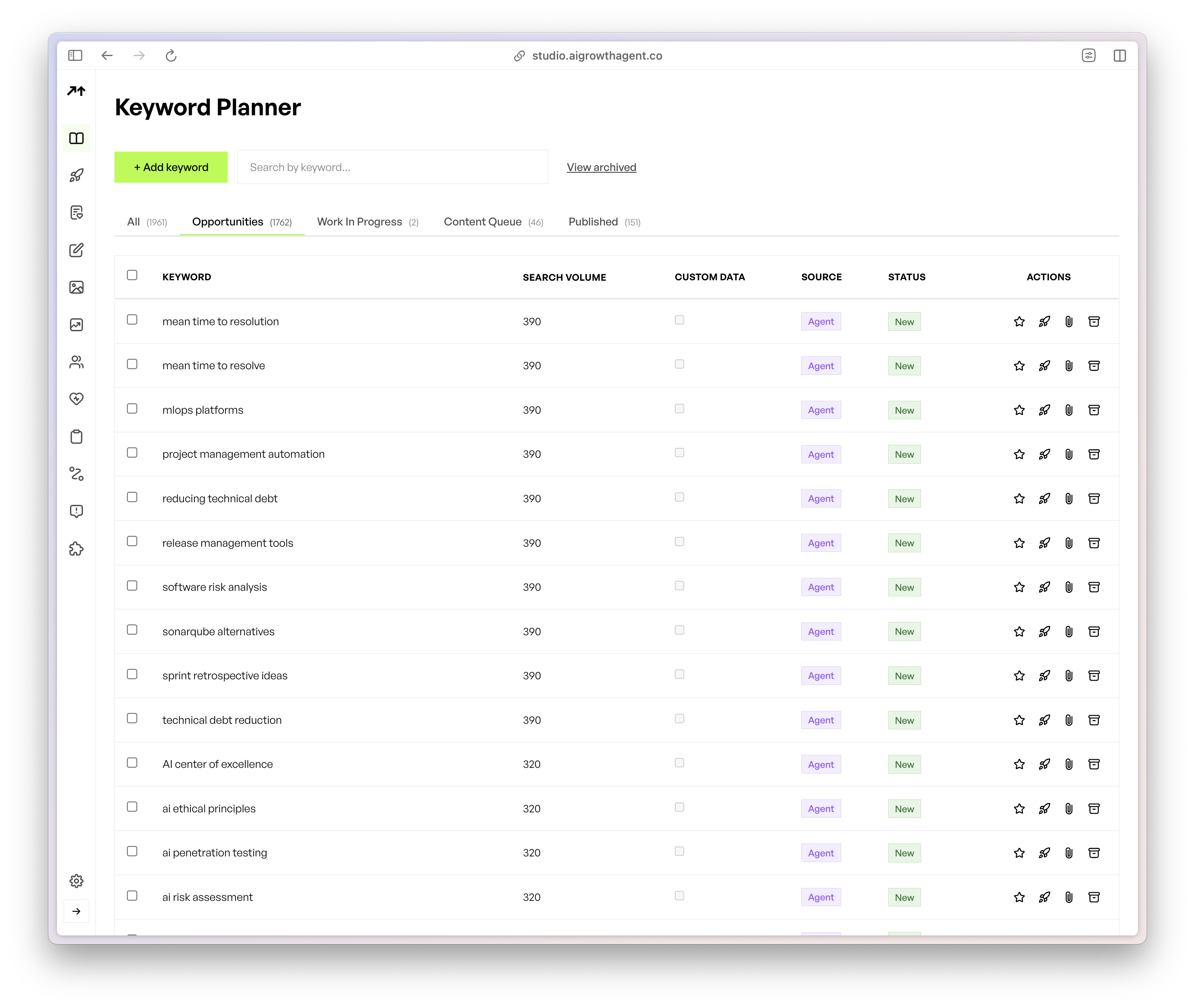
AI Growth Agent operates as a Programmatic SEO Agent that turns keyword search volume data into structured content ecosystems for AI visibility. The focus is on systematic coverage, technical quality, and continuous publishing rather than one-off articles.
The Programmatic Keyword and Content Research module evaluates extensive query sets in your domain, then organizes them into pillars and clusters designed for AI search. The pSEO Content Agent handles strategy, research, drafting, fact-checking, and technical optimization, including schema, metadata, and Model Context Protocol integration that helps AI systems understand and use your content.
|
Capability |
Traditional Agency |
Basic AI Tool |
AI Growth Agent |
|
Keyword Volume Analysis for AI Visibility |
Manual, limited scale |
Basic suggestions |
Programmatic analysis of large datasets |
|
Content Engineering for LLM Inclusion |
1-2 articles per month |
Unstructured text output |
Frequent, template-driven publishing |
|
Technical SEO for AI |
Basic implementation |
No technical optimization |
Schema, MCP, and LLM-focused configuration |
|
Autonomous Operation |
Requires ongoing management |
Manual prompting required |
Largely automated after initial setup |
You can explore how AI Growth Agent converts keyword search volume into an autonomous content engine by scheduling a demo.
Implementation Framework: How Marketing Leaders Put Programmatic Keyword Strategy in Motion
Marketing leaders who adopt programmatic keyword strategy benefit from a clear, staged rollout. AI Growth Agent provides a framework that moves from brand definition to continuous AI search monitoring.
Step 1: Define Your Company Manifesto and AI Programming
The process starts with a guided onboarding session that transfers your positioning, audience insights, and expertise into the agent. The outcome is a Company Manifesto that encodes your brand voice, narrative, and boundaries so content remains consistent and on-message at scale.
Step 2: Programmatic Keyword Research and Clustering
After the Manifesto is in place, the agent reviews extensive query sets to build a Programmatic Content Strategy. This strategy structures pillars, sub-pillars, and clusters that cover your category comprehensively and highlight where AI visibility is most valuable.
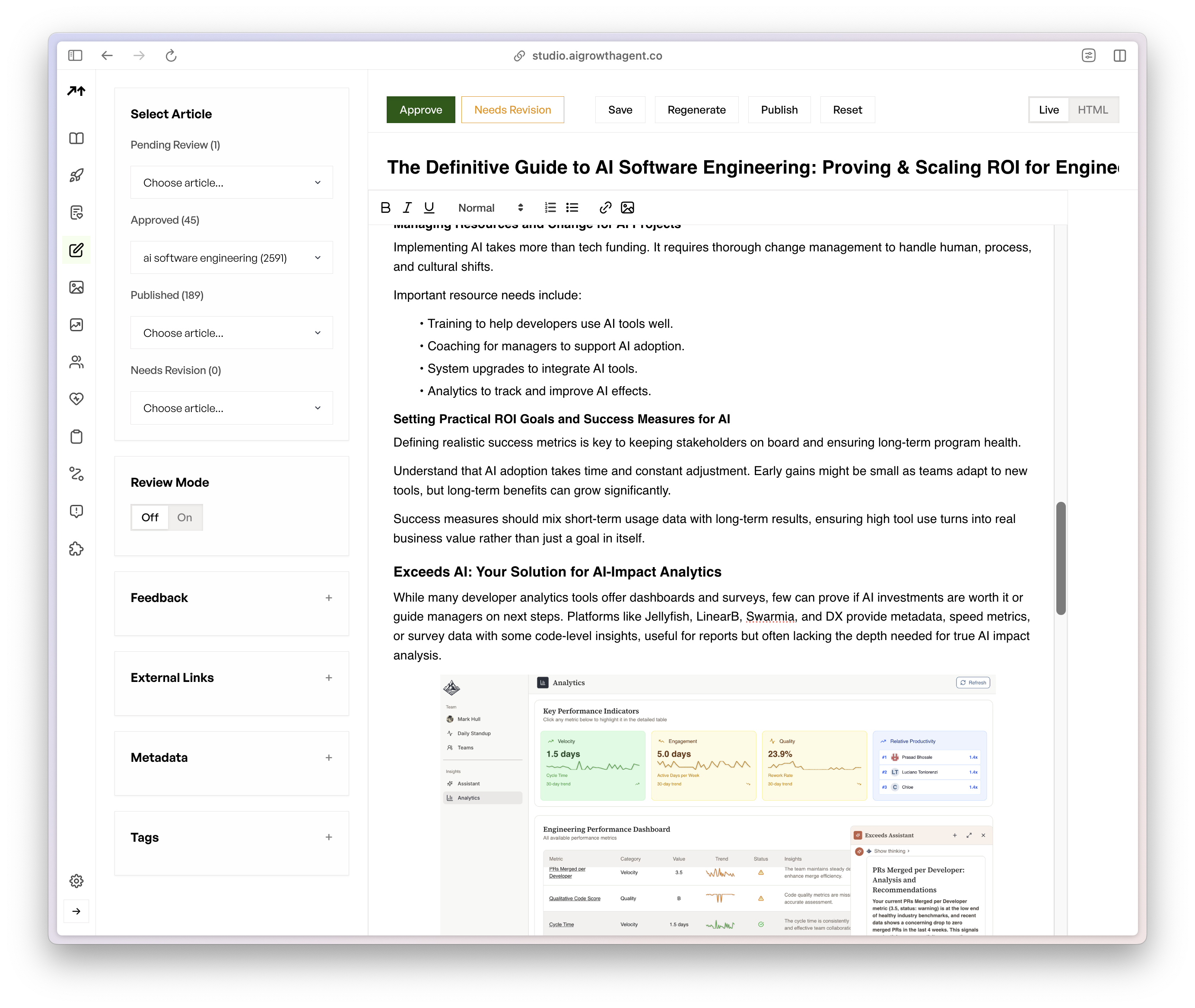
Step 3: Autonomous Content Engineering for AI Visibility
The pSEO Content Agent then runs the content lifecycle. The system drafts, refines, and optimizes each piece, applies schema and metadata, and uses the Model Context Protocol to help AI models recognize and integrate your pages as authoritative references.
Step 4: AI Search Monitoring and Feedback Loops
AI Growth Agent Studio gives you visibility into how AI systems surface your content. Teams can see:
- Which URLs appear in responses from ChatGPT, Gemini, and Perplexity
- How often the brand is mentioned or quoted
- How AI visibility aligns with Google Search Console data and crawl patterns
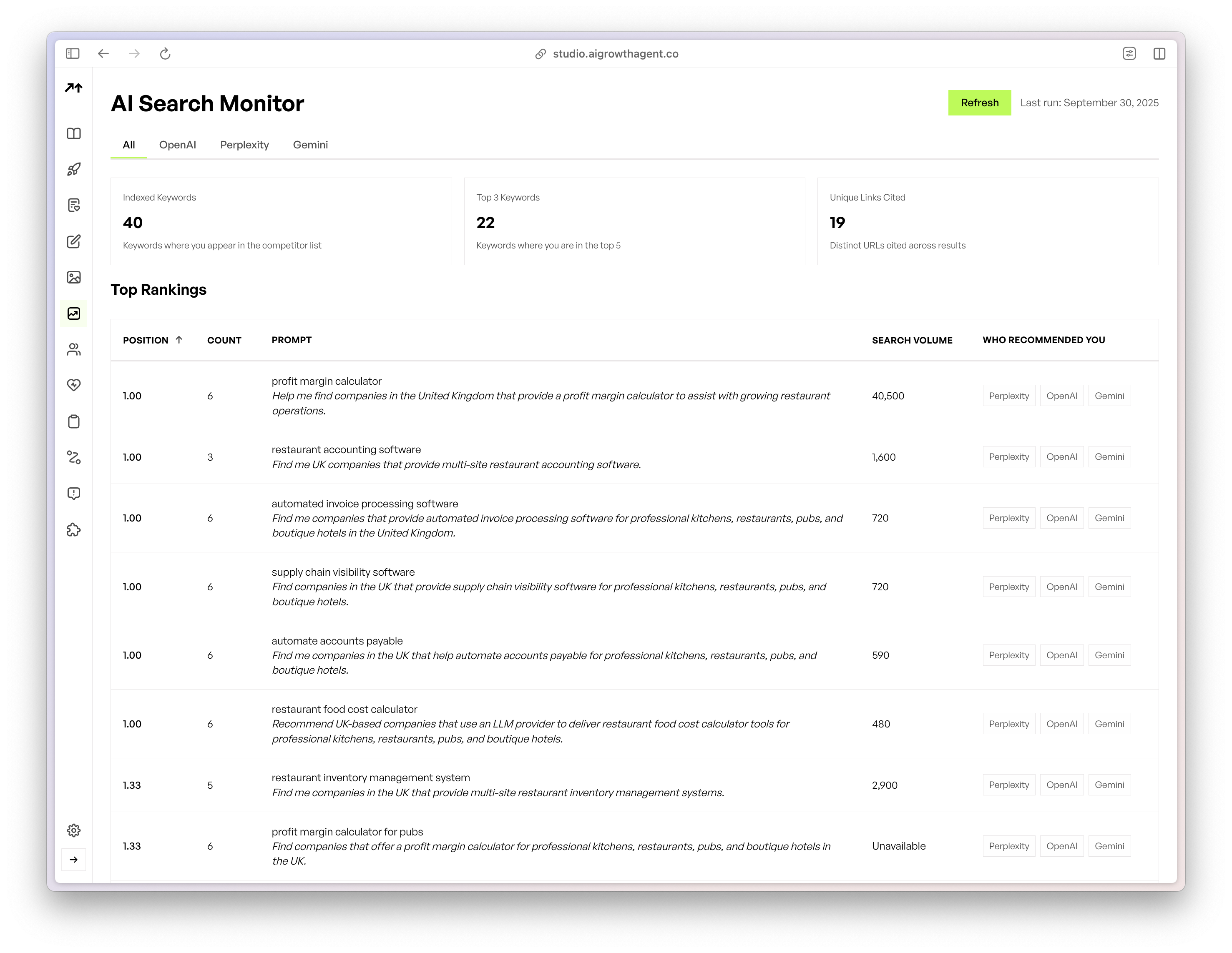
This feedback loop informs future content, technical refinements, and prioritization of high-value topics.
Marketing leaders who want to formalize a programmatic keyword strategy for AI search can schedule a consultation with AI Growth Agent.
Common Challenges in AI-First Keyword Search
Many teams continue to rely on workflows that were designed for a pre-AI search environment. They often:
- Treat search volume as the main success metric
- Use generic AI tools that lack brand context and technical SEO awareness
- Create unstructured content that AI systems find hard to interpret or reuse
- Underestimate the operational load of scaling content without automation
Teams that attempt to scale AI-focused content manually usually face bottlenecks in research, writing, and technical implementation. Specialized, programmatic systems like AI Growth Agent are built to address this gap by aligning strategy, production, and monitoring in one workflow.
Conclusion: Use Programmatic Keyword Search Volume to Build AI Authority
Keyword search volume still matters in 2026, but its role has shifted. The most effective programs use volume as an input to programmatic architectures that aim for AI visibility, topic authority, and consistent coverage rather than isolated rankings.
AI Growth Agent supports this shift with an autonomous system that analyzes keyword data, engineers content, and monitors AI search performance. Marketing leaders who adopt this approach give their brands a structured path to remain visible as AI reshapes discovery.
If you want your company to provide clear, reliable answers in AI search, you can book a strategy session with AI Growth Agent to see whether the platform is a good fit for your goals.
FAQ: Keyword Search Volume and AI Visibility in the New Era
What is the main difference between traditional keyword search volume and its role in AI search?
Traditional keyword search volume primarily guided ranking and traffic goals. In AI search, the same data informs which topics and clusters you should cover so that AI assistants recognize your site as a relevant source.
How can I measure the effectiveness of keywords for AI visibility instead of only organic rank?
Teams track how often their content appears in AI answers, the share of voice across tools like ChatGPT, Google AI Overviews, and Perplexity, and which URLs AI systems quote or reference. AI Growth Agent monitoring consolidates these signals with crawl and Search Console data.
Are high-volume keywords still relevant in an AI-first search environment?
High-volume keywords remain useful, but they now fall into two groups. Some drive traffic, while others mainly drive AI visibility and brand exposure inside summaries and answers.
What is Programmatic SEO, and how does it use keyword search volume data?
Programmatic SEO uses automated analysis of keyword datasets to design content templates, clusters, and publishing schedules. It translates raw query lists into a structured content system that can scale and support AI visibility.
How does AI Growth Agent identify and act on valuable keyword search volume opportunities?
AI Growth Agent evaluates large keyword sets, clusters them into pillars and subtopics, and then instructs the pSEO Content Agent to create technically optimized pages that align with AI search behavior.
Why do many internal teams or agencies struggle to reach programmatic scale for AI visibility?
Most teams rely on manual research, writing, and optimization, which limits scale and consistency. Programmatic systems like AI Growth Agent introduce automation and engineering practices that support the volume and structure AI search now requires.
