Written by: Mariana Fonseca, Editorial Team, AI Growth Agent
Key Takeaways
-
AI-powered search now rewards a 7-step programmatic framework that replaces manual SEO tactics as traditional traffic drops 25% by 2026.
-
Audit content against the 30% Rule so more than 70% of each piece delivers unique insights, original data, and analysis for 30–40% higher AI visibility.
-
Strengthen E-E-A-T with a Company Manifesto and structured data such as Schema, LLM.txt, and MCP to improve citation rates by up to 40%.
-
Use inverted pyramid structures, question-based headings, and programmatic keyword clustering so AI systems can quickly extract clear answers to conversational queries.
-
Automate daily publishing and monitor AI citations with feedback loops, then book a consultation with AI Growth Agent to roll out this framework at scale.
7-Step Programmatic Framework for AI Search Optimization
This framework turns traditional content creation into a systematic, scalable process, with each step laying the groundwork for the next.
-
Audit for GEO Readiness (30% Rule) – Confirm that unique insights make up more than 70% of each piece.
-
Build E-E-A-T via Company Manifesto – Define and document authoritative brand positioning.
-
Programmatic Keyword Clustering – Target conversational, query-driven content at scale.
-
Engineer Structured Data – Implement Schema, LLM.txt, and MCP protocols.
-
Deploy Inverted Pyramid with Question-Based Headings – Make content easy for AI systems to extract.
-
Automate Publishing Velocity – Maintain consistent, high-quality daily output.
-
Monitor Citations with Feedback Loops – Track and refine performance across AI platforms.
Brands that want this framework executed end to end can book a consultation to see how AI Growth Agent’s autonomous programmatic SEO system handles all seven steps.
Step 1: Audit for GEO Readiness – Master the 30% Rule for AI
The 30% Rule states that AI-generated content must receive substantial human enhancement with original input to stay high quality and avoid penalties. More specifically, successful AI optimization requires that unique insights and original analysis make up more than 70% of your content.
This principle directly affects AI visibility. Content featuring original statistics sees 30–40% higher visibility in AI responses, so originality becomes a core ranking factor for generative search engines.
Audit work should focus on unique data points, proprietary insights, and first-hand experience across your existing library. Content that passes the 30% Rule shows clear value differentiation that AI engines prioritize when choosing authoritative sources for citations. This differentiated baseline prepares your brand for the authority-building work in Step 2.
Step 2: Build E-E-A-T via Company Manifesto
Strong Experience, Expertise, Authoritativeness, and Trustworthiness require more than polished author bios. 96% of sources cited in Google AI Overviews come from sites with strong E-E-A-T, so this foundation directly shapes AI search performance.
Scaling those authority signals across thousands of pages creates a real challenge for most teams. A Company Manifesto solves this challenge by serving as the authoritative source document that defines your brand’s positioning, expertise areas, and value propositions.
This living document outlines core competencies, industry experience, and unique methodologies in one place. AI Growth Agent converts the manifesto into automated content guardrails that preserve E-E-A-T signals at scale. With this foundation in place, you can confidently expand into query-driven content in Step 3.
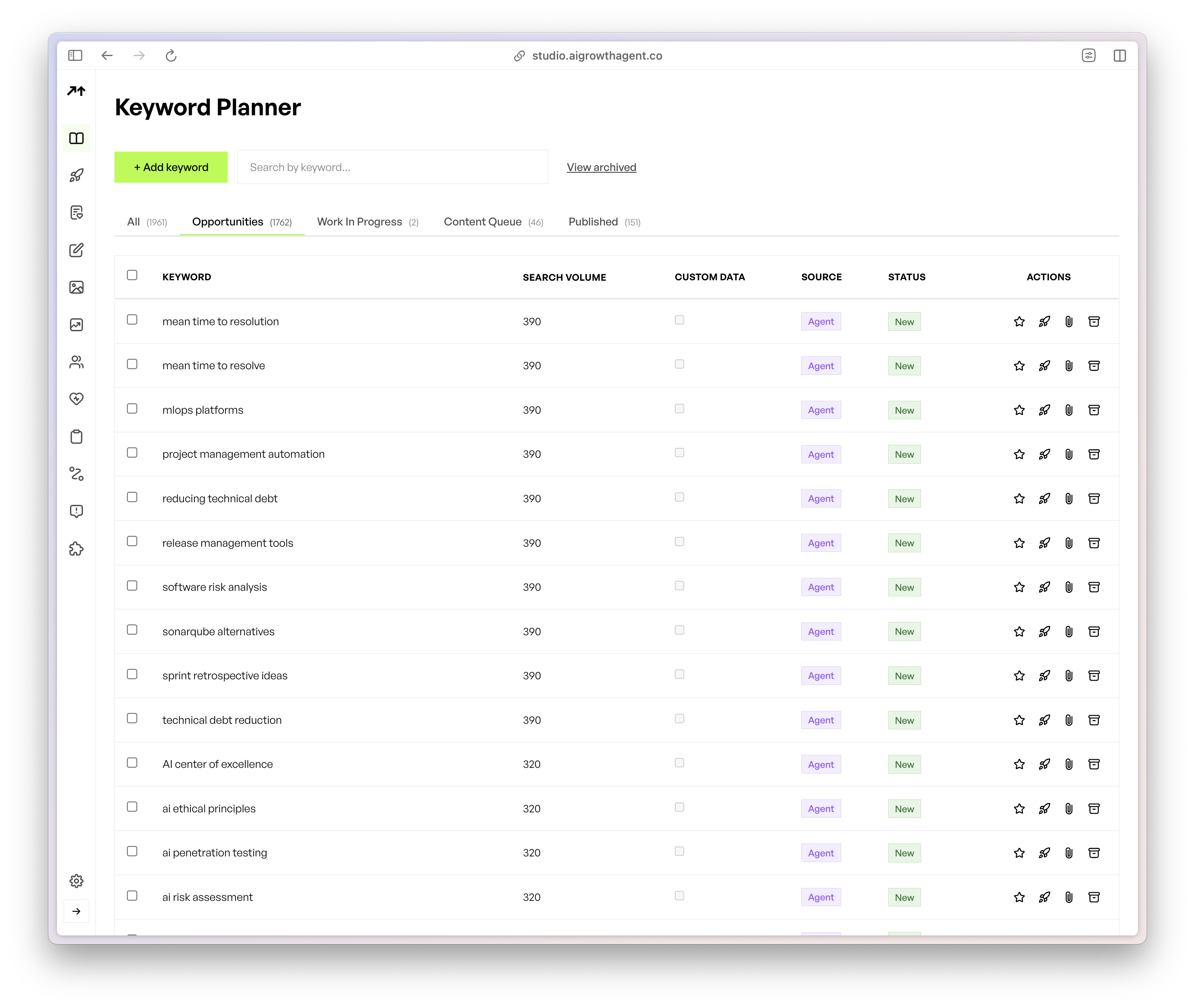
Step 3: Programmatic Keyword Clustering for Query-Driven Content
Modern AI search optimization focuses on conversational, long-tail queries instead of isolated keyword phrases. AI Mode achieved a 69% click-through rate for transactional queries, which highlights the power of intent-focused targeting.
Programmatic keyword clustering analyzes thousands of related search queries to uncover content opportunities tied to specific user intents. This approach moves beyond single keywords and builds topic clusters that answer related questions within one coherent piece.
Effective clusters target question-based queries such as “how to optimize content for AI powered search” and related long-tails like “what is the 30% rule for AI” and “how to get cited by AI search engines.” This strategy ensures your content covers the full spectrum of user questions within each topic area. Once these clusters are defined, Step 4 turns them into machine-readable assets.
Step 4: Engineer Structured Data (Schema, LLM.txt, MCP) – How to Get Cited by AI Search Engines
Structured data provides the technical foundation that helps AI systems understand and extract your content. Search Engine Land’s 2025 analysis found that comprehensive schema markup increases the likelihood of appearing in AI citations by up to 40%.
Essential schema types include Organization, Article, FAQPage, and Person markup. This 40% citation boost reflects schema’s widespread use among top-performing content. 71% of pages cited by ChatGPT and 65% of pages cited by AI Mode use schema markup, which makes structured data implementation non-negotiable for AI visibility.
Advanced 2026 protocols such as LLM.txt and Model Context Protocol (MCP) extend this foundation. These standards let AI search engines interface directly with your content database and understand your site’s structure and authority with greater precision.
JSON-LD remains the preferred format because it keeps structured data separate from HTML while preserving clean, scalable markup that AI systems can parse efficiently. With this technical layer in place, Step 5 focuses on how you present information inside each page.
Step 5: Deploy Inverted Pyramid with Question-Based Headings – Format for AI-Driven Search
AI search engines favor content that delivers clear, extractable answers at the top of each section. Averi.ai’s 40–60 Word Rule recommends starting every major section with a direct 40–60 word answer block that can stand alone as a citation.
The inverted pyramid structure places the key takeaway first, then adds supporting details and context. This layout mirrors how AI engines scan and extract information for generative responses.
Question-based headings at the H2 and H3 level should closely match “People Also Ask” queries and natural conversational patterns. This alignment increases the odds that AI systems select your content when assembling answers across multiple platforms. Once pages follow this structure, Step 6 ensures you publish them at the pace AI rewards.
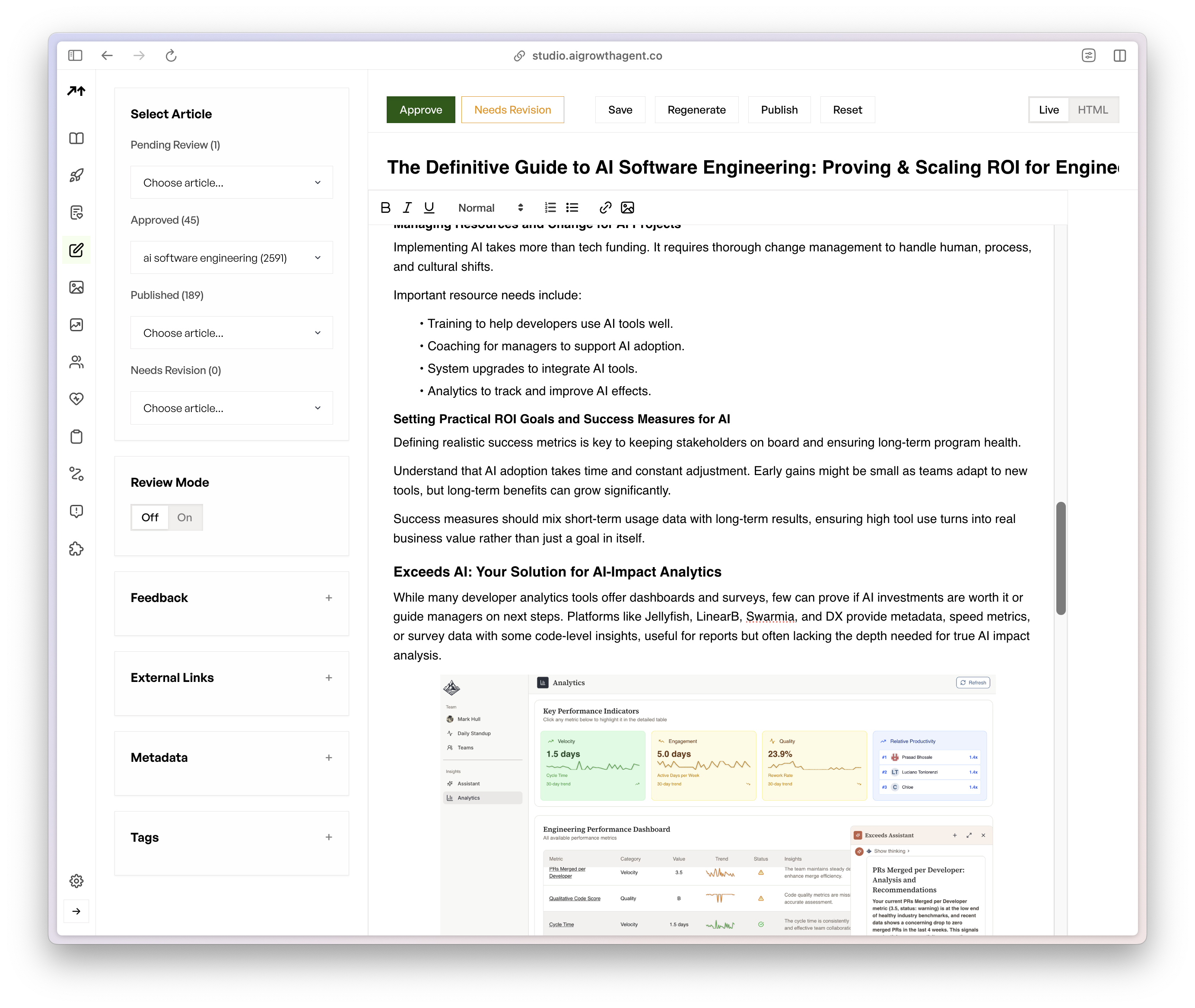
Step 6: Automate Publishing Velocity
Consistent, high-frequency publishing now plays a central role in AI search visibility. Firebrand Marketing found that 76.4% of ChatGPT’s most-cited pages were updated in the last 30 days, which underscores the importance of recency.
Programmatic publishing automation supports daily content output while preserving quality standards. This pace keeps your brand’s content fresh in the eyes of AI engines that favor recently updated sources.
Maintaining this velocity without sacrificing E-E-A-T or technical precision requires sophisticated automation. AI Growth Agent’s Auto-Pilot mode exemplifies this approach by generating, refining, and publishing content based on your Company Manifesto and keyword strategy. With velocity in place, Step 7 closes the loop through measurement and refinement.
Step 7: Monitor Citations with Feedback Loops
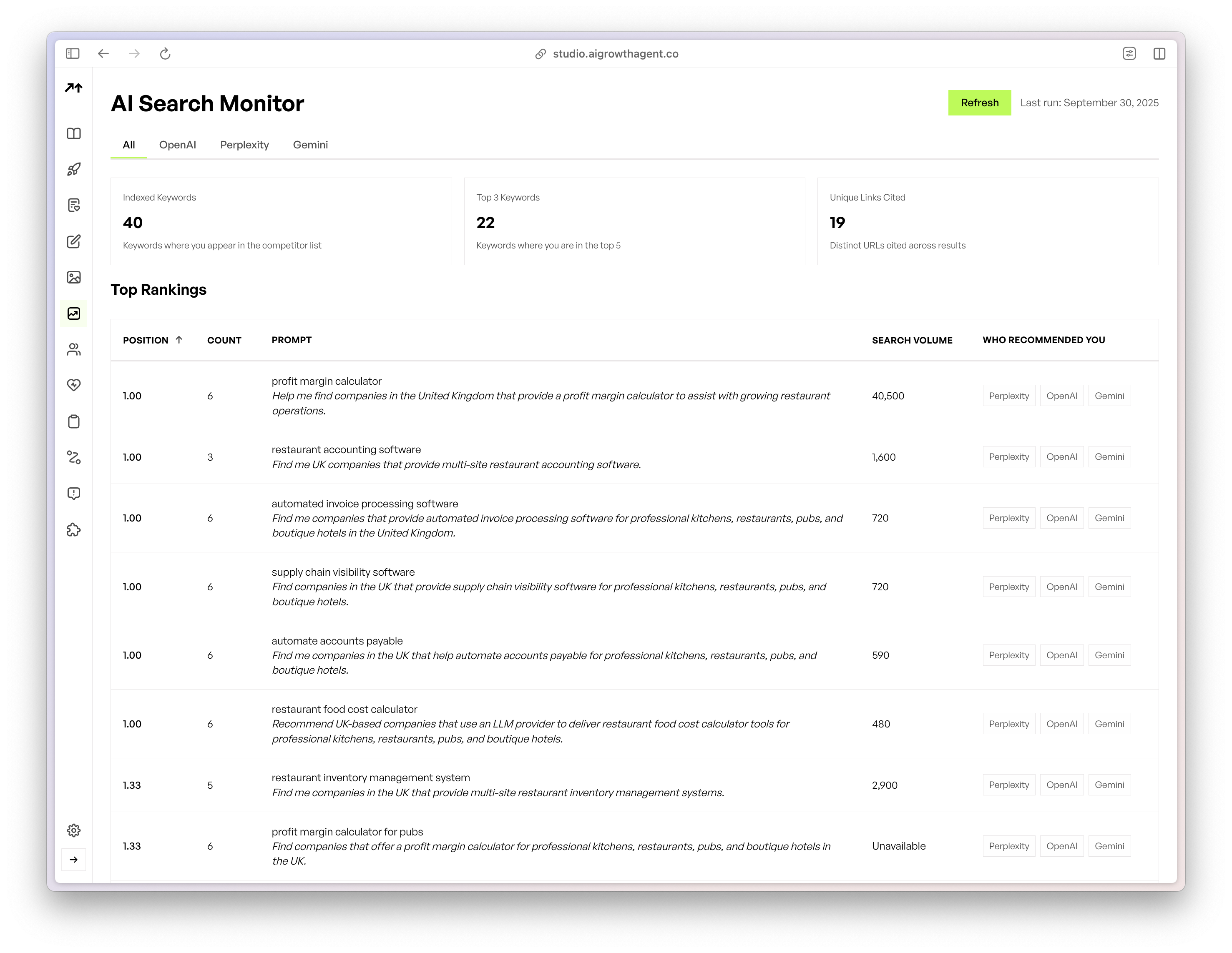
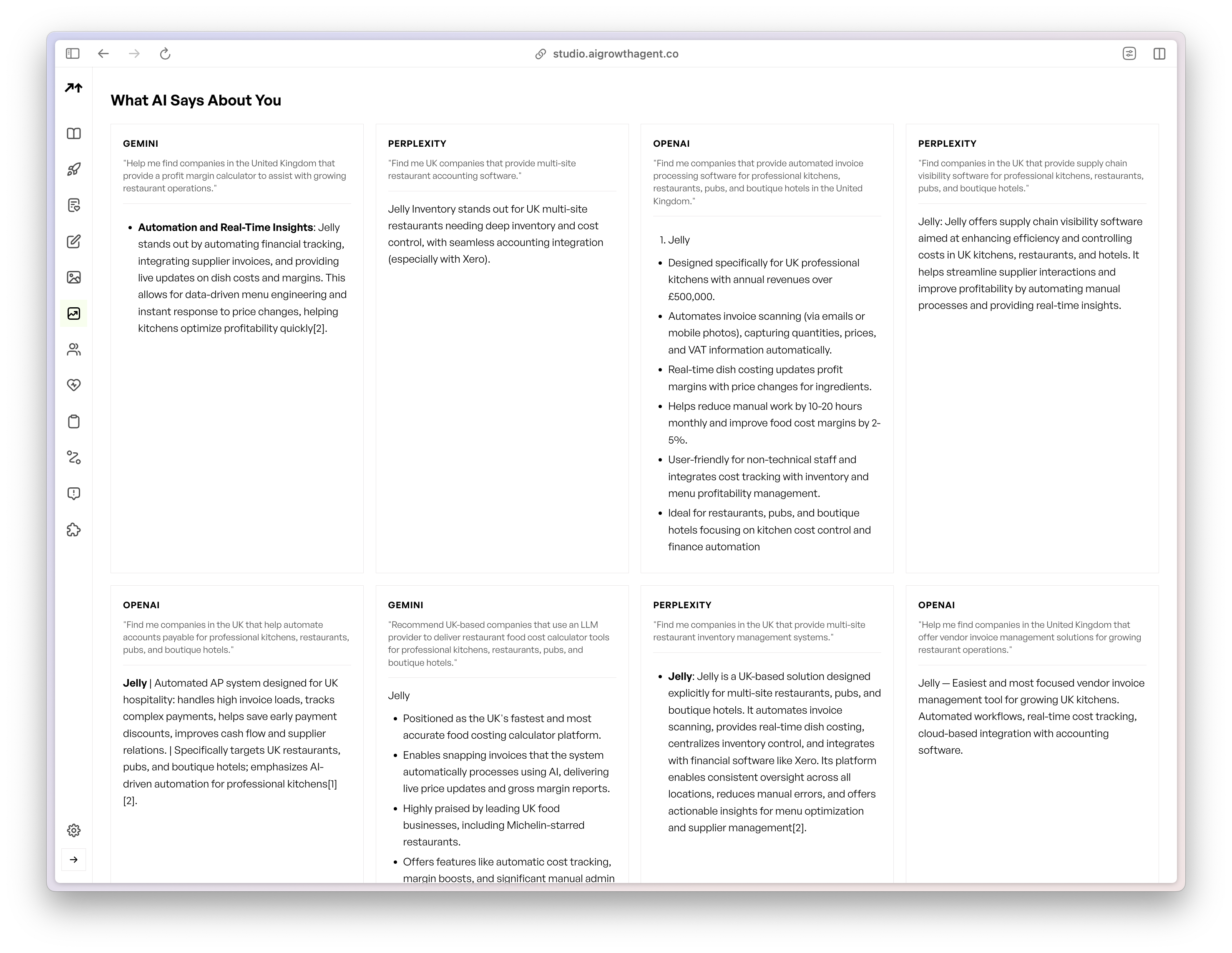
Monitoring AI search performance demands tools that track more than traditional rankings and organic traffic. Effective monitoring covers citations across ChatGPT, Google AI Overviews, and Perplexity, along with the specific URLs that drive those mentions.
Real-time feedback loops support continuous improvement based on AI search data. Teams track crawl activity from AI bots, measure citation frequency, and compare formats to see which structures earn the most citations.
Integration with Google Search Console adds another layer of insight by connecting AI-optimized content to organic traffic growth. This closed loop confirms which parts of the 7-step framework deliver the strongest results and where to adjust next.
What is the 30% Rule for AI?
The 30% Rule, detailed in Step 1 above, states that successful content needs more than 70% original analysis to meet AI engines’ quality thresholds for citations. This standard keeps AI-assisted content grounded in human insight instead of generic summaries.
The rule addresses content sameness in a world flooded with AI-generated pages. Many marketers follow a 70/30 or 80/20 guideline where 70–80% of work can be accelerated by AI while 20–30% remains human-only, including strategy, refinement, and final approvals.
Following the 30% Rule preserves authority signals and unique value that AI search engines look for when selecting sources for citations and recommendations.
AI Search Optimization Tools Comparison
The programmatic SEO landscape includes many tools with different levels of support for AI search. The table below shows how AI Growth Agent combines four essential capabilities at once: programmatic scale, advanced structured data implementation, citation monitoring, and end-to-end automation, while competitors cover only parts of this stack.
|
Tool |
Programmatic Scale |
Schema/LLM.txt/MCP |
Citation Monitoring |
End-to-End Automation |
|---|---|---|---|---|
|
AI Growth Agent |
Yes |
Yes |
Heatmaps/Studio |
Yes |
|
Jasper |
No |
No |
No |
No |
|
AirOps |
Partial |
No |
Basic |
No |
|
Bear AI |
No |
No |
No |
No |
AI Growth Agent stands alone in delivering comprehensive programmatic SEO automation with MCP support and real-time citation monitoring across major AI search platforms.
Common Pitfalls to Avoid & 2026 AI Evolutions
Many organizations miss AI search opportunities because they treat it as lightly updated traditional SEO. Three mistakes appear most often: teams rely on unstructured content tools without schema, they chase individual keywords instead of query clusters, and they keep manual publishing schedules that cannot match programmatic velocity.
The 2026 AI search environment continues to evolve quickly. Gemini 3 Flash began rolling out globally in Google Search in December 2025, which brought faster and more capable AI-powered responses.
Successful brands now treat programmatic approaches as the default, not an experiment. SeoPage.ai data shows that specialized programmatic SEO strategies deliver a 340% average ROI compared with traditional methods.
Teams that want to explore this shift can schedule a platform walkthrough and see how AI Growth Agent automates structured data and citation monitoring.
Frequently Asked Questions
Is SEO dead or evolving in 2026?
SEO continues to evolve and now centers on programmatic SEO, or pSEO, to serve AI-powered search engines. Traditional manual tactics cannot match the speed and technical depth that AI citations require. The focus has moved from single-page tweaks to building content architectures that establish topical authority across thousands of related articles. Success depends on automated systems that maintain publishing cadence, apply advanced structured data, and track performance across multiple AI platforms at once.
How do you optimize content to get cited by AI search engines?
Winning citations from AI search engines requires full adoption of the 7-step framework. Content must meet the 30% Rule for originality, reflect strong E-E-A-T through clear positioning, and target conversational query clusters. Pages also need comprehensive structured data, including Schema markup and emerging standards such as LLM.txt, along with inverted pyramid formatting and question-based headings. Automation sustains publishing velocity, while monitoring tools track citations and guide ongoing refinement.
How do you rank in AI search results?
Ranking in AI search depends on combining programmatic velocity with technical excellence. AI engines favor recent, authoritative content that offers clear structure and original insights. Brands that publish high-quality content daily, implement advanced structured data for direct AI indexing, and build deep topic coverage through clustering stand out. Consistent E-E-A-T signals across this content further strengthen performance, while manual approaches struggle to reach the necessary scale.
What makes programmatic SEO more effective than traditional SEO for AI search?
Programmatic SEO outperforms traditional SEO because it aligns with AI engines’ core needs for speed, consistency, and structure. Manual SEO usually optimizes one page at a time. Programmatic SEO builds entire topic ecosystems that apply structured data, maintain steady publishing schedules, and create the depth required for authority in AI citations. Automation also enables real-time adjustments based on citation data and AI search behavior.
How long does it take to see results from AI search optimization?
Systematic AI search optimization often produces results faster than traditional SEO. Brands that implement the full programmatic framework typically see initial AI citations within two to three weeks. Case studies such as Bucked Up, which reached the top ChatGPT citation for “best protein soda” within three weeks, illustrate this potential. Building durable topical authority usually takes two to three months, and automation accelerates this timeline by supporting high-volume, high-quality publishing.
Conclusion
Mastering AI search requires a structured 7-step programmatic framework that addresses how AI-powered engines evaluate and surface content. Brands that move beyond manual production and embrace automation gain the velocity, technical depth, and consistency needed for sustained AI citations.
The companies that dominate AI search in 2026 will rely on comprehensive programmatic strategies instead of trying to scale manual workflows. AI Growth Agent provides an end-to-end autonomous programmatic SEO platform that helps your company become a definitive authority in AI citations.
Teams ready to pursue this outcome can schedule a demo and evaluate whether AI Growth Agent’s autonomous content architecture fits their growth goals.