Want to get seen, cited, and recommended by Perplexity? In this guide for Perplexity AI Answer Engine Optimization, you’ll learn how.
This guide outlines how Perplexity works, what it values, and how marketing leaders can operationalize Perplexity-focused content and technical strategies at scale. Here’s what you’ll discover:
- Perplexity AI shifts discovery from ranked link results to cited answers, so marketing teams need to optimize for citations and perceived authority rather than positions on a search results page.
- Brands that publish deep, current, and well-sourced content gain more opportunities to be referenced in Perplexity answers, while promotional or shallow content is less likely to appear.
- Effective Perplexity optimization requires content structures that support direct answers, transparent citations, conversational context, and real-time updates.
- AI Growth Agent uses programmatic SEO, technical automation, and AI search monitoring to help brands build topical authority that Perplexity and similar AI systems can reliably cite.
The impact of Perplexity AI on brand visibility
The rise of AI answer engines like Perplexity is reshaping how people find information and how brands build discoverability and trust. Unlike traditional search engines that present ordered lists of links based largely on backlinks and keywords, Perplexity delivers direct, synthesized answers and cites real-time sources for transparency. The focus moves from ranking links to earning citations within AI-generated responses.
For marketing leaders, this shift changes the goal of optimization. The traditional SEO playbook, built around keyword targeting, link building, and ranking positions, becomes less sufficient when users see a single synthesized answer. Perplexity uses an AI-powered conversational interface that provides context-aware responses with citations, so brands need to optimize for credibility, clarity, and completeness, not only visibility.
A citation from Perplexity signifies recognition as a definitive source on a topic. When Perplexity references your content in its answers, it not only directs potential traffic, it also validates your expertise for users who rely on AI-generated responses. This validation reflects the system’s assessment that your content offers accurate, well-presented information on that subject.
The implications extend beyond one-off appearances. As AI answer engines become a primary discovery channel, brands that earn consistent citations build compound authority. Each citation reinforces your position as a trusted source and may increase the likelihood that AI systems return to your content for related queries. Brands that do not adapt to this model risk losing visibility to competitors that align content strategy with AI answer engines.
Marketing teams that want to understand their current position in AI search can request a structured review. Schedule a consultation with AI Growth Agent to assess your Perplexity AI optimization potential.
How Perplexity AI works and why it matters for your brand
Marketing leaders need a clear view of Perplexity AI’s core mechanics to design effective optimization strategies. Perplexity rewards deep topical authority, transparent sourcing, and content structures that AI can parse and cite accurately.
Dynamic real-time retrieval
Perplexity AI does not rely on a static index like traditional search engines. It retrieves information in real time from a curated set of reputable sources, emphasizing freshness and credibility. Recent, high-quality content can become citable almost immediately, instead of waiting weeks or months to accumulate traditional ranking signals.
Brands that publish timely, authoritative analysis on emerging topics gain an advantage. Fast, high-quality publishing on relevant developments creates more chances for Perplexity to surface and cite your content while a topic is trending.
Direct answer synthesis with transparent citations
Perplexity synthesizes natural-language answers that directly address user intent and attaches citations instead of presenting a ranked list of links. The system favors content that it can extract, summarize, and verify without losing context.
Content that uses clear headings, concise explanations, and self-contained sections is easier for Perplexity to interpret. Structured answers to specific questions, followed by deeper context, help AI systems select and cite the right passages.
Advanced intent understanding and conversational AI
Perplexity is designed for intent understanding and conversational interaction. It interprets queries contextually and maintains context across follow-up questions. One user session often includes multiple related questions.
Content that anticipates follow-up questions and related topics can support a longer conversational thread. When your resources cover the full journey from basic definitions to advanced use cases, Perplexity has multiple opportunities to cite your brand within the same conversation.
Source credibility and topical authority as ranking logic
Perplexity ranks sources based on reliability, relevance, and citation transparency, rather than backlinks, keyword density, or traditional user engagement metrics. Topical authority, depth of data, and clarity of presentation carry significant weight, and academic or data-rich sources are especially likely to be cited.
Content that demonstrates clear expertise, uses data responsibly, and presents information in a structured way has higher citation potential. Shallow or purely promotional pages offer less value in this model and tend to be deprioritized.
Perplexity also avoids ads and promotional blocks inside its answers to maintain a user-focused experience. Educational, neutral content that helps users understand problems and solutions is more likely to be selected than sales copy.
Marketing leaders who want consistent Perplexity visibility need content that is comprehensive, current, and technically structured for AI systems. Manual methods often struggle to reach the necessary scale and precision, which increases the value of programmatic and automated approaches.
Strategic implications for marketing leaders in an AI answer world
Perplexity changes the primary objective of digital visibility strategies. Instead of optimizing for search rankings alone, brands now need to optimize for sustained citation and authoritative recommendation within AI-generated answers.
The key strategic shift involves focusing on citation as a success metric. When Perplexity cites your content, it passes perceived authority from the AI system to your brand. Users who see your content referenced in an answer may view your organization as a trusted expert on that topic.
Consistent citations can compound over time. Each citation contributes to your brand’s authority profile inside AI systems and can raise the likelihood that your content will be selected again. Brands that publish high-quality, citable resources across a topic cluster can become frequent sources for Perplexity.
Content requirements in this model are stringent. Optimization efforts should focus on clear, well-structured content that answers queries directly and includes the surrounding context in one place. Content needs to:
- Answer core questions directly and clearly.
- Include sufficient background and definitions within the same page.
- Signal credibility and authorship in a machine-readable way.
- Use structure that allows AI systems to locate and cite specific sections.
The scale of this work creates a resource challenge. Marketing teams must combine deep subject expertise, strong writing, technical SEO, and AI-aware structuring, often across hundreds or thousands of pages. Hiring or coordinating this range of skills manually is slow and expensive.
Measurement models also need an update. Rankings, click-through rates, and organic sessions only tell part of the story when AI systems generate the primary answer. Marketing leaders need to see where and how their content appears in AI answers, which pages drive citations, and how their brand is described in those contexts.
Organizations can respond by building in-house capabilities for programmatic content and AI-focused optimization or by partnering with specialized platforms. Early movers in AI search optimization gain an advantage as answer engines mature and competition for citations increases.
Core strategies for effective Perplexity AI optimization
Brands that want to perform well in Perplexity need a focused approach across content strategy, technical structure, and conversational design. The following pillars form a practical foundation.
Build deep topical authority with comprehensive content
Marketing teams need content that covers their domain in depth, with data, examples, and practical detail. Perplexity shows a clear preference for academic and data-rich sources, so thin overviews rarely earn citations.
Topical authority in this context means systematic coverage of a subject area. Effective strategies often include:
- Cornerstone guides on core topics.
- Detailed articles on subtopics, edge cases, and implementation details.
- Use case explanations for different audiences or industries.
- Reference-style resources, such as glossaries or frameworks.
For instance, a cybersecurity company needs more than a general article on network security. A stronger Perplexity profile would include resources on threat detection, incident response workflows, compliance standards, emergent vulnerabilities, architecture diagrams, and step-by-step implementation guidance.
Content should also reflect real expertise. Specific examples, data interpretations, and practical recommendations signal to both users and AI systems that the material comes from practitioners rather than generic summaries.
Maintain real-time relevance and content freshness
Perplexity retrieves information in real time to keep answers aligned with the latest facts and developments. This behavior is especially important for fast-moving topics such as regulation, technology, finance, and news.
Marketing leaders who want Perplexity visibility need a process for timely coverage. Effective operations typically include:
- Monitoring industry news, standards, and competitor moves.
- Prioritizing topics where your organization can add unique insight.
- Producing expert analysis that explains what a development means for specific stakeholders.
- Publishing within hours or days of key events when possible.
Freshness does not only apply to new content. Existing high-value resources require periodic updates. Regular reviews help ensure statistics, screenshots, recommendations, and regulatory references reflect current conditions, which protects citation potential.
Use transparent citation and strong credibility signals
Perplexity needs to verify information and understand who stands behind it. A technical structure that aligns with schema best practices and clear authorship signals improves the chances that content is surfaced and cited accurately.
Effective credibility frameworks often include:
- Granular schema markup for articles, organizations, and authors.
- Visible publication and update dates.
- Clear attribution for data, quotes, and third-party research.
- Links to related internal resources that expand on key ideas.
Marketing teams can also reinforce credibility through author profiles that highlight relevant experience, organizational credentials that establish authority in a niche, and documented review processes for sensitive topics.
Align content with conversational AI and direct answer needs
Perplexity interacts with users in a conversational way, which means content should support multi-step question flows. The system maintains context across follow-up questions, so it looks for resources that answer the initial query and likely next questions.
Content structures that work well in this model often:
- Open sections with a direct, concise answer.
- Provide a clear explanation of why that answer is correct.
- Add detailed examples, edge cases, and implementation notes.
- Offer paths to related topics a user may ask about next.
Marketing teams can map likely conversation paths around each topic, then design content to support those paths. This approach creates resources that function as reference points for entire conversations, not just individual queries.
AI Growth Agent: A programmatic approach to Perplexity AI optimization
The demands of Perplexity-focused optimization often exceed what traditional content production and manual SEO can deliver. AI Growth Agent addresses these requirements with programmatic SEO capabilities built for AI answer engines.
Programmatic content architecture for consistent authority
AI Growth Agent builds structured content architectures that generate high-quality, authoritative material at scale. The Programmatic SEO Agent creates interconnected topic ecosystems that demonstrate depth and breadth on priority subjects.

This approach increases the number of high-value pages that Perplexity can reference. Content is planned so that each new asset supports the larger authority structure, rather than existing as an isolated article.
Programmatic methods also increase content velocity. While many teams can only create a small number of in-depth articles per month, the AI Growth Agent can publish technically optimized, authoritative content on a daily cadence. Greater coverage across your domain raises the probability of appearing in Perplexity answers.
Autonomous technical engineering for AI-ready content
The Programmatic SEO Content Agent embeds technical SEO elements into every asset, including schema markup, metadata, internal linking structures, and image tags. These elements help Perplexity and other AI systems interpret and categorize content accurately.
AI Growth Agent also deploys LLM.txt and a blog Model Context Protocol (MCP) to give AI systems structured access to your content. These formats are designed to make it easier for AI models to locate, understand, and quote relevant sections.
Technical optimization covers presentation details such as:
- Meta titles and descriptions that clearly state page focus.
- Structured data that describes entities, relationships, and page types.
- Clean, consistent heading hierarchies.
- Media tags that clarify image context.

This level of consistency is difficult to maintain manually at large scale. Automated implementation helps reduce gaps and errors that might otherwise limit citation potential.
Real-time monitoring and feedback for sustained performance
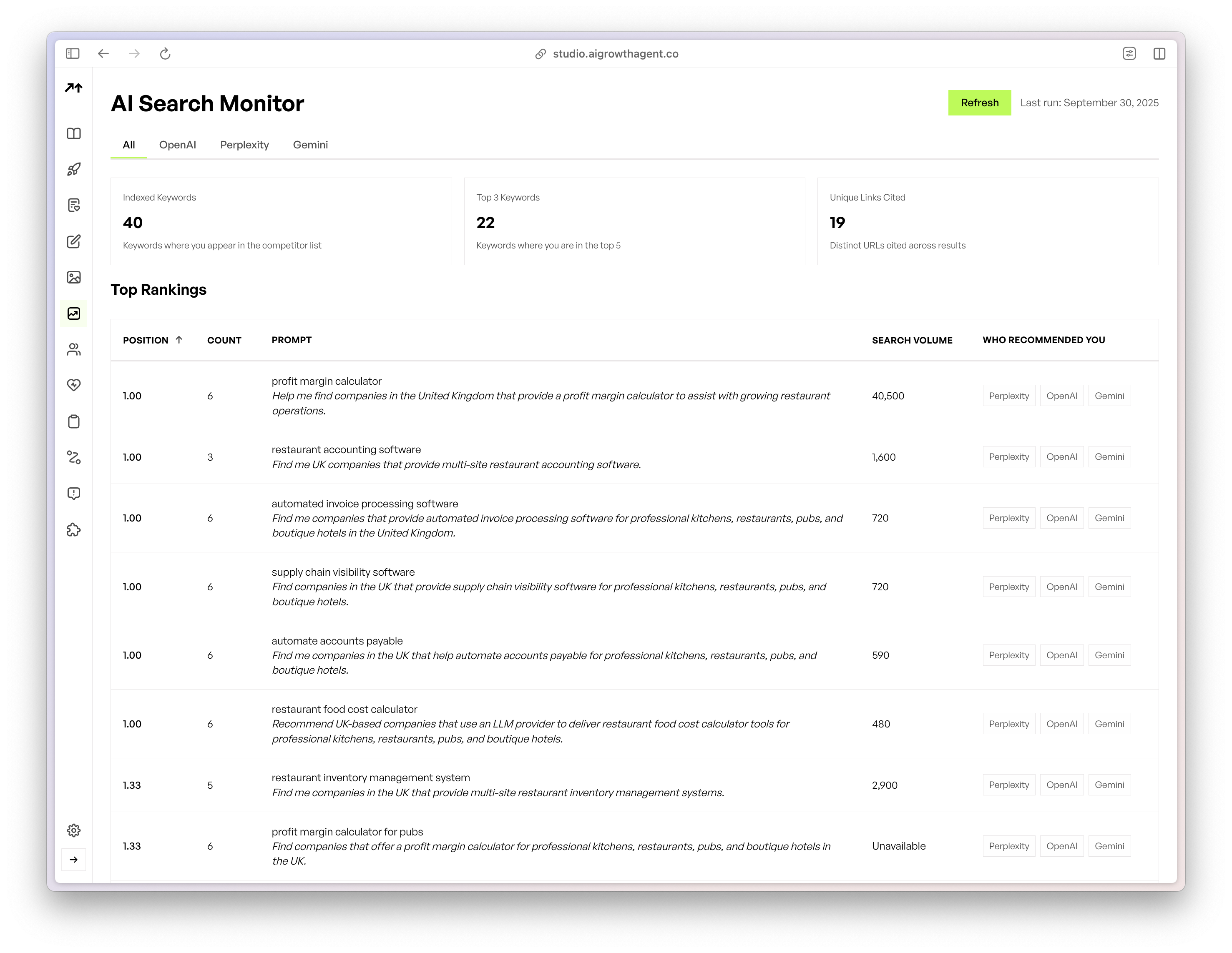
The AI Search Monitor within AI Growth Agent tracks brand visibility and citations across Perplexity. This view helps marketing leaders understand how AI systems use their content.


Monitoring outputs often include:
- Where and how often your content is cited in Perplexity answers.
- Which pages or topics generate the most AI visibility.
- Patterns that show what types of content AI systems prefer to reference.
These insights support an ongoing optimization loop. When specific formats, topics, or content structures perform well, AI Growth Agent can adjust future content generation to reflect those patterns and expand into adjacent opportunities.
Multi-tenant deployment for portfolios and complex organizations
AI Growth Agent supports multi-tenant setups so enterprises can run multiple Programmatic SEO Content Agents from a single interface. Each agent maintains its own manifesto, keyword strategy, and brand voice while sharing the underlying technical infrastructure.
This model works well for:
- Holding companies or portfolio investors with multiple brands.
- Enterprises that manage several product lines or regions.
- Agencies that support multiple clients in related markets.
Each tenant operates as a distinct authority-building engine while still benefiting from standardized technical and monitoring capabilities.
Marketing teams that want to evaluate this model in the context of Perplexity optimization can review a live deployment. Schedule a demo to explore AI Growth Agent’s capabilities for your brand.
A practical framework for implementing Perplexity optimization with AI Growth Agent
Implementing Perplexity-focused strategies works best with a structured rollout that aligns strategy, content, and technical execution. AI Growth Agent follows a framework that supports rapid activation and long-term authority building.
Step 1: Assess your current content and AI visibility
The process starts with an audit of your existing content and current presence in AI search. This assessment looks at:
- Topics where your brand already has strong content and expertise.
- Content gaps where competitors are being cited more frequently.
- Technical foundations that might support or limit AI visibility.
The goal is to establish a baseline and identify the highest-impact opportunities for early gains in citation frequency and authority.
Step 2: Define and program your AI Growth Agent manifesto
The onboarding process produces a Company Manifesto that defines how your brand should appear in AI search. This document captures:
- Core narrative and positioning in your market.
- Primary and secondary expertise areas.
- Preferred voice, terminology, and guardrails.
- Key differentiators that content should reinforce over time.
Marketing leadership participates directly in this step to ensure alignment with broader brand strategy. The manifesto then guides programmatic content generation so that every article, guide, and explainer contributes to a coherent authority story.
Step 3: Use autonomous content engineering at scale
Once the strategy and manifesto are in place, AI Growth Agent manages the content lifecycle from research through publishing. The system:
- Identifies topics and queries where your brand can provide meaningful answers.
- Generates drafts that emphasize accuracy, depth, and clarity.
- Applies technical optimization, including schema and metadata.
- Publishes and interlinks content to strengthen topical clusters.

Content production timelines shorten significantly with this approach. Many brands move from initial consultation to publishing programmatically engineered content within about a week, which helps them respond faster to emerging topics and opportunities in Perplexity.
Common Perplexity optimization challenges and how AI Growth Agent addresses them
Many organizations encounter similar obstacles when they try to optimize for Perplexity using traditional methods. AI Growth Agent is designed to address these constraints.
Challenge: Limited content volume and slow publishing
The amount of authoritative content needed to gain consistent Perplexity citations usually exceeds what small teams can create by hand. A few long-form articles per month rarely provide enough coverage for broad topic clusters.
Solution from AI Growth Agent
The Programmatic SEO Agent publishes technically optimized, in-depth content on a frequent schedule. This higher velocity allows your brand to:
- Cover more topics and subtopics that Perplexity users search for.
- Respond quickly to new developments with expert analysis.
- Build a dense content network that signals strong topical authority.
As the library grows, competitors that still rely on slower, manual processes may find it difficult to match your level of coverage and freshness.
Challenge: Technical gaps that limit AI citation
Traditional SEO tools often focus on keyword and ranking metrics rather than the structures that AI answer engines rely on. Without a consistent schema, clear authorship data, and AI-friendly formats, strong content may remain underutilized.
Solution from AI Growth Agent
Every content asset generated by AI Growth Agent receives a standard set of AI-aware technical enhancements, including:
- Comprehensive schema markup for entities and content types.
- LLM.txt files that describe how AI systems should access your content.
- Integration with the Model Context Protocol (MCP) to facilitate direct AI access to your content repository.
This structure is designed to make it easier for Perplexity and other AI engines to discover, interpret, and correctly attribute your content.
Challenge: Difficulty measuring ROI from AI search efforts
Many analytics stacks were built before AI answer engines became prominent. As a result, teams can struggle to connect investment in AI-focused content with clear visibility or revenue outcomes.
Solution from AI Growth Agent
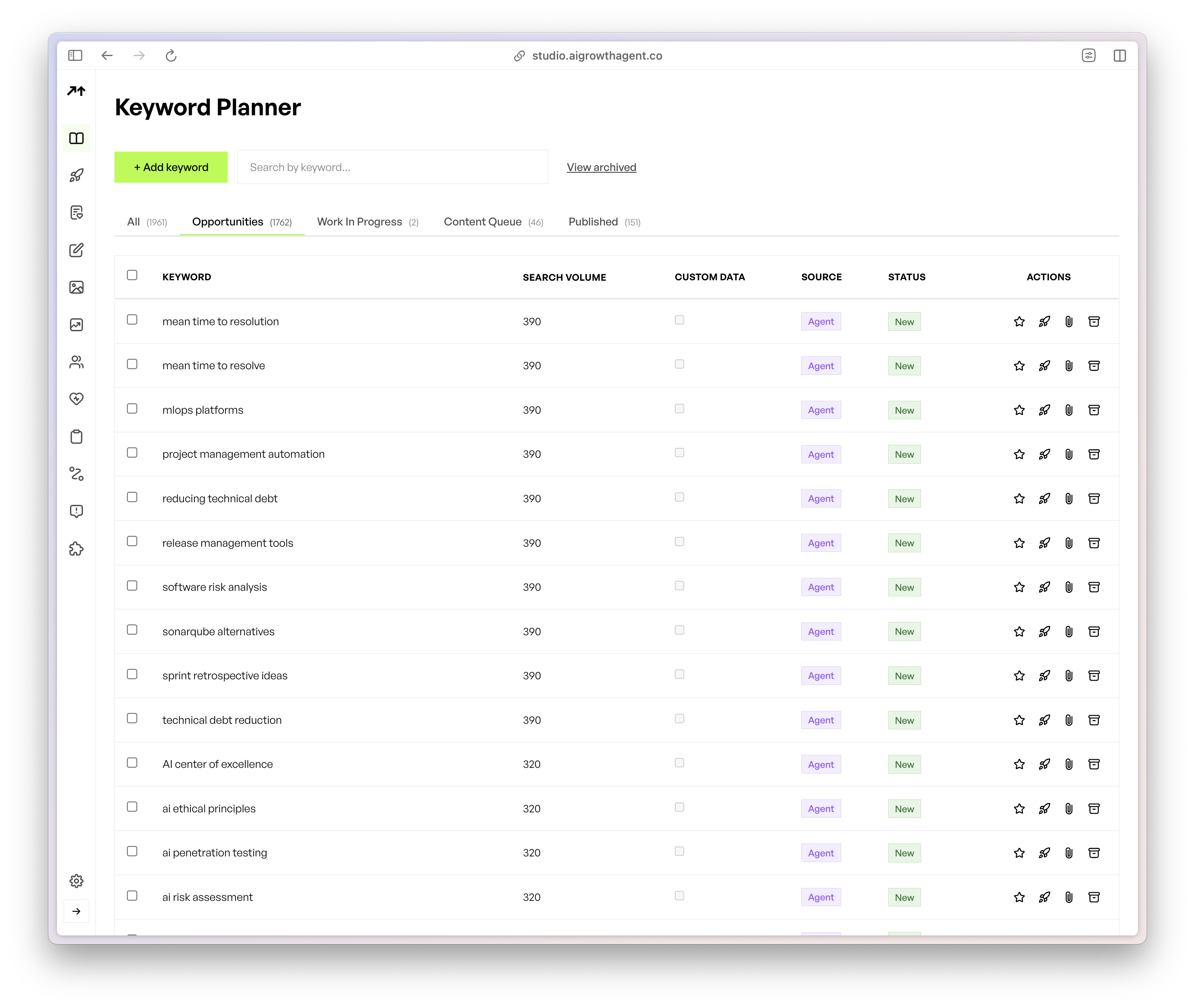
The AI Search Monitor provides metrics that align with how AI systems present and cite content. Key outputs often include:
- Number and nature of Perplexity citations that mention your brand.
- Pages and topics that drive those citations.
- Changes in authority positioning over time within AI-generated answers.
These insights allow marketing leaders to present a clearer case for investment in Perplexity optimization and to refine strategies using observed performance data. Book a demo to see AI Growth Agent’s Programmatic SEO in action for Perplexity AI optimization.
Frequently asked questions about Perplexity AI answer engine optimization
How does Perplexity AI optimization differ from traditional SEO?
Traditional SEO focuses on ranking pages in search results using signals such as backlinks, keyword usage, and user engagement. The primary objective is to earn a high position in search results and drive clicks to your site.
Perplexity optimization focuses on becoming a cited source within AI-generated answers. Content must meet higher expectations for depth, clarity, and verifiability. Technical structures also need to help AI models locate and attribute specific passages, not just whole pages.
The success metrics change from rankings and click-through rates to citation frequency, quality of mention, and share of voice within AI responses on key topics.
Can existing content be optimized for Perplexity AI?
Many organizations can adapt existing high-quality content for Perplexity, but most assets need restructuring and technical enhancement. Useful updates often include:
- Refocusing sections around direct answers to clearly defined questions.
- Adding enough context so each page stands on its own.
- Applying schema markup and explicit authorship details.
- Refreshing outdated information and expanding depth where needed.
Existing content can provide a strong foundation, especially on evergreen topics. However, sustained Perplexity performance usually requires new pieces that are designed from the start with AI answer engines in mind.
What role do keywords play in Perplexity AI optimization?
Keywords still matter for understanding what users care about, but Perplexity emphasizes natural language comprehension over strict keyword matching. Keyword research helps identify topics and user intents rather than serving as a checklist for exact phrases.
Optimization efforts therefore focus on:
- Addressing the real questions behind keyword phrases.
- Covering related subtopics that users often explore next.
- Using natural language that reflects how people actually ask questions.
The goal is to demonstrate authority on entire concepts and problem spaces, not only to repeat target keywords at specific densities.
How quickly can brands see results from Perplexity AI optimization?
Perplexity’s real-time retrieval model allows new or updated content to become visible relatively quickly. Well-structured, authoritative pages can begin earning citations within weeks of publication.
With a programmatic approach like AI Growth Agent, brands often see initial indexing and early citations within two to four weeks after content deployment. Building broad topical authority and sustained citation patterns usually requires consistent effort over several months.
Is Perplexity AI optimization useful if my audience primarily uses Google?
Perplexity reflects broader trends in search and discovery. Many major platforms, including Google, are integrating AI-generated answers into their experiences. Content that meets Perplexity’s standards for authority, clarity, and direct answers often aligns with these broader AI-driven models.
Investing in Perplexity optimization helps brands prepare for a future where AI-generated summaries and answers become more common entry points for information. It also supports brand credibility, since recognition as a trusted source by AI systems reinforces your position across channels.
Conclusion: Position your brand for an AI-driven search future
AI answer engines like Perplexity point toward a search environment centered on conversation, citations, and authority. Brands that adapt content and technical strategies to this model can secure meaningful visibility as user behavior shifts toward AI-generated answers.
Organizations that delay may see a gradual decline in influence as AI systems lean on competitors’ content for explanations, recommendations, and definitions. The requirements for success, including content depth, real-time updates, and detailed technical structures, are best met through systematic approaches rather than isolated projects.
AI Growth Agent provides programmatic scale and technical rigor tailored to AI search. The platform helps marketing leaders create comprehensive, well-structured content libraries and the supporting technical framework that Perplexity and similar systems can cite with confidence.
Marketing teams that prioritize AI search authority now can put their brands in a stronger position as AI-driven discovery accelerates. Schedule a consultation with AI Growth Agent to explore a Perplexity AI answer engine optimization strategy for your organization.