Perplexity Recommendation Algorithm Insights

Explore AI Summary

AI search engines like Perplexity answer questions with synthesized responses that rely on real-time citations, which changes how brands must plan and structure content. Here, you’ll see some recommended insights to master Perplexity’s algorithm and rank in Perplexity search.

  1. Perplexity uses a multi-stage architecture, semantic understanding, and Vespa-powered retrieval, so content needs a clear structure, topical depth, and technical optimization to be discovered and cited.
  2. Content authority on Perplexity depends on manual domain lists, topic multipliers, multi-source corroboration, and external citation signals, which reward brands that publish reliable, well-sourced material at scale.
  3. Deep Research and Sonar 2025 models favor content that supports multi-step reasoning, adjustable search depth, and explicit citation, so comprehensive, interconnected content performs best.
  4. Structured content, detailed schema markup, and robust tracking of Perplexity-specific metrics are now core requirements for AI search visibility, not optional enhancements.
  5. AI Growth Agent uses programmatic SEO, LLM.txt, and Model Context Protocol to produce technically structured, AI-ready content at scale, helping brands earn consistent citations within Perplexity.

Deconstructing Perplexity’s Architecture: The Foundation of AI Search Recommendations

How Perplexity Processes Queries From Intent To Ranking

Perplexity’s recommendation engine operates through five distinct phases: Query Intent Parsing, Semantic Understanding, Routing, Retrieval, and Reranking. The system begins with an LLM that performs semantic analysis to infer user goals and contextual intent, not only surface-level keywords.

The initial query parsing stage marks a clear departure from conventional search. Rather than only matching keywords, Perplexity’s system employs an LLM for comprehensive semantic analysis, focusing on the intent behind the query. This approach allows relevant content to appear even when exact keywords are absent, favoring pages that demonstrate topical authority and semantic depth.

The routing mechanism creates additional efficiency. An intelligent routing system utilizes small classifier models to send queries to the most suitable processing pathway. Simpler questions stay with lightweight models, while complex, multi-step queries route to more capable commercial models such as GPT-5.

The Role of Vespa and Scalability for Content Creators

Vespa sits at the foundation of Perplexity’s infrastructure as a distributed computing platform. It enables scalable and cost-optimized content retrieval by matching model power to query complexity. This architecture lets Perplexity handle large query volumes while maintaining answer quality and relevance.

This distributed design carries direct implications for content strategy. Vespa’s architecture spreads the impact of high-quality, technically optimized content across Perplexity’s entire network. Well-structured, authoritative pages do not only support single queries, they also feed into a broader knowledge graph that Perplexity can reuse across related questions and topics.

Programmatic Integration With AI Growth Agent

A clear view of Perplexity’s architecture shows why programmatic content engineering is essential for consistent visibility. AI Growth Agent aligns its workflow with each stage of Perplexity’s processing pipeline. The Programmatic SEO Agent structures content for semantic richness during query parsing, adds schema and internal structure for efficient retrieval, and implements technical elements like LLM.txt files and Model Context Protocol integration so AI systems can interface with the site directly.

AI Growth Agent also embeds contextual signals, comprehensive schema markup, and broad topical coverage into each content cluster. These elements align with Perplexity’s preference for authoritative, well-corroborated information. Content does more than appear as a blue link, it becomes a source that Perplexity can reliably cite and reuse across related queries.

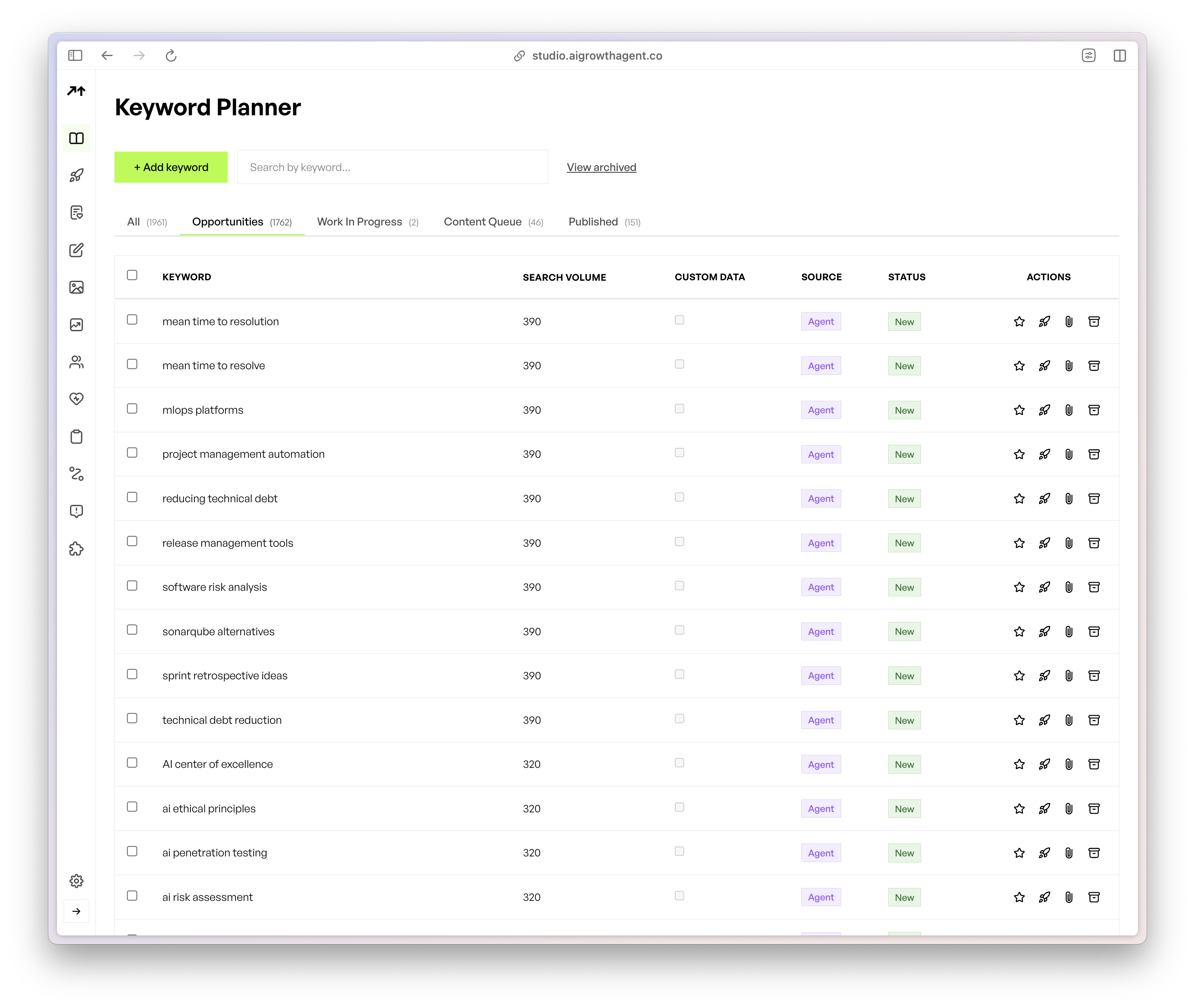
AI Growth Agent Keyword Planner Screenshot

Schedule a consultation session today to see how AI Growth Agent’s programmatic approach supports content engineered for Perplexity’s architecture.

Algorithmic Favor: Key Factors for Perplexity Content Visibility and Citations

Establishing Content Authority on Perplexity

Manual Authoritative Domain Lists and Topic-Specific Multipliers

Perplexity evaluates content authority with methods that move beyond standard domain authority scores. Content visibility is strongly influenced by manual authoritative domain lists and topic-specific multipliers that boost AI and technology content while penalizing other sectors. Visibility depends on both content quality and clear evidence of expertise in topics that Perplexity currently prioritizes.

This approach reshapes content planning. Brands in technology, AI, and related categories benefit from favorable topic multipliers, while those in other industries need stronger evidence of topical authority. Detailed, technically sound content becomes a core requirement for signaling expertise in Perplexity’s preferred knowledge domains.

Multi-Source Corroboration and Credibility Weighting

Perplexity’s Deep Research mode highlights the platform’s focus on source verification. The algorithm weights credibility by prioritizing sources with consistent corroboration across multiple queries and penalizes information from unsubstantiated or fringe domains. Content that can be confirmed by other authoritative sources within a topic gains an advantage.

This credibility weighting creates a compounding effect. When several authoritative sites present or reference similar information, Perplexity treats that overlap as a strong reliability signal. Programmatic strategies that produce comprehensive, fact-based content with robust external citations therefore support long-term visibility.

External Citation and Trust Signals

Perplexity places strong emphasis on real-time citation and external validation. Perplexity employs a relatively straightforward ranking framework but assigns significant weight to external citation and source grounding. This focus creates room for brands that can become frequent, trusted sources in their fields.

These trust signals extend beyond simple backlink counts. Perplexity looks at citation context, topical relevance, and the authority of the referring sites. Over time, this network of signals rewards brands that consistently publish citable, accurate material and become reference points across related topics and queries.

Dynamic Ranking Parameters That Affect Visibility

Content Freshness and Engagement Metrics

Perplexity measures engagement and recency in ways that directly affect ranking. Freshness is managed via strict impression thresholds and time-decay curves, causing rapid visibility decline for older content unless sustained by engagement. Content teams face constant pressure to publish material that remains relevant and actively used.

The platform tracks several engagement signals that influence visibility, including new_post_ctr (engagement metric) and discover_engagement_7d (rolling engagement window). These measures create a feedback loop: high-performing content gains additional exposure, while low-engagement pieces fall out of view quickly.

This dynamic makes consistent, high-quality publishing essential. Single articles may have short peak periods, but an ongoing stream of engaging, authoritative content can build cumulative algorithmic benefits over time.

Semantic Matching and User Intent Alignment

Perplexity’s semantic capabilities expand how it understands both queries and documents. The embedding_similarity_threshold parameter helps Perplexity understand user queries beyond keyword matching. This lets the system surface content that fits the user’s intent even when there are no direct keyword matches.

Content that covers a topic comprehensively and explains concepts in context performs better in this environment. Pages should address the broader problem space around a query, clarify relationships between subtopics, and offer enough detail for Perplexity to link them to a range of related user intents.

AI Growth Agent’s Programmatic Edge for Perplexity

AI Growth Agent approaches these algorithmic factors as interconnected requirements. The Programmatic SEO Agent builds content with explicit authority signals, systematic fact-checking, and detailed schema that align with Perplexity’s credibility standards. Continuous publication and topical expansion help maintain freshness and engagement, while semantic optimization ensures coverage of the full conceptual space around priority topics.

The platform also supports direct AI interface through LLM.txt and Model Context Protocol integration. These implementations help AI systems like Perplexity understand how a site’s content is structured, how topics relate, and where authoritative information lives, improving discovery and citation.

Schedule a demo today to see how AI Growth Agent engineers high-citation content that earns consistent visibility within Perplexity’s recommendations.

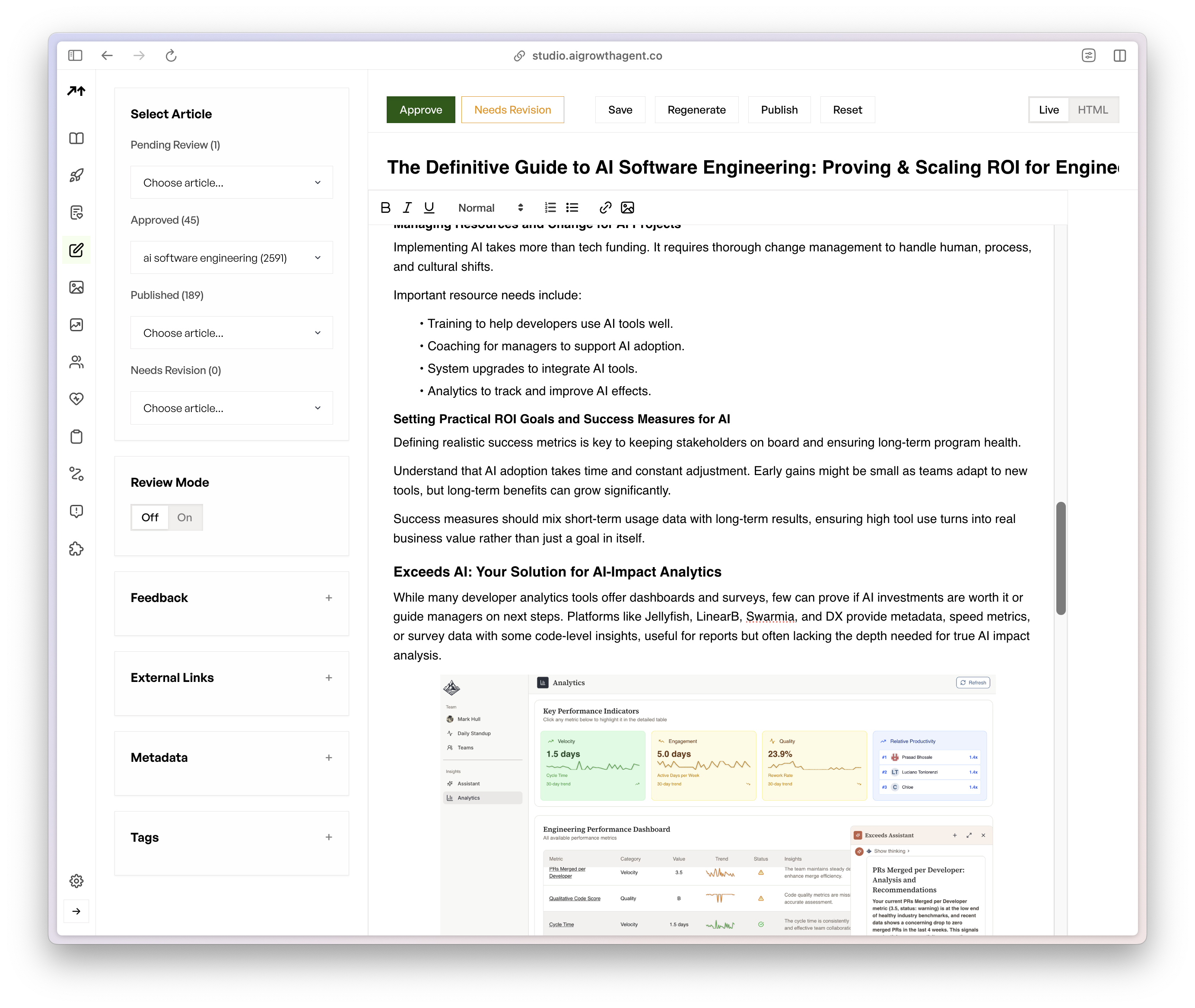
AI Growth Agent Rich Text Content Editor

Deep Research Insights: Unlocking Enhanced AI Citation and Synthesis

Advanced Deep Research Workflows and Their Benefits

Perplexity’s Deep Research mode delivers advanced AI-powered synthesis for complex questions. Deep Research mode autonomously performs dozens of searches and reads hundreds of sources, then synthesizes results into comprehensive, citation-rich reports. This capability changes how users conduct in-depth research and opens new paths for expert content to earn citations.

The multi-source design of Deep Research favors content that appears in several related result sets. During one research session, Perplexity touches many queries and pages. Authoritative, well-structured content that surfaces across these queries gains repeated exposure and citation opportunities.

Deep Research workflows enable multi-source, multi-step reasoning, allowing Perplexity to crawl, rank, and verify results iteratively. This process promotes the most reliable, well-supported sources within each topic domain.

Adjustable Search-Depth Modes and Discovery

Sonar 2025 models add control over how deeply Perplexity searches for information. Sonar 2025 models feature adjustable search-depth modes (Low, Medium, High) that directly control how extensively the algorithm pulls external content for citation and synthesis. Each mode creates a different discovery pathway for content.

These depth modes carry practical consequences for creators. Low-depth searches tend to highlight highly ranked, broadly relevant sources. High-depth searches reach further into specialized or niche material, which creates opportunities for focused expert content to appear and earn citations. This structure rewards both general coverage and deep specialization.

The Role of Prompt Design in Earning Citations

Prompt quality and configuration shape Perplexity’s output and use of sources. Well-crafted prompts and explicit citation requirements dramatically improve Perplexity’s output quality and citation accuracy. Content that is easy for AI systems to interpret and cite benefits from these optimized prompts.

This emphasis on citation is built into Sonar’s design. Sonar’s citation-driven design reduces hallucination and rewards multi-source synthesis. Structured, well-cited content that fits naturally into multi-source answers gains an advantage.

Programmatic SEO for Deep Research Optimization

AI Growth Agent is designed to match the technical needs of Deep Research. Its use of LLM.txt and Model Context Protocol (MCP) lets AI search engines access structured content databases directly, giving Deep Research clear paths into a site’s most relevant information.

The platform also focuses on content architecture, not only on single pages. AI Growth Agent builds embedded context signals, internal links, and semantic relationships that clarify how topics connect across a site. When Perplexity’s Deep Research mode processes this structure, it can reuse and cite content more effectively across multiple related questions and synthesis tasks.

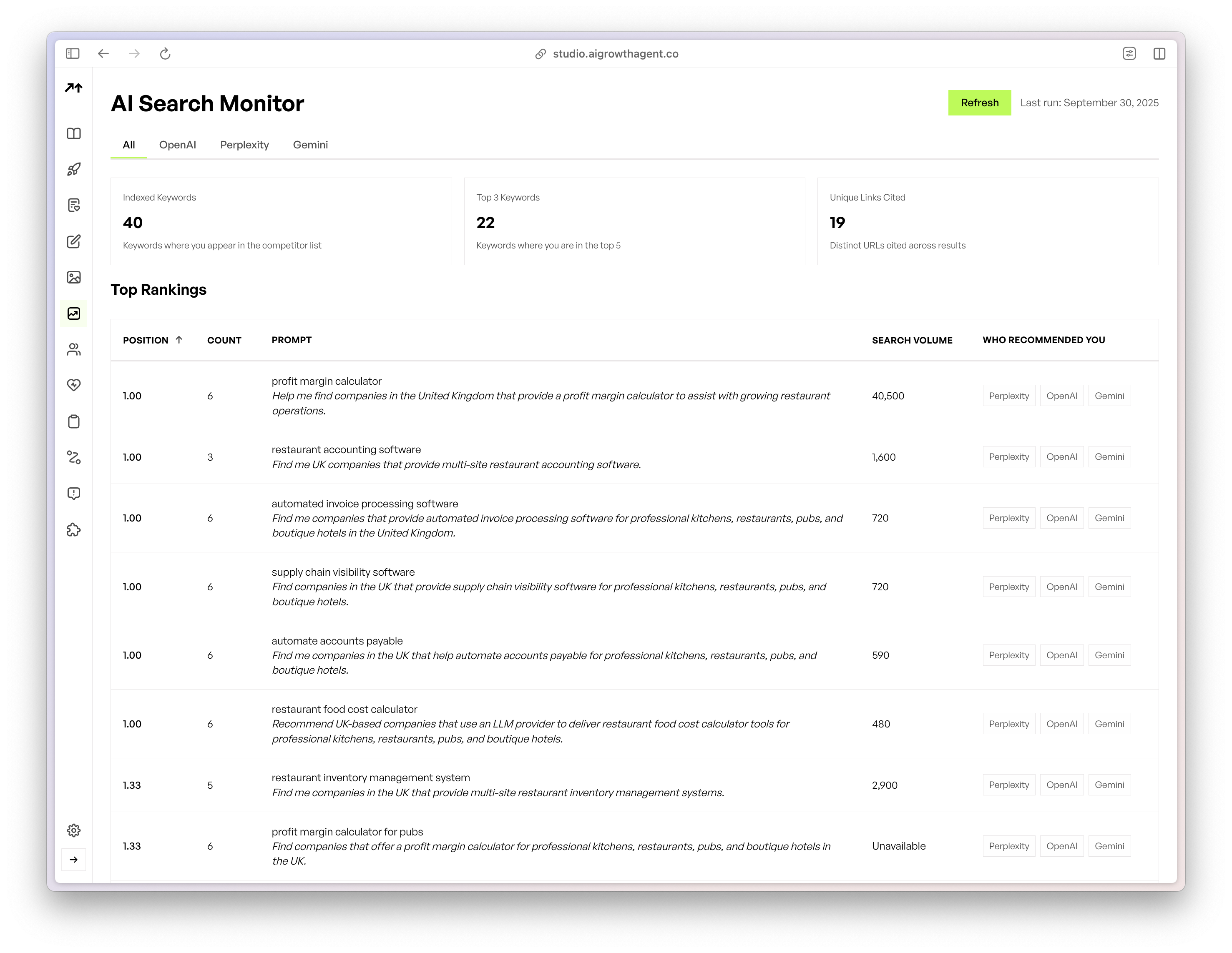
Screenshot of AI Growth Agent AI Search Monitor
Screenshot of AI Search Monitor where you can see what AI is saying about you across ChatGPT, Gemini, and Perplexity

Strategic Implementation: Optimizing Content for Perplexity’s Recommendations

Structured Content and Schema Markup as Baseline Requirements

Technical structure now plays a central role in how Perplexity understands and uses content. Businesses can maximize their likelihood of citation by focusing on relevant schema markup, publishing timely and well-structured content, and establishing clear expertise and trust signals. These elements form the entry point for reliable visibility.

Schema for AI search goes well beyond basic markup. Perplexity can read complex schema relationships, entity connections, and data hierarchies that signal authority, recency, and topical scope. Brands that invest in this technical layer give Perplexity more information to work with when selecting and citing sources.

Query Suggestion, Autosuggest, and Additional Visibility Paths

Perplexity’s query suggestion system opens visibility routes beyond standard ranking. Content recommendation is shaped by a sophisticated query suggestion system that groups user behaviors into always active, domain-triggered, and threshold-based suggestions. Each group creates different ways for users to encounter relevant content.

The autosuggest mechanism reflects real-time interest patterns. Autosuggest draws from trending and suggested query clusters, requiring content to pass multiple validation and block-word layers. This process helps explain sudden visibility spikes when well-structured content aligns with active or emerging topics.

Tracking and Measuring Perplexity Performance

AI search requires new measurement methods that focus on citations and coverage, not only rankings. Tools are emerging to monitor brand mentions, CTR, and topical penetration within Perplexity’s recommendations. These tools support iterative optimization for AI visibility.

Businesses should track engagement metrics, visibility signals, and citation frequency to gauge performance within Perplexity’s AI-powered search environment. Effective reporting focuses on citation quality, topical authority, and sustained presence across related query clusters rather than single-position rankings.

The AI Growth Agent Advantage in Implementation

AI Growth Agent addresses these implementation requirements as part of a single programmatic system. Its research workflows surface trending topics and query patterns, while its technical engine applies schema markup, LLM.txt, and Model Context Protocol across large content sets to improve discovery in Perplexity’s recommendation layers.

Real-time content injection features also help brands respond quickly to new topics and news events. This speed allows content to capture demand early, while consistent technical standards maintain quality over time. Together, these capabilities support durable visibility in AI search environments.

Schedule a demo to see how AI Growth Agent’s autonomous programmatic SEO keeps your content discoverable and citable within Perplexity’s recommendation ecosystem.

Provide the agent with images to naturally incorporate into your content.

Programmatic SEO vs. Traditional Methods: Optimizing for Perplexity AI

AI-powered search engines like Perplexity highlight the gap between traditional SEO methods and programmatic approaches. Brands that want sustained citation in AI environments need to understand how these models differ.

Feature Area

Traditional SEO Agency

Basic AI Content Tools

AI Growth Agent (Programmatic SEO)

Content Output Volume

Low (manual, “craftsman” model)

High (unstructured text)

Very high (programmatically engineered)

Technical Engineering

Limited, manual schema

None (raw text)

Advanced schema, LLM.txt, MCP, site architecture

AI Citation Focus

Indirect, keyword-based

Minimal to none

Direct, explicit for AI systems (for example, Perplexity)

Velocity and Agility

Slow (billable hours)

Fast (text generation)

Instant (Real-Time Content Injection)

Traditional SEO agencies often rely on manual processes that do not scale to AI search requirements. They may create strong individual assets, but usually lack the technical architecture and publishing velocity needed for consistent citation within Perplexity’s dynamic system.

Basic AI content tools focus on text generation rather than structured optimization. They create volume but leave strategy, technical configuration, and refinement to internal teams. This often results in unstructured content that AI systems can crawl but cannot easily prioritize or cite.

AI Growth Agent focuses on the specific needs of AI search. It combines technical SEO features such as schema markup, LLM.txt, and MCP integration with automated execution. This combination supports large-scale content production that is natively structured for discovery, interpretation, and citation by Perplexity and similar platforms.

Frequently Asked Questions (FAQ) about Perplexity AI and Programmatic SEO

How does Perplexity AI determine content authority for its recommendations?

Perplexity AI determines content authority through a multi-factor evaluation system that emphasizes source credibility and corroboration. The platform maintains manual authoritative domain lists and uses topic-specific multipliers that may boost content in areas such as AI and technology while applying more stringent criteria in other sectors.

The algorithm favors multi-source corroboration, so content that several authoritative sites can verify gains greater visibility and citation potential. Perplexity also reviews external citation patterns and trust signals, assessing both the on-page information and the broader ecosystem of sites that reference it. This process helps the system highlight verified, reliable knowledge rather than isolated claims.

What technical elements of content does Perplexity’s algorithm prioritize?

Perplexity’s algorithm prioritizes technical elements that improve understanding, structure, and recency. Content with relevant schema markup ranks higher because schema helps the system categorize and contextualize information. The algorithm also weighs freshness and engagement, using impression thresholds and time-decay curves to keep recommendations current.

Embedding-based semantic matching lets Perplexity evaluate relevance beyond exact keywords, rewarding pages that provide deep, coherent topical coverage. The L3 reranker uses quality thresholds and engagement signals to refine visible results, and technical implementations such as LLM.txt files and Model Context Protocol integration can give AI systems more precise access to a site’s structured knowledge.

Can traditional SEO strategies effectively optimize for Perplexity’s Deep Research mode?

Traditional SEO strategies usually fall short for Deep Research because they were built for page-level rankings, not multi-step AI synthesis. Deep Research runs dozens of searches and analyzes hundreds of sources to produce a single answer, so content must be easily discoverable, machine-readable, and citable across many related queries. Standard tactics that focus on individual keywords and basic technical hygiene do not fully address this requirement.

Deep Research benefits from content architectures that include advanced schema, semantic relationship mapping across topics, and direct AI interface methods such as LLM.txt and Model Context Protocol. These elements help Perplexity treat a site as a connected knowledge base rather than a collection of isolated pages.

Why is programmatic SEO, specifically AI Growth Agent, uniquely suited for Perplexity optimization?

AI Growth Agent is built for the scale and technical demands of AI search optimization. Its programmatic SEO model supports high-volume content creation while maintaining consistent structure, schema, and AI-ready formatting. The platform implements LLM.txt, Model Context Protocol, and detailed schema markup so systems like Perplexity can read and organize site content more effectively.

Autonomous research and content generation workflows are designed to align with Perplexity’s preference for multi-source corroboration and strong domain signals. Real-time content injection then helps brands respond quickly to trending queries, supporting sustained freshness and engagement. Combined, these capabilities help establish topical authority across large subject areas while keeping each asset technically optimized for AI citation.

How do engagement metrics influence content visibility within Perplexity’s recommendations?

Engagement metrics play a central role in Perplexity’s dynamic ranking system. The platform tracks signals such as new post click-through rates and seven-day rolling engagement to understand how users interact with content. Material that does not reach certain impression or engagement thresholds tends to lose visibility as time-decay curves take effect. Strong engagement can have the opposite impact, increasing exposure and extending a page’s useful life.

Perplexity also considers patterns like interaction depth and query completion to gauge whether content fully addresses user needs. These signals reward pages that deliver consistent value over time and encourage ongoing improvement rather than one-time optimization.

Conclusion: Master AI Citation With Programmatic SEO

Perplexity’s recommendation algorithm reflects a significant shift in how search systems evaluate and present information. Its multi-stage processing, emphasis on credibility, and dynamic ranking parameters create new opportunities for brands that design content for AI consumption and citation.

Reaching this standard requires more than traditional SEO or basic AI-generated text. Effective optimization now depends on advanced schema, semantic modeling, and direct AI interface capabilities such as LLM.txt and Model Context Protocol. Many conventional approaches do not operate at the speed or technical depth needed for this environment.

AI Growth Agent is designed to meet these requirements. Its Programmatic SEO Agent combines technical engineering with scalable execution so content can be produced, structured, and updated in ways that fit Perplexity and other AI search platforms. Integrated research, schema, and real-time publishing workflows help brands maintain a consistent presence where AI systems look for reliable sources.

Brands that invest in this level of content engineering can establish durable authority within AI search ecosystems. As Perplexity and similar tools gain adoption, early movers that build structured, citable content foundations are more likely to retain visibility, while organizations that rely on legacy tactics risk losing share of voice.

To position your brand as a trusted source for Perplexity and other AI search engines, schedule a demo to see how AI Growth Agent can architect your programmatic SEO strategy. Programmatic workflows help shift content operations from manual production to systematic authority building so your brand can appear more often in AI-generated answers across your market.

Publish content that ranks in AI search

START RANKING NOW