


Key Takeaways
- AI search systems like ChatGPT, Google AI Overviews via Gemini, and Perplexity now favor authoritative citations and structured entities over traditional keyword rankings.
- Brands that publish high-velocity, well-structured, and transparently sourced content gain an advantage in how often AI systems reference and recommend them.
- Structured data, schema, and entity-centric content design act as gateways that help AI models correctly interpret, retrieve, and cite your information.
- Programmatic SEO operationalizes this work at scale, allowing smaller and mid-size brands to compete with large publishers in specialized niches.
- AI Growth Agent helps teams implement programmatic SEO for AI citations, from strategy to technical execution; schedule a strategy session to see how it can support your growth goals.
The New AI Search Landscape: Why Citations Outrank Traditional SEO
Shift From Keywords To AI Citations
AI search now treats content as a network of citations rather than a list of keyword matches. The focus has moved from isolated pages that rank for specific phrases to domains that act as reliable, structured references for a topic.
Major media organizations appear in at least 27% of over 1M observed citations across generative AI models, which shows how LLMs lean toward domains that look like their training data. AI evaluates trust, depth, and clarity more than traditional keyword density or on-page tricks.
Why Programmatic Velocity Now Matters
AI tools rapidly expand the volume of content online, which reduces the relative footprint of any single brand. Publishing a handful of manual posts each month rarely provides enough coverage or recency for LLMs that reward depth and fresh updates.
LLMs balance long-term authority with current information, favoring entities that maintain consistent coverage and refresh key resources. Brands need systematic, ongoing publication rather than occasional campaigns.
How Invisibility Lets Competitors Own Your Narrative
Insufficient content volume and topical depth leave gaps that competitors fill. If AI models lack enough reliable signals about your brand, they turn to better-documented alternatives and cite those sources instead.
Competitors that invest in structured, citation-ready content shape the answers that AI gives to buyers researching your space. Their positioning becomes the default explanation of the category.
AI Citation Signals: What LLMs Look For In Authoritative Content
Trusted Formats And Domains Give You A Head Start
Pretraining data for LLMs draws heavily from books, academic journals, reference works, news archives, and government or technical documents. Content that mirrors these formats, with clear structure and sourcing, aligns more closely with what models already recognize as reliable.
Smaller brands can compete by publishing well-structured reports, guides, and explainers that provide more granular coverage than large publishers offer in niche areas.
Topical Depth And Semantic Coverage Improve Citation Odds
LLMs reward domains that cover a topic as a connected web of concepts, subtopics, and related questions. Sites that address advanced practitioner-level questions, not only basic FAQs, send a clearer signal of expertise.
Brands build topical authority by organizing content into clusters that share vocabulary, entities, and intent, so AI can see a consistent pattern of knowledge around a subject.
Transparency And Governance Support Trust
LLMs factor in expert authority, factual accuracy, entity consistency, content freshness, and cross-source corroboration when assessing trust. Clear authorship, editorial standards, and source disclosure strengthen how AI and human readers interpret brand accountability.
Pages that omit this context may still rank for some queries but are less likely to be selected as citations in AI-generated answers.
Cross-Source Corroboration And Verifiable Facts
Models place more weight on claims that appear consistently across multiple independent, reliable domains. LLMs also compare statements against known reference sources to validate accuracy.
Content that cites primary research, government data, and recognized industry reports makes it easier for AI systems to verify information. These pages become more attractive candidates for citation.
Schedule a demo to review how well your current content aligns with these AI citation signals.
Structured Data And Schema: Gateways To AI Discoverability
Schema As A Practical Bridge To AI Systems
Pages that use JSON-LD or microdata schema appear more often in AI answers than similar pages without structured data. LLMs depend on structured information that search engines pass through to retrieval layers, so schema helps clarify entities, relationships, and context.
Search engines index this metadata and feed it into AI models, which improves the chance that your content appears as a source behind an AI-generated response.
Entity-Centric Metadata Supports Precise Answers
Identifiers such as GTIN, ISBN, product IDs, prices, and availability let AI systems ground answers in specific products, services, or locations. This precision reduces ambiguity and encourages models to surface your page when users ask detailed commercial or local questions.
Programmatic SEO strategies extend this practice across large content sets, so every query-relevant page carries consistent schema and entity data.
Model Context Protocol And LLM.txt For Direct AI Context
AI Growth Agent supports a blog-focused Model Context Protocol (MCP) that enables AI systems to interface more directly with your content. This structure clarifies how posts relate to each other, which topics they cover, and which entities they describe.
Combined with advanced LLM.txt implementation, this approach creates a machine-readable map of your content that improves AI retrieval and citation potential.
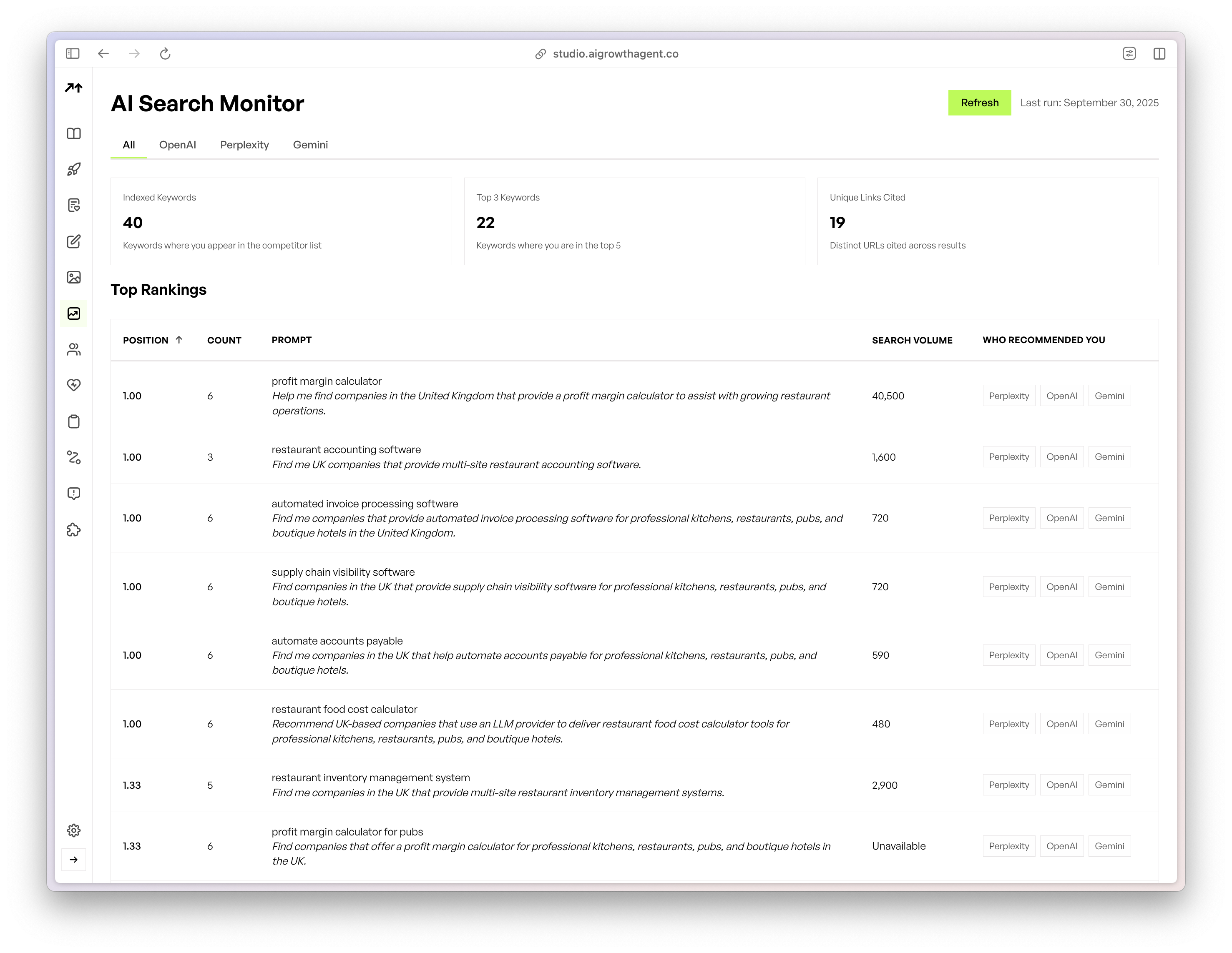
Book a strategy session to learn how structured data and MCP can improve your AI visibility.
AI Growth Agent: Programmatic SEO For AI Citations
Autonomous Programmatic SEO For Scaled Content Engineering
AI Growth Agent operates as a Programmatic SEO Agent that designs and executes citation-focused content architectures at scale. The platform reduces manual work and manages the full SEO lifecycle, from strategy through publication.
Teams move from initial planning to live, technically optimized content in about a week, while preserving the authority signals that matter to AI systems.
Onboarding And The Company Manifesto For Brand Consistency
Engagements start with a focused onboarding session that produces a Company Manifesto. This internal reference document defines positioning, voice, and non-negotiable guidelines for how the brand should appear across content.
The agent uses this manifesto to keep high-volume, programmatic output aligned with your messaging and differentiation.
Programmatic Research And Content Strategy
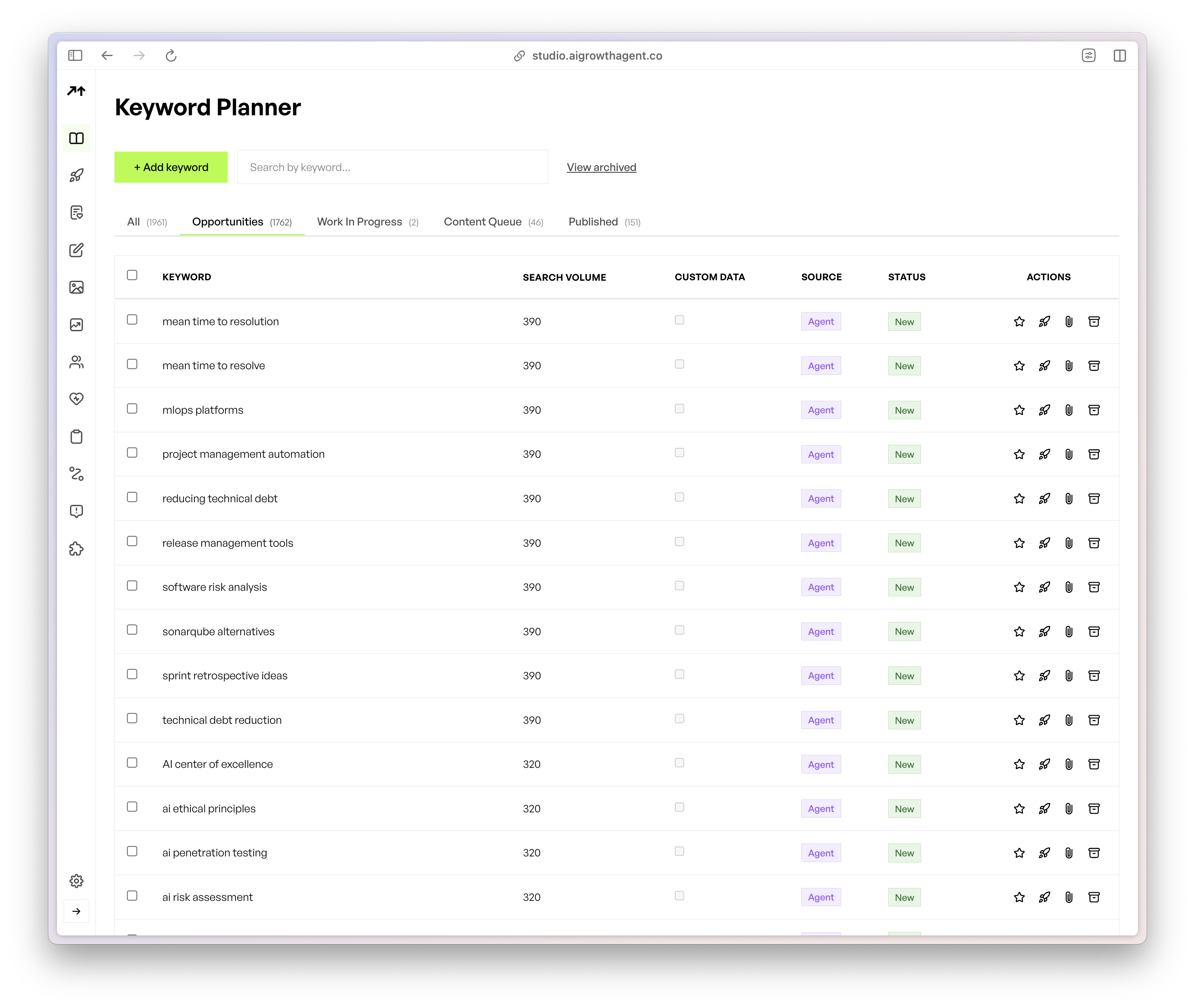
After onboarding, the agent ingests your context and analyzes large sets of relevant search queries. It then assembles a Programmatic Content Strategy organized into pillars and clusters that reflect how AI search groups’ intent.
Each cluster targets a defined opportunity for AI rankings and citations, giving teams a clear roadmap for building topical authority.
End-To-End Content Engineering For LLM Retrieval
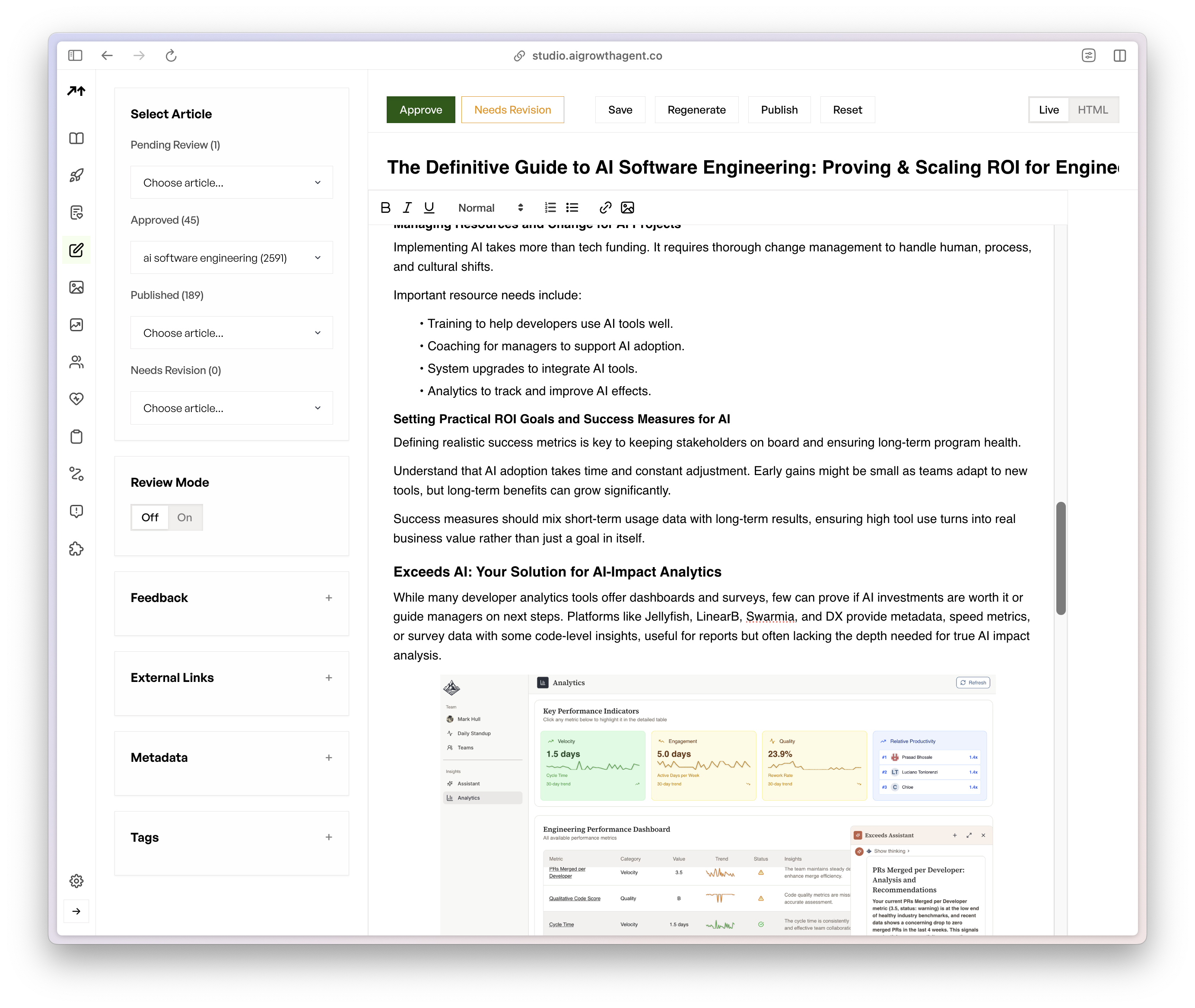
The Programmatic SEO Agent manages strategy, research, drafting, fact-checking, and technical optimization. Every post includes rich schema, optimized metadata, LLM.txt, and MCP implementation to support AI indexing and retrieval.
This workflow goes beyond generic AI writing tools that only generate unstructured text and leave technical SEO work to manual processes.
Real-Time Content For Emerging AI Search Demand
AI Growth Agent can also respond to breaking topics. Teams provide a link or prompt for trending news, and the agent creates SEO-ready content that reflects your brand perspective within minutes.
This speed helps your brand appear in AI answers for new or fast-moving queries while interest remains high.
|
Feature |
AI Growth Agent |
Traditional SEO Agency |
Generic AI Tools |
|
Content Velocity |
Daily programmatic output |
1-2 posts per month |
High volume, low quality |
|
Technical SEO |
Automated schema, MCP, LLM.txt |
Manual implementation |
Little to no technical optimization |
|
Brand Consistency |
Company Manifesto integration |
Style guide adherence |
Generic output that needs editing |
|
AI Citation Focus |
Engineered for LLM retrieval |
Traditional ranking focus |
No explicit citation strategy |
Schedule a demo to see how the Programmatic SEO Agent compares to your current approach.
Case Studies: How Brands Built AI Authority With Programmatic SEO
Exceeds AI: Rapid Multi-Platform Citations
Exceeds AI used AI Growth Agent to strengthen visibility for performance review tools. Within two weeks, Perplexity recommended the brand as a top alternative in its category. By week three, core terms appeared in Google AI Overview and Gemini snapshots. Exceeds AI now shows up across ChatGPT, Google AI Overview, Gemini, and Perplexity for searches related to AI performance review tools for engineers.
BeConfident: Niche Leadership In Language Learning
BeConfident competes with larger players in language learning. After programmatic publishing with AI Growth Agent, the content indexed quickly and began appearing in Google AI Overview and Gemini. Within weeks, BeConfident became the top recommended English-learning app in Brazil for relevant AI-assisted queries.
Bucked Up And Gitar: Commercial And Technical Authority
Bucked Up gained citations in sports nutrition. Within three weeks, ChatGPT cited the brand as a leading protein soda option and surfaced it as the top citation for “best protein soda” in relevant AI results. Gitar applied the same approach for AI-powered CI or CD automation and now appears across major AI systems for queries about fixing broken CI builds, AI reviewers for CI failures, and self-healing software for developers.
Book a strategy session to explore similar AI citation opportunities for your brand.
Frequently Asked Questions About Programmatic SEO For AI Citations
How do LLMs balance content freshness with historical authority for citations?
LLMs favor domains that show a long record of accurate coverage while also updating important resources with new information. Programmatic SEO supports this by refreshing key URLs instead of fragmenting authority across many similar pages.
Does traditional SEO still matter for gaining AI citations?
Traditional signals such as backlinks, content quality, and user trust still correlate with AI citations. Pages that rank well in search engines are more likely to be retrieved by AI systems, but citation-focused optimization adds layers like structured data and answer-ready formatting.
Can small sites compete for AI citations against large publishers?
Specialized sites can compete by focusing on narrow topics with more depth and better sourcing than broader media properties. Fact-dense reports, guides, and explainers supported by strong schema give smaller domains an edge in detailed or technical queries.
How does AI Growth Agent support content quality and factual accuracy?
AI Growth Agent uses your Company Manifesto, structured research workflows, and integrated fact-checking modules to shape each article. Technical outputs such as LLM.txt and MCP help AI systems interpret content accurately and connect it to the right queries.
What makes programmatic SEO different from traditional content marketing for AI search?
Programmatic SEO centers on scalable, technically rigorous content systems that AI can parse and cite. It emphasizes structured data, entity modeling, and interconnected clusters rather than one-off articles, which better matches how AI search organizes knowledge.
Conclusion: Why Programmatic AI Citation Strategies Are Now Essential
LLM-focused SEO builds on traditional foundations but introduces a distinct discipline centered on retrieval, structure, and answerability. Brands that adapt to this model improve both human search performance and AI visibility.
Manual content programs rarely achieve the consistency, pace, and technical depth needed for sustained AI citations. AI Growth Agent supports teams by engineering content around AI trust signals, from schema and LLM.txt to MCP and citation-aware strategy.
Brands that invest in AI citation strategies today shape how their category is described in AI results over the coming years. If you have a strong product and want to lead your space through Programmatic SEO, schedule a strategy session with AI Growth Agent.
