


AI-driven search tools such as ChatGPT, Google AI Overviews via Gemini, and Perplexity are reshaping how customers discover e-commerce brands, favoring structured, recent, and high-volume content.
Programmatic SEO helps e-commerce teams convert product and customer data into thousands of targeted, optimized pages that expand search coverage and support AI citations. What you’ll see in this article:
- E-commerce brands that rely only on manual content production risk losing visibility to competitors that scale content programmatically across products, categories, and use cases.
- Effective programmatic SEO requires a data-driven keyword strategy, strong technical foundations, quality controls for brand voice, and continuous monitoring across AI search platforms.
- AI Growth Agent offers tools for keyword planning, content generation, technical SEO, and AI search monitoring built for e-commerce catalogs and multi-brand portfolios.
Why AI Search Makes Programmatic SEO Essential for E-commerce Brands
E-commerce brands face shrinking visibility as AI multiplies the volume of online content. AI systems now surface and summarize information from large content libraries, which favors brands with consistent, structured, and frequently updated content.
The new baseline is programmatic velocity. Large language models prioritize recency, depth, and structural consistency across many related pages. For e-commerce teams managing extensive product catalogs, manual content strategies cannot keep pace with the volume and technical requirements of AI search optimization.
Insufficient content volume becomes a strategic liability in this environment. If AI engines do not find enough relevant data points about your brand, they will rely on other sources. Competing brands then receive citations, recommendations, and category authority in AI-generated answers.
E-commerce brands now need programmatic SEO strategies that generate high-quality, authoritative content at scale. Traditional approaches such as manual product descriptions, occasional blog posts, and seasonal campaigns do not provide enough coverage or structure for modern AI indexing.
Marketing leaders who want to strengthen AI search performance can explore a programmatic approach. Schedule a consultation session with AI Growth Agent to assess how programmatic SEO can support your e-commerce growth goals.
Understanding Programmatic SEO for E-commerce: Fundamentals and Benefits
What is programmatic SEO for e-commerce brands
Programmatic SEO shifts content creation from one-off writing to data-driven, template-based generation at scale. For e-commerce brands, this approach uses automated systems to create large numbers of optimized pages that target specific keywords, product attributes, categories, and customer search behaviors.
Instead of relying on individual writers to craft every page, programmatic SEO uses structured data, content templates, and algorithms to generate content that meets search requirements. This content includes metadata, on-page copy, internal links, and schema that align with how AI search engines crawl and interpret information.
The core strength of programmatic SEO comes from processing large datasets, including product information, customer behavior patterns, search trends, and competitor positioning. These data sources become structured content that AI systems can easily interpret, index, and cite. This model aligns well with e-commerce, where every product, category, and interaction produces data that can become an SEO asset.
Key benefits for e-commerce brands
- Scalable content generation: Programmatic SEO offers scalability that allows e-commerce brands to generate large volumes of content that keep pace with changing market conditions and customer trends. This scale supports fresh, relevant coverage across many product pages, categories, and supporting resources.
- Enhanced targeting for niche markets: Programmatic systems allow brands to reach very specific customer segments with tailored content. Programmatic SEO improves rankings for long-tail keywords by expanding coverage for specialized product queries. This approach is valuable for brands in niche categories or with many product variations.
- Improved product discoverability: Programmatic SEO supports the creation of thousands of product and category pages optimized for specific terms. Broad coverage helps each product in a catalog appear for more relevant searches across traditional and AI-powered platforms.
- Dynamic content updates: E-commerce content must reflect changing inventory, prices, promotions, and features. Dynamic updates ensure that frequent changes are reflected in indexed content, which improves visibility and accuracy. Programmatic systems can update content automatically as data changes in product feeds or databases.
- Technical SEO at scale: Structured data and schema markup deployed at scale help search engines interpret and present e-commerce content more effectively, which can improve click-through rates and trust. AI search engines rely heavily on this structure when selecting and citing sources.
- Operational efficiency: Programmatic SEO automates bulk optimization so thousands of product pages stay SEO-ready with less manual effort. Teams can then spend more time on strategy, testing, and creative campaigns.
How to Implement Programmatic SEO Across Your E-commerce Catalog
Building a data-driven content strategy
Effective programmatic SEO for e-commerce starts with a clear, data-backed view of how customers search across the full journey, from discovery to purchase and post-purchase support. This includes informational, navigational, and transactional queries.
Successful strategies account for common e-commerce behaviors, such as comparison searches, specification lookups, price checks, and review research. Content clusters should address primary product keywords and related topics, including alternatives, use cases, compatibility, and buying guides that AI systems draw on when answering questions.
Structured data plays a critical role in programmatic SEO for e-commerce by increasing visibility and providing richer contextual signals to search engines. Strong data structures help AI systems understand what products are, how they relate to each other, and how they solve customer problems.
Balancing automation with quality control
Programmatic SEO can produce content at a pace that manual teams cannot match, but scale introduces quality and brand risks. Automated content generation can lead to thin content, weak relevance, or off-brand messaging if not managed carefully.
Governance frameworks help maintain standards across thousands of pages. These frameworks usually include brand voice guidelines, content quality benchmarks, and automated checks that flag pages with issues or gaps. Editorial review can then focus on the pages with the highest impact or highest risk.
Maintaining a cohesive brand identity across large numbers of automated pages requires deliberate editorial oversight. Modern programmatic systems use brand voice models and rules to apply tone and messaging consistently while still tailoring content to specific products and intents.
Establishing technical foundations for programmatic success
Strong technical infrastructure allows programmatic SEO to run reliably at e-commerce scale. Key components include clear site architecture, a flexible content management system, and automation that can handle frequent updates without slowing performance or degrading user experience.
Programmatic SEO automates bulk optimization so large product catalogs remain SEO-ready. Automation works best when it rests on reliable templates, clean data, and a clear internal linking strategy.
Modern implementations also need to account for AI-specific requirements. This includes detailed schema markup, well-structured metadata, and consistent content patterns that AI search tools can interpret and reuse confidently.
E-commerce teams that want a faster path to this infrastructure can use purpose-built tools. Schedule a demo with AI Growth Agent to see how technical setup and content deployment can be simplified for programmatic SEO.
Overcoming Common Programmatic SEO Challenges for E-commerce
Reducing duplicate content and keyword cannibalization
Programmatic systems that rely heavily on shared templates can unintentionally create duplicate or near-duplicate content across many product and category pages. Duplicate content remains a major implementation risk for e-commerce brands using programmatic SEO when templates repeat the same descriptors.
Effective solutions use dynamic elements and product-specific data to differentiate each page. These can include unique specifications, use cases, buyer profiles, comparisons, and contextual details that add clear value for a visitor and a search engine.
Keyword cannibalization occurs when many pages target the same queries and compete with each other. E-commerce teams can address this through keyword mapping, intent segmentation, and clear rules that define when a query should route to a product page, category page, or educational resource.
Maintaining brand voice and authority at scale
Content that scales quickly can drift away from brand standards if not guided carefully. Maintaining brand consistency and a cohesive identity across large numbers of automated pages requires clear editorial models.
Brands can respond by translating their personality, value propositions, and tone into structured rules that guide automated generation. These rules can specify how to describe benefits, how to handle sensitive claims, and how to vary tone across product types or customer segments.
Advanced programmatic SEO tools support this with brand-specific training data, voice controls, and quality checks. These features help ensure that each page supports both search performance and brand perception.
Adapting to evolving AI search behavior
AI search platforms and ranking signals evolve quickly. E-commerce brands that depend on programmatic SEO benefit from systems that adapt without requiring full rebuilds of their content strategy.
Adaptable setups monitor AI search performance and integrate feedback loops. These loops track changes in visibility, citations, and engagement across platforms, then adjust templates, metadata, and internal linking patterns in response.
Programs that include ongoing performance review, automated testing, and incremental updates are better positioned to maintain visibility as AI search behavior shifts.
E-commerce teams that want structured support for these challenges can use specialized platforms. Schedule a consultation session with AI Growth Agent to explore programmatic SEO options for your brand.
AI Growth Agent: Programmatic SEO Support for E-commerce Brands
AI Growth Agent is a programmatic SEO platform built for the AI search era. It focuses on helping e-commerce brands design content architectures that improve authority, search coverage, and AI citations across their categories.
Key features for e-commerce teams
- Autonomous technical infrastructure: AI Growth Agent sets up optimized blog and content architectures that align with an existing site, preserving brand consistency while adding a programmatic foundation. The platform manages technical SEO elements such as schema markup, metadata, and internal linking.
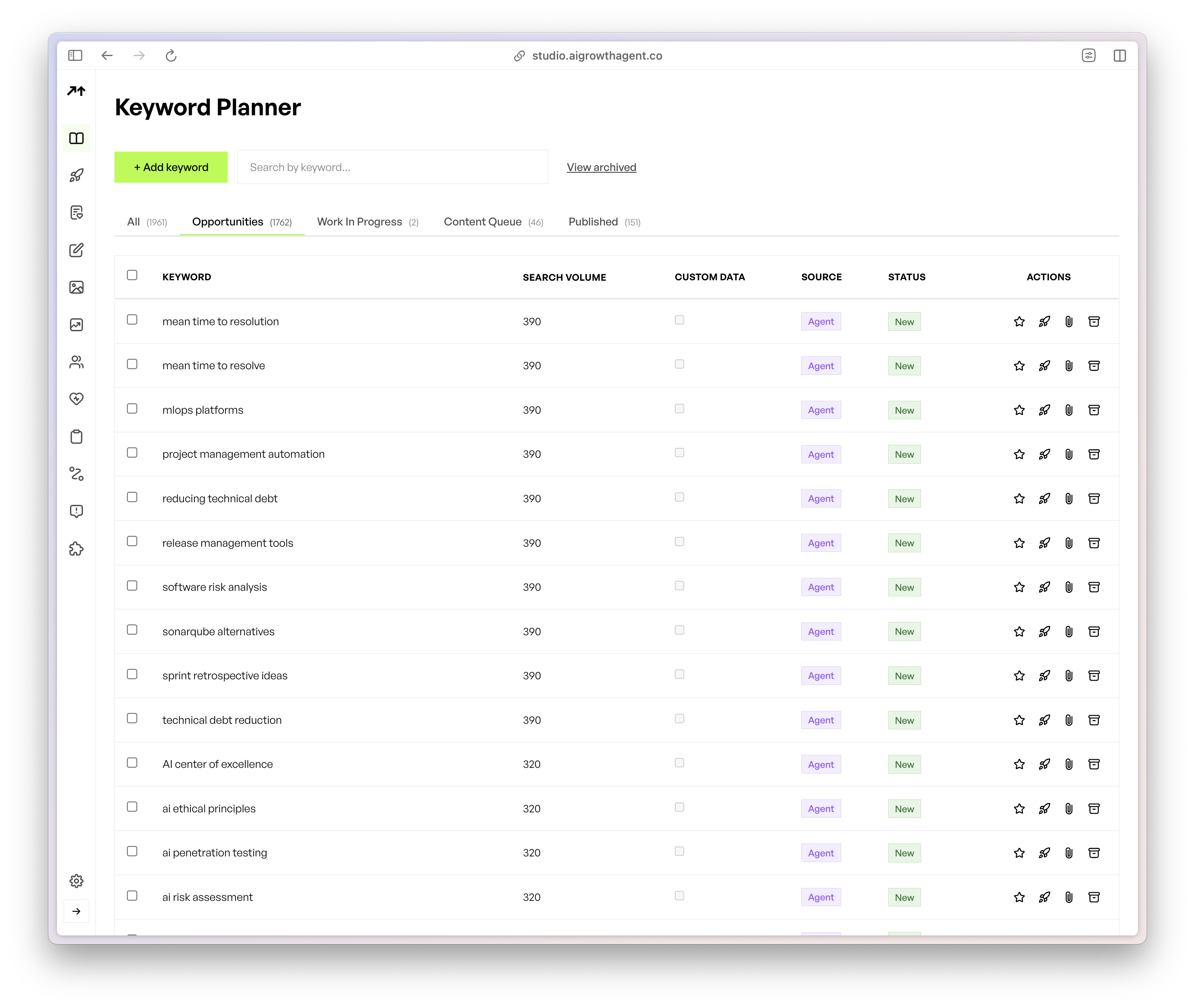
- Programmatic keyword and content research: AI Growth Agent evaluates large sets of search queries and topics related to a brand’s domain, then organizes recommendations into pillars and clusters structured for AI-powered search engines.
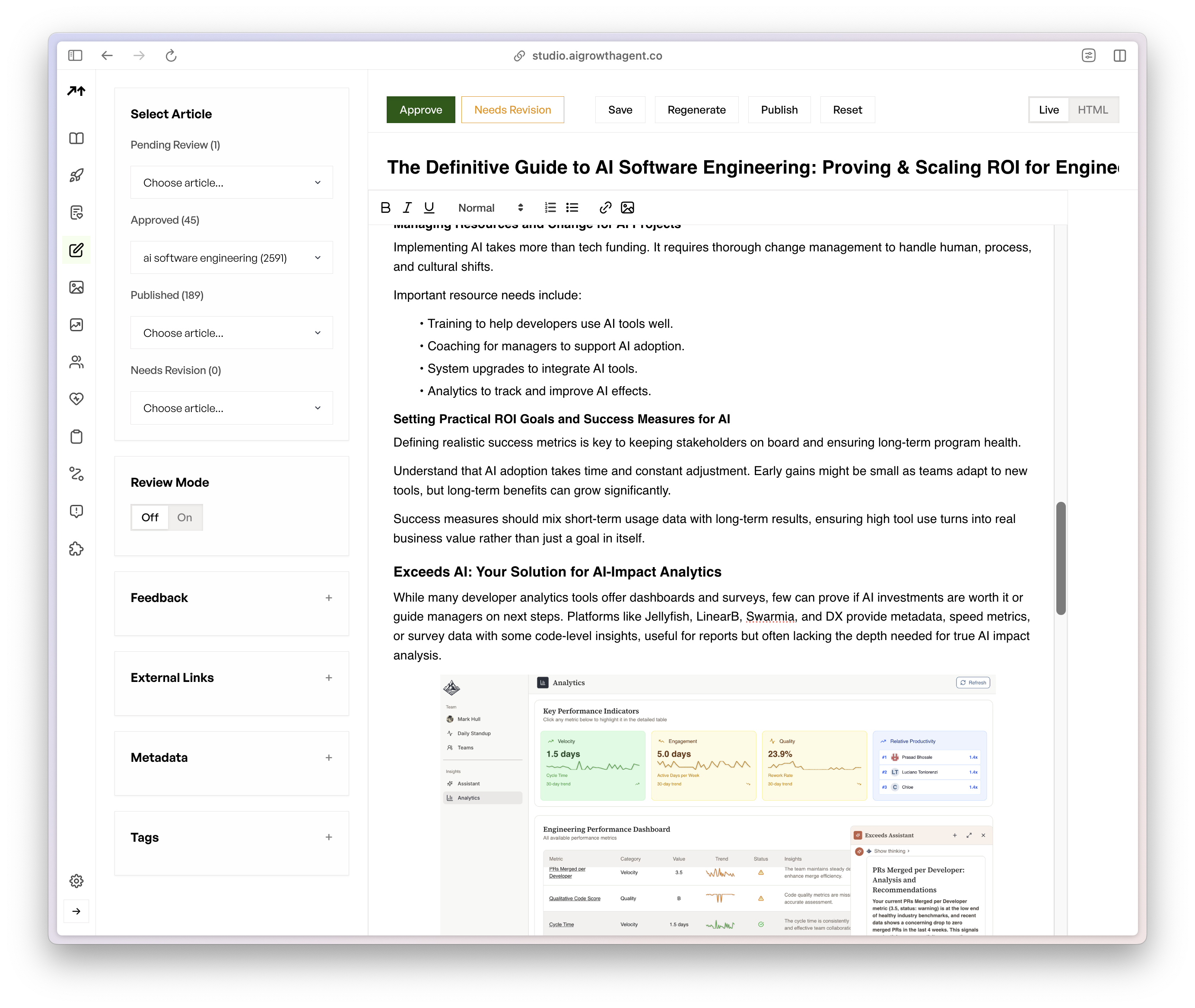
- Content creation and editing: The platform can generate and refine long-form and supporting content that aligns with brand guidelines and programmatic templates, while giving teams editorial control where needed.
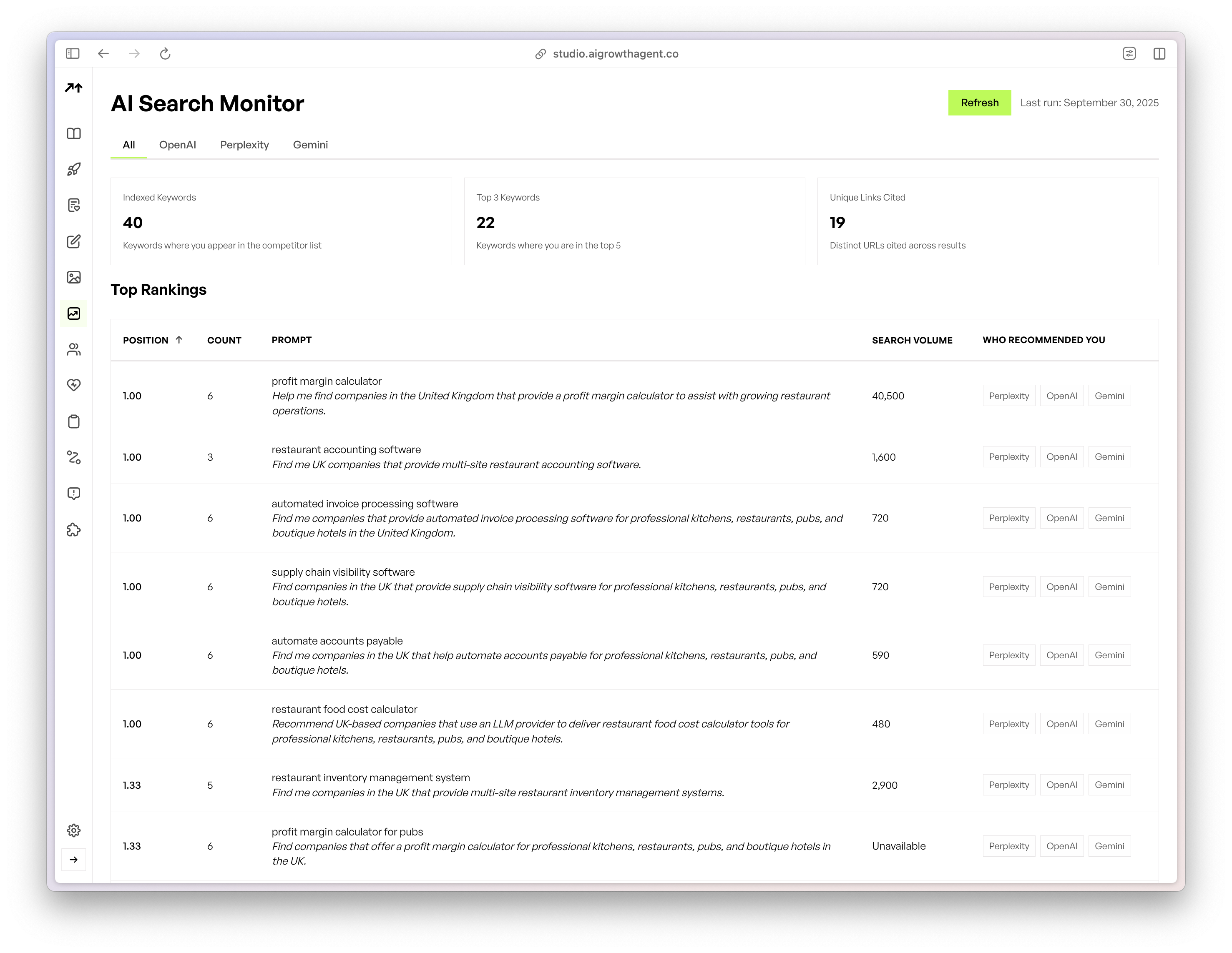
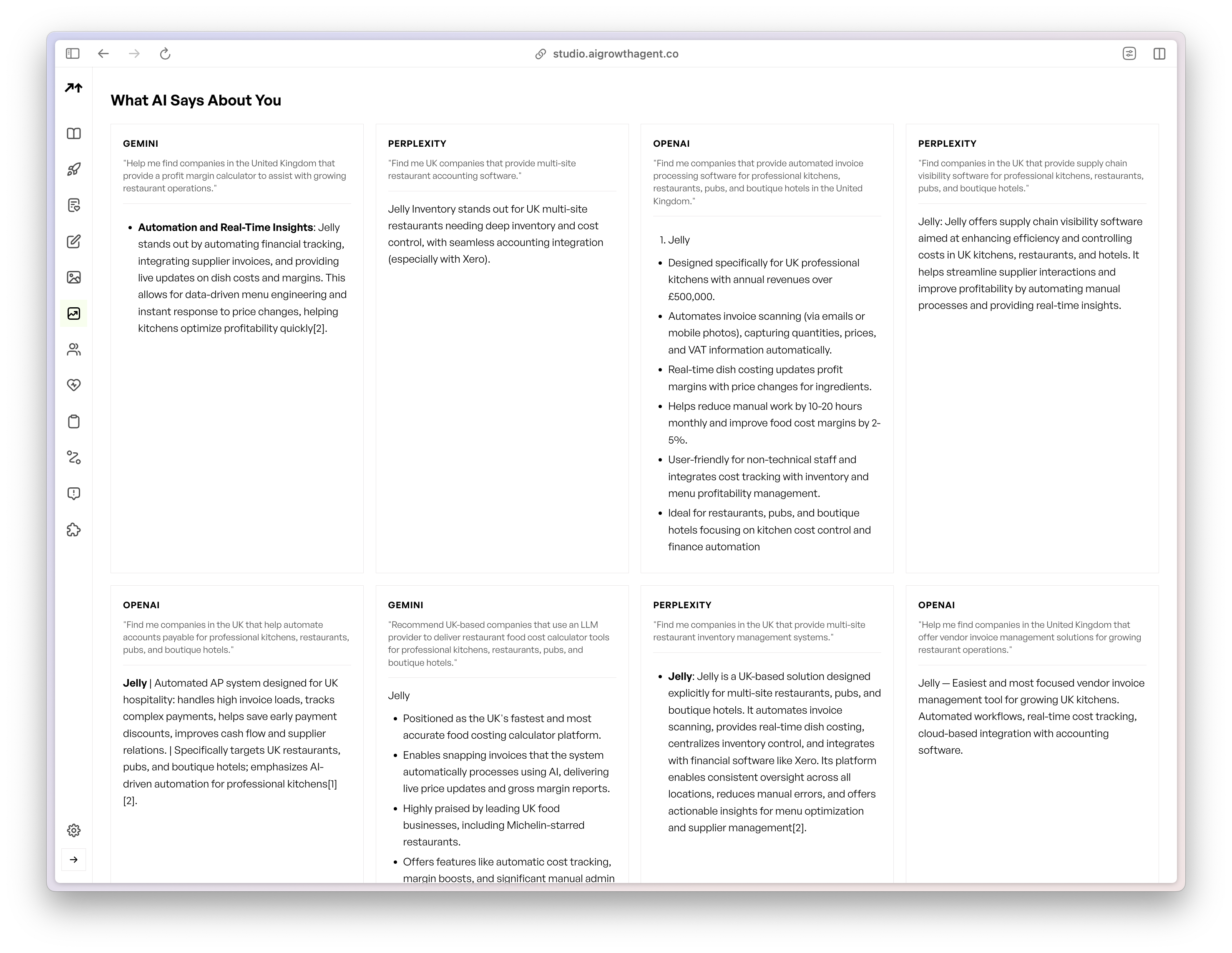
- AI search monitoring and feedback loop: AI Growth Agent tracks performance across ChatGPT, Google AI Overviews via Gemini, and Perplexity. Brands can see which content influences AI visibility, monitor citations, and surface new optimization opportunities.
- Multi-tenant programmatic deployment: Enterprises with several brands or product lines can manage multiple programmatic SEO strategies from a single interface, while still maintaining distinct brand voices and content approaches for each.
- Database-to-content automation: AI Growth Agent connects to proprietary databases, such as product or recommendation systems, and turns that data into structured SEO content. This process helps teams convert internal knowledge into search-facing assets.
- Real-time content generation: The platform supports rapid content creation for new products, trends, or seasonal opportunities, which helps brands maintain freshness that AI search engines often reward.
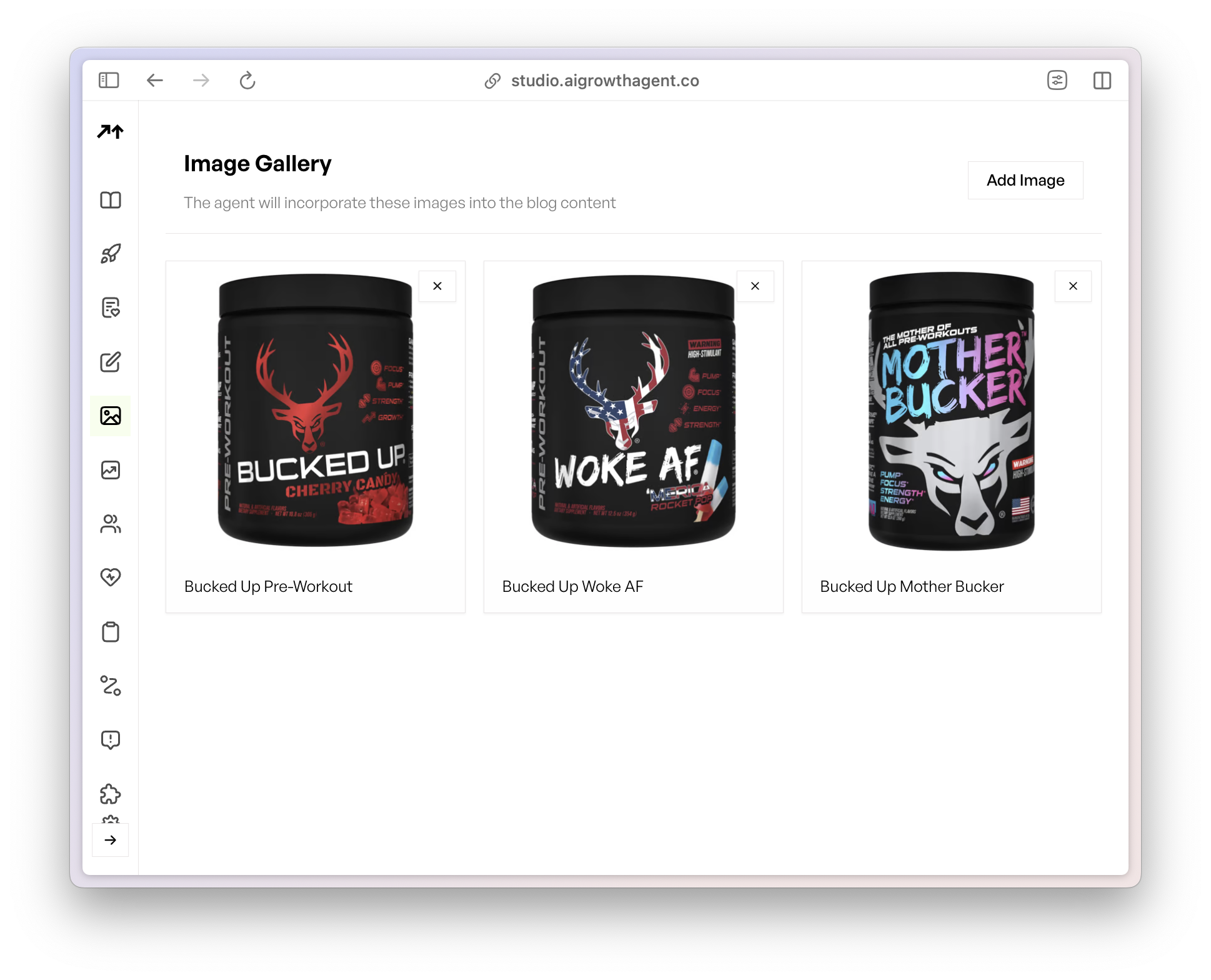
- Image-aware content: Teams can provide product or brand imagery for the agent to incorporate into content in a natural way, creating richer pages without manual formatting.
AI Growth Agent compared with traditional and manual approaches
|
Feature |
AI Growth Agent |
Traditional SEO agencies |
Manual AI content tools |
|
Scalability |
High scale with automated execution |
Limited by team size and manual workflows |
Requires manual coordination and assembly |
|
Technical SEO |
Advanced schema, metadata, and stack integration |
Often manual and basic, usually not focused on LLM needs |
Handled by internal teams, not built in |
|
Content quality |
Structured for uniqueness and brand alignment at scale |
Quality can vary and volume is constrained |
Output can be generic and may not support authority |
|
AI search optimization |
Designed with AI indexers and citations in mind |
Typically optimized for traditional search only |
No native integration with AI search behavior |
The programmatic capabilities in AI Growth Agent address common limits of traditional content workflows. Agencies depend on manual production, and basic AI writing tools require additional systems for planning, deployment, and monitoring. AI Growth Agent instead provides an integrated platform for programmatic content planning, creation, and optimization in the AI search context.
Case Studies: E-commerce Brands Using Programmatic SEO with AI Growth Agent
Bucked Up, a sports nutrition brand, illustrates how programmatic SEO can support category authority. Within three weeks of implementing AI Growth Agent, Bucked Up appeared in ChatGPT as a leading protein soda brand. The brand became the top citation for high-intent queries such as “best protein soda,” appearing alongside key competitors while maintaining its own positioning.
BeConfident, an English learning app, shows how programmatic SEO can support niche markets. In a competitive category with strong established players, BeConfident used AI Growth Agent to achieve rapid indexing and early authority. Within weeks, the brand surfaced as a top recommendation in Brazil for English learning through Google AI Overview and Gemini.
Frequently Asked Questions: Programmatic SEO for E-commerce
What are the main benefits of programmatic SEO for an e-commerce store with a large product catalog?
Programmatic SEO helps large catalogs achieve broader search coverage by automating the creation and optimization of product and category pages. Key benefits include expanded coverage of long-tail queries, faster updates when product data changes, and more unique content for each product variation or use case, which supports a stronger organic footprint.
How can e-commerce brands ensure content quality and brand consistency with automated content generation?
Brands can maintain quality and consistency by defining clear voice and style guidelines, using structured templates, and applying multi-step quality checks. Effective platforms combine automation with brand-specific data and oversight, so that content remains on-brand while benefiting from scale.
What are the risks of programmatic SEO for e-commerce, and how can they be mitigated?
Key risks include duplicate or thin content, keyword cannibalization, and potential issues with search engine compliance. These risks can be reduced by using content differentiation strategies, detailed keyword mapping, and ongoing review processes that focus on user value and clear search intent alignment.
How does programmatic SEO help e-commerce sites adapt to rapidly changing product inventories and market trends?
Programmatic SEO systems connect to product databases and update content as availability, pricing, or features change. Advanced setups can also generate new content quickly for emerging trends or new product lines, which helps brands capture demand earlier in the cycle.
Is programmatic SEO suitable for all e-commerce brands, or primarily for large enterprises?
Programmatic SEO is most effective for brands with many products, variations, or markets to cover. While large enterprises often adopt it first, fast-growing premium brands can also benefit when they have a clear positioning and a commitment to building category authority through content.
How does AI Growth Agent address the technical SEO needs of e-commerce brands?
AI Growth Agent automates technical SEO tasks that matter for AI search, including schema markup, metadata optimization, and large-scale on-page structure. This support helps ensure that e-commerce content is both indexable and eligible for AI-driven recommendations.
Conclusion: Using Programmatic SEO to Support E-commerce Growth
AI-powered search has raised the bar for e-commerce content. Manual efforts alone rarely provide the depth, structure, and volume required to earn consistent citations from tools such as ChatGPT, Google AI Overviews, and Perplexity.
Programmatic SEO has become a practical requirement for e-commerce brands that want to expand their organic presence. Many leading e-commerce platforms now create millions of product pages using data-driven templates. Brands that deploy structured, authoritative content at scale are better positioned to appear in both traditional and AI search results.
Marketing leaders at premium e-commerce brands face a clear strategic choice. Teams that invest in programmatic SEO can build durable visibility and authority in their categories, while teams that rely solely on traditional methods risk losing share of voice as AI search evolves.
AI Growth Agent offers a framework to operationalize this shift. By combining automated content generation, technical SEO, and AI search monitoring, it helps e-commerce brands build and maintain programmatic content advantages.
The brands that provide AI search engines with comprehensive, accurate, and structured content will shape how customers discover and evaluate products. Programmatic SEO is a central component of that effort.
E-commerce teams that want to improve their presence in AI search can explore a structured rollout. Schedule a demo with AI Growth Agent to evaluate how programmatic SEO can support your organic growth strategy.
