


AI-powered search and conversational systems like Perplexity, ChatGPT, and Gemini have changed how content is found and recommended. These platforms focus on understanding context, user intent, and meaning, moving away from old-school keyword matching. For marketers, this shift creates a new approach to building visibility and authority online.
This guide explains how to adapt keyword strategies for AI search. It provides practical steps to help marketing leaders navigate this evolving landscape. Brands that fail to update their approach may lose visibility to AI systems, while those who adjust can position themselves as trusted leaders in their field.
With AI-generated content growing rapidly, optimizing for AI citation is essential to maintain a strong online presence. Using semantic groups, intent-focused content, and technical setup, brands can stand out in AI recommendations. AI Growth Agent offers a unique platform with specialized AI tools to support this transition and build category authority.
How AI Search Engines Redefine Keyword Strategy
Search mechanics have evolved significantly. Unlike traditional engines that relied on direct keyword matches, AI systems use natural language processing to grasp context and user goals. This change reshapes how content is evaluated and delivered.
AI search prioritizes the purpose behind a query over exact word matches. These systems focus on user needs and meaning to provide relevant results. Marketers must now align content with this emphasis on intent.
Thanks to advanced language processing, AI interprets conversational searches with precision. Users often phrase queries as full questions, and AI delivers answers based on context. This boosts the importance of detailed, natural language phrases in content.
Personalization also plays a key role. AI uses data like search history and location to customize results. Tailored outputs mean content must address varied user contexts for better visibility.
Content quality now outweighs keyword frequency. AI values depth and relevance over repetition. Focusing on value and context improves chances of ranking in AI results. Old tactics like stuffing keywords can hurt visibility.
AI rewards in-depth topic coverage. Instead of multiple pages for small keyword variations, comprehensive content addressing related questions performs better. Marketers need to prioritize broad understanding and authority over narrow targeting.
Want to evaluate your current strategy for AI search? Schedule a consultation with AI Growth Agent to check your readiness.
Shifting Focus: From Keywords to Intent and Semantics
How AI Interprets Keywords Differently
AI search engines analyze keywords through semantic grouping and intent evaluation, moving beyond basic research tactics. Grouping related terms helps create relevant, high-impact content. This method lets AI recognize context even without exact matches.
For instance, content on “remote work tips” might appear for searches like “home office hacks” due to shared meaning. Marketers should target entire topic areas rather than single terms to align with AI’s approach.
AI also identifies detailed user goals beyond simple categories. Behavioral cues help classify specific needs across the user journey. This allows AI to match content with precise user motivations.
Topic clusters are now a core strategy. Instead of separate pages for similar terms, brands build content hubs covering subjects thoroughly. This structure supports AI’s preference for complete, connected information.
Why Contextual Keyword Research Matters
Keyword research now uses AI to reveal deeper user behavior insights. Modern tools analyze intent, group terms, spot questions, and find gaps competitors miss. This gives a clearer view of audience needs.
AI tools uncover the actual questions users ask, digging into the reasons behind searches. They organize terms by purpose and highlight real user queries. Content can then address these needs directly.
Predictive analysis offers a competitive edge. AI spots trends early and groups terms for relevance based on user actions. Brands can create content for emerging topics before others notice.
This approach also finds unique content opportunities. AI platforms highlight intent-based clusters and gaps traditional methods overlook. Marketers can fill these spaces to establish leadership in their niche.
Practical Tips for Keyword Usage in the AI Era
Focus on Long-Tail and Conversational Queries
Conversational AI has increased the value of detailed, natural queries for capturing targeted traffic. AI’s ability to process everyday language elevates specific phrases. Content should reflect how people naturally speak.
Queries like “best budgeting app for small businesses” show clearer intent than generic terms like “budgeting app.” Targeting these detailed searches helps brands reach users closer to making decisions.
AI’s personalization makes relevance critical. Custom results mean content must connect directly with user needs. Addressing specific queries boosts the chance of AI recommendations.
To succeed, understand the language your audience uses. Consider regional differences, industry terms, and voice search patterns. Mastering these nuances positions brands to excel in natural language searches.
Create Content Driven by User Intent
AI search engines favor content that fully addresses user needs over keyword-heavy pieces. Updates to algorithms value topic depth over specific term usage. Depth and expertise are now priorities.
Build content around the full context of user needs. Factor in their knowledge level, goals, challenges, and related questions. Cover the entire topic area instead of focusing on isolated terms.
Organize content into clusters around main topics. Grouped content shows relevance and authority to AI systems. This approach helps establish expertise across a subject.
Map content to different stages of the user journey. Align topics and terms to specific needs at each stage, ensuring every piece guides users toward a clear outcome while building trust.
Use Advanced AI Tools for Keyword Insights
AI keyword tools offer powerful ways to plan content strategically. They go beyond basic suggestions, providing trend predictions and insights to seize opportunities early.
These tools excel at spotting trends and gaps. Predictive analysis and grouping help align content with user needs for better performance. This allows proactive rather than reactive strategies.
Semantic grouping reveals connections between topics that might not be obvious. These insights help uncover unique content ideas competitors often miss, strengthening overall topic coverage.
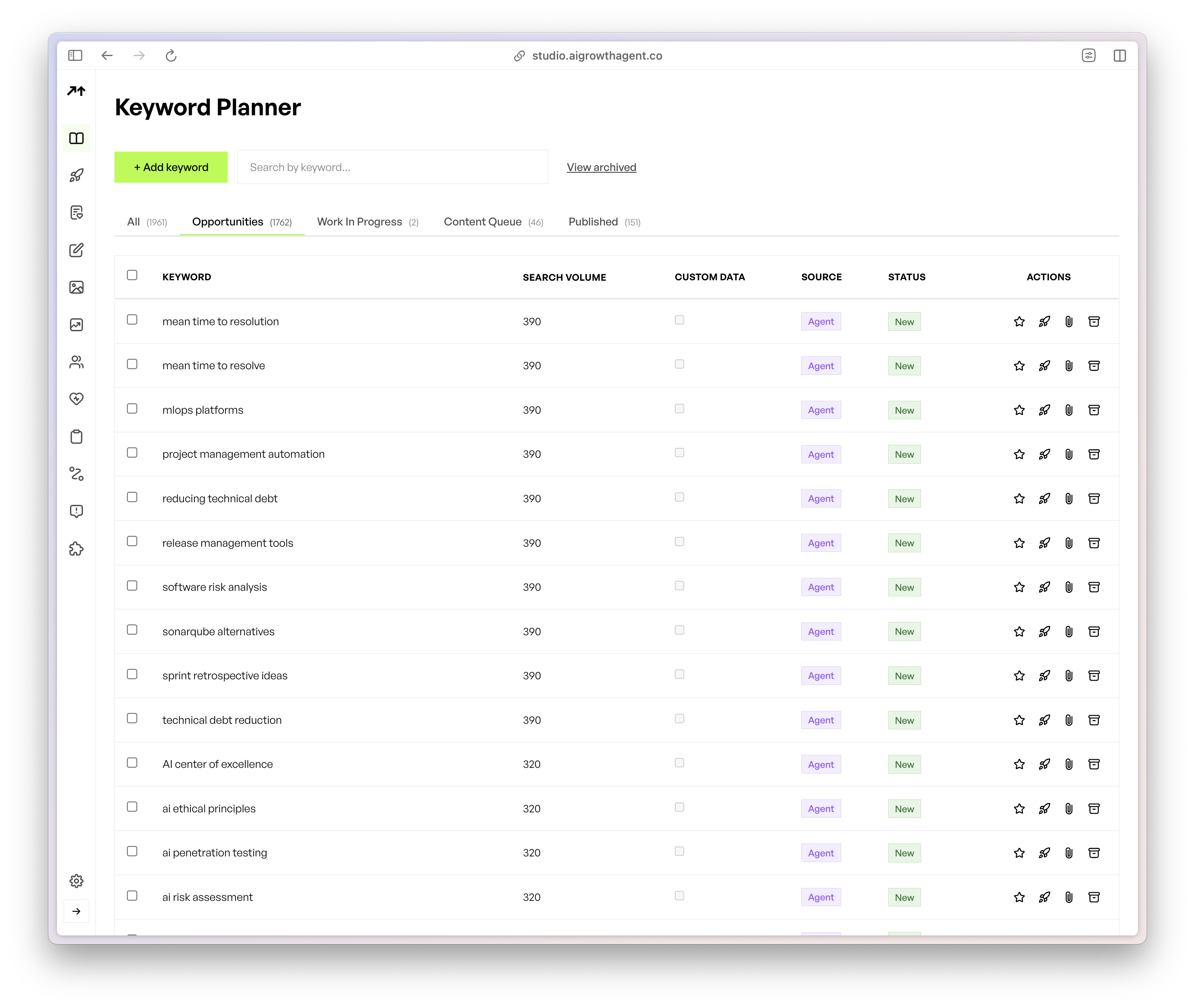
AI Growth Agent’s Keyword Deep Research Agent analyzes thousands of queries and topics relevant to a brand. It delivers a detailed strategy in 24 hours, creating a clear plan for content opportunities.
Technical Setup for AI Indexing Beyond Keywords
Technical aspects of content are just as vital as the content itself for AI visibility. New practices are needed to support AI integration. Brands must adopt setups that help AI process and cite content accurately.
AI-era technical needs differ from traditional SEO. Past efforts focused on basic navigation for users and crawlers. Now, setups must cater to the complex needs of AI models and language systems.
Why Structured Data and Schema Markup Matter
Structured data and schema markup are vital for AI to interpret content correctly. They provide context that helps categorize and reference material. These formats assist AI in processing and ranking content.
Schema markup offers details on topics, authors, and connections. This helps AI decide when to reference content, increasing its chances of appearing in responses.
Proper markup also aids attribution. When AI can identify a source’s credibility, it’s more likely to recommend that content for users seeking reliable answers.
AI Growth Agent applies advanced schema markup automatically to every article. With added metadata and image tags, content is ready for AI recognition right after publishing.
Understanding LLM.txt Files and Context Protocols
LLM.txt files and Model Context Protocols are innovative tools for AI optimization. They create direct links between AI systems and content, offering better interaction than standard crawling.
LLM.txt files guide AI crawlers by outlining a site’s content scope and organization. They help AI efficiently index material while noting freshness and focus areas.
Model Context Protocols enable real-time data access. AI can query content directly, gaining the latest details and connections traditional methods can’t match.
AI Growth Agent uses cutting-edge LLM.txt files and a pioneering blog Model Context Protocol. This ensures content aligns with current and future AI technologies for maximum visibility.
Discover how AI Growth Agent boosts your keyword strategy with technical optimization. Book a demo to explore the platform.
Common Mistakes in AI Keyword Strategy
Avoid Overloading on Keyword Density
Relying on keyword density harms AI search performance. AI values context over frequency of terms. Overusing keywords can lower authority and recommendation chances.
AI evaluates meaning and user value, not word counts. Content focused on repetition often seems unnatural, reducing its appeal to AI systems.
This focus also weakens user experience. Prioritizing keywords over flow creates content that doesn’t meet needs, which AI is less likely to promote.
Instead, aim for broad topic coverage and natural phrasing. Brands sticking to density metrics while others focus on intent will lose ground in AI results.
Don’t Ignore User Intent and Context
Failing to address user intent undermines keyword efforts. AI prioritizes understanding purpose over exact matches. Content missing this focus struggles to gain traction.
Intent varies beyond basic types like informational or transactional. AI detects subtle differences through queries and behavior. Content must adapt to these variations.
Context includes the full user journey. Without addressing how users research and decide, content lacks the depth AI values for recommendations.
Successful strategies dive into why users search and what they need next. This builds content that serves goals and positions the brand as a key resource.
Struggling to Scale Quality Content
Producing authoritative content quickly is a major hurdle in the AI era. Traditional methods, whether through teams or agencies, often can’t keep up with the needed volume.
AI prioritizes fresh, consistent content. Publishing infrequently fails to build authority in competitive spaces. Scaling output is critical to stay relevant.
Human-led processes face limits in time and cost. Even with strong pieces, they can’t match the pace required for broad AI visibility.
AI Growth Agent solves this with specialized AI agents. From research to publishing, it enables high-quality content at the speed needed for authority.
How AI Growth Agent Supports Keyword Usage for AI Search
Automated Keyword Strategy and Content Production
AI Growth Agent streamlines keyword planning and content creation. Its Keyword Deep Research Agent evaluates thousands of queries, delivering a categorized strategy in 24 hours for a focused content plan.
The platform automates the content process. The Core Content Agent handles everything from briefing to optimization, turning weeks of work into minutes.
This allows steady publishing while ensuring each piece builds authority. Brands can act on opportunities early, staying ahead of competitors.
Maximizing AI Citation and Authority
AI Growth Agent ensures content is ready for AI indexing. With LLM.txt files and a unique Model Context Protocol, it connects content directly to AI systems for better visibility.
Automated schema markup and technical setup help AI categorize content. This increases the odds of being cited in relevant user searches.
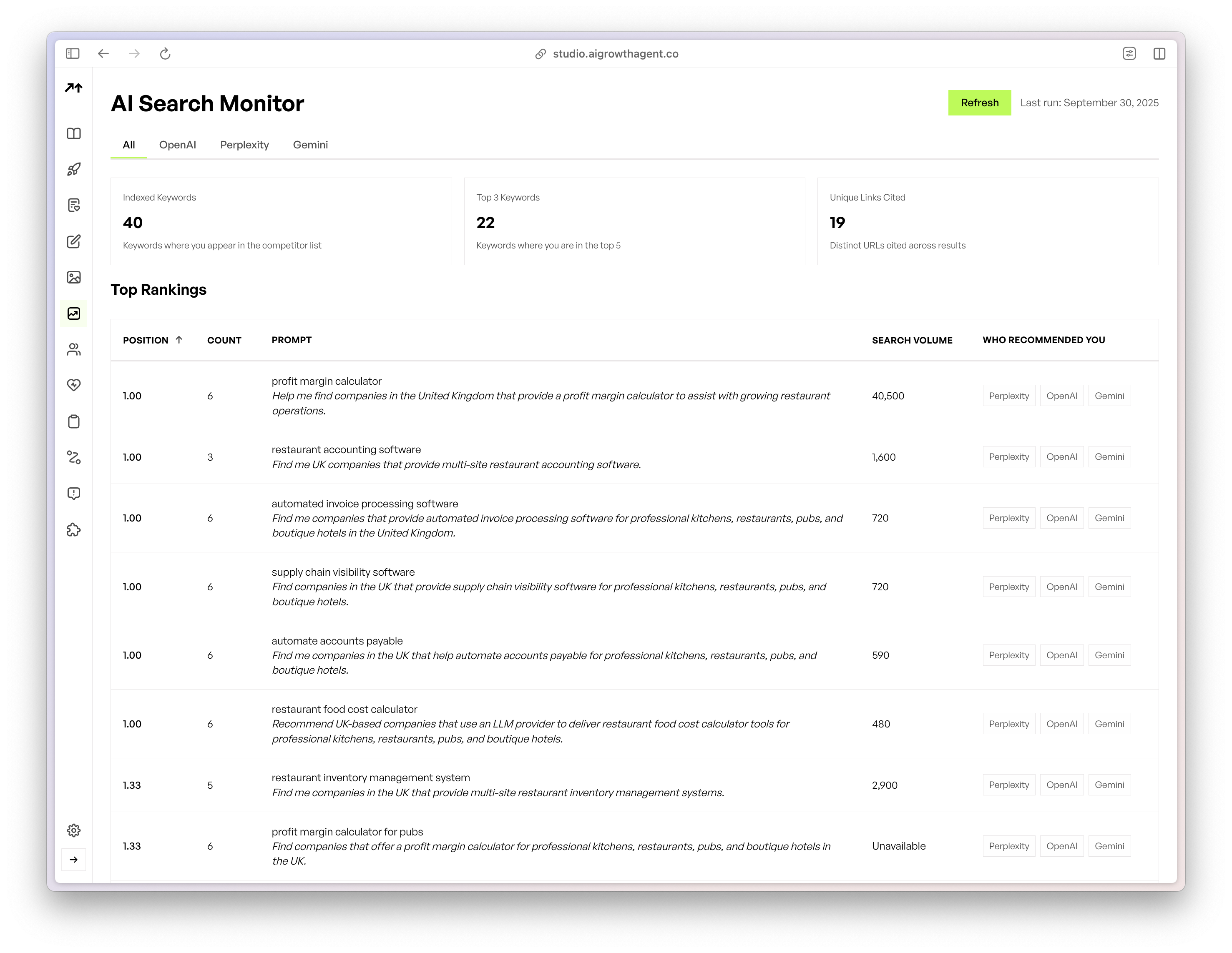
The AI Search Monitor tracks performance across platforms like ChatGPT and Gemini. Clients see keyword heatmaps, citations, and competitor data, enabling ongoing adjustments.
This cycle of optimization and monitoring refines targeting. Strategies evolve based on real AI data rather than outdated metrics.
Comparing Traditional Methods to AI Growth Agent
| Aspect | Traditional Approach | Generic AI Tools | AI Growth Agent |
|---|---|---|---|
| Keyword Research | Manual, narrow scope, old metrics | Basic ideas, needs manual planning | Automated deep analysis of thousands of queries, prioritized strategy |
| Content Creation | Takes weeks, limited by staff | Raw drafts need heavy editing | Full process completed in minutes |
| Technical Optimization | Manual, often incomplete | Limited or no technical focus | Automatic schema, LLM.txt, protocols |
| AI Search Monitoring | No insight into AI performance | Only basic SEO data | Live citation tracking on key platforms |
Key Questions About Keyword Usage in AI Search
How Does AI-Driven Keyword Research Differ From Traditional Methods?
Traditional research looks at volume and competition, often missing broader topics. It depends on past data and manual effort, limiting depth.
AI-driven research analyzes intent and trends across huge datasets. It uncovers user needs, questions, and emerging areas that older methods skip.
The result is a full topic strategy, not just keyword lists. This aligns better with how AI evaluates content for recommendations.
Why Is User Intent Vital for Keyword Strategy?
AI search uses advanced processing to analyze query structure and behavior. It determines not just the search but the reason behind it.
Addressing intent matters because AI favors content that meets user needs fully. Without this focus, content may miss the mark for citations.
AI detects fine differences in purpose, like seeking facts versus guides. Strategies covering these variations gain visibility across user types.
Does Keyword Density Still Impact AI SEO?
Keyword density no longer helps and can hurt performance if it disrupts flow. AI focuses on meaning and context over repetition.
Emphasis should be on varied language and topic depth. AI values content that naturally covers concepts without forced terms.
Key factors for AI SEO include authority, intent focus, and technical setup. These signal content worth citing to users.
What Technical Elements Boost AI Keyword Indexing?
Essential elements include schema markup for context, structured data for connections, and LLM.txt files for crawler communication.
Model Context Protocols allow direct AI queries for fresh data. They improve how AI understands content scope and expertise.
Clear site structure and internal links also help. They show AI how content connects, reinforcing authority across topics.
How Can Content Gain AI Citations for Target Keywords?
AI citation requires deep topic coverage, technical prep, and sustained authority. Content must show expertise and value.
Focus on full user intent, not just keywords. Comprehensive answers to questions increase citation likelihood.
Regular publishing and consistency matter. A strong content library signals reliability, encouraging AI to reference your brand often.
Can AI Growth Agent Uncover New Keyword Opportunities?
AI Growth Agent’s research agent analyzes vast query sets for your field. It provides a detailed strategy in 24 hours, targeting clear opportunities.
The platform spots gaps and trends. Its monitor tracks AI search performance, offering insights for adjusting content plans proactively.
What Is Generative Engine Optimization (GEO) in Keyword Strategy?
GEO involves optimizing for AI systems that generate answers instead of linking pages. It focuses on making content citable by AI.
Unlike traditional SEO for rankings, GEO targets AI references. This shifts keyword use toward authority and depth.
GEO strategies use natural language and technical tools like structured data. These make content easy for AI to process and cite.
Final Thoughts: Building AI Authority Through Keywords
Moving from old keyword tactics to AI-focused semantic strategies marks a major change in marketing. Brands clinging to past methods risk fading in AI search, while those adapting can gain an edge.
Keywords now fit into broader meaning networks. Success comes from targeting user goals, grouping related terms, addressing natural queries, and setting up technically for AI recognition.
The scale and complexity of AI optimization outpace many traditional tools. Manual teams and basic AI often can’t deliver the depth and speed needed for visibility.
AI Growth Agent offers a platform with dedicated AI tools to build authority. It supports brands with research, content, technical setup, and tracking for AI search success.
Brands thriving in AI search will prioritize meaning, user needs, and technical readiness. This positions them as trusted sources for AI recommendations, driving traffic and growth.
Ready to strengthen your AI search approach? Schedule a demo with AI Growth Agent to see if it fits your needs.
