


Executive summary
- AI search experiences such as Google AI Overviews, Gemini, and Perplexity are changing how people discover brands, which increases the need for high-quality content produced at consistent scale.
- Traditional SEO agencies deliver strong editorial quality and strategy, but they struggle to match the publication volume, speed, and technical depth required for AI search visibility.
- Self-service AI content tools improve drafting speed and reduce costs, but they leave gaps in strategy, brand consistency, and technical implementation for AI search.
- Autonomous programmatic SEO agents, including AI Growth Agent, combine research, writing, technical SEO, and publishing into one system that is built for AI search requirements.
- Marketing teams that adopt programmatic, technically sophisticated content operations now are better positioned to earn citations and visibility across AI search interfaces.
The Escalating Challenge: Producing High-Quality Content for AI Search
Your Shrinking Digital Footprint: Why Programmatic Velocity Matters
Artificial intelligence systems generate millions of new pieces of content every day. As overall content volume grows, an individual brand’s voice occupies a smaller share of the digital landscape. Without a systematic, programmatic content approach, even strong brands risk becoming less visible to the AI indexers that drive modern search.
Programmatic velocity now acts as a baseline requirement for digital competitiveness. Consistent production of satisfying, high-quality content helps maintain relevance, because AI algorithms tend to reward recency, depth, and structural consistency. Most teams publish only one or two manually crafted posts per month. That volume is rarely enough to stay visible in environments where competitors may publish new material every day.
Marketing leaders who rely on monthly content calendars or quarterly pushes work from assumptions that no longer match how search engines operate. AI-driven search favors brands that maintain both steady publication cadence and strong technical execution across a wide content set.
The New Standard of Quality for AI Search Engines
Content quality now includes both human relevance and machine readability. Strong writing and engagement still matter, but AI search engines also evaluate technical structure, depth, and clarity of expertise. Systems favor content that demonstrates clear domain knowledge, detailed explanations, original insight, and concrete applications.
Modern content quality spans several technical dimensions that many traditional approaches overlook:
- Semantic structure and entity optimization. Content built for AI-powered search benefits from clear semantic structure, extensive FAQ sections, and language patterns that map to conversational and voice search. This includes explicit entity definitions, comprehensive topic coverage, and logical information architecture that AI systems can parse and interpret.
- E-E-A-T compliance at scale. Google’s ranking systems for AI-related content lean on E-E-A-T (Experience, Expertise, Authoritativeness, Trustworthiness). Content needs to show original, fact-based insight while keeping that standard consistent across hundreds or thousands of pages.
- Advanced technical implementation. Quality content increasingly incorporates structured data, schema markup, optimized metadata, and emerging standards such as LLM.txt files and Model Context Protocol implementation to improve machine readability and AI extractability.
Marketing leaders who want to maintain authority in AI search can use programmatic approaches to meet these new standards. Schedule a consultation session with AI Growth Agent to evaluate whether this model fits your needs.
Approach 1: The Traditional SEO Agency Model – Artisan Quality, Limited Scale
How traditional SEO agencies approach content
Traditional SEO agencies rely on a craft-focused model that uses human writers, strategists, and SEO specialists to create content manually. These teams emphasize bespoke work, with research, planning, and multiple review rounds that aim to produce polished, long-form assets such as pillar pages and thought leadership articles.
This model emerged when search engines primarily rewarded carefully crafted, manually optimized content. Agencies built their services around industry expertise, strategic planning, and the ability to create material that resonated with both algorithms and human readers. Typical workflows include keyword research, competitor analysis, content brief development, writing, editing, and technical optimization, all handled by specialized team members.
Strengths of traditional SEO agencies for content quality
Traditional agencies still provide meaningful advantages in areas that require human judgment and creativity:
- Strategic planning depth. Experienced agencies contribute industry knowledge and structured planning. They can identify content gaps, evaluate competitive landscapes, and build content roadmaps that align with business objectives.
- Creative execution. Skilled writers and editors often excel at narrative structure, accessible explanations, and clear formatting that improve user experience.
- Brand voice consistency. Human writers can maintain a coherent brand voice and messaging across many pieces, so each asset reinforces positioning and values.
- Editorial quality control. Multi-step review processes that include editing, fact-checking, and technical checks help produce polished final content that matches defined editorial standards.
Limitations of traditional SEO agencies for AI search scale
Despite these advantages, traditional agencies face structural constraints that limit their effectiveness for AI search optimization:
- Cost and speed constraints. Human-centered workflows depend on billable hours and finite headcount. Many agencies produce only a few pieces per month for each client, which makes it difficult to reach the velocity required for consistent AI search visibility.
- Scalability barriers. Manual production does not scale efficiently. Reaching the content volume needed for AI search often requires adding more staff, which increases costs and complexity.
- Technical depth limitations. Many agencies do not maintain dedicated engineering resources for advanced AI search optimization. Implementing elements such as LLM.txt files, Model Context Protocol, or programmatic schema often sits outside their core capabilities.
- Rigid planning cycles. Agency processes often follow monthly or quarterly plans. This cadence makes rapid response to algorithm shifts, breaking news, or emerging conversations more difficult.
Impact on AI content quality and citation potential
Traditional agencies can deliver high-quality individual articles, but the lack of programmatic scale limits performance in AI search. AI systems tend to reward broad topic coverage, frequent updates, and advanced technical optimization. Manual processes can create bottlenecks that reduce the number of pages eligible for AI citations and high-visibility placements.
Approach 2: Self-Service AI Content Tools – Efficiency Gains, Structural Gaps
How self-service AI content tools work
Self-service AI content tools provide generative AI through accessible interfaces. Platforms such as ChatGPT, Jasper, and AirOps allow users to generate text by entering prompts, selecting templates, and configuring basic settings. These tools make it possible to produce drafts quickly without hiring additional writers.
In most cases, users still own the strategy and execution. They need to define content plans, research topics, craft prompts, review outputs, and apply technical SEO best practices. The tools function as advanced word processors rather than full content systems.
Strengths of self-service AI content tools
These tools offer several practical benefits compared with fully manual production:
- Higher drafting productivity. AI-assisted drafting helps writers and marketers create first drafts and iterate on ideas much faster than traditional methods.
- Lower direct content costs. Subscription pricing often costs less than agency retainers or large in-house writing teams, which makes ongoing content production more accessible.
- Speed and experimentation. Rapid generation allows teams to test new angles, try different formats, and respond more quickly to immediate content needs.
- Broader access to content creation. Teams without formal writing backgrounds can still produce usable drafts, then refine them through review and editing.
Limitations of self-service AI content tools for AI search optimization
Self-service tools improve speed, but they leave several important gaps for AI search performance:
- Integration gap. Outputs usually arrive as unstructured text. Users must still handle formatting, schema markup, page creation, and publishing in their own systems.
- Context gap. Tools typically treat each prompt as a separate request. Maintaining deep understanding of brand positioning, message hierarchy, and long-term strategy across many pieces requires ongoing manual input.
- Strategy gap. Users remain responsible for keyword research, topic clustering, and competitive analysis. The tools do not automatically generate or execute a full content strategy.
- Quality and accuracy risk. AI-generated drafts can lack depth, originality, or rigor. They may also introduce factual errors that require careful human review and correction.
- Technical implementation burden. Metadata, schema, image optimization, internal linking, and publishing workflows remain in the hands of the user, which adds time and demands specialized skills.
Impact on AI content quality and citation potential
Self-service AI tools can increase content volume, but they do not guarantee the level of technical optimization and strategic cohesion that AI search engines favor. Even well-written drafts may underperform if they lack structured data, clear topical architecture, or consistent signals of expertise. As a result, citation potential and visibility in AI search often remain limited.
Approach 3: Autonomous Programmatic SEO Agents (The AI Growth Agent Advantage) – Engineered Authority at Scale
How autonomous programmatic SEO agents work
Autonomous programmatic SEO agents form a newer category of content technology that aims to overcome the limits of both agencies and self-service tools. These systems combine AI, technical engineering, and automation to manage the content lifecycle with minimal ongoing human involvement.
Unlike simple writing assistants, programmatic SEO agents such as AI Growth Agent function as integrated content platforms. They handle strategy development, research, writing, technical SEO, and publishing within one environment. Their design focuses on the specific technical and structural requirements of AI search, including emerging standards and optimization techniques that are difficult to implement manually at scale.
The unique strengths of AI Growth Agent for high-quality AI content
AI Growth Agent provides several capabilities that support both scale and quality:
- Programmatic velocity and scale. The platform can generate and publish technically optimized content on a daily cadence. That level of output helps brands maintain consistent presence in AI search environments while still aligning to defined quality standards.
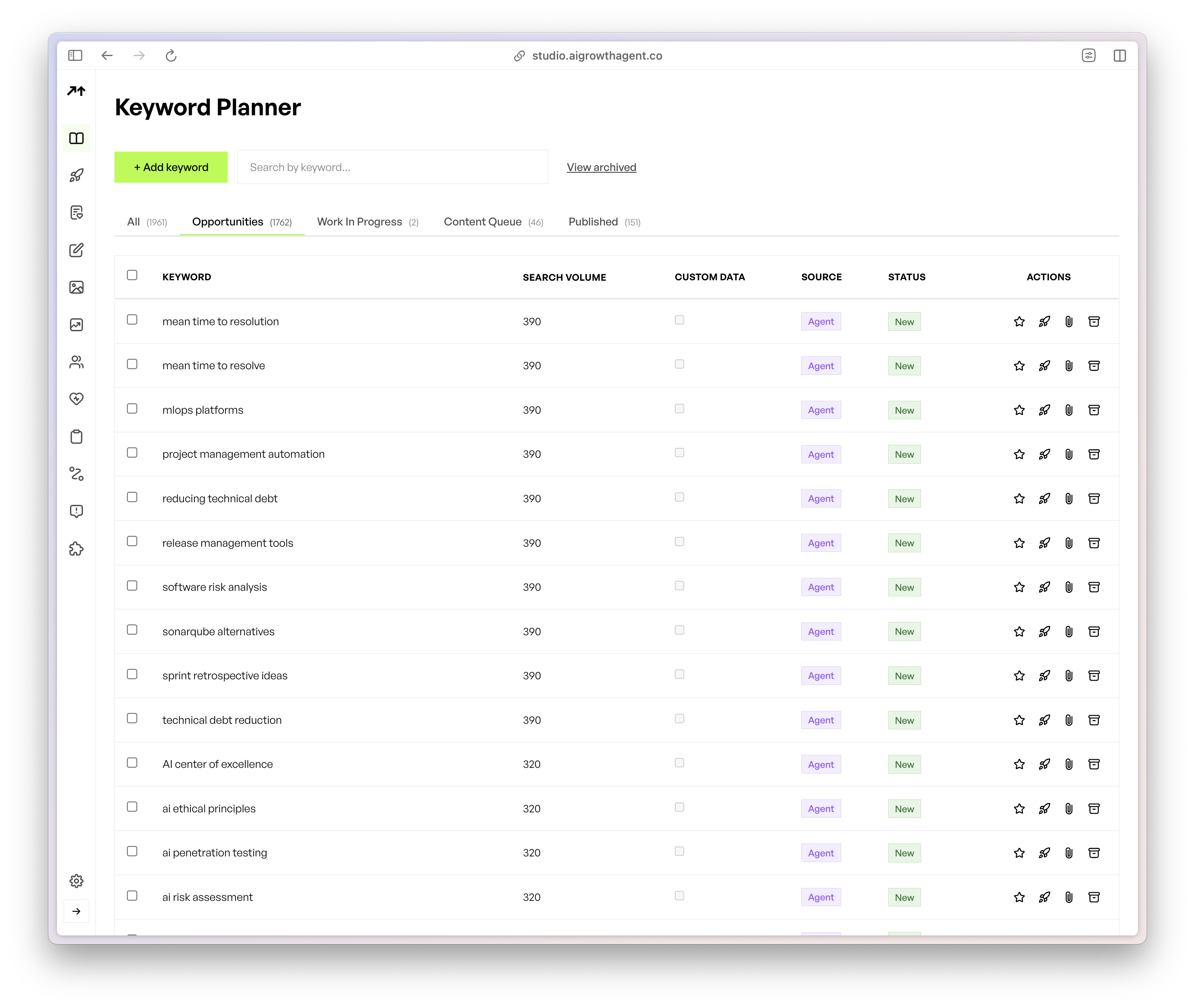
- Advanced technical optimization. AI Growth Agent automatically applies schema markup, optimized metadata, LLM.txt files, and Model Context Protocol for blogs. These features support machine readability and make it easier for AI systems to extract and reuse content.
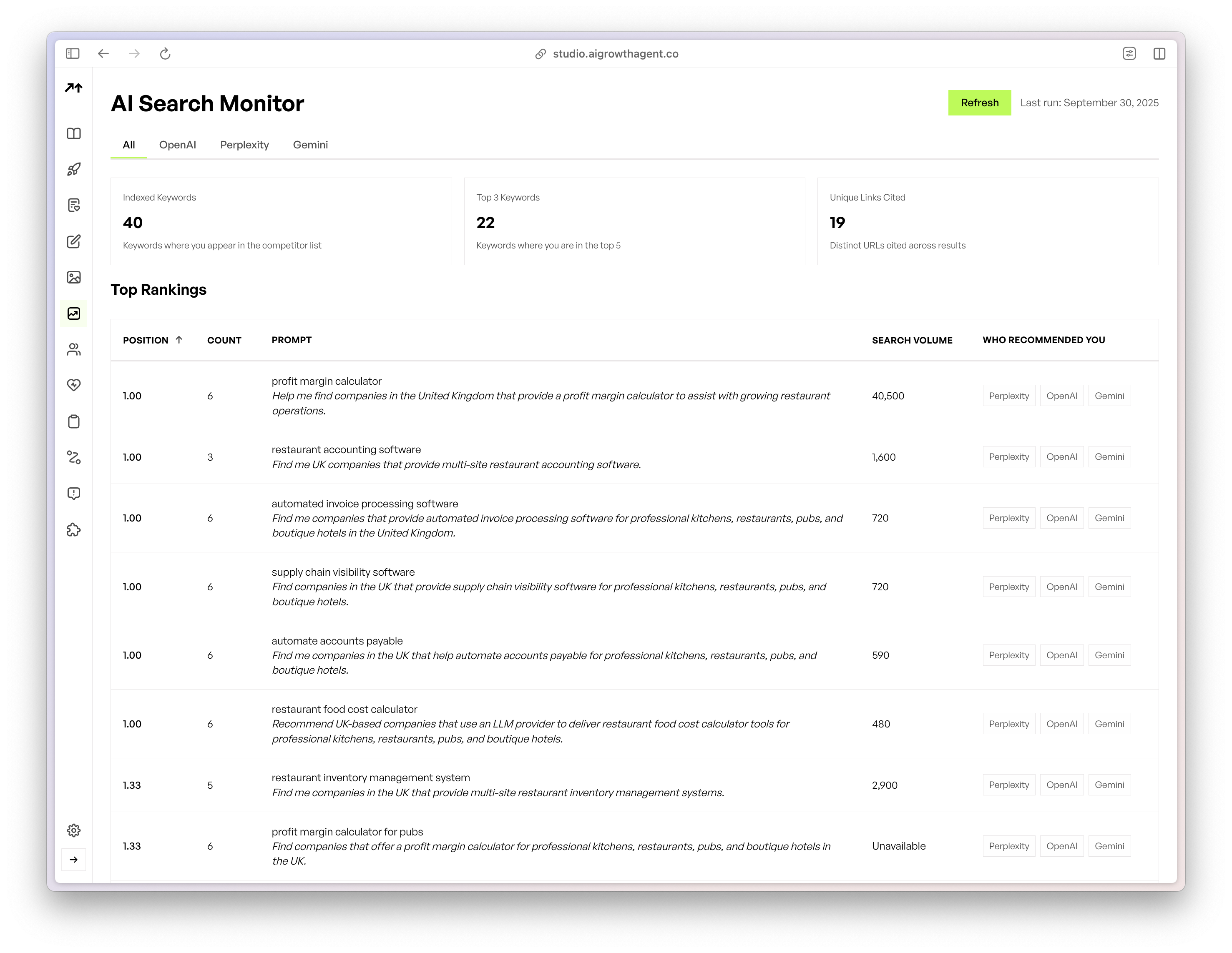
- Authority engineering through brand understanding. A white-glove onboarding process produces a detailed Company Manifesto that encodes positioning, tone, and expertise areas. This foundation helps the agent generate content that reflects each brand’s perspective rather than generic output.
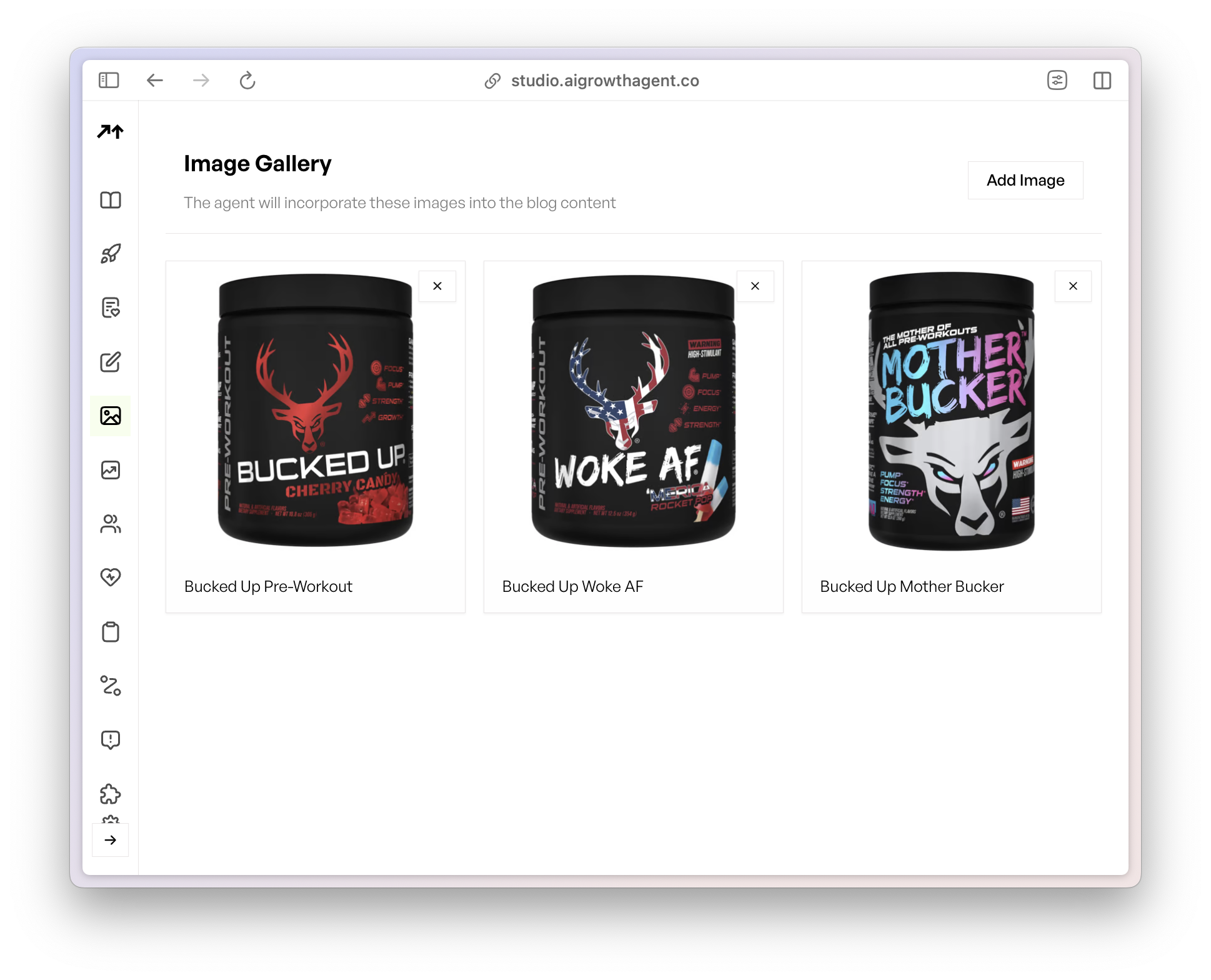
- Autonomous full lifecycle management. AI Growth Agent manages keyword research and clustering, content briefs, research support, writing, editing, technical SEO, image handling, and direct publishing to an optimized blog infrastructure. Teams can choose to review drafts or enable more automated publishing flows.
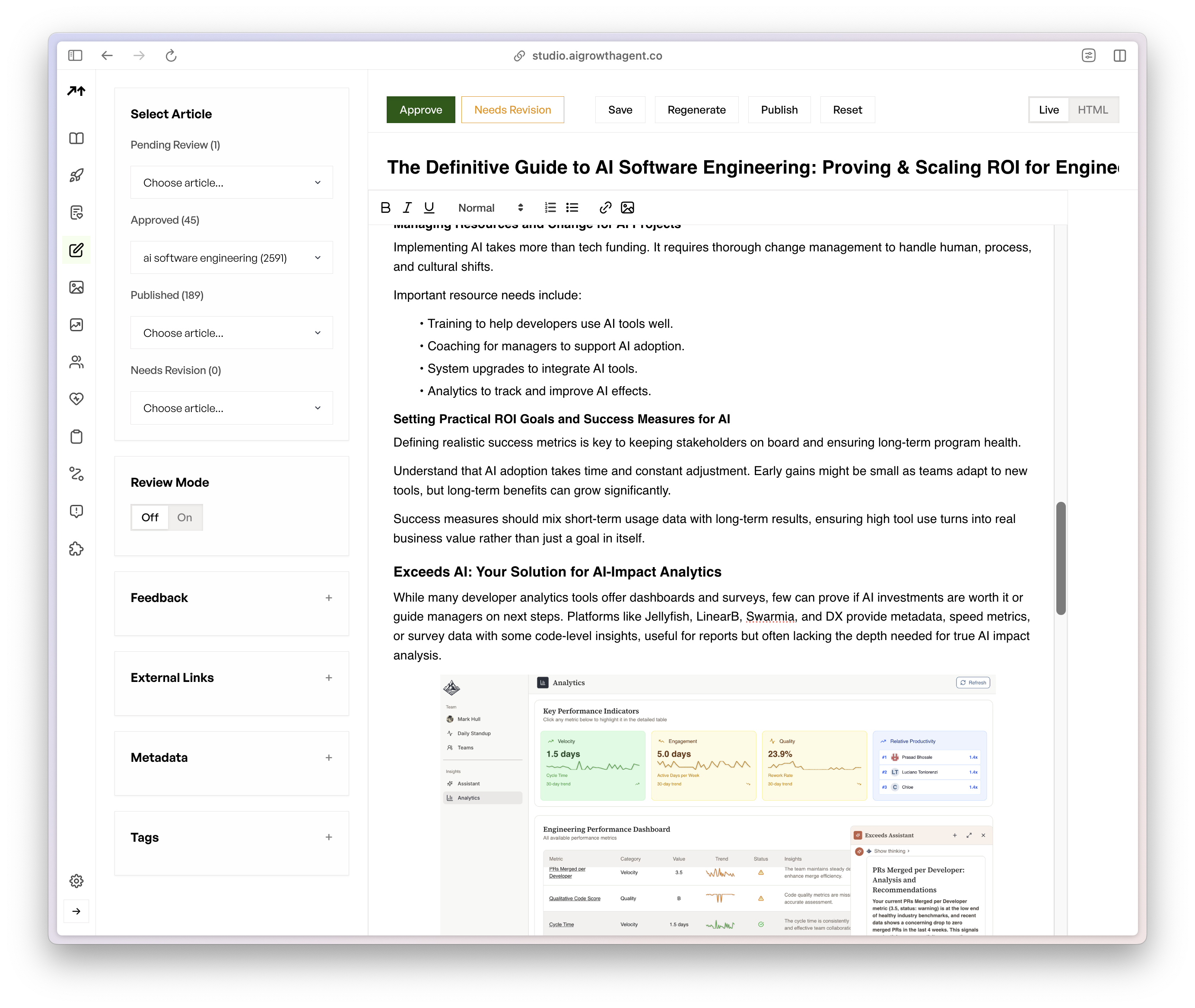
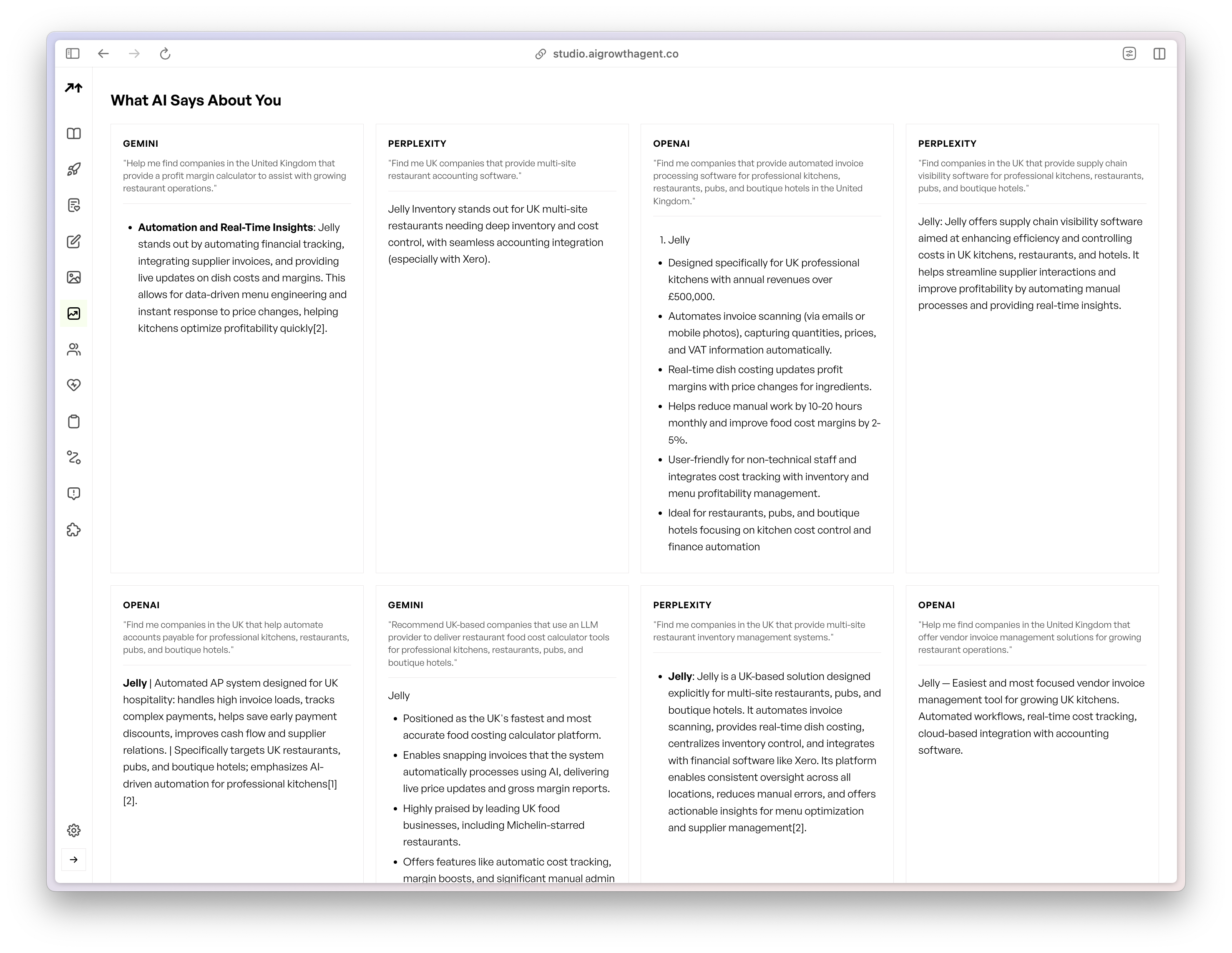
- Breakthrough capabilities for complex setups. Features such as multi-tenant programmatic deployment, real-time programmatic content injection for trending topics, and database-to-content automation support more advanced use cases. Intelligent image and asset placement with automatic metadata optimization builds further technical depth into each page.
Considerations for AI Growth Agent implementation
AI Growth Agent is built for brands that already have solid fundamentals. The platform does not serve as an SEO repair service. Clients see the best results when they have clear positioning, reliable technical infrastructure, and a competitive product or service. In those cases, the agent extends an existing foundation rather than trying to compensate for core business or technical gaps.
Impact on AI content quality and citation potential
AI Growth Agent addresses the long-standing tradeoff between scale and quality by designing each step of the workflow for AI search. Content is structured for machine understanding, targeted to specific topics and intents, and published at a pace that supports visibility. This combination increases the likelihood that AI search systems cite the brand as a relevant source.
Teams that want to evaluate this approach in more detail can see the platform in action. Schedule a demo to see if you’re a good fit for a programmatic content model.
Comparative Analysis: Agencies vs. AI Tools vs. AI Growth Agent
In-depth feature comparison table
|
Feature area |
Traditional SEO agencies |
Self-service AI content tools |
AI Growth Agent |
|
Content volume potential |
Low (1-3 pieces per month) |
Medium (10-20 pieces per month) |
High (daily publication capability) |
|
Content quality control |
High (multiple human reviews) |
Variable (depends on user) |
High (AI-driven with human oversight) |
|
Technical AI search optimization |
Limited (basic manual SEO) |
Minimal (user implementation required) |
Advanced (LLM.txt, Model Context Protocol, auto schema) |
|
Scalability and authority building |
Low (constrained by human resources) |
Low to medium (manual oversight required) |
High (autonomous scaling) |
|
Publication velocity |
Slow (weeks per piece) |
Medium (days per piece) |
Fast (same-day publishing) |
|
Team effort required |
Medium to high (ongoing coordination) |
High (strategy, review, and publishing) |
Low (setup and oversight) |
|
CMS integration and technical setup |
Manual (client or agency managed) |
Manual (user responsible) |
Automated (white-glove setup) |
|
AI citation potential |
Limited (volume constraints) |
Minimal (optimization gaps) |
High (purpose-built for AI search) |
Key differentiators explained
The comparison highlights how each approach addresses modern content challenges:
- Volume and quality balance. Traditional agencies focus on high individual quality but rarely reach the volume needed for AI search dominance. Self-service tools improve volume but leave quality and implementation to users. AI Growth Agent automates much of the quality control and technical work so teams can achieve both volume and consistency.
- Technical sophistication. AI Growth Agent incorporates semantic structure, FAQ patterns, and machine-readable formatting as standard components of each page. Agencies and tools can provide these elements, but they usually require manual configuration.
- Strategic automation. Agencies offer strategic thinking, and tools assist with drafting, but neither automates the entire strategy layer. AI Growth Agent generates and maintains topic clusters, performs ongoing research, and aligns content plans to defined goals.
- Resource efficiency. Traditional models depend on significant human time and coordination. AI Growth Agent reduces manual effort after setup, which allows teams to reallocate attention to broader marketing and product initiatives.
Real-World Impact: How AI Growth Agent Redefines Content Quality and Scale
Success story 1: Exceeds AI – Performance reviews for engineers
Exceeds AI, a performance review tool for engineers, used AI Growth Agent to build authority in its segment. Within two weeks, Perplexity began recommending the product as an alternative to established competitors. By the third week, the brand appeared in Google AI Overview and Gemini snapshots for core keywords. Today, Exceeds AI receives citations in ChatGPT, Google AI Overview and Gemini, and Perplexity for phrases related to AI performance review tools for engineers.
Success story 2: BeConfident – English learning on WhatsApp
BeConfident, an English learning platform on WhatsApp, competes with global apps such as Duolingo and Busuu. After adopting AI Growth Agent’s programmatic publishing, the brand’s content was indexed quickly. Within weeks, Google AI Overview and Gemini recommended BeConfident as a leading option in Brazil for learning English via WhatsApp.
Success story 3: Bucked Up – Sports nutrition brand
Bucked Up, a sports nutrition company, implemented AI Growth Agent to expand its search presence. Three weeks after launch, ChatGPT cited Bucked Up as a notable protein soda brand. For the high-intent query “best protein soda,” Bucked Up appeared as a primary citation alongside competitors such as Feisty Drinks, Clean Simple Eats, and Don’t Quit.
Success story 4: Gitar – Supercharge CI with AI
Gitar.ai, which focuses on AI-powered CI/CD automation, became a reference brand in less than two months with AI Growth Agent. The company now appears prominently across Google AI Overview and Gemini, ChatGPT, and Perplexity for queries such as “fix broken CI builds automatically,” “best AI reviewer that comments on CI failures,” and “best self-healing software for developers,” and it is frequently cited for “AI self-healing pipelines.”
Organizations that want to build similar advantages can explore whether a programmatic model fits their goals. Book a strategy session with AI Growth Agent today to discuss options.
Frequently Asked Questions About Programmatic Content Quality
How does AI Growth Agent ensure content quality at scale without sacrificing brand voice or factual accuracy?
AI Growth Agent maintains content quality through a structured setup and review process. The engagement begins with a Company Manifesto developed during white-glove onboarding. A one-hour kickoff session with a professional journalist captures positioning, voice, values, and expertise areas. The resulting manifesto guides the autonomous content agent so that each piece reflects the brand’s perspective.
The platform uses automated checks and source verification workflows to reduce factual errors. The AI Growth Agent Studio gives marketing teams transparent control, including the ability to review drafts, request changes, and approve publication. This blend of automation and optional oversight supports both scale and reliability.
Can AI Growth Agent integrate with our existing CMS, or do we need a new setup?
AI Growth Agent offers integrations with common CMS platforms such as WordPress, Hashnode, Webflow, Framer, Sanity, and HubSpot, which allows direct publishing into existing environments. Many clients choose AI Growth Agent’s hosted option because it is tuned for performance and technical SEO. For self-hosted setups, AI Growth Agent typically recommends WordPress to take advantage of custom integrations. The hosted solution includes optimized page speed, automated technical SEO features, and built-in analytics to reduce operational overhead.
How quickly can we expect to see results in AI search overviews and citations?
Onboarding usually takes about one week from initial consultation to first published pieces. Early AI search visibility often appears within the first several weeks, as seen in the Exceeds AI example where Perplexity recommendations arrived in week two and Google AI Overviews in week three. Results tend to compound over time as the content library grows and technical optimization signals accumulate, as demonstrated by brands like Bucked Up and Gitar achieving prominent citations within weeks.
What kind of commitment is required from our team to use AI Growth Agent?
AI Growth Agent is designed to reduce day-to-day workload for marketing teams. The main upfront commitment is the kickoff session and related inputs needed to build the Company Manifesto. After onboarding, the platform manages research, strategy, content creation, and publishing. Teams can use the AI Growth Agent Studio to review and adjust content as needed, and many choose to enable more automated modes once they are confident in the output.
Conclusion: The Imperative for Programmatic Content Quality in the Age of AI Search
Manual, low-volume approaches to content creation increasingly struggle to meet the demands of AI search. Marketing leaders who rely only on agency workflows or basic AI writing tools face growing competitive pressure from brands that run programmatic, technically sophisticated content operations.
The central decision for enterprise marketers is how to build a system that delivers both scale and quality while meeting modern technical requirements. Autonomous programmatic SEO agents such as AI Growth Agent offer one path by combining strategy, production, and optimization into an integrated workflow.
Brands that adopt structured, automated content technologies now are better positioned to build authority, capture search volume, and appear as reliable sources when AI systems answer user questions. Delays make it harder to close the gap later, because competing brands continue to accumulate content and citations.
AI Growth Agent helps companies provide consistent, technically optimized answers when AI systems seek information in their category. Book a strategy session with AI Growth Agent today to assess whether this programmatic approach aligns with your goals for AI search visibility.
