


Executive Summary
- AI-powered search engines such as ChatGPT, Google AI Overviews via Gemini, and Perplexity are changing how people discover brands, so enterprises need SEO that is optimized for AI-driven discovery, not only traditional search results.
- Traditional SEO agencies offer strategic guidance and handcrafted content, but their human-centered workflows limit the speed and volume required for AI search visibility.
- Self-service AI writing tools generate large amounts of text, but they leave strategy, technical SEO, and publishing to internal teams, which limits impact in competitive markets.
- Programmatic SEO establishes “programmatic velocity” as a baseline, where automated systems create high-quality, technically optimized content at scale to feed AI models with current, structured information.
- Key evaluation criteria for any SEO scalability solution include automation level, technical AI optimization, authority and citation potential, cost-effectiveness, and adaptability to new AI search platforms.
- AI Growth Agent uses an autonomous Programmatic SEO approach to handle research, writing, technical optimization, and publishing, and it adds capabilities such as multi-tenant deployment, real-time content injection, and database-to-content automation.
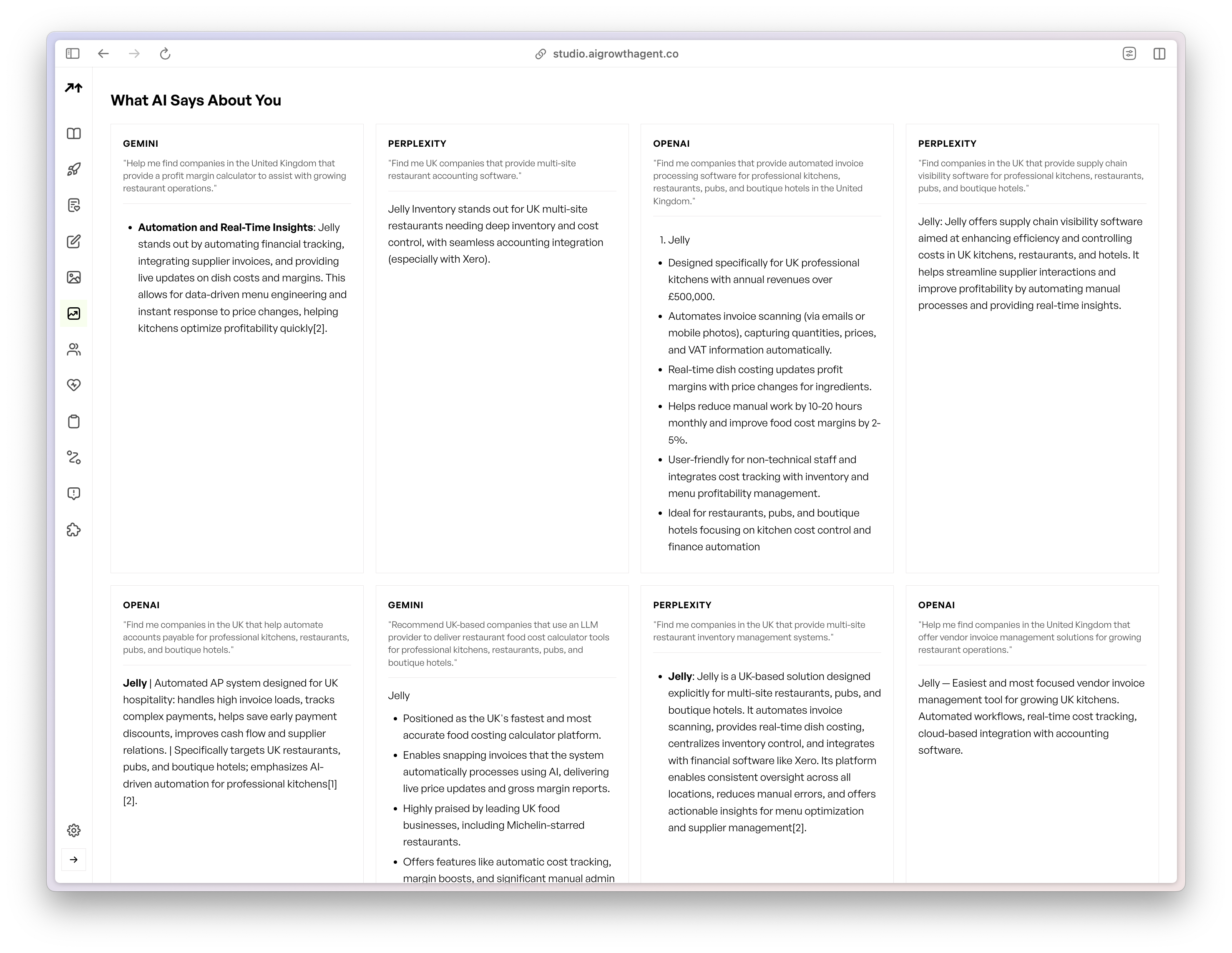
- Case studies across software, language learning, sports nutrition, and developer tools show AI Growth Agent content gaining citations in ChatGPT, Google AI Overviews, and Perplexity within weeks, giving brands earlier exposure in AI search.
- Enterprise leaders who invest in programmatic SEO now can start shaping how AI systems describe their category and brand, while slower movers risk having competitors define that narrative.
The AI Search Imperative: Why Scalability Redefines Authority in 2025
This article compares traditional SEO agencies, self-service AI tools, and autonomous programmatic SEO, and evaluates how each option supports AI search visibility, scalable content, and sustainable authority.
The relationship between businesses and search engines has changed. Previously, ranking often depended on manual keyword targeting and link building. Today, AI-powered search engines favor programmatic content that demonstrates authority and earns citations within large language models (LLMs) across multiple discovery platforms.
Keyword-based search is giving way to AI-powered discovery systems that focus on intent and outcomes. The shift from keyword-based search to AI-powered discovery systems requires enterprises to optimize for click value, not just visibility, so manual content workflows and basic AI writers struggle to keep pace in competitive categories.
Search behavior is spreading across AI platforms, social media, and traditional search results. Search behavior is fracturing across AI platforms, social media, and traditional SERPs, requiring enterprises to adopt multi-platform discovery strategies that extend beyond conventional SEO optimization.
The volume of information has increased sharply. Enterprises that do not publish high-quality, technically optimized content on a frequent basis fall behind competitors that treat content as a daily operational process. Large language models reward recency, depth, and structural consistency, so one or two manually crafted posts per month rarely sustain technical relevance or create enough citation opportunities in AI search.
Another important factor is narrative control. Brands that do not define their story through sufficient content volume and authority leave gaps that competitors can fill. In AI search environments, limited data about a brand pushes AI systems to rely on competing sources, which then receive the citations and recommendations that shape category perception.
This environment has created what many practitioners describe as “programmatic velocity as the new baseline.” Enterprises now need automated, high-volume content production that maintains quality and structure while reaching the scale required to compete for AI attention and citation opportunities.
Decision Framework: Key Criteria for Evaluating AI SEO Scalability Solutions
Enterprise marketing leaders should consider several critical factors when they compare solutions for SEO scalability in an AI-driven environment. These criteria distinguish approaches that can support long-term authority from those that only create short-term gains.
Efficiency & Automation
Operational efficiency is the first consideration. Leaders need to understand how much manual effort each approach requires and what share of tasks can be automated. In the AI era, solutions that depend on heavy human intervention create bottlenecks that slow the content deployment needed to maintain an advantage. Manual, traditional SEO methods cost enterprises an average of $12.9 million annually due to fragmented data, silos, and slow decision-making that limit timely adaptation to algorithm updates.
True automation should cover the entire content lifecycle, from strategic research and keyword clustering to technical implementation and publishing. Solutions that automate only text generation, while leaving strategy, optimization, and deployment to manual processes, do not solve the core scalability challenge.
Technical AI Optimization
Modern AI search engines rely on sophisticated technical implementation that goes beyond traditional on-page SEO. Effective solutions implement advanced schema markup, LLM.txt files, and emerging technologies such as Model Context Protocol (MCP), which allow AI search engines to interface directly with content databases. Technical infrastructure gaps including SSL configuration, JavaScript rendering issues, inconsistent data, redirect chains, and lack of structured data significantly limit visibility in both traditional and AI-powered search results.
This technical depth requires specialized engineering knowledge that many marketing teams do not have in-house. The choice between manual implementation and automated technical optimization becomes a critical factor in any enterprise SEO strategy.
Authority & Citation Potential
In AI search environments, authority shows up as citation frequency and recommendation likelihood across multiple platforms. Authority in generative search is built on relevance and entity optimization rather than traditional backlink metrics, so content must be structured to be discovered, interpreted, and cited by AI systems.
Effective solutions create content that ranks in traditional search engines and also appears in ChatGPT responses, Google AI Overviews, Perplexity answers, and other AI-powered discovery experiences. This outcome requires insight into how each AI system evaluates, ranks, and presents information to users.
Cost-Effectiveness & ROI
Enterprises need to assess total economic impact, not only direct subscription or agency fees. Evaluation should include upfront investment, ongoing operational overhead, the opportunity cost of delayed implementation, and the long-term value of earning authority in AI search results. AI-powered Organic Visibility Systems can automate up to 44.1% of key SEO tasks, processing vast datasets at speeds unattainable by humans and producing real-time insights that tie search performance to business outcomes.
Adaptability & Future-Proofing
The AI search landscape changes quickly as new platforms, algorithms, and optimization standards emerge. Solutions need to adapt to these shifts without full reimplementation or heavy incremental investment. Adaptable systems handle new AI search platforms, updated technical requirements, and evolving user behavior across multiple discovery channels.
Approach 1: The Traditional SEO Agency Model – Manual Craftsmanship, Limited Scale
What it Offers
Traditional SEO agencies built their reputation during the era of manual keyword targeting and link building. Typical services include manual keyword research, bespoke content creation, technical audits, strategic recommendations, and account management. Many agencies excel at producing high-quality individual pieces of content and providing strategic guidance for specific projects or campaigns.
The agency model emphasizes human expertise and creative thinking. Experienced practitioners analyze market opportunities, design content strategies, and deliver recommendations based on industry knowledge. For companies that need occasional high-impact content or strategic consultation, agencies can provide useful insights and execution support.
Strengths
Traditional agencies offer advantages in specific situations. Human expertise enables nuanced understanding of complex business requirements, industry dynamics, and strategic positioning. Agencies also provide structured communication and relationship management, which many enterprises value for high-stakes projects that involve multiple stakeholders.
Agencies often perform well in creative strategy development. They bring external perspectives and pattern recognition from working across many clients and industries. For companies that prioritize strategy development or need high-quality creative execution for selected campaigns, the agency model can deliver focused value.
Limitations in the AI Era
The agency model struggles to meet AI search scalability requirements. The main challenge is the combination of slower delivery cycles and cost structure. Agencies operate on a services model tied to billable hours and human capacity, which makes them expensive and relatively slow for the high-volume content production required in AI search environments.
This manual approach creates resource bottlenecks that hinder rapid responses to algorithm updates or emerging topics. Recommendations often face delays of weeks or months as teams work through project management steps, review cycles, and capacity constraints.
Another significant limitation is the lack of programmatic engineering capabilities. Most agencies cannot produce the volume of technically precise, structured content required for AI citation at enterprise scale. Many can deliver one or two excellent articles per month, but they rarely engineer comprehensive content architectures that establish authority across multiple AI platforms at the same time.
The manual nature of agency work also limits consistent application of advanced technical optimizations across large content libraries. Each piece of content needs individual attention for schema markup, metadata, and AI-specific requirements, which reduces scalability and makes it difficult to compete in high-velocity digital environments.
Approach 2: Self-Service AI Content Tools – Generative Text, Missing Technical Depth
What it Offers
Self-service AI content tools such as Jasper and basic ChatGPT usage give marketers a way to generate text quickly with AI assistance. These platforms usually provide templates, prompts, and interfaces that support blog posts, social content, and marketing copy.
The appeal of these tools lies in accessibility and speed. Marketing teams can start generating content without significant upfront investment or complex setup. Marketers are leveraging AI for high-volume, low-creativity tasks: 44% use AI for social content, 43% for SEO analysis, and 40% for data reports, which shows broad adoption for specific workflows.
Strengths
Self-service tools work well for speeding up text production and supporting content drafting, especially for low-creativity, high-volume tasks. They can help teams move past writer’s block, generate first drafts, and maintain a regular publishing rhythm. For organizations with limited budgets or short-term content needs, these tools provide an accessible entry point to AI-assisted writing.
The self-service model appeals to marketing teams that want direct control over content creation without relying on external agencies or complex implementation projects. Teams can choose topics, formats, and schedules while keeping upfront costs relatively low.
Limitations in the AI Era
Despite their usefulness, self-service AI content tools have clear limits when enterprises need SEO scalability for AI search. The primary issue is unstructured output. These tools create raw text rather than fully engineered web pages that include the technical SEO elements required for AI citation.
This pattern creates integration gaps. Internal teams still handle strategy development, keyword research, technical formatting, schema implementation, and publishing. These steps are the same ones that already create scalability constraints in traditional content programs.
Quality and citation risk present another limitation. Generic AI outputs often lack the depth, authority, and distinct brand perspective that AI search engines favor when selecting sources to cite. Without aligned technical implementation and strategic context, content created in these tools may not produce the signals that AI systems look for when recommending resources.
Most self-service platforms also lack comprehensive technical SEO capabilities. Marketers need to handle schema markup, metadata, and AI-specific features in separate systems, which adds workload for teams that are already resource constrained.
The absence of an end-to-end programmatic solution is the most important gap. Text generation accelerates one part of the workflow, but it does not solve research, technical implementation, or publishing automation. Enterprises that rely only on self-service tools still need a separate strategy for true SEO scalability in AI search environments. Schedule a demo to see if AI Growth Agent can fill this gap in your SEO program and support next-generation scalability.
Approach 3: Autonomous Programmatic SEO with AI Growth Agent – Engineered Authority at Enterprise Scale
What it Offers
AI Growth Agent uses an autonomous Programmatic SEO (pSEO) approach to SEO scalability. Unlike agencies that rely on billable hours or tools that generate unstructured text, AI Growth Agent deploys a specialized Programmatic SEO Agent that automates the content engineering lifecycle from strategic research through technical optimization and publishing.
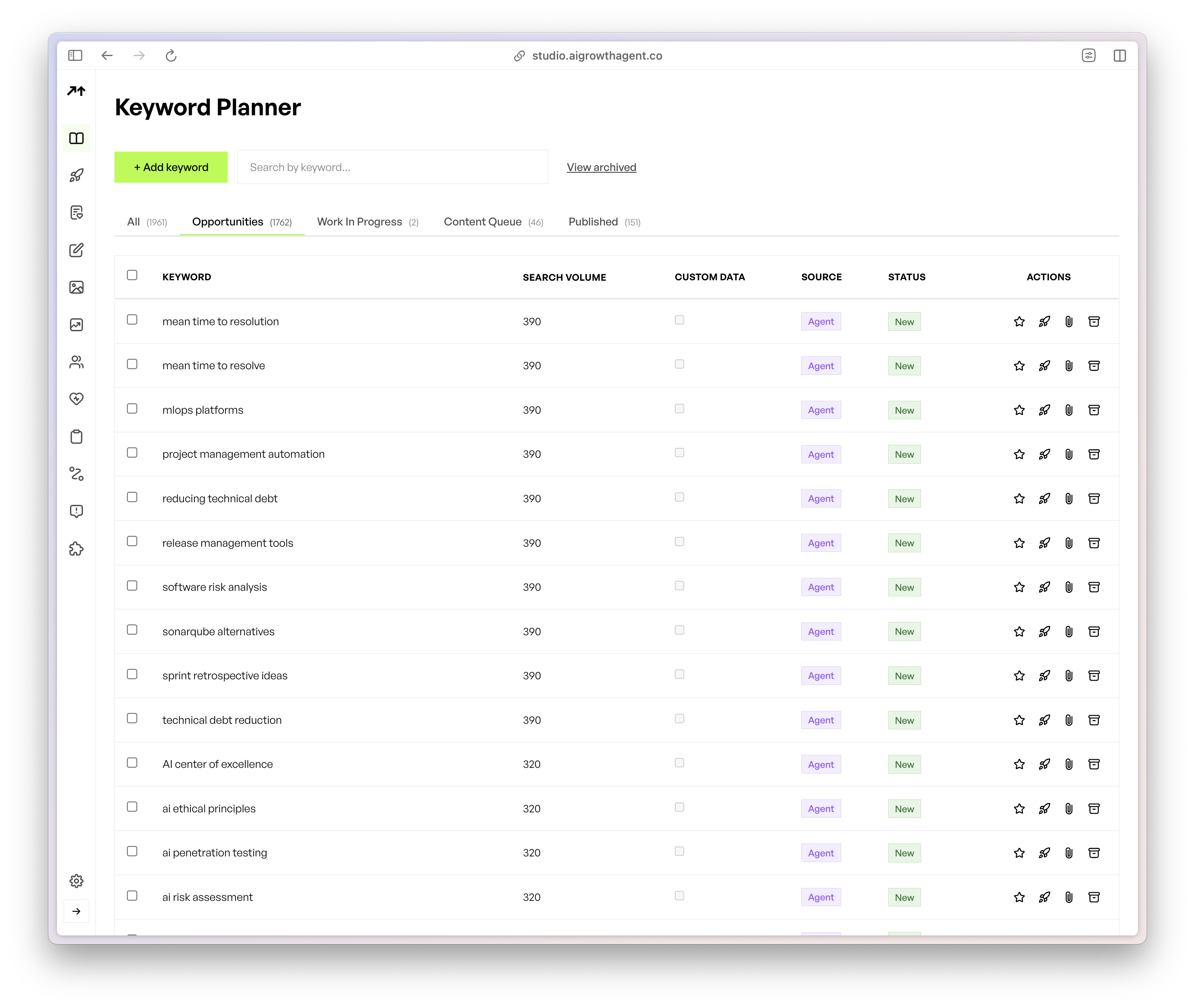
The platform manages keyword clustering, content strategy development, research, writing, fact-checking, technical SEO implementation, and direct publishing to optimized blog architectures. This end-to-end automation helps brands build comprehensive content structures that support authority in AI search environments.
How AI Growth Agent Solves AI Search Challenges
AI Growth Agent addresses AI search scalability through several capabilities. Programmatic velocity allows teams to publish high-quality, technically optimized content on a daily cadence, which supports the volume and consistency required for AI search. Automation removes human bottlenecks while keeping quality and brand alignment under control.
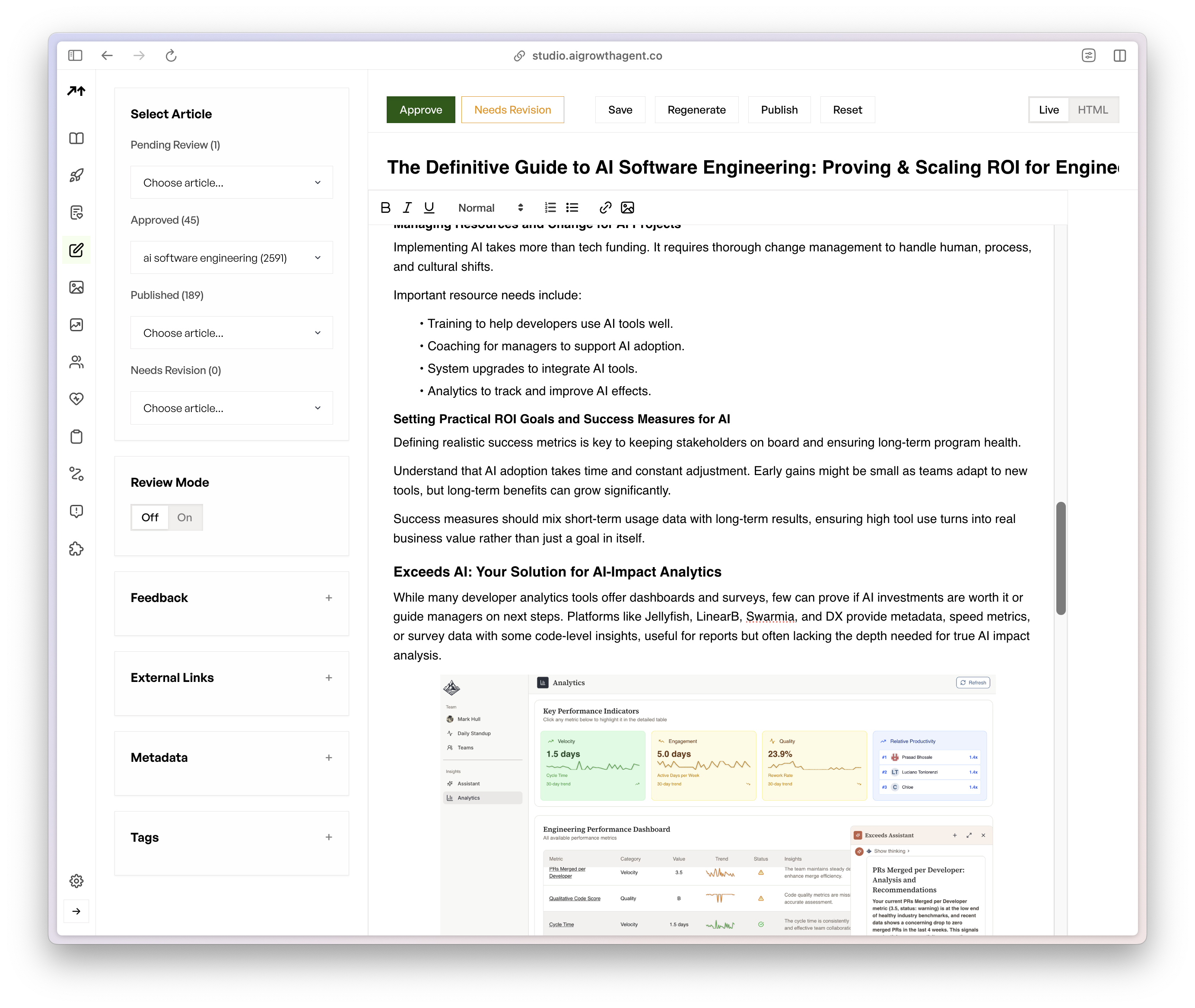
Technical AI optimization sits at the core of the system. AI Growth Agent implements advanced schema markup, LLM.txt files, and a dedicated blog Model Context Protocol (MCP) that helps AI search engines interface with content databases. This level of implementation supports indexing and interpretation by AI systems.
Scalability and efficiency improve through complete automation of repetitive tasks. From deep keyword clustering to schema implementation and direct publishing, the agent reduces technical friction that often prevents enterprises from reaching true SEO scale.
Key Capabilities
AI Growth Agent introduces several capabilities that expand what Programmatic SEO can cover at the enterprise level. Multi-tenant programmatic deployment allows private equity firms, venture portfolios, and enterprises with multiple product lines to run parallel Programmatic SEO Content Agents from a single interface. Each agent maintains its own Manifesto, keyword strategy, and brand voice, and can publish to different domains or subdomains.
Real-time Programmatic SEO content injection gives teams a way to respond quickly to trending topics. Users can provide a link to a relevant news article, and the agent generates a high-quality, SEO-optimized article with their brand’s perspective, which helps capture search volume from emerging opportunities.
Database-to-content automation unlocks value from proprietary data. For example, for a client with food recommendations stored inside a non-indexed app, the agent created SEO-rich articles for each recommendation list, turning offline or hidden data into a Programmatic SEO asset.
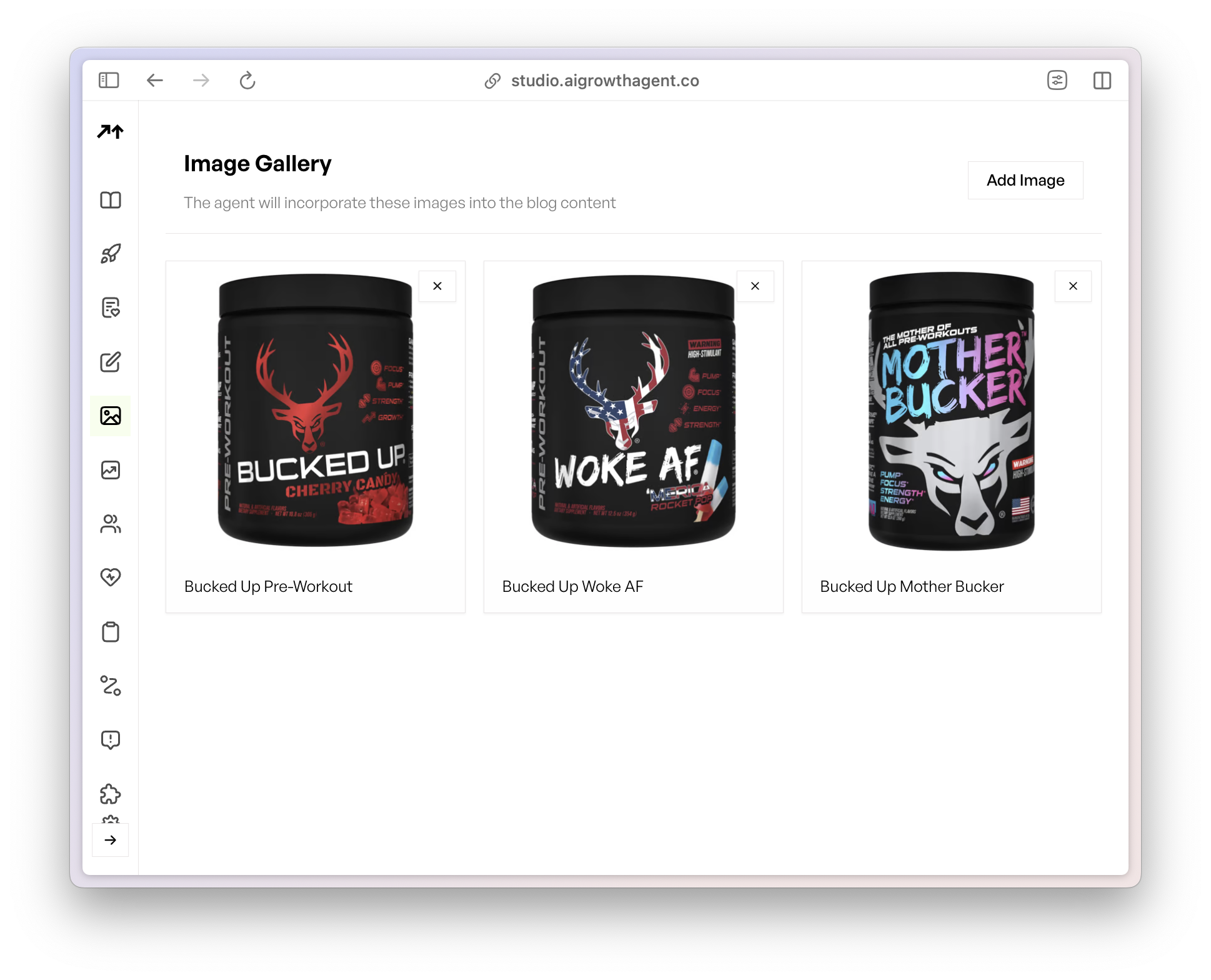
Intelligent image and asset placement allows the agent to select and insert relevant visuals from approved galleries or AI-generated images, including metadata that supports image SEO.
Comparative Analysis: Agencies vs. AI Tools vs. AI Growth Agent for AI SEO Scalability
This comparison table helps enterprise marketing leaders evaluate how each approach performs against the core criteria that shape success in modern search environments.
|
Criteria |
Traditional SEO Agency |
Self-Service AI Tools |
AI Growth Agent |
|
Primary Output |
Manual content, recommendations |
Unstructured text |
Engineered web pages, structured data |
|
Scalability for AI Search |
Low (human-limited) |
Medium (text volume only) |
High (autonomous system) |
|
AI Technical Optimization |
Basic to moderate |
Minimal to none |
Advanced (LLM.txt, MCP, schema) |
|
Authority and Citation |
Dependent on manual quality |
Low (generic content) |
High (engineered for citation) |
|
Cost-Effectiveness |
High fixed or hourly cost |
Low direct cost, high hidden effort |
High ROI potential (autonomous) |
|
Time to Value |
Weeks to months |
Immediate for drafting, longer for publishing |
Days to weeks (full engineering) |
|
Management Effort |
High (oversight, revisions) |
High (strategy, editing, publishing) |
Low (autonomous, ‘Auto-Pilot’ mode) |
The table highlights clear differences in capability and approach. Traditional agencies provide strong strategic guidance and high-quality individual assets but struggle to reach the volume required for AI search leadership. Self-service AI tools speed up text generation but still require significant internal effort for strategy, technical implementation, and publishing.
AI Growth Agent combines programmatic scale with technical depth and autonomous operation. The platform focuses on engineering content architectures that support AI search visibility while reducing the day-to-day workload for internal teams.
Real-World Impact: AI Growth Agent Successes in AI SEO Scalability
Autonomous Programmatic SEO can translate into measurable results across different industries. These examples show how AI Growth Agent has helped brands gain citations and recommendations inside AI search platforms.
Exceeds AI: Performance Reviews for Engineers
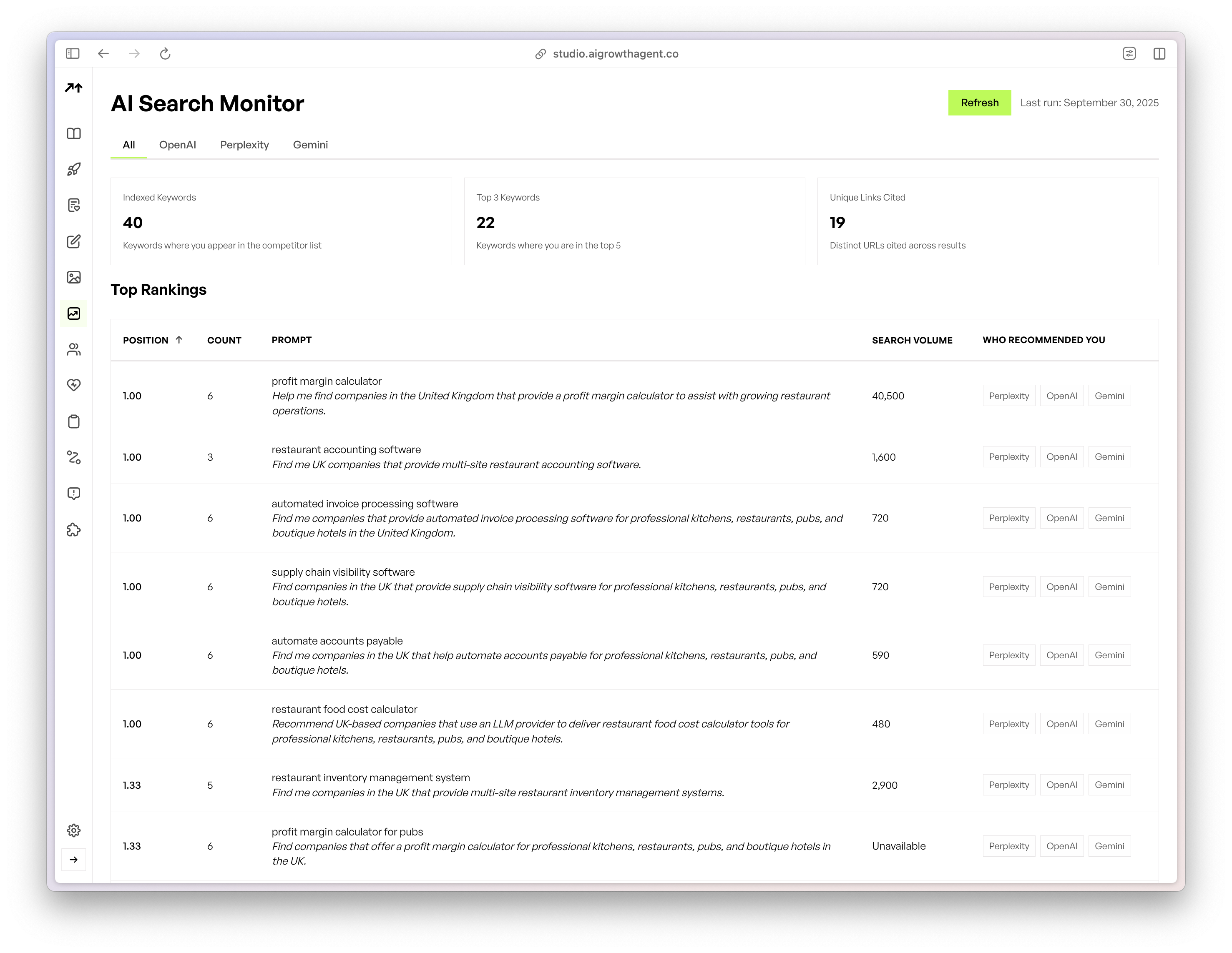
Within 2 weeks of implementation, Exceeds AI was recommended by Perplexity as a top alternative to established competitors. By week 3, it appeared in Google AI Overview and Gemini snapshots for core keywords. Today, Exceeds AI is featured across ChatGPT, Google AI Overview and Gemini, and Perplexity as a leading source for AI performance review tools for engineers.
BeConfident: English Learning on WhatsApp
BeConfident achieved fast indexing after programmatic publishing. Within weeks, it was recommended as a top app in Brazil for learning English in WhatsApp through Google AI Overview and Gemini.
Bucked Up: Sports Nutrition Brand
Within 3 weeks of publishing, Bucked Up was cited by ChatGPT as a top protein soda brand. It appears as a primary citation for the high-intent query “best protein soda” alongside other competitors in the category.
Gitar: Supercharge CI with AI
In less than 2 months, Gitar emerged as a reference brand for AI-powered CI and CD automation. It consistently appears as a top-cited tool across Google AI Overview and Gemini, ChatGPT, and Perplexity for queries such as “fix broken CI builds automatically,” “best AI reviewer that comments on CI failures,” and “best self-healing software for developers.” Schedule a consultation session to evaluate how similar Programmatic SEO strategies could support your brand’s AI search visibility.
Navigating Your Next Step: Choosing the Right Path for AI SEO Scalability
The choice between traditional agencies, self-service AI tools, and autonomous Programmatic SEO depends on objectives, resources, competition, and timelines. Evidence from current AI search environments indicates that autonomous programmatic approaches can deliver the scale and technical sophistication that AI optimization demands.
Enterprises that seek incremental improvements or targeted strategic consultation can benefit from traditional agencies. These partners provide human expertise and coordination but face inherent limits on volume and speed.
Self-service AI tools offer a low-friction way to increase text production. Enterprises that rely on these tools alone still need internal capacity for research, strategy, and technical SEO, which can limit the impact of AI-generated drafts.
Autonomous Programmatic SEO with AI Growth Agent addresses these gaps by supporting multi-platform optimization and real-time content deployment. Schedule a consultation session today to determine whether AI Growth Agent aligns with your goals for AI search leadership.
Frequently Asked Questions (FAQ) about AI SEO Scalability
How quickly can Programmatic SEO with AI Growth Agent impact AI search visibility?
Documented success stories show that AI Growth Agent can deliver measurable AI search visibility within 2 to 3 weeks of implementation. Exceeds AI achieved a Perplexity recommendation in 2 weeks and a Google AI Overview placement in 3 weeks, while Bucked Up gained a ChatGPT citation within 3 weeks. This timeline reflects the effect of technical optimization and automated content engineering.
Is AI Growth Agent suitable for companies that already have an in-house SEO team or agency?
AI Growth Agent is designed to complement existing SEO programs. The platform handles programmatic scale by producing high-volume, technically optimized content each day, so in-house teams and agencies can focus on higher-level strategy, experimentation, and creative work.
How does AI Growth Agent ensure content quality and brand voice at scale for AI search?
Quality and brand consistency draw on AI Growth Agent’s white-glove onboarding process, which creates a Company Manifesto that captures business positioning and brand voice. This document guides all content production. The pSEO Content Agent also learns from feedback inside the AI Growth Agent Studio, which refines alignment over time.
What kind of technical expertise is required to implement AI Growth Agent for AI SEO scalability?
AI Growth Agent removes most technical barriers, so marketing teams can adopt Programmatic SEO without dedicated engineering resources. The platform manages infrastructure setup, schema markup, metadata, and AI-specific features such as LLM.txt, and it does not require coding or specialist technical SEO skills.
How does AI Growth Agent adapt to changes in AI search algorithms and new platforms?
AI Growth Agent monitors updates across AI platforms and adjusts optimization and content approaches to maintain visibility. The AI Search Monitor module provides real-time feedback on performance and emerging opportunities, which supports ongoing refinement of the content program.
Conclusion: The Future of SEO Scalability Is Programmatic
AI-powered discovery is reshaping how brands build authority and gain visibility. Traditional approaches to SEO scalability can contribute value but do not always align with the speed, structure, and consistency that AI search optimization now requires.
Traditional SEO agencies provide strategic experience, and self-service AI tools expand text generation capacity. Autonomous Programmatic SEO adds technical depth and AI-focused optimization. Recent examples from Exceeds AI, BeConfident, Bucked Up, and Gitar demonstrate how programmatically generated content can gain citations and recommendations across major AI platforms within weeks.
Marketing leaders now face a timing decision. Consumer trust in AI content is evolving, creating both opportunities and challenges for brands seeking citation and visibility in AI-powered search results, so early movers can shape how AI systems present their category and brand.
AI Growth Agent offers an autonomous Programmatic SEO solution for enterprises that want to establish and defend category authority in the AI era. Schedule a demo to evaluate whether AI Growth Agent fits your SEO strategy and to explore how programmatic content engineering can support your growth goals.
