


Key Takeaways
- AI search systems now rely on structured, authoritative, and frequently updated content, so manual-only SEO workflows no longer keep pace.
- Programmatic and AI-assisted platforms help teams cover entire topic clusters, implement schema, and maintain site health across large content libraries.
- Multi-tenant, API-first, and database-to-content solutions give enterprises and agencies ways to manage complex portfolios without proportional headcount growth.
- Monitoring AI search visibility across tools like ChatGPT, Gemini, and Perplexity is becoming as important as traditional rankings in web search.
- AI Growth Agent offers an end-to-end programmatic SEO platform for brands that want to scale AI-ready content, and teams can explore it by booking a demo.
Why Scalable SEO Content Platforms Are Critical for AI Search
Shrinking Digital Footprint in the AI Era
AI-generated content has increased the volume of pages competing for attention in search and chat interfaces. As more results come from AI summaries, each brand’s visible presence in search results and AI citations becomes smaller. Manual SEO and content workflows struggle to maintain that visibility at the required pace.
AI Search Prioritizes Authority and Structured Data
AI systems favor content that signals clear expertise and structure. Entity-based optimization and knowledge graph work, such as entity-focused SEO and schema-driven knowledge graph integration, help AI models understand relationships between topics, brands, and products. Topical depth and technical precision now matter more than single keyword placement.
The Velocity Gap Between Manual and Programmatic SEO
Content teams that publish only a few posts per month find it difficult to compete with organizations that publish optimized pages daily. Large language models reward fresh, comprehensive content that stays aligned with evolving search behavior. Scalable systems close this velocity gap by combining automation with human oversight.
Programmatic Content as a Core Capability
Programmatic content engineering supports consistent schema, internal linking, and topic coverage across hundreds or thousands of pages. This approach creates the breadth AI search needs when selecting sources for summaries and recommendations. Brands that invest in these systems can build durable authority signals over time.
The 10 Scalable SEO Content Platforms Redefining Digital Authority
1. Advanced Programmatic SEO Agents (included in AI Growth Agent)
What it is: Autonomous systems that plan, write, optimize, and publish content at scale. These agents apply technical SEO elements such as schema markup, LLM.txt, and structured internal linking across every piece.
Why it matters: Teams gain a repeatable way to publish AI-ready content without managing each article by hand. Capabilities such as multi-tenant deployment and real-time content injection let enterprises react quickly to new opportunities while keeping governance in place.
Trade-offs: Effective use often requires process changes, integration with analytics and CMS tools, and a willingness to trust programmatic workflows. AI Growth Agent makes that transition smoother by handling the whole process.
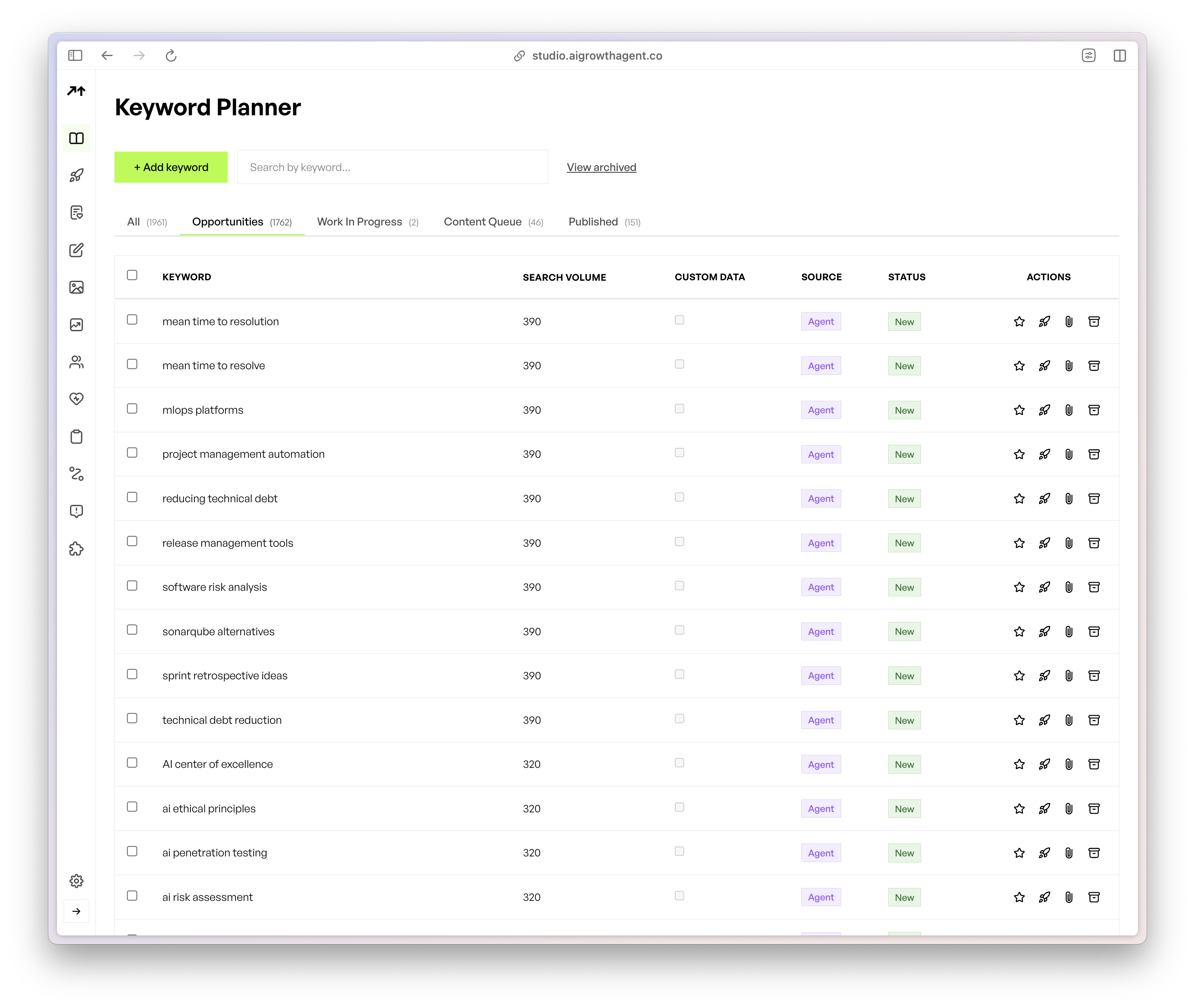
2. AI-Powered Keyword Research and Topical Clustering Tools (included in AI Growth Agent)
What it is: Platforms that use machine learning to group related queries into topic clusters and map search intent. Automated keyword research with predictive analytics gives teams a structured view of which themes to prioritize.
Why it matters: Cluster-based planning makes it easier to build pillar pages and supporting content that signal topical authority. Topic clustering frameworks also guide internal linking and content sequencing.
Trade-offs: These tools inform strategy but do not write or publish content on their own, so teams still need production workflows or automation. AI Growth Agent has keyword research and topical clustering as a part of its offering, which includes writing and publishing content.
3. Enterprise CMS Platforms with Advanced SEO Integrations (setup included in AI Growth Agent)
What it is: Flexible content management systems with APIs, plugin ecosystems, and SEO-focused modules. These systems support streamlined publishing to WordPress, Shopify, and Wix with platform-specific optimizations.
Why it matters: A capable CMS provides the foundation for schema templates, metadata rules, and publishing workflows. Teams can use content governance features such as style guides and tone rules to keep large libraries consistent.
Trade-offs: Implementing automation often requires development resources and ongoing maintenance of integrations. AI Growth Agent handles these tasks.
Book a demo to see how AI Growth Agent connects with existing CMS workflows for programmatic publishing.
4. AI-Driven Content Optimization and Auditing Suites (included in AI Growth Agent)
What it is: Tools that compare drafted content against top results and recommend improvements. These platforms run NLP analysis, suggest semantic terms, and check technical elements. They also support AI-based optimization against high-performing pages.
Why it matters: Optimization suites help bring older and new content in line with current expectations. Some tools provide automated “rank-high” recommendations across search environments.
Trade-offs: Insights still need implementation, either by writers and SEO specialists or by connecting to automation platforms. AI Growth Agent has the best of both worlds, combining close strategy touchpoints with a dashboard that shows the best-performing articles and further queries to explore, guiding optimizations.
5. Structured Data and Schema Markup Automation Tools (included in AI Growth Agent)
What it is: Platforms that generate and validate Schema.org markup at scale for articles, products, FAQs, and other content types. These tools support knowledge graph alignment and entity-driven SEO.
Why it matters: Rich, accurate schema helps AI systems interpret context and relationships. This improves eligibility for rich results and can support AI citations.
Trade-offs: Schema tools cover technical markup but usually do not manage content strategy or production. Ai growth Agent offers an end-to-end service.
6. Multi-Tenant Content Generation Systems (included in AI Growth Agent)
What it is: Systems that manage separate content agents and configurations for multiple brands or business lines from one interface. AI Growth Agent’s multi-tenant deployment is an example of this approach.
Why it matters: Agencies and large enterprises can share infrastructure while keeping messaging and rules distinct. Centralized content governance becomes easier when each brand instance still follows its own style and constraints.
Trade-offs: Administration requires clear documentation of brand guidelines and careful role management. AI Growth Agent has processes in place for maintaining your brand tone across accounts while taking into consideration the specifics of each vertical.
Schedule a consultation to explore multi-tenant options with AI Growth Agent.
7. Real-Time Content Injection and News-Driven Workflows (included in AI Growth Agent)
What it is: Platforms that identify trending topics or news events and generate optimized content quickly. AI Growth Agent’s real-time programmatic content injection illustrates how agents can turn signals into live pages.
Why it matters: Timely content helps brands capture short-lived spikes in search demand and appear in AI summaries that reflect current events.
Trade-offs: Governance, fact-checking, and approvals must move quickly or be embedded into automated rules.
8. Database-to-Content Automation Solutions (included in AI Growth Agent)
What it is: Systems that convert structured internal data, such as product catalogs or location tables, into search-optimized pages. AI Growth Agent uses this approach to turn offline or internal data into programmatic SEO assets.
Why it matters: Many organizations hold detailed data that never reaches the web. Database-to-content tools create specific, useful pages for long-tail searches and support authority across niches.
Trade-offs: Results depend on data quality, taxonomy, and access to reliable internal systems.
9. API-First SEO and Content Platforms (included in AI Growth Agent)
What it is: Platforms designed around APIs so teams can integrate content workflows with CRM, analytics, translation, and approval tools. These capabilities enable API-based content pipelines that combine CMS, localization, and review.
Why it matters: Interconnected optimization frameworks reduce manual steps and support compound gains across channels.
Trade-offs: Teams need engineering support to design, implement, and maintain these integrations. AI Growth Agent handles blog design and maintenance so that enterprises don’t have to worry about integrations.
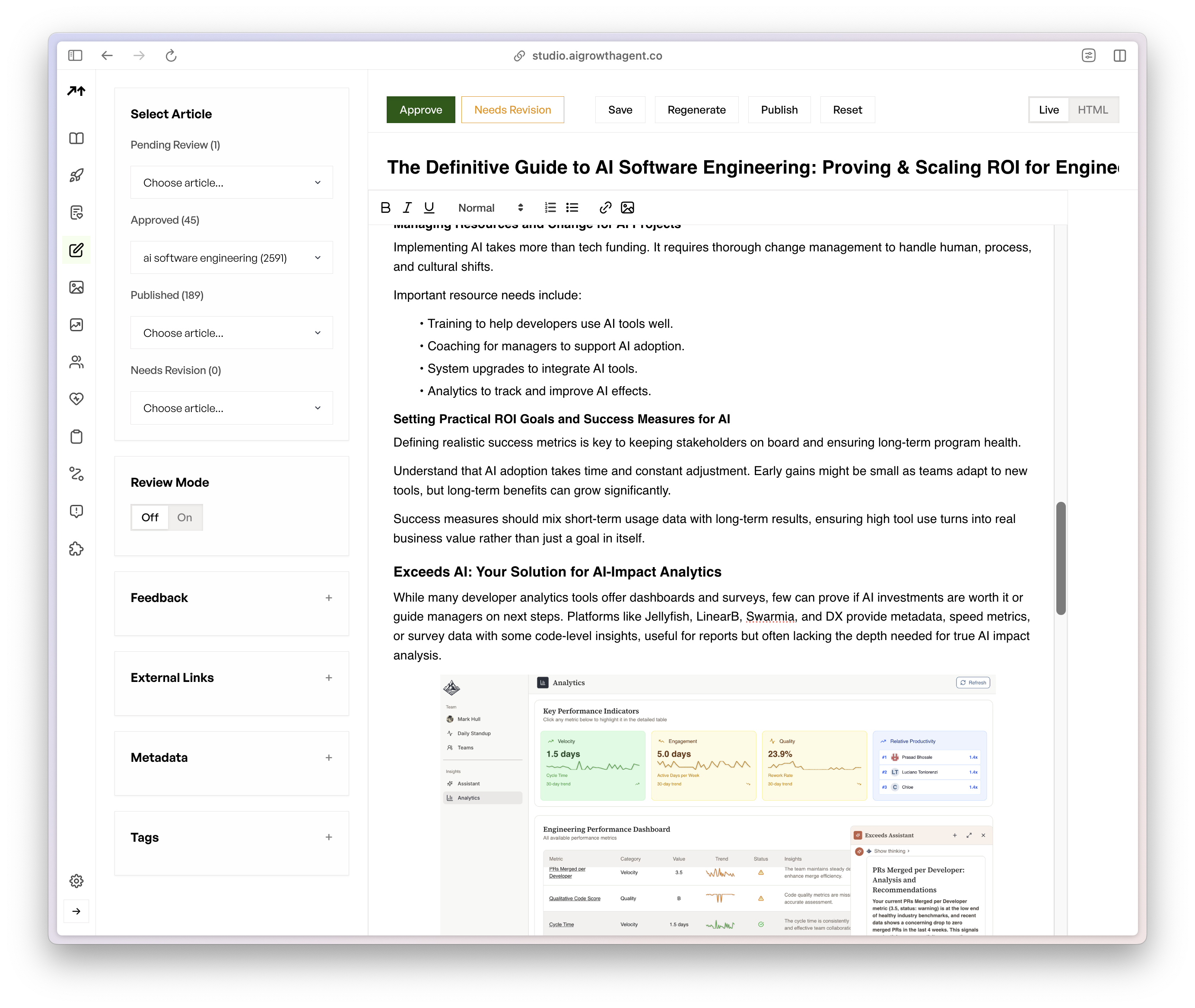
10. AI Search Monitoring and Feedback Loop Platforms
What it is: Tools that track how content appears in AI environments, such as ChatGPT, Gemini AI Overviews, and Perplexity. AI Growth Agent’s AI Search Monitor and feedback loop show coverage, citations, and gaps.
Why it matters: Visibility in AI responses can differ from traditional rankings. Coverage and relevance metrics tuned to AI search help teams refine content based on how AI systems actually respond to users.
Trade-offs: These tools surface insights and issues, so teams still need workflows or agents to act on those findings.
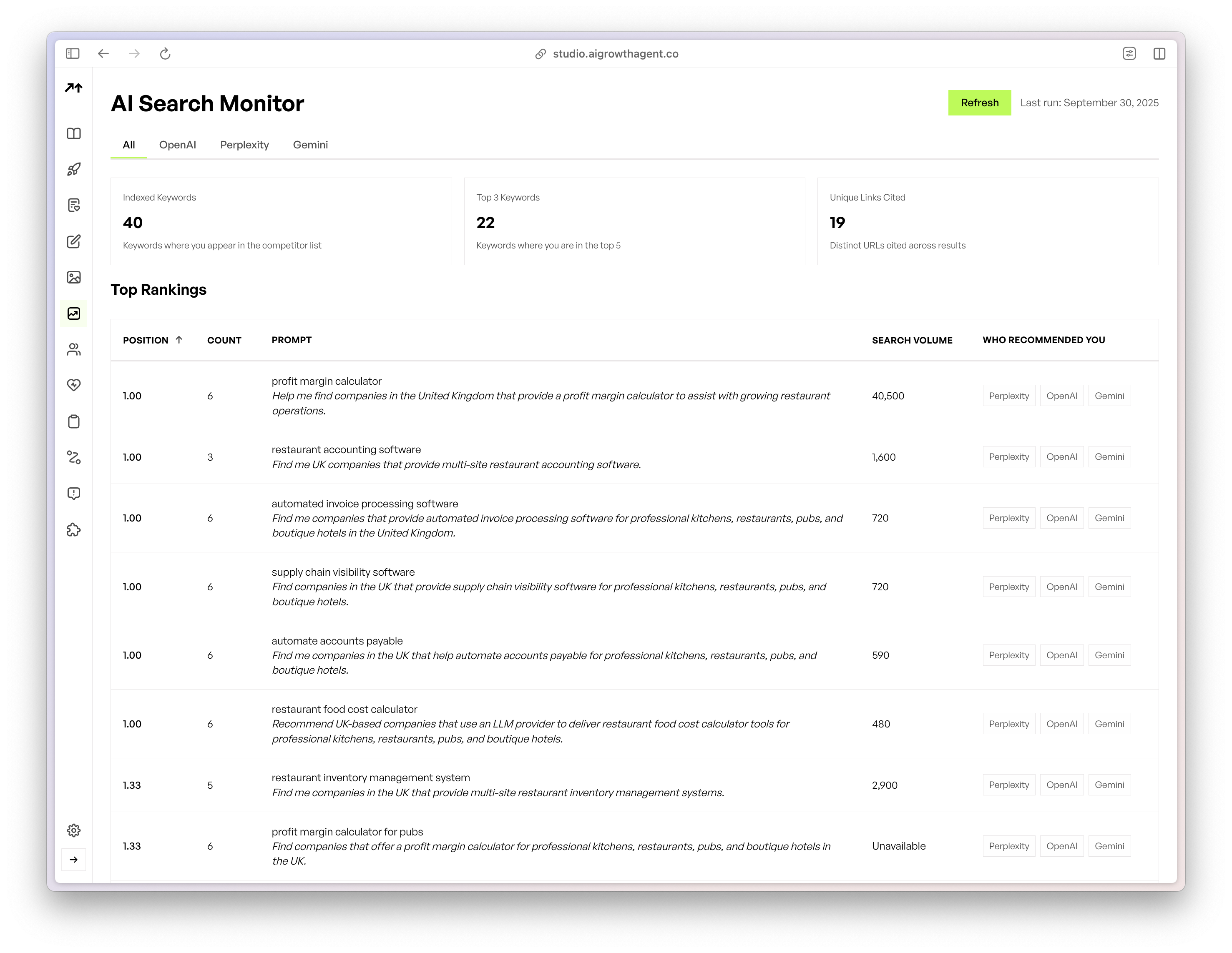
Request a demo to review how AI Growth Agent tracks and improves your AI search presence.
Implementing a Scalable SEO Content Platform
Clarify Your Main Scalability Goal
Define whether your priority is volume, technical AI-readiness, or multi-brand management. Some teams focus on daily optimized articles with LLM support, while others care most about structured workflows across regions or business units.
Prioritize AI-Ready Foundations
Select platforms that treat schema, LLM.txt, and semantic optimization as core features. Capabilities such as schema templates and entity optimization for multimodal content reduce rework later.
Look for End-to-End Automation
Effective scalability links research, planning, drafting, optimization, publishing, and monitoring into one flow. Integrated frameworks that remove handoffs lower costs and help teams maintain consistent output.
Confirm Integration and Governance Capabilities
Check whether the platform connects cleanly to your CMS, analytics, and approval tools. API-based workflows for content, translation, and review improve control and make compliance simpler.
Schedule a consultation with AI Growth Agent to map these requirements to your current stack.
Frequently Asked Questions (FAQ) about Scalable SEO for AI Search
What defines a scalable SEO content platform in the AI era?
A scalable platform handles the full content lifecycle at high volume without proportional increases in headcount. It supports keyword research, topic planning, drafting, technical optimization, schema, LLM.txt, internal linking, publishing, and monitoring. Quality and technical accuracy remain stable or improve as volume grows.
How do programmatic SEO platforms differ from traditional content agencies?
Programmatic platforms such as AI Growth Agent rely on software agents and engineering workflows, not primarily on manual production. They can publish many schema-rich pages while applying shared rules for tone and brand. Traditional agencies focus on individual pieces and rely more on manual project management.
Can basic AI tools like ChatGPT replace scalable SEO platforms?
General-purpose AI tools can assist with drafting, outlines, and structured elements such as metadata or schema. They do not usually provide integrated publishing, analytics, monitoring, or governance. Reaching true scale requires orchestration, not just text generation.
How quickly can a business see results from scalable SEO systems?
Timelines vary by domain strength, content gaps, and technical health. Some AI Growth Agent clients, including BeConfident and Exceeds AI, reported AI recommendations within weeks after implementation. Most brands see more consistent signals over three to six months as content volume and internal linking grow.
Book a session to review timelines and expectations for your specific domain.
Conclusion: Building Authority for 2026 and Beyond
AI search continues to change how people discover products, tools, and expertise. Scalable SEO content platforms give teams the structure and automation needed to publish AI-ready content, maintain technical standards, and observe performance across both web and AI search.
Brands that adopt programmatic content engineering in 2026 can grow topic coverage, improve structured data, and respond faster to new opportunities. Teams that stay with slow, manual workflows risk losing visibility as AI systems favor sources that publish consistently and maintain clear authority signals.
Schedule a demo with AI Growth Agent to evaluate whether programmatic SEO is a fit for your organization.
