


Key takeaways from this article:
- AI search engines like Perplexity, ChatGPT, and Gemini now shape how buyers discover brands, so content must be designed for their ranking systems, not only for traditional SEO.
- Perplexity relies on semantic embeddings, content clusters, authority signals, and freshness, which reward deep, interconnected, and frequently updated content.
- Manual agencies, internal teams, and basic AI text tools struggle to meet the required volume, technical rigor, and publishing speed for Perplexity recommendations.
- Programmatic SEO offers a structured way to engineer content for AI search, including semantic depth, technical indexing, topic clustering, and coordinated distribution.
- AI Growth Agent automates this programmatic model by combining research, content creation, technical SEO, and AI search monitoring into one integrated system.
- Marketing leaders who adopt AI-focused content operations now are better positioned to secure durable visibility and authority as AI search continues to expand.
The New Reality: Why AI Search Demands a Scaled Content Strategy
The Shrinking Digital Footprint: The Imperative to Scale Content
Marketing leaders now face a difficult challenge: maintaining brand visibility while AI rapidly increases the volume of content published online. Millions of AI-generated articles appear every day, which dilutes attention and makes traditional content approaches less effective. The relationship between businesses and search has shifted from manual keyword targeting toward programmatic content that signals credible authority.
Publishing one or two manually crafted posts each month rarely maintains technical relevance. AI-powered search engines reward recency, depth, and consistent structure at a scale that manual workflows cannot match. Brands that lack a tailored programmatic strategy risk falling out of view for the AI indexers that power discovery across modern search interfaces.
This shift has strategic consequences. If AI search engines do not find enough high-quality, up-to-date data points about your brand, they draw on competitors instead. Those competitors then receive citations, recommendations, and narrative control inside AI answers.
Industry Trends: The Fundamental Shift in AI Search Engine Ranking
AI search optimization is diverging from traditional SEO. Search behavior is splitting into traditional results and AI overviews, which require distinct optimization strategies.
Traditional search engines lean on backlinks, keyword usage, and domain authority. Perplexity instead uses a three-layer reranking system that relies on machine learning models to refine result quality for entity and topic searches. This approach raises the bar for semantic and structural quality.
The ranking system also changes how organizations must think about freshness. Perplexity runs a real-time web crawler that continuously processes new information, in contrast with static databases used in older models. This behavior makes ongoing content updates and continuous coverage central to visibility.
Marketing leaders who want to build AI search authority can move faster by working with specialists. Schedule a consultation session to explore how AI Growth Agent scales content for Perplexity recommendations using a programmatic approach.
Decoding Perplexity AI: Key Ranking Factors & Recommendation Mechanisms
Semantic Embedding & Contextual Relevance: Beyond Keywords
Perplexity ranking revolves around semantic relevance instead of simple keyword matching. Content that reaches semantic embedding similarity scores of 0.75 or higher tends to qualify for citations, while content below 0.60 is effectively ignored, even on strong domains.
Pages must pass embedding_similarity_threshold checks, which test how closely the overall meaning of the content matches the user query. This process looks at intent and context, not just repeated keywords.
Relevance Matching evaluates semantic relationships and contextual signals with AI models, so well-structured, interconnected content ecosystems tend to perform better than isolated articles.
Building Authority: Quality, Expertise, and Content Clusters
Authority in Perplexity relies on more than domain-level metrics. Source Authority Assessment looks at domain strength, publication credibility, author expertise, and content freshness, giving extra weight to academic and verified expert sources.
Content quality also receives close inspection. Content Quality Analysis rewards depth, factual accuracy, comprehensive coverage, use of multiple sources, and clear subject-matter expertise. Brands that publish organized content ecosystems can benefit from this emphasis on thorough coverage.
Content clustering is a major multiplier. Perplexity uses boost_page_with_memory systems that favor interconnected clusters, where related pieces reinforce one another. Single, standalone pages struggle to match the sustained visibility that clusters can earn.
The Velocity Imperative: Recency, Impressions, and Time Decay
Time-based ranking rules in Perplexity make publishing speed and early traction critical. Content that fails to generate at least 1,000 impressions in the first 30 minutes can drop into lower-priority index tiers, which reduces future citation odds by 60–70 percent. Most manual workflows cannot coordinate this level of launch activity.
Ongoing updates matter as well. Aggressive time decay rules mean content updated every 2–3 days can maintain full weight, weekly cadence retains about 70 percent, monthly updates fall toward 40 percent after 60 days, and static pages receive minimal attention. This pattern weakens traditional evergreen content tactics.
The algorithm balances both recency and established authority, favoring fresh content on time-sensitive topics while still recognizing long-standing expert sources. Brands must deliver both speed and sustained quality to stay competitive.
Strategic Topic Prioritization & Algorithmic Multipliers
Topic selection can unlock significant algorithmic advantages. Certain topic categories receive 3x multiplier boosts based on how Perplexity classifies them, so vertical focus becomes a strategic decision rather than a cosmetic one.
High-value categories receive top_topic_multiplier boosts, while restricted_topics face penalties. Content strategy needs to reflect these differences so that high-effort pieces land in supportive, not constrained, categories.
Perplexity also relies on three suggestion types: Always Active Suggestions, Domain-Triggered Suggestions, and Threshold-Based Suggestions. Structuring content clusters to align with these suggestion models can increase exposure across a wider range of queries.
The Shortcomings of Traditional Content & SEO for Perplexity
Why Manual SEO Agencies Can’t Keep Pace
Most traditional SEO agencies rely on manual content production. This model tends to be slow, expensive, and difficult to scale to the volumes Perplexity favors. Teams might deliver a few strong articles each month, but they rarely generate the structured, high-volume data layer needed for AI search.
Perplexity’s technical requirements extend beyond the comfort zone of many agencies. Manual workflows struggle to hit the early impression thresholds and ongoing update cadence that the algorithm rewards. Agencies also often lack engineering capacity for advanced schema markup, LLM.txt files, and Model Context Protocol integrations at scale.
Semantic depth and clustering present another gap. Effective boost_page_with_memory performance depends on tightly planned topic clusters and dense internal connections. Manual planning usually leaves coverage gaps, which weakens the network effects that Perplexity’s systems favor.
Internal Teams: Resource Gaps and Technical Hurdles
Internal marketing teams often face even sharper constraints. Many organizations do not have dedicated engineers for programmatic SEO, even though optimal AI indexing relies on advanced schema, refined robots.txt rules, and well-structured LLM.txt files.
The operational side can also become a bottleneck. Effective Perplexity distribution often involves launching across 5–7 channels in the first 30 minutes, including founder posts, email, internal messaging tools, and newsletter teasers. Coordinating this level of activity manually is challenging for most teams.
Strategic analysis adds further complexity. Teams must understand which topic categories carry multipliers, how to build clusters that support them, and how AI search engines interpret those clusters. Few marketers have the time or background to specialize in these AI-specific mechanics.
Basic AI Tools: Generating Text, Not Authority
Most self-serve AI writing tools focus on fast text output. They do not handle the full stack of programmatic SEO requirements that AI search demands. The result is unstructured copy that still needs strategy, technical formatting, schema, and publishing work from internal teams.
Generic systems like baseline ChatGPT interfaces cannot configure semantic embeddings, clustering logic, or technical SEO for Perplexity. They also do not build the interlinked architectures that boost_page_with_memory methods favor. Content often needs heavy editing and development before it meets AI ranking standards.
Velocity and iteration present additional limits. Without automated publishing, technical implementation, and monitoring, content from basic tools rarely meets Perplexity’s requirements for rapid impressions and continuous updates.
Schedule a demo to see how AI Growth Agent closes these gaps and scales content for Perplexity recommendations with an end-to-end, engineered approach.
Programmatic SEO: The Blueprint to Scale Content for Perplexity Recommendations
Strategy 1: Engineering Content for Semantic Depth and AI Citation
Perplexity-ready content needs to be engineered for AI comprehension, not just human reading. Effective pages often combine real semantic depth, conversational language patterns with Flesch scores above 55, and coverage that answers likely follow-up questions within the same article.
Each piece should demonstrate expertise through multiple credible citations, clear fact patterns, and explanation that goes beyond surface summaries. Content structure must clarify relationships between concepts while staying approachable, so AI models can parse meaning and intent accurately.
Technical engineering plays a parallel role. Metadata, schema markup, and LLM.txt configuration help AI search engines understand both the page and its connections to other content. These elements raise the odds of citation and strengthen performance inside AI recommendation systems.
Strategy 2: Building Interconnected Content Clusters
Strong clusters help Perplexity understand where your brand has depth. The three suggestion categories—Always Active, Domain-Triggered, and Threshold-Based—provide a useful guide for mapping how content should interconnect.
Effective clusters usually start with pillar pages that frame the topic, supported by detailed subpages that address narrower questions or use cases. Internal links, consistent terminology, and shared structure help Perplexity interpret the cluster as a coherent source of authority.
Topic selection should align with algorithmic multipliers. Multiple repeatable tactics now exist for ranking in Perplexity, and most of them emphasize systematized topic clusters instead of one-off posts. Brands that design content as ecosystems tend to see more durable visibility.
Strategy 3: Accelerating Time-to-Index & Sustaining Freshness
Launch coordination has become a ranking input. High-performing Perplexity strategies often rely on synchronized campaigns across 5–7 channels within the first 30 minutes of publication. Automation makes this kind of rollout far more reliable.
Freshness then becomes a recurring operational task. Content that does not receive updates loses algorithmic weight quickly, so teams need a process for spotting pages that are drifting out of date and refreshing them before rankings erode.
Maintaining both speed and depth requires systems, not heroics. Programmatic content pipelines that output well-structured, technically optimized articles give brands a more stable way to compete in AI search.
Strategy 4: Mastering Technical Indexing for AI Bots
Understanding how Perplexity discovers and processes content is a foundation for any technical strategy. Site infrastructure must make it easy for AI bots to crawl, interpret, and reuse information.
Structured data is central here. Rich schema markup, LLM.txt files, and Model Context Protocol support give AI systems more precise signals about what each page covers. These tools help AI search engines move from guessing meaning to reading explicit definitions.
Site architecture and governance matter as well. Clean URL structures, robots.txt rules that support AI crawlers, and consistent metadata reduce friction and raise the odds that high-value content will be indexed and reused in answers.
Marketing leaders who want to implement these elements more quickly can rely on automation. Schedule a consultation session to see how AI Growth Agent automates technical indexing for Perplexity recommendations.
AI Growth Agent: The Definitive Solution to Scale Content for Perplexity
Autonomous Content Engineering at Scale
AI Growth Agent is built to address the specific technical and operational demands of AI search optimization. The platform functions as a Programmatic SEO Agent that engineers high-authority content architectures so companies can build recognizable expertise in their categories and earn consistent AI citations.
The process begins with a structured onboarding session. In about an hour, experienced journalists work with your team to create a Company Manifesto that captures positioning, messaging, and boundaries. This document becomes a living reference that guides all future content while staying aligned with AI comprehension needs.
After the manifesto is in place, AI Growth Agent runs large-scale research across tens of thousands of queries and topics in your domain. This analysis produces a pillar-and-cluster strategy adapted to AI query behavior, so every asset supports specific opportunities for Perplexity ranking and citation.
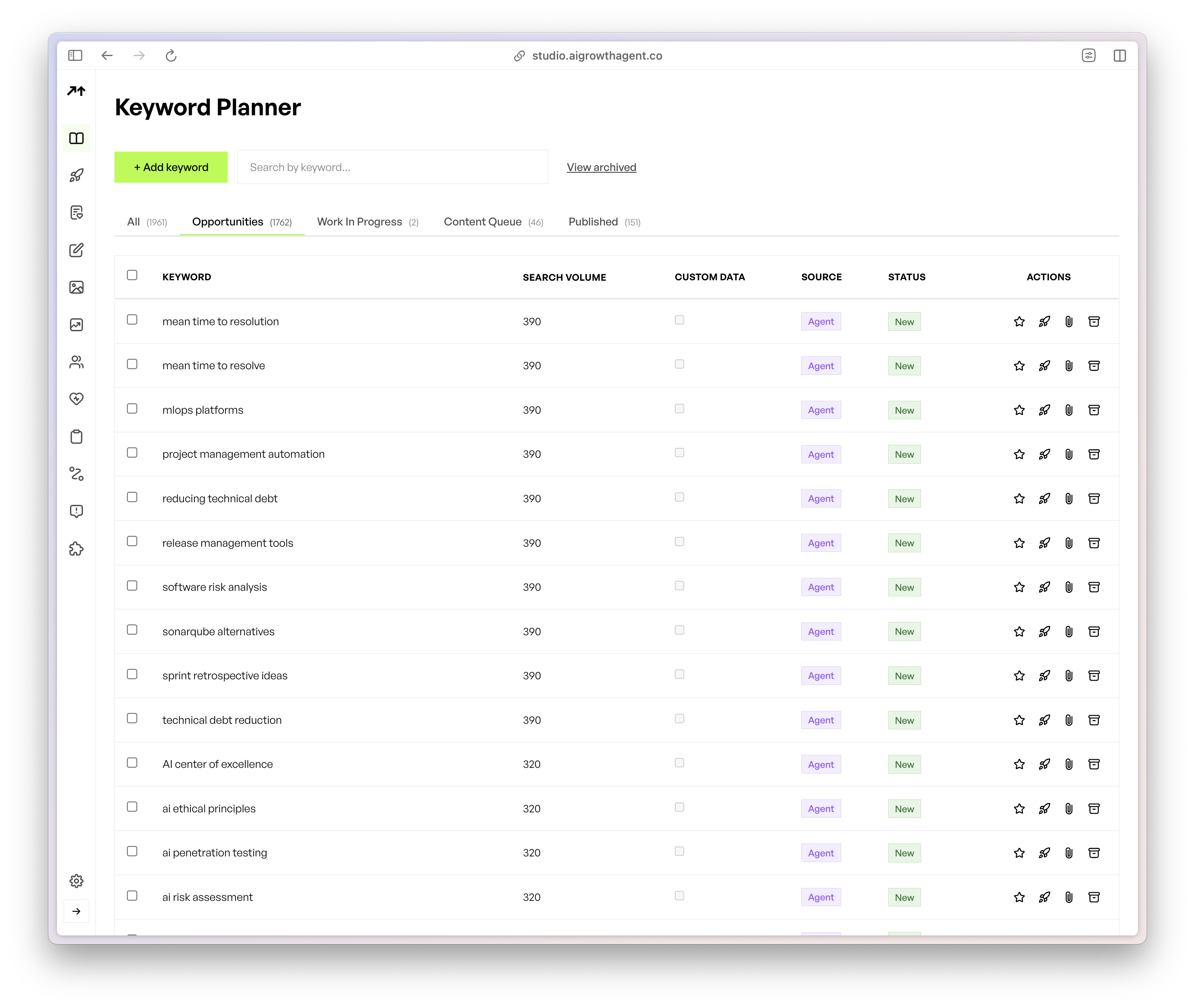
The platform then sets up an optimized blog architecture that matches your existing brand style while providing a clean base for programmatic SEO. The Programmatic SEO Content Agent manages the full lifecycle: strategy, in-depth research, drafting, fact-checking, and technical engineering, including schema markup, metadata optimization, and LLM.txt setup.
Breakthrough Capabilities for Enterprise-Grade Authority
AI Growth Agent includes capabilities designed for organizations that manage multiple brands or products. The Multi-Tenant Programmatic Deployment system lets private equity firms, venture portfolios, and multi-brand enterprises run several Programmatic SEO Content Agents from a single interface. Each agent maintains its own manifesto, keyword strategy, and brand voice while publishing to separate domains or subdomains.
Real-Time Programmatic SEO Content Injection supports time-sensitive topics. The system can generate brand-aligned, SEO-optimized articles from trending news links in minutes, helping brands capture search demand during short-lived windows when manual teams would still be drafting.
Database-to-Content Automation converts proprietary data into indexable content. A company with a large database of food recommendations, for example, can automatically generate tailored, SEO-ready pages for each list, turning previously hidden data into AI-searchable assets.
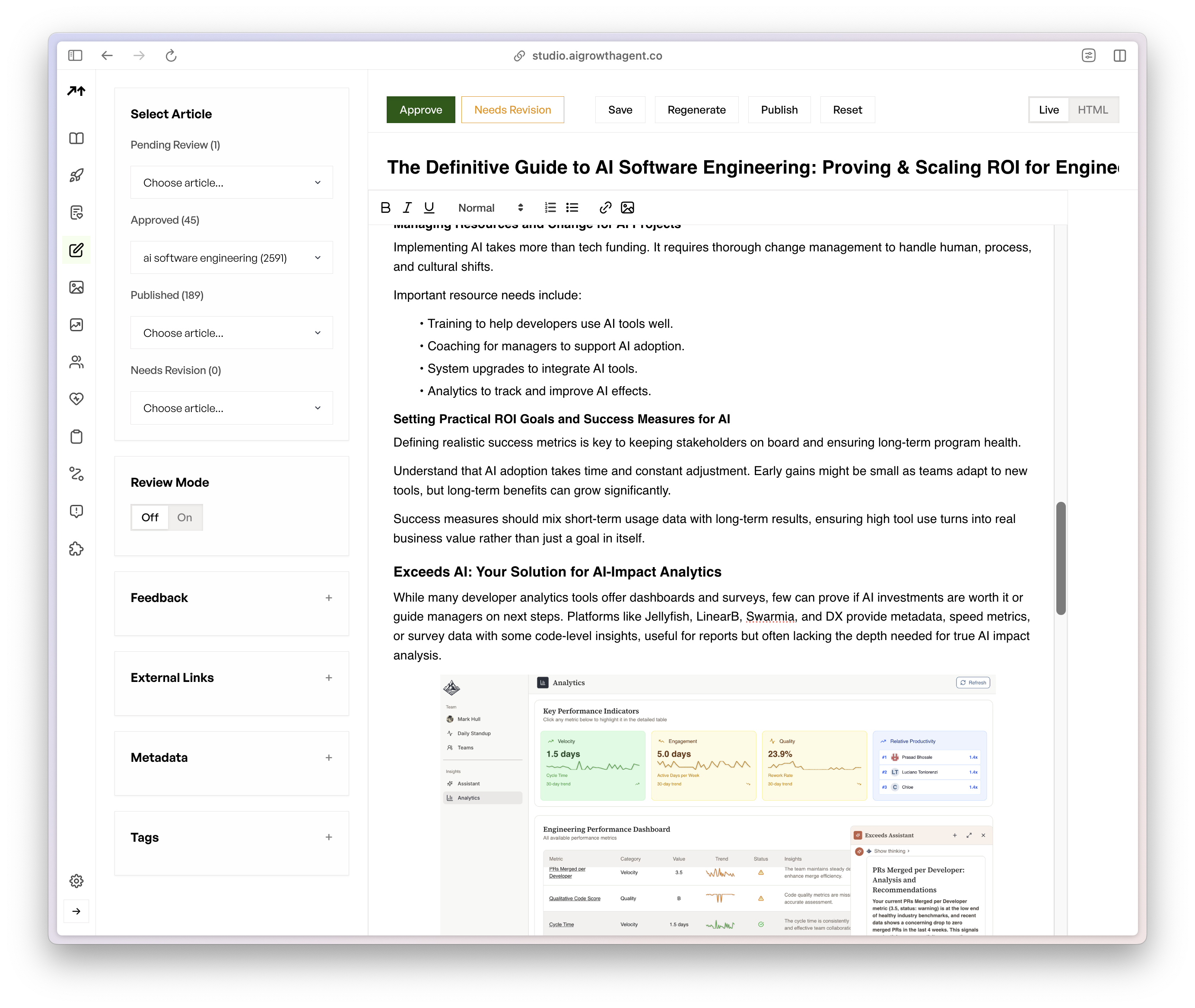
Intelligent Image & Asset Placement selects and inserts images and other media with full metadata optimization for image SEO. The system can draw on existing brand assets or generate new visuals as needed, which removes another manual step from the publishing process.
AI Search Monitor & Feedback Loop for Continuous Optimization
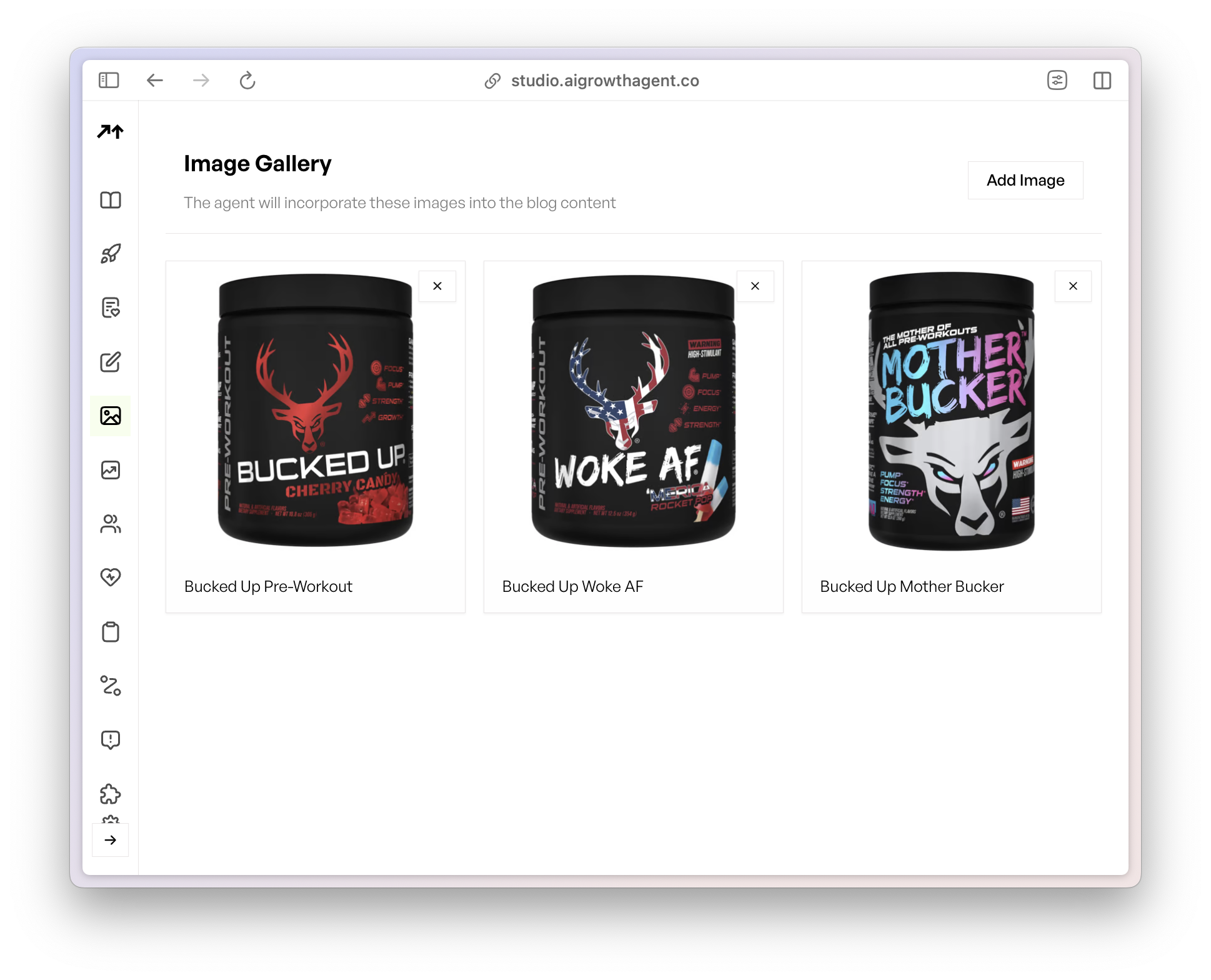
The AI Growth Agent Studio gives marketing leaders visibility into performance across AI search engines. A dedicated AI Search Monitor shows how content indexes and surfaces inside ChatGPT, Gemini, and Perplexity, using heatmaps to display coverage by topic and URL.
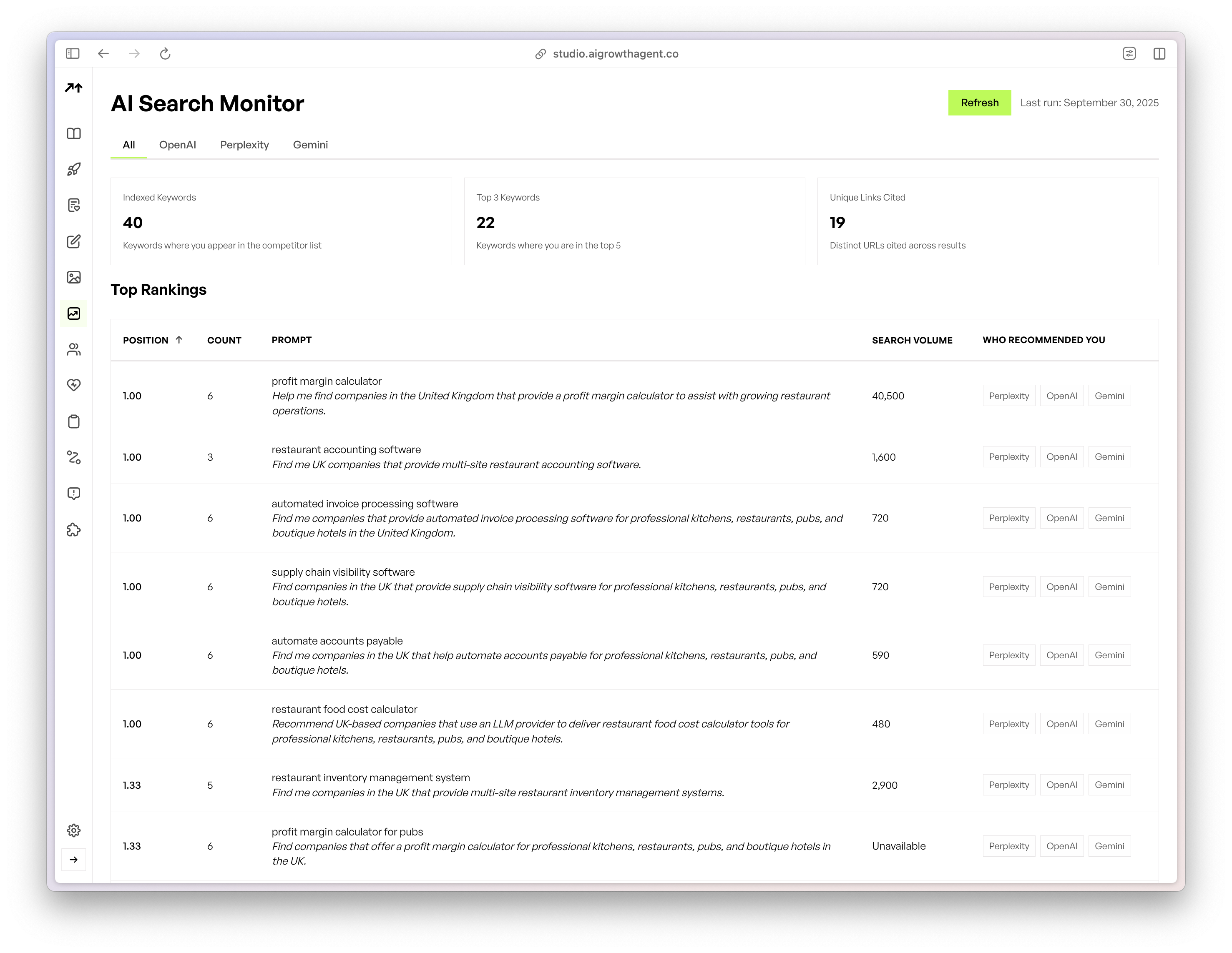
Marketers can see which URLs drive AI visibility, how AI systems quote or summarize content, and how often different bots crawl the site. These insights support precise adjustments to topics, structure, and internal linking.
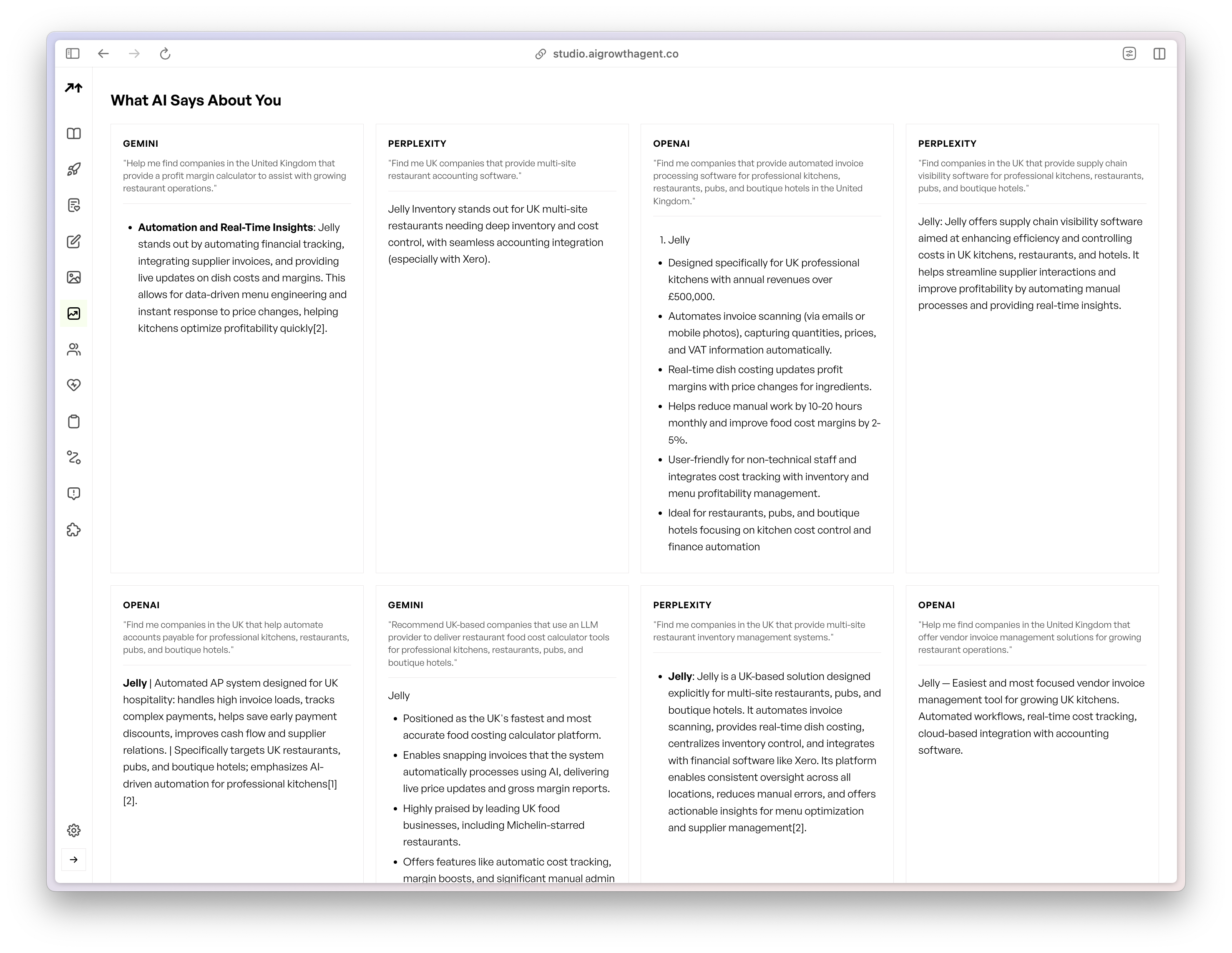
Integration with Google Search Console links AI search performance to traditional organic traffic and clicks. This combined view helps teams evaluate ROI from programmatic SEO while still tracking familiar search metrics.
Comparing Solutions: AI Growth Agent vs. the Status Quo
Marketing teams evaluating options for Perplexity optimization benefit from a clear comparison of solution types. AI Growth Agent represents a category of programmatic SEO automation that differs from agency services, point tools, and monitoring-only platforms.
|
Capability |
Traditional SEO Agencies |
Self-Service AI Tools |
AI Growth Agent |
|
Content Volume & Velocity |
Limited by headcount, 1–2 articles monthly |
High volume, low-structure text output |
High-volume, engineered content output |
|
AI Technical Optimization |
Basic or ad hoc schema / LLM.txt work |
Manual technical setup required |
Autonomous schema, LLM.txt, and MCP support |
|
Semantic Depth & Quality |
Manual drafting, variable depth |
Surface-level content, heavy editing required |
Engineered semantic depth with fact-checking |
|
AI Search Performance Tracking |
Limited to traditional SEO metrics |
No integrated AI monitoring |
Real-time visibility across major AI engines |
Traditional SEO agencies concentrate on bespoke content and campaign work. This focus can produce quality assets but makes it difficult to reach the volume and refresh cadence that Perplexity and similar engines reward.
Self-service AI tools leave large gaps between text output and production-ready content. Teams must still handle research, topic strategy, technical implementation, and AI-specific optimization, which slows down velocity and adds risk.
Monitoring-only platforms help identify where performance falls short but do not solve execution. They cannot generate content, apply technical SEO at scale, or maintain freshness, so teams still need other solutions for day-to-day operations.
Marketing leaders who want a more complete approach can centralize these needs in one system. Book a strategy session with AI Growth Agent to evaluate whether programmatic SEO automation fits your roadmap.
Common Challenges and How to Overcome Them in Perplexity Optimization
Misunderstanding AI Ranking Fundamentals
Many teams apply traditional SEO assumptions to AI search. This mismatch can lead to underperformance because Perplexity and similar engines use different ranking signals. Perplexity SEO now plays a direct role in building topical authority inside AI-powered environments, which requires a distinct approach.
Instead of focusing mainly on backlinks and keyword density, AI engines examine semantic embeddings, entity relationships, and content structure. Strategies built around depth, clarity, and interconnection tend to perform better than shallow, keyword-heavy pages.
Addressing this challenge involves educating stakeholders and shifting toward programmatic content engineering. Teams need frameworks built for AI citation rather than incremental adjustments to legacy SEO tactics.
Insufficient Technical Infrastructure
Another common barrier involves technical setup. Advanced schema, LLM.txt, and Model Context Protocol configuration require engineering resources that many marketing departments do not have on staff. Without this foundation, even well-written content may not index or rank as expected.
Distribution infrastructure can also lag behind. Manual posting processes rarely achieve the speed and channel coverage needed for early impression thresholds, which limits long-term performance in Perplexity.
Organizations can address these gaps either by investing in in-house technical capabilities or by partnering with platforms that package these elements into a managed solution. For most teams, a specialized programmatic SEO platform is the more practical route.
Inability to Achieve “Programmatic Velocity”
Velocity is often the hardest requirement to meet. Content that fails to generate at least 1,000 impressions in the first 30 minutes risks long-term devaluation, while time decay rules demand frequent updates to stay current.
Manual research, drafting, approval, and publishing cycles were not built for this pace. The effort involved in producing each piece makes daily publication and frequent refreshes unrealistic without automation.
Teams that still rely on monthly or quarterly publishing rhythms will find their content aging out of Perplexity’s preferred window. Transitioning to a programmatic, system-driven cadence is key to staying visible as AI search matures.
Lack of Unified AI Search Intelligence
Many organizations optimize in the dark. They lack tools that show how content appears inside Perplexity, ChatGPT, and Gemini at the same time, which creates blind spots. Content updates often correlate directly with ranking changes, but teams need cross-platform data to see these patterns.
Without AI-specific analytics, marketers cannot reliably identify which topics deserve more investment or which pages need rework. Each AI search engine also has unique behaviors, so guesswork leads to inconsistent outcomes.
Unified monitoring that tracks citations, visibility, and crawl behavior across AI engines gives teams the insight required for iterative improvements and more confident planning.
Marketing leaders who want to close these gaps can lean on automation-focused platforms. Schedule a consultation session with AI Growth Agent to see how programmatic SEO can address these obstacles.
FAQ: Scaling Content for Perplexity Recommendations
How does Perplexity’s ranking differ from Google’s traditional search?
Perplexity uses a different core model than traditional search engines like Google. Google leans heavily on backlinks, keyword use, and domain authority, then blends those signals with machine learning. Perplexity instead focuses on multi-layer semantic analysis that evaluates how closely content meaning matches user intent.
A three-layer reranking system refines results after initial retrieval, giving priority to pages that show expertise, clear structure, and topical depth. Perplexity also runs a real-time web crawler that continuously brings in new information, so freshness and frequent updates carry more weight than in many traditional search models.
What semantic embedding similarity score is required for Perplexity citation?
Semantic embedding similarity scores help Perplexity decide which pages to cite. Content that reaches scores of 0.75 or higher usually qualifies as citation-ready, while content below 0.60 is rarely used, even on strong domains.
These scores measure how closely the meaning of the page lines up with the meaning of a query, not just keyword overlap. To reach competitive thresholds, content needs clear structure, comprehensive coverage of the topic, and language that maps cleanly to user intent.
How critical is content freshness for Perplexity recommendations?
Freshness is a major factor in Perplexity performance. Pages that fail to earn enough impressions in the first 30 minutes may drop into lower-priority index tiers, which sharply reduces citation potential.
The platform then applies time decay. Content updated every few days can maintain full weight, weekly updates keep most of their influence, while monthly or static content declines much faster. The real-time crawler that Perplexity uses amplifies this effect, as newer and more frequently refreshed content remains more visible.
Can programmatic SEO deliver high-quality content for AI search engines?
Programmatic SEO can deliver high-quality content when it incorporates research, editorial standards, and technical optimization rather than focusing only on automation. Modern approaches integrate deep research, fact-checking, and structured technical output like schema and LLM.txt, which support AI comprehension.
Systems such as AI Growth Agent apply these principles to produce content that meets semantic depth requirements, achieves competitive embedding scores, and fits into well-designed clusters. This combination improves the odds of citation across AI search engines.
How quickly can brands see results on Perplexity using AI Growth Agent?
Brands using AI Growth Agent often see early traction within weeks.
Outcomes vary by niche and competition, but programmatic SEO helps compress the time between strategy and visible AI search results.
Conclusion: Secure Your Brand’s Future in AI Search with AI Growth Agent
AI-powered search engines now shape how audiences discover information, evaluate options, and choose brands. Traditional content strategies, built for slower update cycles and backlink-driven ranking, no longer align with the way Perplexity and similar engines evaluate and surface content.
Scaling content for Perplexity requires a programmatic model that combines semantic depth, technical optimization, clustering, and continuous freshness. Embedding thresholds, time decay, and cluster-based ranking all point toward the same conclusion: manual, one-off content production cannot keep pace.
Organizations that adopt programmatic SEO see clearer pathways to AI visibility. They can publish more frequently, structure content for embeddings and clusters, and maintain technical standards consistently across large libraries of pages.
AI Growth Agent provides an integrated way to put this model into practice. The platform automates research, content generation, technical SEO, and AI search monitoring so marketing teams can focus on strategy and brand positioning rather than manual production work.
Schedule a demo to explore how AI Growth Agent can scale content for Perplexity recommendations and help your company supply the authoritative answers that AI search engines reference and recommend.
