Written by: Mariana Fonseca, Editorial Team, AI Growth Agent | Last updated: July 18, 2026
Key Takeaways
- Scaling content for Perplexity AI requires an autonomous headless engine that maps queries, validates claims, and publishes with agentic technical SEO instead of manual or agency processes.
- Only 11% of domains earn citations from both ChatGPT and Perplexity, and brands closing the gap do so through repeatable, high-volume systems rather than one-off improvements.
- The 8-step monthly workflow automates everything from universe mapping and multi-agent drafting to anti-hallucination checks, bot tracking, and incremental visibility reporting.
- Generic GEO checklists and agency timelines fail at scale because they lack mechanisms for sustained volume, self-healing content, and real-time adaptation to AI citation signals.
- AI Growth Agent delivers this complete engine in one week; book a demo to see how it builds your Perplexity-citable content system.
The 8-Step Monthly Workflow
This workflow table shows the autonomous monthly production cycle that powers a Perplexity-citable content engine at scale.
| Step | Stage | What the Engine Does | Living/Self-Healing Mechanic |
|---|---|---|---|
| 1 | Universe Snapshot | Runs 3,000+ real searches weekly across Google and ChatGPT to refresh seed terms and the long-tail query map | Topology updates automatically as query demand shifts |
| 2 | Search Intelligence | Agents process title structures, forum signals, People Also Ask, and competitor URLs per query | Weekly competitive picture replaces stale manual audits |
| 3 | Content Prioritization | Real-time AI Overview and ChatGPT results act as the objective function for which long-tail queries to pursue | Evidence-based selection replaces editorial guesswork |
| 4 | Multi-Agent Drafting | Parallel research agents gather primary sources, and orchestration across OpenAI, Anthropic, Gemini, Grok, Perplexity, Exa, and Firecrawl produces validated drafts | Manifesto and memory systems enforce brand voice at every generation |
| 5 | Anti-Hallucination Cascade | Every claim, source, and quote is re-extracted after drafting and checked against primary sources, product pages, and verified external research | Unsupported claims are removed before publication |
| 6 | Agentic Technical SEO | Full schema suite, Blog MCP, llms.txt, /.well-known/ discovery, natural-language query parameters, and instant indexing deploy automatically with every article | Schema errors are blocked at CI validation before publish |
| 7 | Publication and Bot Tracking | Articles publish to the owned blog, and per-article bot tracking records every crawl, citation, and training sweep including PerplexityBot | Bot signals feed back into refresh prioritization |
| 8 | Incremental Visibility Reporting | Centralized Google Search Console data and bot analytics isolate visibility generated by the new engine, week over week | Internal linking lifts underperforming articles automatically |
Why Generic GEO Checklists Fail at Scale
Generic GEO checklists identify what to fix but provide no mechanism to fix it repeatedly, at volume, without a team. They describe the destination without supplying the engine. The result is one improved article, then drift, then silence from Perplexity’s citation layer.
The two wrong doors are well documented and share the same failure pattern: they cannot sustain consistent volume. The first is the agency RFP, with roughly three months to select a vendor and three more months before the first asset ships, which creates a six-month lag that leaves competitors unchallenged. The second is the DIY chatbot path, where one article is possible but the second requires running the entire process again, so quality drifts from piece to piece. One company produced roughly 300 articles this way and not one earned a citation, which shows that manual repetition cannot maintain the consistency AI citation algorithms expect.
Domains with 10 or more interlinked pages on a topic cluster earn AI citations at 2 to 3 times the rate of single-page competitors, with topical authority driving a large share of citation decisions. That volume is structurally impossible through manual or traditional agency processes. Fully agentic content engines often publish more than 100 posts per quarter, while single-editor manual pipelines typically produce around 35 posts per quarter. Only a headless engine sustains the 50-plus articles per month required to build and hold topical authority across a full query universe, and that engine must know exactly which queries to target before it starts writing.
Search Intelligence: Mapping the Full Query Universe
Search Intelligence forms the foundation of a Perplexity-citable content program. It maps every seed term and long-tail query in a market using real-time Google and ChatGPT data, which produces an evidence-based topology rather than a guessed keyword list. Without this map, brands focus on the head terms they already know and lose the rest of the conversation by default.
Robots search the long tail, and that behavior shapes which pages Perplexity retrieves. Mentioning specific entities within content increases Perplexity retrieval probability. Real-time AI Overview and ChatGPT results act as the objective function for which long-tail queries deserve coverage, so every article from the engine targets a query with demonstrated retrieval demand. Mature AI Growth Agent clients reach universes of 1,600-plus queries, with the system running more than 3,000 searches every week just to refresh the snapshot. That weekly picture stays more current than Google Search Console and lets the brand respond to competitive shifts in real time.
Schedule a demo to see whether you are a good fit and get a live view of your query universe.
AI Analytics and Bot Tracking: Proving the Engine Works
AI Analytics and Bot Tracking provide the measurement layer that proves a content engine is working. Centralized Google Search Console data, per-article bot tracking, and citation monitoring together isolate the incremental visibility the new engine generates, separate from visibility the brand already had before launch.
Perplexity and similar AI tools show varying citation rates across studies of AI responses, so brands need direct evidence of what earns mentions. Tracking which articles earn those citations, and which bot visits precede them, closes the loop between content production and citation outcome. AI Growth Agent’s four-pillar data foundation covers Search Intelligence, AI Analytics, Bot Tracking, and AI Ranking, which gives the CMO a defensible answer for the CEO every week. Across the first twelve weeks, clients average more than 12,000 additional AI citations and mentions, over 100,000 additional bot visits, and a lift in impressions of more than 20 percent.
AI Ranking: Owning Citation Order and Context
AI Ranking replaces the traditional position-one metric with a more precise measure based on order of mention and citation context within the AI answer. Where a brand appears in a Perplexity response, what claim it is cited for, and how that position evolves week over week together define the new leaderboard. A brand cited second for a high-intent query is winning, while a brand absent from the answer is invisible regardless of its organic rank.
Pages that begin sections with a direct answer to the implied question are cited more than pages that build up to an answer gradually. Comparison tables with proper schema markup show higher citation rates. The four pillars of Search Intelligence, AI Analytics, Bot Tracking, and AI Ranking reinforce each other: the universe map identifies where to win, bot tracking confirms when Perplexity reads the content, and AI Ranking shows whether the brand is being cited and in what context.
Agentic Technical SEO Requirements for AI Surfaces
Agentic technical SEO provides the infrastructure that makes content readable and citable by AI surfaces. Traditional technical SEO remains table stakes but no longer covers the full requirement. Perplexity, ChatGPT, and Google’s AI Mode expect additional signals that most brands have not yet deployed, and those signals determine whether a page enters the citation candidate pool at all.
Automated schema deployment covers a high percentage of pages on average, compared to lower coverage with manual implementation. Complete error-free schema markup increases AI citation probability compared to pages without structured data. To ensure every article meets this standard, AI Growth Agent deploys a full technical stack automatically, with no manual configuration required. Every AI Growth Agent article and site ships with:
- Blog MCP, compatible with Chrome 146-plus and other WebMCP-enabled browsers, with schema, manifest, discovery, and capability guidance exposed to agents
- llms.txt and llms-full.txt so AI surfaces can read the brand the way they need to
- OpenAI discovery and Agent Card guidance served via /.well-known/
- Natural-language query parameters via /?s={query} that auto-trigger personalized, internally linked responses for agent crawlers
- Full schema suite covering Article, FAQPage, Author, Organization, Product, and the rest of the schema.org suite, validated before deployment
- Proper sitemap.xml with accurate lastmod values, advanced robots.txt with explicit PerplexityBot allowance, instant indexing, autoredirects, and 404 tracking
Blocking PerplexityBot or Perplexity-User in robots.txt eliminates citation eligibility entirely. AI Growth Agent’s WordPress plugin handles this configuration automatically. No technical skill is required from the client, and every package includes the full stack.
Agency Timelines Versus One-Week Reality
The agency model is structurally incompatible with the speed at which AI search citation leaderboards are being written. The six-month agency cycle described earlier cannot keep pace with AI surfaces that refresh answers continuously. By the time the first article ships, a competitor running an autonomous engine has published hundreds of citable pieces and is already training the next generation of models with its own narrative.
Agentic AI workflows reduce total time per article from manual processes while improving quality scores. Marketing teams using AI agents report faster campaign development and shorter content creation timelines compared to manual processes. AI Growth Agent goes from kickoff to the first published article in approximately one week, with content indexing in as little as ten days. The standard pilot runs for three months because indexing takes time and varies by industry, but clients see movement early and the engine produces at volume from week one.
Living, Self-Healing Content Mechanics
Living content provides the operational answer to Perplexity’s freshness requirements. Static content decays over time. Content published within the last 30 days receives more AI citations than older content, with citation likelihood dropping at three to six months and again after twelve months. A content engine that ships articles and forgets them behaves like a content graveyard, not a growth system.
AI Growth Agent’s self-healing mechanics run automatically and keep articles current without manual sweeps.
- When the year turns, every article in a sector is refreshed for the new year
- Google Search Console signals and bot-traffic awareness trigger automatic refreshes on stale articles
- Memory systems enforce brand voice, block unwanted language, and apply saved feedback to every future generation without re-briefing
- Anti-hallucination controls re-extract and verify every claim after drafting and before publication
- Internal linking compounds authority across the universe automatically and lifts underperforming articles
Content teams with automated decay detection systems recovered lost traffic faster than teams relying on monthly manual audits. Self-healing content keeps the brand’s presence current without added headcount.
Incremental Visibility Reporting
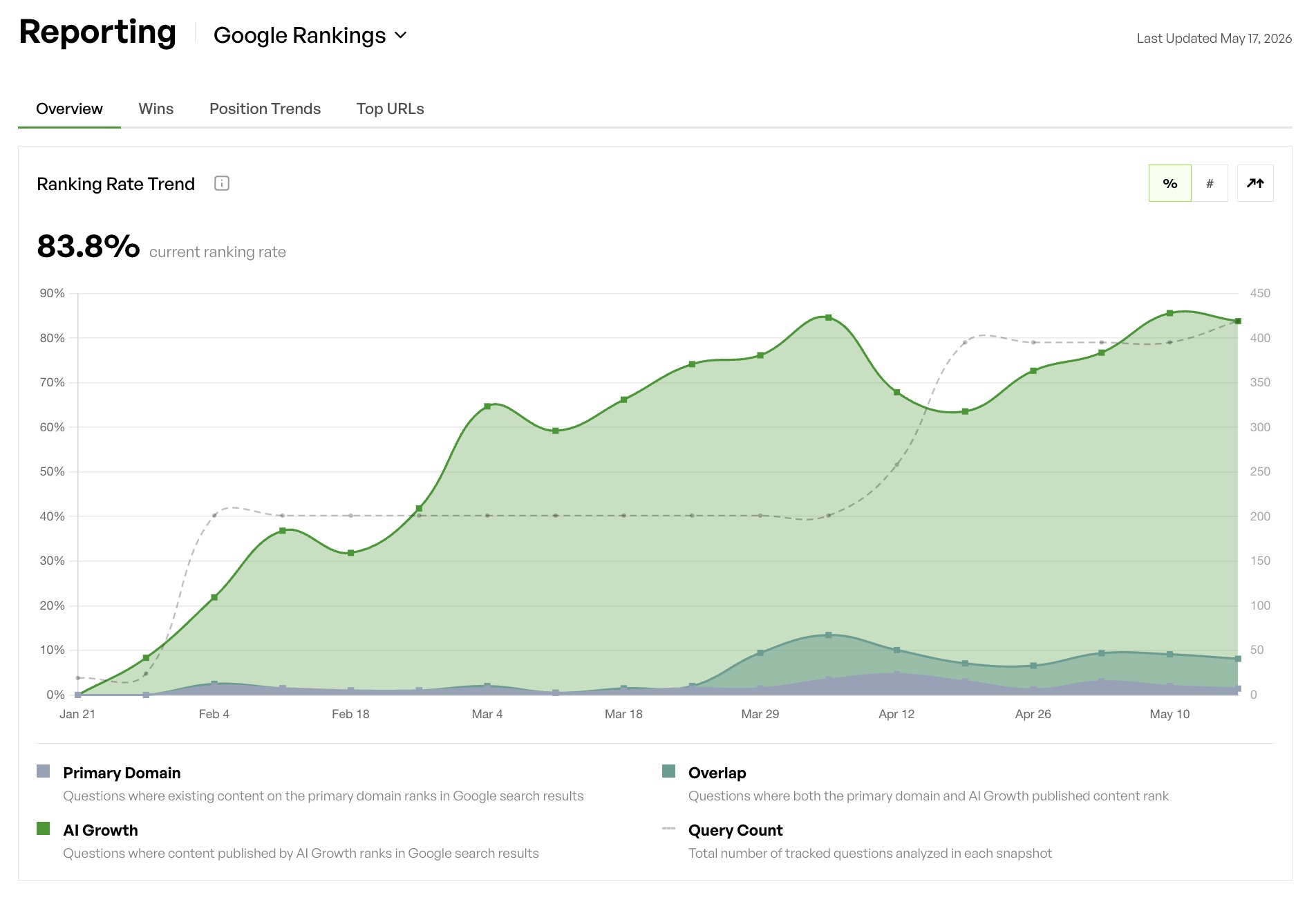
Incremental visibility reporting answers the question every CMO eventually asks: whether the new results actually come from the engine or from visibility the brand already had. AI Growth Agent publishes into a separate environment specifically to isolate what the new engine generates, week over week, from the brand’s pre-existing organic presence.
The reporting layer cross-references three independent data streams to deliver that clarity. Per-article bot tracking records every PerplexityBot crawl and citation sweep, while centralized Google Search Console data acts as an independent audit. AI Ranking data then tracks order of mention and citation context across the query universe. A 2026 study of 34,234 AI responses found Perplexity’s brand citation rate at 13.05%, which makes it more achievable than ChatGPT’s rate for most brands. Knowing which articles drive those citations, and which are not yet indexed, turns a reporting dashboard into a steering wheel.
Frequently Asked Questions
How long does it take to get the first article live and see Perplexity citations?
AI Growth Agent goes from kickoff to the first published article in approximately one week. Content has indexed in as little as ten days and often within two weeks. Initial Perplexity citations typically appear within two to four weeks for well-structured content on authoritative domains. The standard engagement is a three-month pilot because indexing timelines vary by industry, but clients see measurable bot traffic and citation activity early in the engagement.
What technical setup is required on the client’s side?
The only integration step required from the client is a reverse proxy rewrite that connects the AI Growth Agent blog to a subdirectory under the brand’s domain, or a subdomain configuration. Everything else, including the full schema suite, Blog MCP, llms.txt, /.well-known/ discovery, robots.txt, sitemap.xml, instant indexing, autoredirects, and 404 tracking, is included in every package and deployed automatically. No engineering team or technical skill is required from the client.
How does AI Growth Agent prevent content from going stale or losing Perplexity citation eligibility?
Content stays living by design rather than through ad hoc refreshes. The engine automatically updates articles when the year turns, when Google Search Console signals indicate decay, and when bot-traffic data shows reduced crawl frequency. Memory systems apply saved feedback to every future generation, and anti-hallucination controls verify every claim against primary sources before publication. This self-healing architecture keeps content above Perplexity’s freshness threshold without manual review cycles or added headcount.
How is AI Growth Agent different from a GEO monitoring tool like Profound?
Monitoring tools track whether a brand appears for a capped set of prompts and stop there. They show what is happening but provide no mechanism to change it. AI Growth Agent produces the content, owns the publishing, deploys the full agentic technical SEO stack, and proves the incremental result through per-article bot tracking and centralized Search Console data. The differentiator is not data volume. It is that AI Growth Agent turns data into published, self-healing content and isolates the visibility it generates week over week.
How does the engine maintain content quality at 50-plus articles per month?
Quality is enforced through a multi-stage orchestration rather than a single model. Parallel research agents gather primary sources before drafting begins, which grounds every article in real evidence. A post-draft anti-hallucination cascade re-extracts every claim and checks it against the manifesto, product pages, and verified external sources. Memory systems carry brand voice rules, terminology preferences, and legal disclaimer requirements that apply automatically to every generation. The journalist-led layer on the founding team shapes how the system encodes editorial rigor into the pipeline, so output stays consistent at any volume.
Summary: Control the Narrative on Autopilot
The Perplexity AI citation leaderboard is being written in 2026, and brands that establish authoritative, self-healing content now are training the next generation of models with their own narrative. Brands that wait are training the next generation with whatever happens to be sitting on the open web.
The playbook stays concrete and repeatable: map the full query universe with real-time Search Intelligence, produce evidence-based long-tail content through multi-agent orchestration, deploy the complete agentic technical SEO stack automatically, self-heal content before it decays, and isolate incremental visibility through bot tracking and centralized Search Console data. That combination forms the headless engine that turns a brand into the answer.
The universe still requires periodic review because query demand shifts, competitors move, and Perplexity’s freshness requirements mean that content left untouched loses citation eligibility within weeks. The engine handles that review automatically by refreshing the snapshot every week and self-healing content before decay sets in.
Traditional search tools show you where your brand stands. AI Growth Agent makes your brand the answer. Book a kickoff and see your first article live within a week.