


Key Takeaways
- AI-first search in 2026 favors structured, machine-readable content published at programmatic scale.
- WordPress SEO plugins provide the technical base for schema, crawling, and indexing across large content libraries.
- Rank Math, Yoast SEO, All in One SEO, and SEOPress each support programmatic SEO, but in different ways that matter for enterprise teams.
- Plugin selection should account for performance, workflow fit, team expertise, and long-term maintainability.
- AI Growth Agent can add programmatic SEO automation on top of your plugin stack, helping you scale content for AI search visibility; schedule a demo to see how it fits your organization.
The AI Search Transformation: Why Programmatic SEO and Plugin Choice Matter More Than Ever
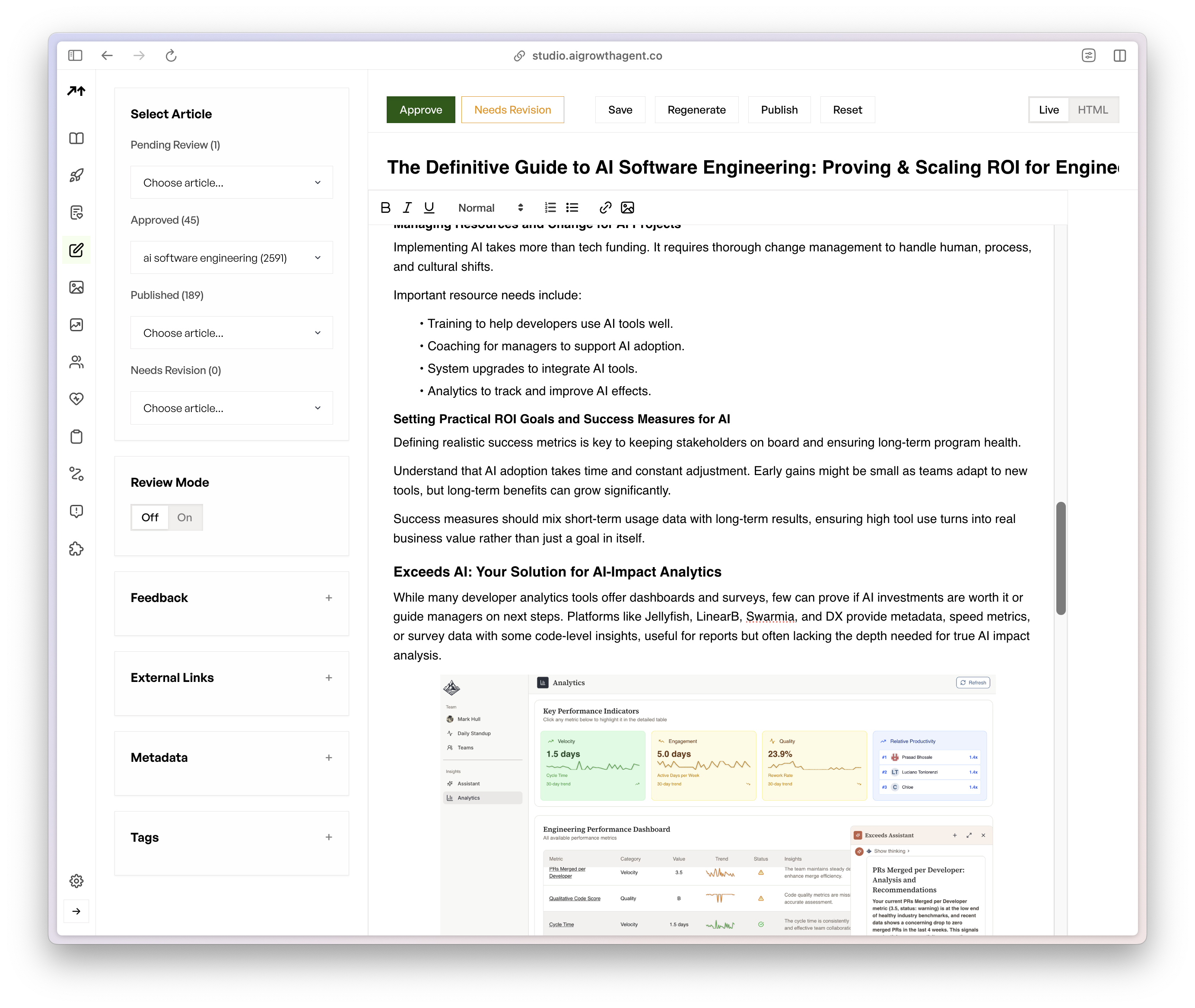
AI search engines now shape how users discover content. Platforms such as ChatGPT, Google AI Overviews via Gemini, and Perplexity surface material that is high quality, structured, and easy for models to parse.
Enterprise sites that rely on manual keyword targeting and infrequent updates lose ground as AI-generated and AI-optimized content expands. Programmatic velocity has become a baseline requirement. Brands that publish consistent, structured, high-depth content see stronger representation in AI answers, because large language models tend to favor recency, clarity, and predictable structure.
The WordPress SEO plugin you select defines much of your technical SEO foundation. It controls schema, crawling and indexing signals, sitemaps, and key on-page elements across thousands of URLs. For programmatic SEO, this foundation needs to support automation, scale, and AI-specific optimization requirements.
Key implications for WordPress SEO plugin selection
Advanced schema implementation: AI search engines rely heavily on structured data to understand entities, relationships, and topical authority. The plugin should support rich schemas for articles, organizations, products, services, and local entities, not just basic article markup.
Technical SEO for AI indexing: Enterprise teams need reliable XML sitemaps, canonical control, robots directives, meta management, and emerging signals that help AI crawlers understand content hierarchies and site architecture.
Scalability: Programmatic SEO can generate thousands of URLs. The plugin must handle large volumes without degrading load times or introducing technical errors that block indexing.
Integration: Enterprise content operations depend on APIs, bulk editing, and automation. The plugin should integrate cleanly with content engineering tools and workflows that drive programmatic publishing.
Introducing AI Growth Agent: Programmatic SEO for AI Authority
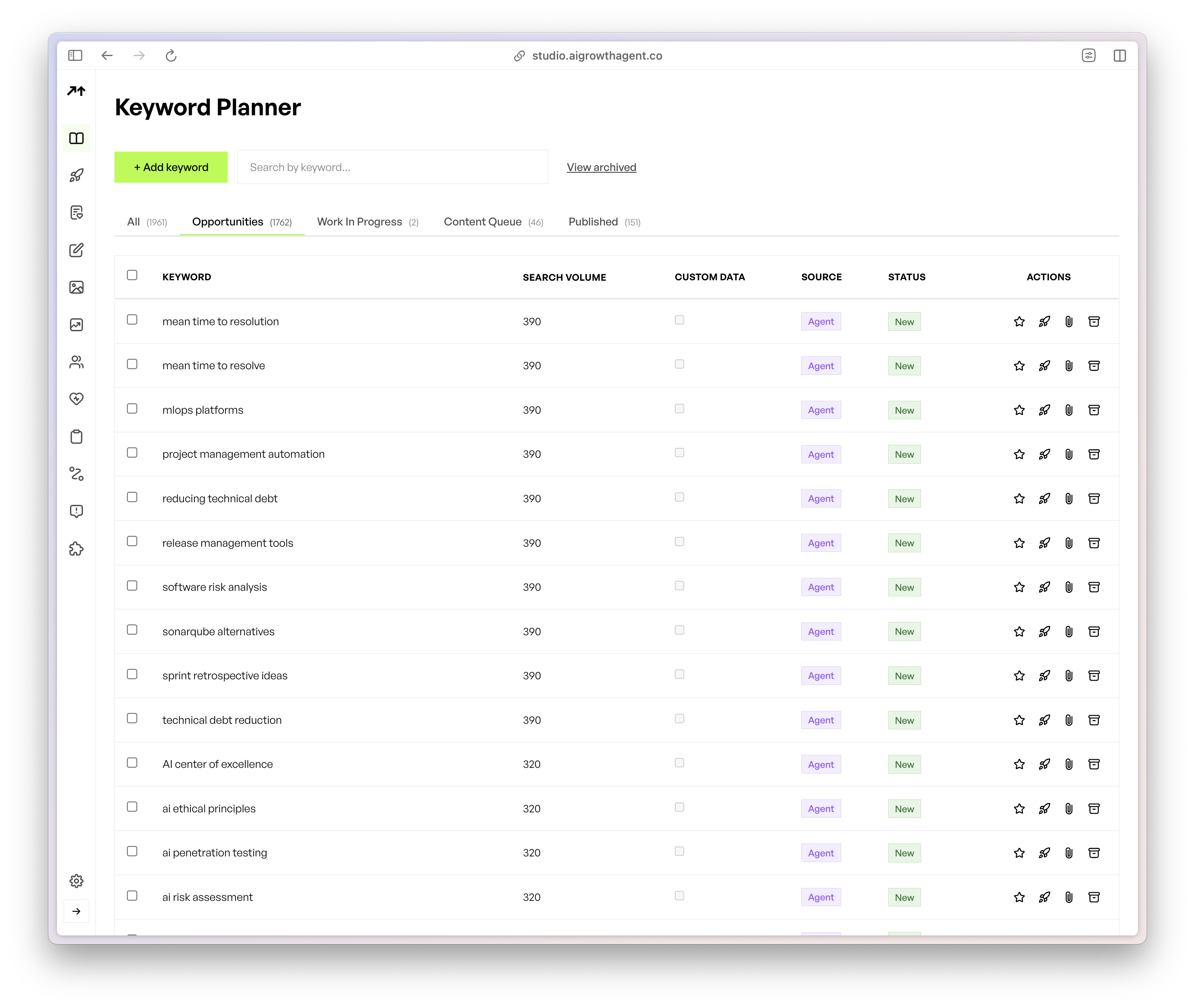
AI Growth Agent is a programmatic SEO platform that helps brands build structured content architectures designed for AI search visibility. The system focuses on making companies more likely to be cited and recommended by AI search engines across their category.
The Programmatic SEO Agent handles keyword clustering, content briefs, writing, and technical optimization, then supports schema and publishing workflows. This reduces manual effort and gives enterprises a way to create consistent, high-quality pages at scale that align with AI search expectations.
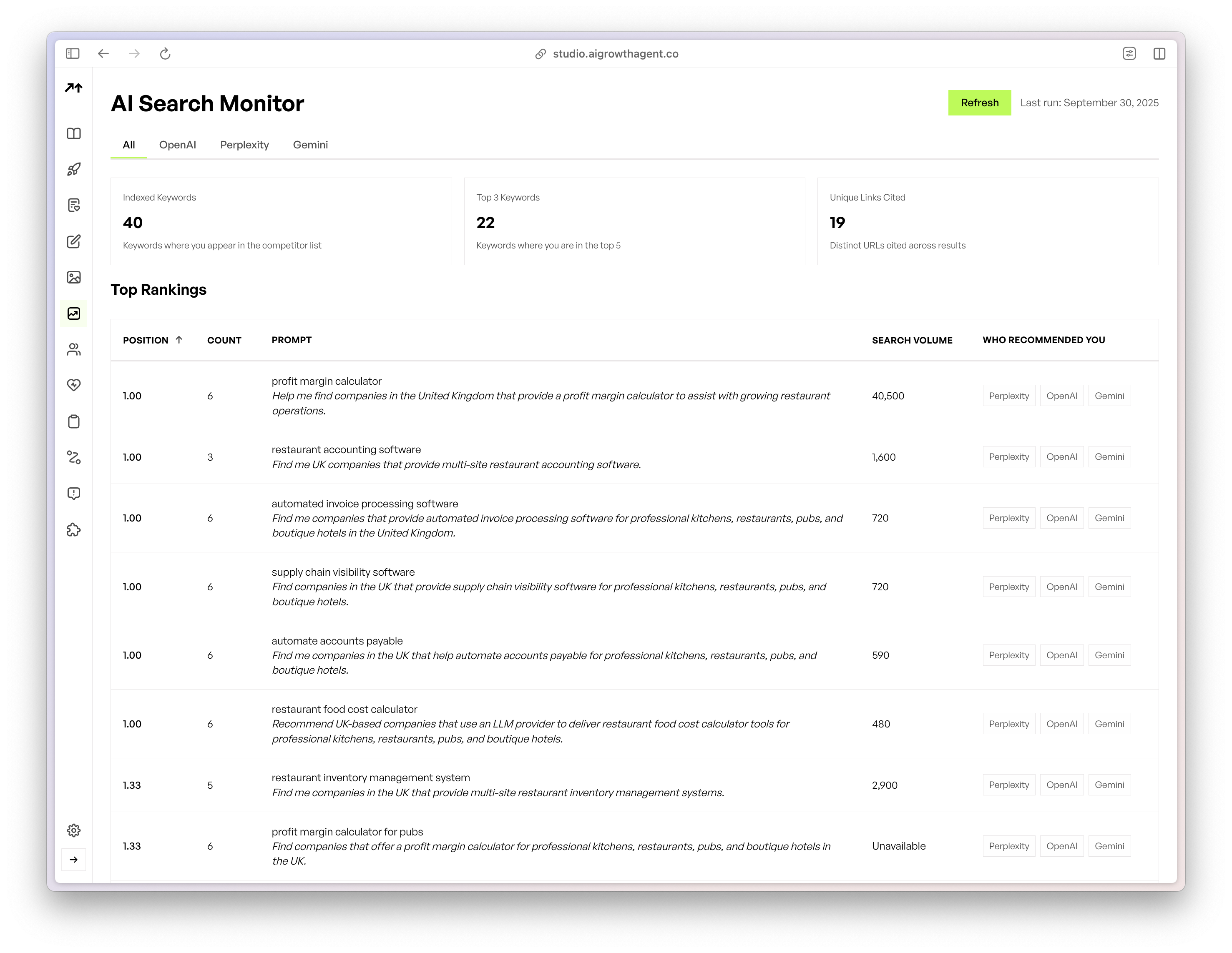
Client outcomes illustrate the impact of pairing strong technical foundations with programmatic SEO. Exceeds AI became a recommended alternative on Perplexity within weeks, BeConfident reached the top recommended English-learning app in Brazil in Google AI Overviews, Bucked Up appears as a leading protein soda brand in ChatGPT, and Gitar gained visibility as an AI-powered CI/CD reference across multiple AI search platforms.
Schedule a demo with AI Growth Agent to review how programmatic SEO could extend your current plugin-based setup.
The Contenders: Leading WordPress SEO Plugins for Enterprise in 2026
In 2026, a small group of WordPress SEO plugins dominates enterprise adoption. Rank Math, Yoast SEO, All in One SEO (AIOSEO), and SEOPress appear consistently in evaluations of top WordPress SEO tools for their feature depth and scalability.
Each plugin covers core SEO needs, but differences emerge in schema coverage, AI features, performance at scale, and fit for complex workflows. Choosing among them requires a clear view of how they support programmatic SEO and AI-focused optimization.
Feature-by-Feature Comparison: Evaluating Plugins for Programmatic SEO in the AI Era
Rank Math: AI-Focused Feature Depth
Rank Math offers advanced schema markup, detailed on-page analysis, and optional AI content optimization. Its design consolidates many tasks that often require multiple plugins, which helps maintain performance on large sites.
Tests have shown minimal impact on load times when configured carefully, yet enterprise teams still need monitoring. Rank Math suits organizations with technical resources that can configure and govern its extensive feature set.
Yoast SEO: Editorial Guidance and Fundamentals
Yoast SEO remains a standard choice for content-centric teams. Its in-editor guidance supports writers with readability and on-page SEO checks, which helps keep programmatically produced content accessible for human readers.
Yoast includes solid technical basics such as XML sitemaps and canonical handling. Some advanced capabilities for complex architectures require premium add-ons, which can raise costs for multi-site or high-volume deployments.
All in One SEO (AIOSEO): Broad Coverage for Mixed Content
AIOSEO positions itself as a full SEO suite with tools for WooCommerce, video, local SEO, and OpenAI-assisted workflows. This range suits enterprises that manage diverse content types and multiple business lines.
AI-powered link assistance and automation features can reduce manual SEO work. The breadth of options introduces a learning curve, and complex environments may require careful configuration to avoid overlaps with other plugins.
SEOPress: Flexible Control with Lightweight Design
SEOPress is known for combining a relatively lightweight footprint with a comprehensive feature set. Its free version already covers many enterprise needs, which can help reduce licensing costs.
Granular controls appeal to agencies and organizations managing multiple sites. Teams often need training to fully leverage its flexibility for programmatic SEO, especially when coordinating large content architectures.
Comparison Table: WordPress SEO Plugins for Programmatic SEO in the AI Era
|
Feature/Criteria |
Rank Math |
Yoast SEO |
All in One SEO (AIOSEO) |
SEOPress |
|
AI-assisted features |
High, content optimization and keyword research add-ons |
Basic, readability analysis |
Moderate, AI link assistance and automation |
Moderate, AI-assisted meta generation in premium |
|
Advanced schema support |
Extensive built-in types |
Core types with premium extensions |
Rich snippets for local, video, product, and more |
Wide range of structured data types |
|
Technical SEO capabilities |
Sitemaps, redirects, technical controls |
Sitemaps, canonicals, core technical SEO |
Robots.txt, IndexNow, sitemaps, redirects |
Sitemaps, redirects, detailed settings |
|
Scalability for enterprise |
Designed for complex, high-volume sites |
Proven on large editorial properties |
Handles mixed portfolios and custom post types |
Well suited to multi-site and agency setups |
|
Integration with large content operations |
Strong fit for AI and automation workflows |
Requires process design for bulk work |
Broad feature set with integration potential |
Flexible options for custom workflows |
|
On-page optimization support |
Detailed scoring and recommendations |
Combined SEO and readability feedback |
Robust content analysis tools |
Focused meta and keyword controls |
Integrating WordPress SEO Plugins with AI Growth Agent
The WordPress SEO plugin provides your technical baseline. AI Growth Agent can build on that baseline with programmatic content engineering, schema planning, and AI-oriented optimization.
The Programmatic SEO Agent clusters keywords, designs content architectures, and generates draft content aligned with your plugin’s schema and technical rules. WordPress and the plugin then handle final rendering, indexing, and ongoing technical compliance.
This combination supports both scale and authority. The plugin maintains consistent technical implementation across thousands of URLs, while AI Growth Agent increases the volume and structural quality of pages targeting your priority topics and AI search surfaces.
Key Considerations for Enterprise Marketers
Performance and overhead: Feature-heavy plugins can affect load times on large deployments. Enterprise teams should test performance with realistic content volumes, then add caching, monitoring, and regular audits as content libraries grow.
Team expertise and workflow: Different plugins align with different skill sets. Rank Math or SEOPress may suit technically strong teams that want granular control, while Yoast can support editorially led organizations. AIOSEO fits teams that manage many content types in one environment.
Cost-benefit over time: Premium features, license counts, and support costs can rise quickly at enterprise scale. Evaluate total cost across all sites and plan for training and integration work, not just plugin subscriptions.
Future readiness: Plugin vendors that track AI search trends and ship regular updates provide more stability. Active development roadmaps, clear documentation, and strong support channels reduce risk as AI search requirements evolve.
Programmatic advantage: No plugin alone delivers AI-era scale. The strongest stacks pair a capable WordPress SEO plugin with programmatic SEO systems like AI Growth Agent that can produce structured content architectures at volume.
Schedule a consultation with AI Growth Agent to review how a programmatic layer could support your current plugin strategy.
Frequently Asked Questions
What is the role of WordPress SEO plugins in AI search optimization?
Leading WordPress SEO plugins provide structured data, sitemaps, and on-page controls that AI search engines rely on to understand content. They form the technical base for AI optimization, while programmatic SEO systems such as AI Growth Agent add large-scale content engineering, schema planning, and topic coverage.
How should I select a plugin for programmatic SEO use cases?
Rank Math often fits programmatic SEO because of its AI features, schema depth, and technical controls. AIOSEO works well for organizations with varied content types, and SEOPress supports agency-style, multi-site setups with fine-grained settings. The best option is the one that aligns with your architecture, workflows, and integration plans.
How does AI Growth Agent work alongside existing plugins?
AI Growth Agent integrates with existing WordPress stacks by respecting the schemas, taxonomies, and technical settings managed by your plugin. The platform designs and generates content that fits those rules, then relies on the plugin for consistent indexing, metadata, and technical SEO across the site.
Conclusion: Building an AI-Ready SEO Stack
AI-driven search in 2026 rewards brands that pair strong technical foundations with scaled, structured content. WordPress SEO plugins such as Rank Math, Yoast SEO, AIOSEO, and SEOPress provide the technical layer for schema, crawling, and on-page optimization across large sites.
Programmatic SEO systems add the volume, structure, and topic coverage that AI search now expects. AI Growth Agent supports this layer for enterprise teams, helping them publish more complete content architectures that align with AI search behavior.
Brands that combine the right plugin, clear workflows, and programmatic SEO are better positioned to maintain visibility across AI search platforms. Schedule a demo with AI Growth Agent to assess how this approach could support your 2026 growth goals.
