


Written by: Mariana Fonseca, Editorial Team, AI Growth Agent
Key Takeaways
- Structured data with JSON-LD schema markup increases AI search citation odds by 0.546 times and drives visibility in ChatGPT, Google AI Overviews, and Perplexity.
- Choose high-impact schemas like FAQPage (28–40% higher citations), HowTo, Article, and Organization based on your content type to improve AI performance.
- Follow a 7-step process: select schemas, generate JSON-LD code, inject it into the head, validate with Google tools, enhance with sameAs and knowsAbout, deploy, and monitor citations.
- Avoid incomplete JSON syntax, content mismatches, and manual scaling bottlenecks that stop AI systems from parsing and citing your content.
- Scale schema deployment across hundreds of pages with AI Growth Agent and schedule a demo to automate your AI search work.
Technical Setup Before You Add Schema
Confirm your technical foundation before you roll out structured data for AI search visibility.
- Basic HTML and JSON knowledge plus CMS access
- Google Search Console account with a verified property
- HTTPS-enabled website with a clean robots.txt file
- Robots.txt that allows GPTBot and PerplexityBot crawling
- Updated LLM.txt file for 2026 AI compatibility
Process Overview: The Implementation Framework
Structured data for AI search follows a framework that covers schema selection, JSON-LD code generation, validation and deployment, AI-focused enhancements, and ongoing monitoring. Each part builds on the previous one and creates a durable schema strategy.
Manual implementation usually takes 2–4 hours per page and slows down scale-up brands that manage hundreds of content assets. Complexity grows quickly when you maintain schema across multiple domains, content types, and teams. Skip the manual complexity and schedule a demo to see how AI Growth Agent automates the full schema lifecycle.
This framework breaks down into seven concrete steps that guide you from initial schema selection through long-term performance tracking.
Step-by-Step Guide: 7 Steps to Implement Structured Data
1. Choose AI-Optimized Schemas for Your Content
Match schema types to your content format to improve AI citation performance.
| Schema Type | Use Case | AI Citation Impact | Priority Level |
|---|---|---|---|
| FAQPage | Q&A content, FAQ sections | Supports the 28–40% citation lift mentioned above | High |
| HowTo | Step-by-step tutorials | High AI citation impact | High |
| Article/BlogPosting | Blog posts, news articles | Medium-high AI citation impact | High |
| Organization | Brand pages, about pages | Medium AI citation impact | High |
| Product | E-commerce pages | Medium-high AI citation impact | Medium |
2. Generate JSON-LD Code From Proven Templates
Use production-ready templates to create JSON-LD markup that AI systems can parse reliably. JSON-LD is the preferred format for AI search in 2026 because it separates structure from content and keeps maintenance simple.
Article Schema Template:
{ "@context": "https://schema.org", "@type": "Article", "headline": "Your Article Title", "author": { "@type": "Person", "name": "Author Name", "jobTitle": "Position", "worksFor": { "@type": "Organization", "name": "Company Name" } }, "publisher": { "@type": "Organization", "name": "Publisher Name", "logo": "https://example.com/logo.png" }, "datePublished": "2026-04-19", "dateModified": "2026-04-19" }FAQPage Schema Template:
{ "@context": "https://schema.org", "@type": "FAQPage", "mainEntity": [ { "@type": "Question", "name": "What is structured data?", "acceptedAnswer": { "@type": "Answer", "text": "Structured data is code that helps AI systems understand content context and relationships." } } ] }3. Add JSON-LD to the Head or Body
Place JSON-LD code inside script tags in your page head section for clean separation from visible content. Google Search Central recommends JSON-LD as the easiest solution for website owners to implement and maintain at scale.
<script type="application/ld+json"> { // Your JSON-LD schema here } </script>For WordPress sites, use plugins like Yoast SEO or RankMath to inject schema without editing code. For custom-built sites, either add schema directly to template files for static pages or use tag managers like Google Tag Manager for dynamic insertion across many URLs.
4. Validate Markup With Trusted Tools
Run your schema through validation tools to catch syntax issues and missing fields before deployment.
| Tool | Purpose | Common Errors | Fix Method |
|---|---|---|---|
| Google Rich Results Test | Rich snippet eligibility | Missing required properties | Add mandatory fields |
| Schema.org Validator | Syntax validation | JSON formatting errors | Check brackets and commas |
| Google Search Console | Live site monitoring | Content mismatch | Align schema with visible content |
5. Strengthen Your AI Trust Graph
Use advanced schema properties to connect your entities and build trust with AI systems. Entity disambiguation with sameAs, knowsAbout, and Organization schema has become a high-impact tactic after March 2026.
Add sameAs properties that link to authoritative profiles and databases.
"sameAs": [ "https://www.linkedin.com/company/yourcompany", "https://www.crunchbase.com/organization/yourcompany", "https://www.wikidata.org/wiki/Q12345" ]Include knowsAbout properties to signal clear areas of expertise.
"knowsAbout": [ "Search Engine Optimization", "Digital Marketing", "Content Strategy" ]6. Deploy Pages and Support Indexing
Submit updated URLs in Google Search Console to speed up indexing and schema recognition. Monitor crawl statistics for GPTBot and PerplexityBot so you confirm that AI systems can reach your structured data.
Google Search team confirmed in April 2025 that structured data gives content an advantage in AI Overviews.
7. Monitor and Improve AI Citations
Track performance through Google Search Console, third-party tools, and direct testing in AI interfaces. Pages with strong structured data are 3.2 times more likely to appear in AI-generated summaries than pages without schema markup.
Common Schema Mistakes and Quick Fixes
Prevent avoidable errors that block AI citations and slow results.
- Incomplete JSON syntax: Missing commas or brackets break parsing.
- Content mismatch: Schema data must match visible page content exactly.
- Missing entity connections: Isolated schemas lack context for AI systems.
- Manual scaling bottlenecks: Page-by-page work limits content velocity.
Run this 10-point audit checklist every quarter.
- Validate JSON-LD syntax in the Schema.org validator.
- Verify schema data matches visible content.
- Check that required properties are complete.
- Test entity connections through sameAs properties.
- Monitor Google Search Console for structured data errors.
- Update dateModified when content changes.
- Audit and remove deprecated schema properties.
- Test AI query responses for citations.
- Review crawl statistics for AI bots.
- Validate entity consistency across related pages.
How to Measure Structured Data Results
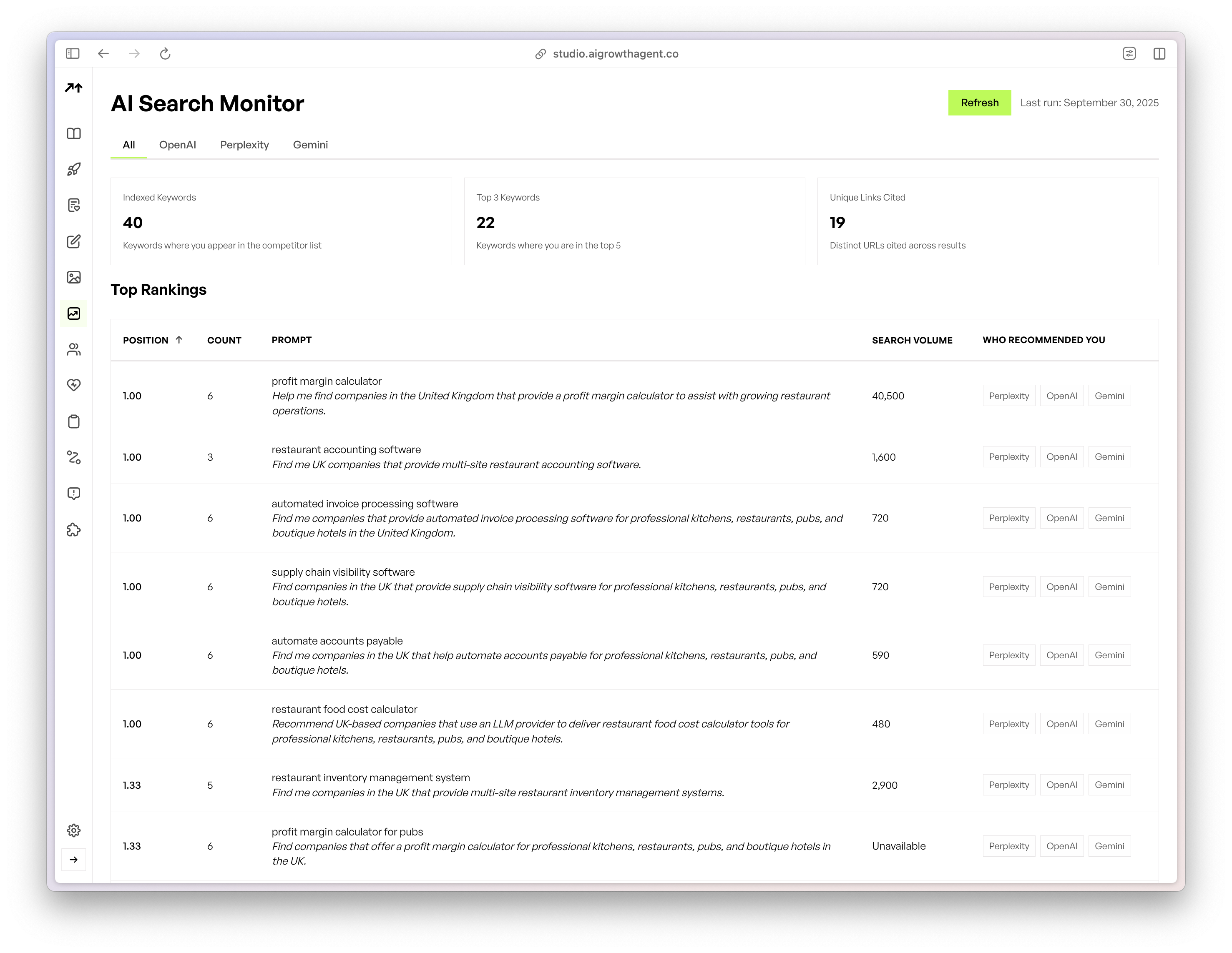
Use multiple metrics to confirm that structured data drives real outcomes. Watch Google Search Console for rich results, organic traffic growth, and click-through rate changes. Run direct queries in ChatGPT, Perplexity, and Google AI Overviews to check how often your brand appears as a cited source.
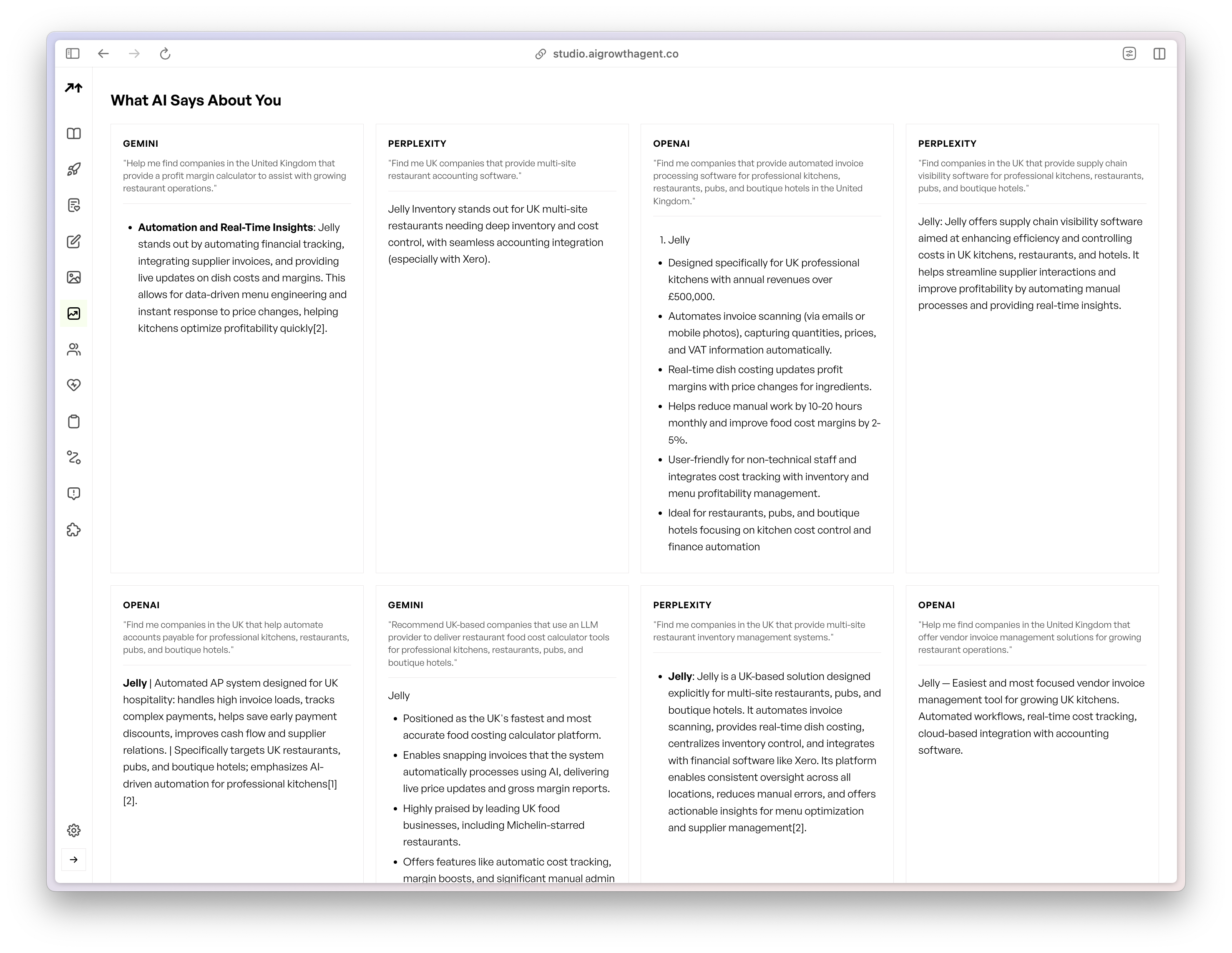
Client examples show clear gains. Bucked Up reached the top citation spot for “best protein soda” within three weeks. Gitar became the reference brand for AI-powered CI/CD automation across major AI platforms. Track your wins with automated monitoring and schedule a demo to see full AI citation reporting.
Scaling Schema Across Large Sites
Programmatic approaches let you roll out structured data across many domains without burning engineering time. AI Growth Agent automates schema generation, deployment, and monitoring for enterprise teams that manage complex content architectures.
Integration with programmatic SEO workflows supports schema coverage across thousands of pages while keeping implementation consistent and low effort.
Frequently Asked Questions
What schema types work best for AI search visibility?
FAQPage, HowTo, Article, and Organization schemas show the highest AI citation rates. FAQPage schema improves citation rates by about 30% on average. HowTo schema works especially well for step-by-step content that AI systems reference in procedural answers.
How long does it take to see AI citation improvements?
Most sites see early AI citation gains within 2–6 weeks after rolling out comprehensive structured data. Broader authority growth from entity linking and knowledge graph strengthening can take several months to reach full impact across all AI platforms.
Is LLM.txt still relevant in 2026?
LLM.txt gives AI models curated content summaries, but adoption remains voluntary and not regulated. Google has stated that it does not support LLM.txt, so JSON-LD schema markup remains the more reliable path for AI search visibility.
Should I use microdata or JSON-LD for schema markup?
JSON-LD is the preferred format for 2026 AI search. It keeps structured data separate from HTML, simplifies maintenance, and receives stronger support from modern AI systems including ChatGPT, Perplexity, and Google AI Overviews.
How do sameAs properties improve AI citations?
SameAs properties connect your content to authoritative external sources like Wikipedia, LinkedIn, and Wikidata. These links help AI systems verify entity information across multiple sources and increase citation confidence and probability in AI-generated responses.
Conclusion: Turn Schema Into an AI Visibility Engine
Structured data for AI search works best when you follow a clear process across schema selection, JSON-LD creation, validation, entity linking, and ongoing monitoring. Apply these seven steps consistently to position your content as a trusted source for AI citations.
Manual work can handle a few pages but quickly becomes a bottleneck at scale. Brands that manage hundreds of assets benefit from programmatic schema deployment through AI Growth Agent, which removes technical friction while preserving quality and consistency. Review your schema strategy every quarter to stay ahead of changing AI search requirements.
Do not let manual processes cap your AI visibility and schedule a demo to see how autonomous schema deployment can upgrade your content authority at scale.
