


AI Overviews, and Perplexity now prioritize expertise, structure, and citability instead of simple keyword matching. In this article, you’ll learn the differences between agencies and platforms when doing Programmatic SEO with a focus on AI Search. What you’ll see:
- Manual, agency-led content production often cannot meet the volume, speed, and technical depth required for AI visibility, especially across competitive categories.
- Programmatic SEO agencies provide human expertise and customized service but face structural limits in scalability, technical implementation, and time-to-market.
- Programmatic SEO platforms, like AI Growth Agent, automate research, content creation, and technical SEO, enabling large-scale, consistent publishing for AI search authority.
- Brands with ambitious growth goals and limited internal SEO resources typically achieve stronger AI search outcomes with platform-based approaches than with traditional agencies.
- Early investment in an AI-focused programmatic SEO platform creates a durable advantage as AI search protocols, models, and ranking standards continue to evolve.
The Imperative of Programmatic SEO in the AI Era
AI Search Reimagined: From Keywords to Citatability
The digital discovery landscape has changed quickly. Traditional search optimization focused on keyword density and backlink profiles. AI search engines such as ChatGPT, Google AI Overviews, and Perplexity now prioritize content that shows clear expertise and provides specific, reliable answers.
AI search engines evaluate content with different criteria than traditional search algorithms. They focus on contextual understanding, topical authority, and depth of coverage rather than simple keyword matching. Content needs to solve specific queries and position your brand as a trusted source that AI systems can reference repeatedly.
This shift has significant implications. Brands that do not adapt to AI search risk becoming less visible in key discovery channels. As AI systems become a primary interface between users and information, consistent citations from these systems often create more value than traditional search rankings. Content must be structured, comprehensive, and technically optimized to earn those AI citations.
The Content Velocity Gap: Why Manual Approaches Fail in AI Search
The volume of content required to build AI authority has increased sharply. Traditional agency models and internal teams often cannot match the pace needed for technically sound, frequent publishing. Manual content creation processes that once worked now create a bottleneck in AI search environments.
AI search engines reward consistent publishing velocity, topical depth, and clear structure. Publishing one or two manually crafted articles per month rarely sustains visibility when AI systems process thousands of new pieces daily. Brands need programmatic solutions that can deliver high-quality, technically optimized content at scale.
This content velocity gap represents a central challenge for marketing leaders. Brands that close this gap with programmatic SEO are positioned to lead their categories in AI search results. Brands that rely on slow, manual approaches risk losing visibility over time. Schedule a consultation session to explore how AI Growth Agent’s programmatic approach can help close your content velocity gap.
Programmatic SEO Agencies: A Deep Dive into Services and Limitations
Agency Operational Model and Service Offerings
Programmatic SEO agencies operate on a human-centric, service-based model similar to traditional marketing agencies. They usually employ strategists, writers, and SEO specialists who collaborate on client projects through manual research, planning sessions, writer assignments, and staged reviews.
Many agencies outsource specific tasks to freelancers or offshore teams. This structure adds coordination work and can create quality control challenges. Typical services include content strategy development, keyword research, content creation, basic SEO implementation, and performance reporting. These capabilities often remain limited by human bandwidth and manual workflows.
The agency model usually follows a project-based framework, with deliverables planned weeks or months ahead. This approach can work for brands with modest content needs. It becomes less effective when volume requirements grow, because scaling output requires hiring more people, which increases cost and complexity.
Advantages of Programmatic SEO Agencies
Programmatic SEO agencies offer clear advantages for certain brands and use cases. Their core strength lies in providing human judgment and personalized guidance, which can help smaller-scale projects or highly nuanced topics.
Experienced agencies contribute strategic advice from practitioners who understand industry dynamics and audience behavior. They can tailor approaches for niche markets or regulated industries where deep subject matter expertise is important. Brands that value high-touch service and direct collaboration with human teams often find this model appealing.
Disadvantages and Limitations of AI Search Ranking
Programmatic SEO agencies also face structural limitations that become more serious in the AI search era. The most basic constraint is scalability. Human bandwidth is finite and becomes expensive when content volume climbs.
Technical debt introduces another major limitation. Many agencies lack the engineering depth needed for advanced AI SEO implementations, such as LLM.txt files and Model Context Protocol integration. These technical components matter for AI search visibility but often sit outside standard agency offerings.
Quality consistency also presents a recurring challenge for agencies. Content quality can vary across writers, teams, or subcontractors, which affects brand voice and technical standards. Time-to-market is usually slower because of manual reviews and coordination, so production cycles often stretch into weeks.
Agencies also struggle to implement the technical infrastructure required for AI search optimization. Advanced schema markup, automated metadata generation, and AI-specific indexing protocols typically require engineering support that most agencies do not have in-house.
Ideal Use Cases for Programmatic SEO Agencies
Programmatic SEO agencies remain useful in specific situations despite these limits. They perform well for niche content that needs deep human subject matter expertise, but not high volume.
Companies that place a high value on relationship-based service models and prefer ongoing interaction with a dedicated team often favor agency partnerships.
These use cases, however, are narrowing as AI search optimization increasingly requires both technical sophistication and high content volume. Even in specialized niches, the velocity required for AI search often exceeds what manual agency processes can support over time.
Programmatic SEO Platforms: Examining the Future of AI Content
Platform Operational Model and Autonomous Capabilities
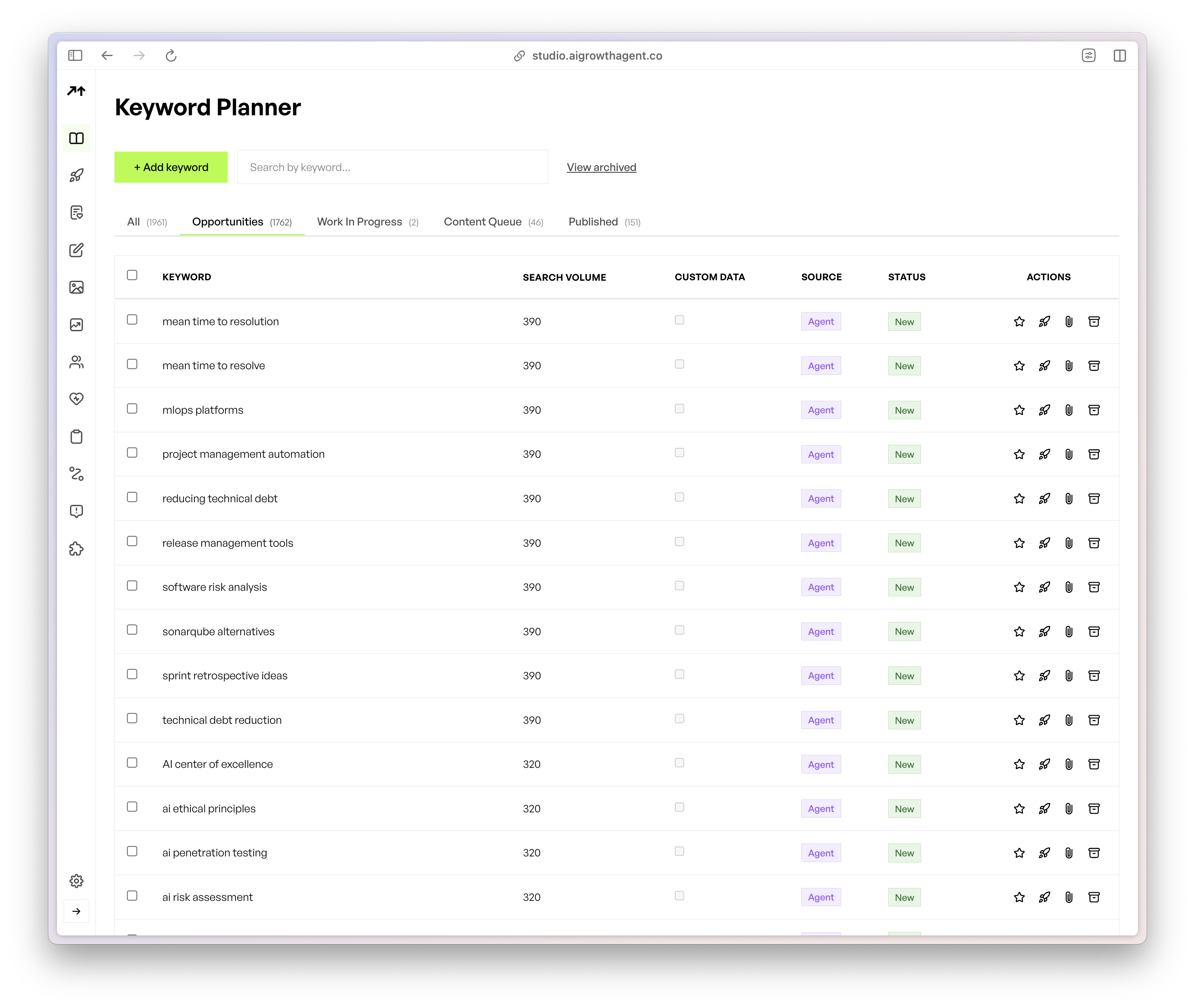
Programmatic SEO platforms use a technology-first approach to content creation and optimization. These systems automate the content lifecycle from research and strategy through writing, technical optimization, and publishing.
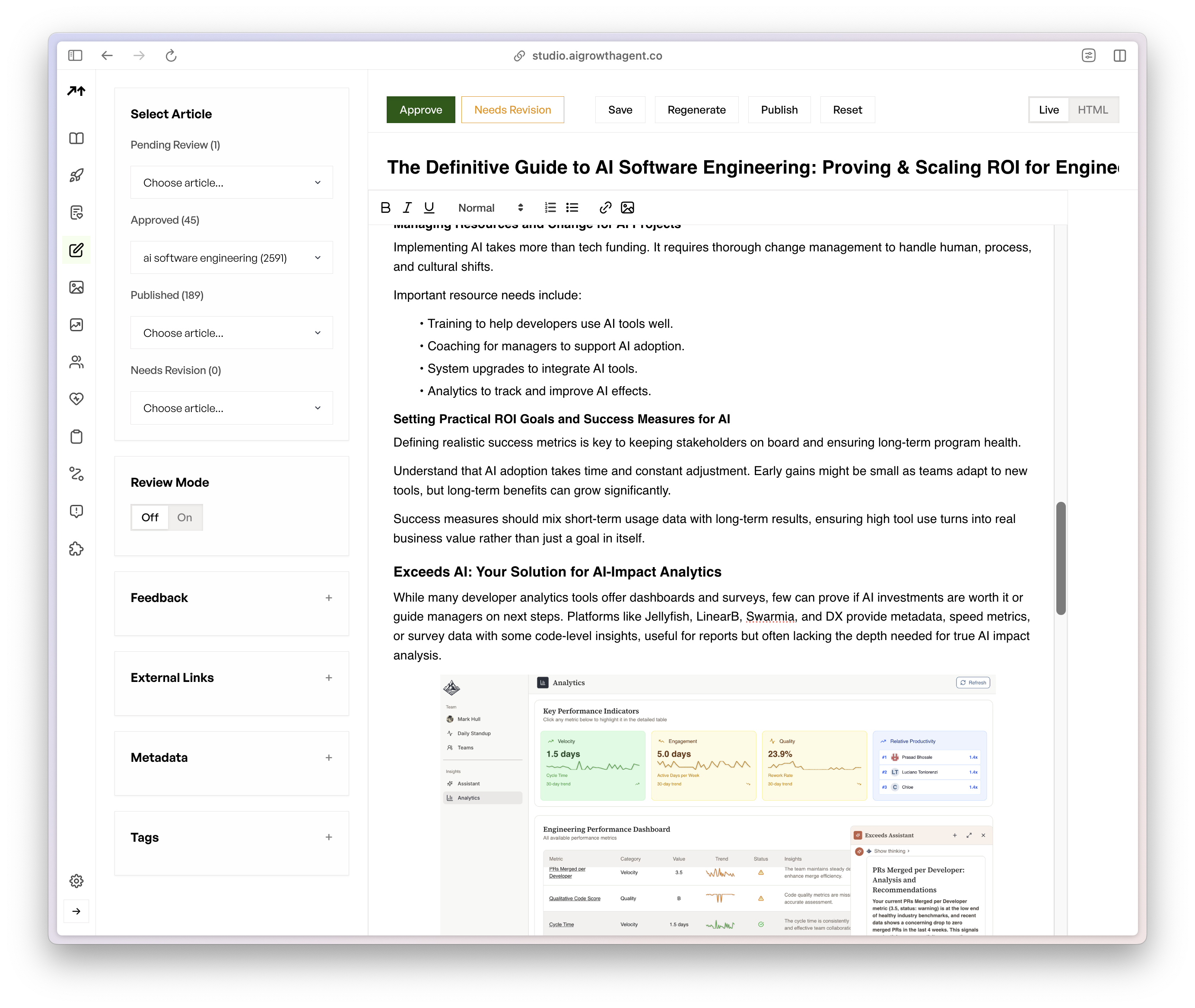
AI Growth Agent exemplifies this platform model with an autonomous agent that engineers, writes, and technically optimizes content at a speed and consistency that humans cannot match.
The platform manages end-to-end automation, which removes many manual bottlenecks common in agency workflows. Capabilities include automated keyword research, content briefs, writing, fact-checking, and technical SEO implementation.
The platform model runs continuously rather than on one-off project cycles. After configuration, these systems can publish optimized content daily, adjust to search trends, and maintain defined quality standards. This ongoing operation enables large-scale publishing while meeting the technical requirements of AI search optimization.
Advanced platforms rely on sophisticated AI that can learn brand voice, maintain consistency across large content libraries, and apply complex technical SEO requirements without constant human involvement. This foundation supports performance levels that manual processes struggle to reach.
Advantages of Programmatic SEO Platforms for AI Authority
Programmatic SEO platforms offer high scale and velocity. They can produce large volumes of high-quality, technically optimized articles in short timeframes. This volume helps build the depth and breadth of content that AI search engines reward.
Technical sophistication represents a core strength of advanced platforms. AI Growth Agent autonomously implements AI-focused SEO features such as LLM.txt and Model Context Protocol for accurate AI indexing. These capabilities typically fall outside the reach of most agencies but are important for strong AI search performance.
Consistency and quality control also improve with AI-driven platforms. Each piece of content follows the same tone, quality, and technical standards across the portfolio. AI Growth Agent maintains this consistency at scale, which becomes harder to achieve as human teams grow.
Cost-efficiency at scale creates an additional advantage. Cost per article usually drops as volume increases on a platform, especially when compared to agency pricing for similar output. This economic shift allows brands to pursue content volume that would be difficult to fund through agency-only partnerships.
AI Growth Agent offers a focused solution for the AI search era by combining scale, technical depth, and consistency in a single programmatic SEO platform.
Potential Challenges and Considerations of Programmatic SEO Platforms
Programmatic SEO platforms also present considerations that brands should review before adoption. Initial setup and integration can feel complex. AI Growth Agent addresses this with a structured onboarding process that usually delivers the first programmatically engineered article within about a week.
Platforms require a clear Company Manifesto to guide AI outputs and protect brand voice. This effort adds some upfront work, but it becomes a strength of AI Growth Agent’s onboarding approach by aligning content with brand positioning from the start.
Some organizations feel uncertain at first about reducing direct human involvement in content creation. Advanced platforms such as AI Growth Agent address this through clear control panels, review workflows, and feedback loops that allow teams to oversee content while still benefiting from automation.
The technology must connect with existing marketing tools and systems. Most advanced platforms integrate with common CMS platforms and marketing stacks. Schedule a demo to review how AI Growth Agent can fit into your current environment.
Ideal Use Cases for Programmatic SEO Platforms
Programmatic SEO platforms work best for brands that need significant content scale to lead a category. Companies seeking to build strong AI authority and appear consistently across AI search engines match this profile.
Multi-brand enterprises benefit from advanced platform capabilities as well. AI Growth Agent’s multi-tenant setup lets portfolio companies manage several brand strategies from one interface while maintaining distinct voices and approaches.
Businesses that want to respond quickly to trending topics or unlock value from internal data also gain from platforms. AI Growth Agent’s real-time injection and database-to-content features can turn proprietary data and insights into searchable content assets.
Organizations with ambitious growth goals and limited internal SEO staff typically see the greatest gains from platform models. The autonomous nature of advanced platforms reduces the need for large internal SEO teams while aiming for stronger results.
Comparative Analysis: Agencies vs. Platforms in the AI Search Landscape
Technical Capabilities Comparison for AI SEO
The technical capabilities gap between agencies and platforms becomes clear when reviewing key AI SEO elements. Schema markup provides one example. Agencies often implement schema manually and in limited scopes, while platforms such as AI Growth Agent automate advanced schema across all content.
LLM.txt and Model Context Protocol highlight another difference. Most agencies lack the infrastructure to deploy these features at scale. AI Growth Agent includes them as core capabilities, which can directly influence AI search visibility and citation frequency.
Content architecture also diverges. Many agencies handle content structure in an ad-hoc way. Platforms engineer content architectures specifically for AI search behavior, which improves AI understanding and indexing.
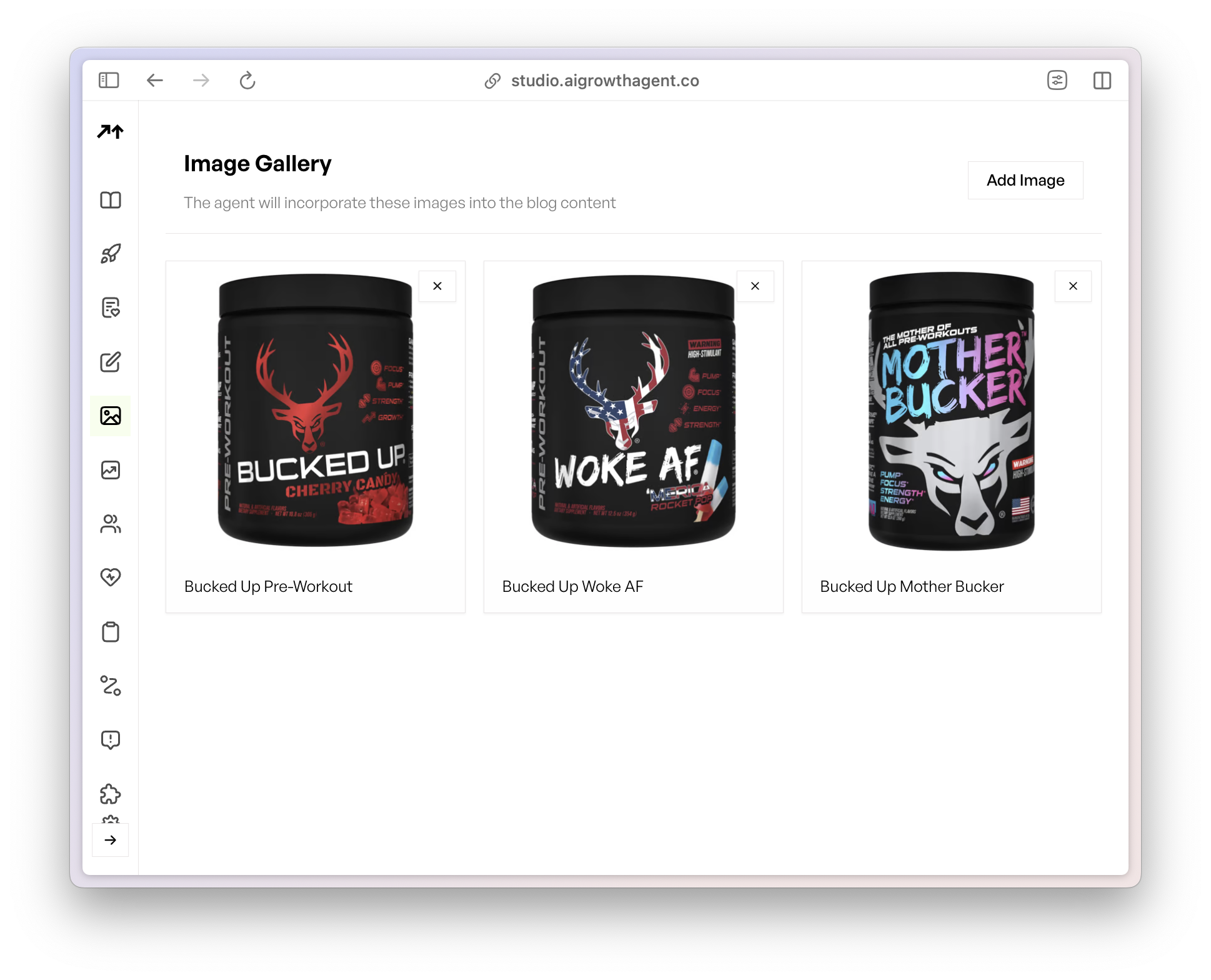
Image optimization reveals operational differences as well. Agencies usually optimize images manually, which can create delays and inconsistencies. AI Growth Agent automates image placement and optimization so each visual asset supports SEO performance.
Scalability, Cost, and Time-to-Market Comparison
A side-by-side comparison highlights key differences between programmatic SEO agencies and platforms across business metrics:
|
Feature |
Programmatic SEO Agency |
Programmatic SEO Platform |
|
Content Velocity |
Slow (manual processes) |
Very high (autonomous system) |
|
Cost-Per-Asset (at scale) |
High |
Low |
|
Technical AI SEO |
Basic/Limited |
Advanced (LLM.txt, MCP) |
|
Scalability |
Limited by headcount |
High |
|
Consistency |
Variable |
High |
|
Time to First Article |
Weeks/Months |
Days (AI Growth Agent: about 1 week) |
|
Multi-Brand Management |
Complex/Costly |
Integrated (Multi-tenant) |
These metrics show how platform approaches often provide a better fit for organizations that view AI search as a core growth channel. The advantages in scale and speed usually become more pronounced as content needs expand. Schedule a consultation to compare programmatic SEO options and identify the right mix for your organization.
Case Studies: Real-World Impact on AI Visibility with AI Growth Agent
Success with AI Growth Agent in AI Search
Real-world results highlight the impact of advanced programmatic SEO platforms. AI Growth Agent clients have achieved AI citations and recommendations that support the platform-based approach.
Exceeds AI provides an example of fast AI search traction. Within two weeks of programmatic content publishing, Perplexity began recommending Exceeds AI as a top alternative to established competitors. By week three, the company appeared in Google AI Overview/Gemini snapshots for core keywords. Exceeds AI now appears as a featured source across ChatGPT, Google AI Overview/Gemini, and Perplexity for “AI performance review tools for engineers.”
BeConfident shows how programmatic SEO can help in crowded markets. Through programmatic publishing with AI Growth Agent, BeConfident gained visibility in the English language learning space and built a stronger presence in a competitive field.
Bucked Up demonstrates rapid authority in a focused niche. About three weeks after launching programmatic content, ChatGPT began citing Bucked Up as a top protein soda brand. The company now appears as a leading citation for high-intent queries such as “best protein soda,” competing directly with larger brands.
Gitar’s growth illustrates how programmatic SEO supports category leadership. In under two months, Gitar.ai established itself as a reference brand for AI-powered CI/CD automation. The company appears as a frequently cited tool across Google AI Overview/Gemini, ChatGPT, and Perplexity for queries about automated CI builds, AI code review, and self-healing software development pipelines.
These outcomes support AI Growth Agent’s approach of helping companies provide clear, reliable answers that AI search engines can reference. The speed and repeatability of these results are difficult to match with traditional, manual-only agency methods.
Future Outlook: The Domination of AI-Powered Programmatic Content
The Inevitable Shift Towards Autonomous Content Engineering
The future of SEO for AI visibility is moving toward technical, automated systems that can match the pace and complexity of AI search engines. Manual content creation alone is unlikely to meet growing expectations for volume, precision, and publishing speed.
This shift toward autonomous content engineering reflects a broader pattern where automation replaces manual processes in areas that demand scale and consistency. Manufacturing moved from craft production to industrial systems. Content creation is now following a similar path from craft-based work to engineered workflows.
AI Growth Agent reflects this direction with autonomous capabilities that help clients stay in front of industry changes through a programmatic SEO platform built for the AI search era.
Organizations that adopt this model early are likely to gain durable advantages over competitors that remain tied to manual approaches. The cumulative effect of ongoing programmatic publishing helps early adopters build content libraries and AI authority that become difficult for others to match.
How Marketing Leaders Can Prepare for AI’s Continued Evolution
Marketing leaders need platforms that can adapt to new AI search protocols rather than static solutions that require constant manual updates. The AI search ecosystem changes quickly, with new engines, model updates, and technical standards emerging regularly.
Effective preparation involves choosing programmatic SEO solutions that anticipate future needs. Platform capabilities should include support for new technical standards, the ability to respond to emerging AI search engines, and room to scale content production as competition increases.
Investment in programmatic SEO platforms functions as infrastructure, not just a tactical tool purchase. Similar to enterprise software or core manufacturing systems, these platforms become foundational capabilities that support long-term growth.
The most effective marketing leaders recognize that AI search optimization requires engineering-level solutions rather than purely marketing tools. This shift calls for platforms like AI Growth Agent that combine marketing insight with technical depth to deliver complete programmatic SEO solutions.
Frequently Asked Questions (FAQ) on Programmatic SEO
Can a traditional SEO agency effectively implement Programmatic SEO for AI?
Traditional agencies can offer useful strategic guidance. Their manual, human-centric model, however, typically lacks the technical infrastructure and scale needed for full programmatic SEO in the AI era. Features such as LLM.txt and Model Context Protocol rarely fall within their standard operations.
Project-based timelines also make it difficult to match the velocity that AI search optimization demands. Human-dependent processes create bottlenecks that slow consistent, high-volume content production. Most agencies also lack the engineering resources needed to implement advanced technical SEO elements that AI search engines prioritize.
How quickly can a Programmatic SEO platform like AI Growth Agent show results in AI search?
AI Growth Agent clients have seen fast progress in AI citations and recommendations. Exceeds AI appeared in Perplexity recommendations within about two weeks and began ranking in Google AI Overview/Gemini snapshots within three weeks. BeConfident gained rapid visibility in the English language learning space through programmatic publishing with AI Growth Agent.
The onboarding process typically moves faster than many alternatives, often taking clients from initial meeting to the first programmatically engineered article in about one week. This speed comes from the platform’s autonomous technical infrastructure and the structured Company Manifesto process.
Is programmatic SEO only for large enterprises or can smaller brands benefit?
Programmatic SEO can benefit brands of many sizes that want to build AI authority. Large enterprises use platforms for massive scale. Smaller brands often see some of the strongest relative gains because platforms help them compete with larger players.
Small and mid-sized businesses can rely on platforms such as AI Growth Agent to create content libraries that manual processes would not support, narrowing the gap with bigger competitors. Improved cost-efficiency also makes advanced SEO capabilities more accessible than comparable agency services. Smaller brands that adopt programmatic SEO early can establish market presence before larger rivals fully adjust to AI search opportunities.
What technical requirements are necessary for effective AI search optimization?
Effective AI search optimization relies on technical infrastructure that extends beyond traditional SEO.
Important components include LLM.txt files that give AI search engines structured guidance on content organization and authority. Model Context Protocol implementation allows AI systems to connect directly with content databases, improving understanding and citation accuracy. Advanced schema markup needs to be applied consistently across content to provide clear signals on structure. Automated metadata generation helps ensure every piece includes accurate descriptions, titles, and tags. Real-time or frequent indexing support allows new content to appear quickly in AI search systems.
These requirements usually demand engineering capabilities that most agencies do not have, but that advanced platforms like AI Growth Agent provide as standard.
How does programmatic SEO maintain brand voice and quality at scale?
Advanced programmatic SEO platforms maintain brand consistency through structured training and control systems.
The process usually begins with a detailed Company Manifesto that captures voice, positioning, and communication rules in a structured format. AI systems rely on this manifesto as a guide for all content generation, which supports consistent output across many articles. Continuous learning algorithms incorporate client feedback and performance data to refine alignment with brand standards. Quality control layers handle fact-checking, grammar checks, and voice analysis before publication. Human review options remain available so teams can adjust content while still benefiting from automated scale.
The result is content that maintains quality standards while reaching volumes that manual processes rarely achieve. Schedule a demo to see how programmatic SEO can support your brand while protecting voice and quality.
Conclusion: Strategic Choices for AI Authority with Programmatic SEO
The decision between a programmatic SEO agency and a platform depends on your target scale, technical requirements, and long-term view of AI visibility.
This research suggests that agencies can provide valuable human oversight for limited-scope or highly specialized projects. The growing demands of AI search optimization, however, tend to favor platform-based approaches for most brands.
Brands that want to become reliable, frequently cited sources for AI search engines often gain more value from advanced programmatic SEO platforms such as AI Growth Agent. The combination of autonomous content generation, technical SEO implementation, and scalable workflows creates advantages that manual approaches struggle to match.
Evidence from AI Growth Agent implementations across several industries supports this platform approach. Examples range from Exceeds AI’s rapid citations in Perplexity to Gitar’s emergence as a leading reference for AI-powered development tools. These outcomes show the impact that well-executed programmatic SEO can have on AI visibility.
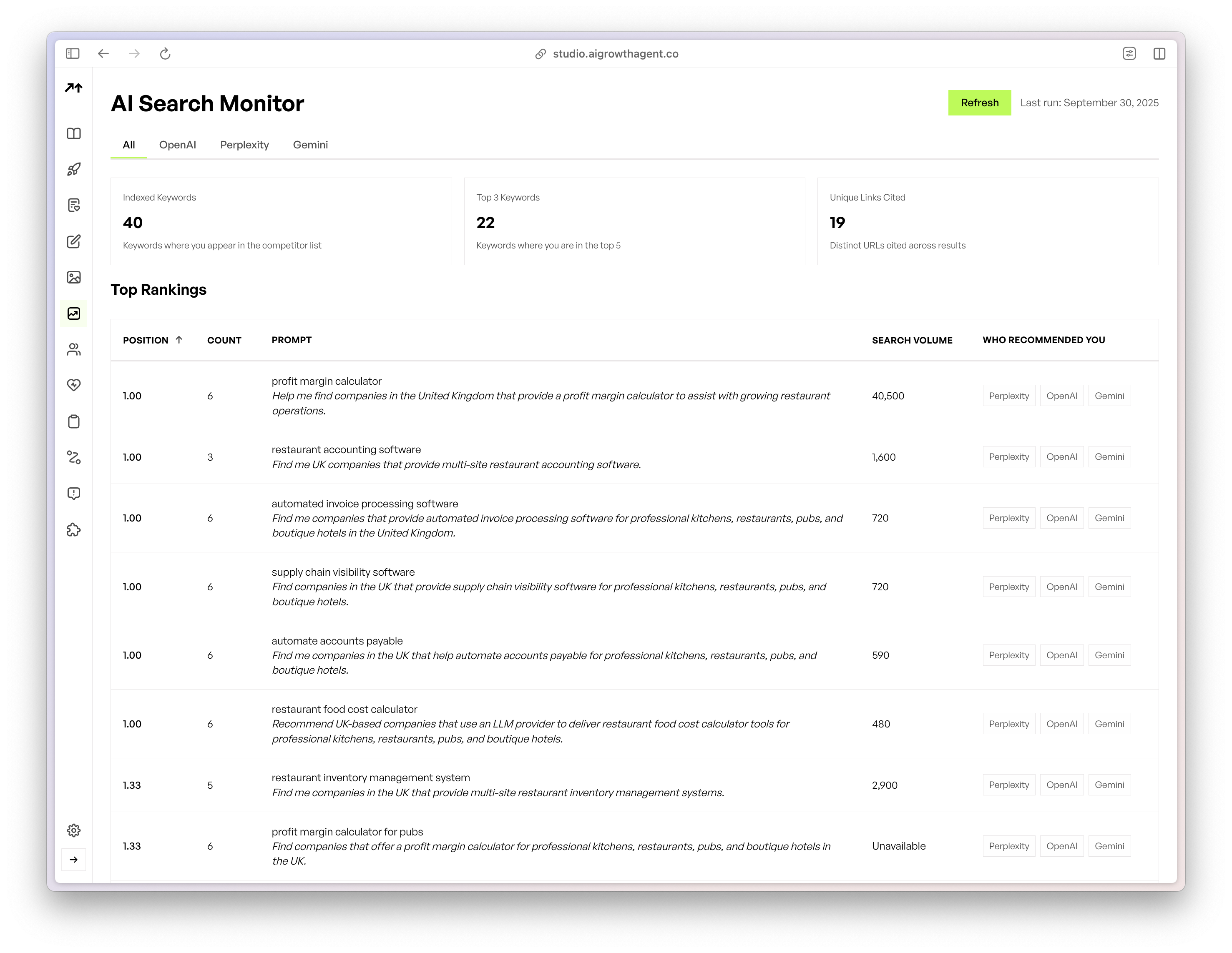
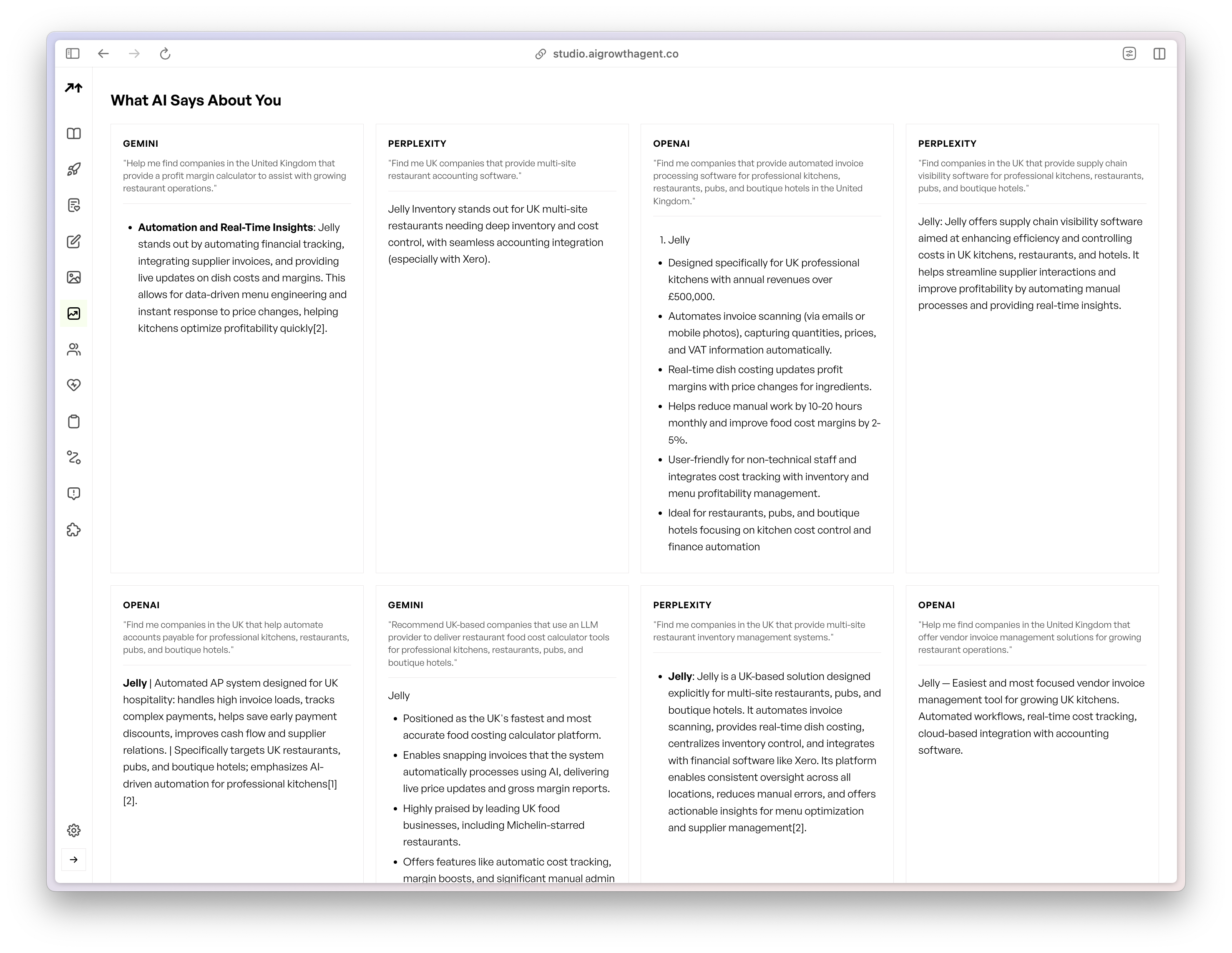
AI Growth Agent helps companies provide clear, comprehensive answers for AI search engines through autonomous content engineering, advanced technical optimization, and ongoing adaptation to new AI search requirements. The platform’s multi-tenant features, real-time content injection, and AI search monitoring tools form a complete system for building and maintaining AI authority.
As AI search continues to evolve and competition intensifies, brands that adopt programmatic approaches early and implement them thoroughly are more likely to succeed. The key question is no longer whether to adopt programmatic SEO, but which solution can deliver the scale, quality, and technical depth required for strong AI search performance.
Marketing leaders who want their company to become a primary answer for AI search can schedule a consultation session to determine whether AI Growth Agent is the right fit.
