


Key Takeaways
- AI-native search experiences in tools like ChatGPT, Google AI Overviews, and Perplexity now influence how enterprise buyers discover vendors, so brands need content that these systems can reliably cite.
- Manual content workflows and basic prompt engineering cannot keep pace with the scale, structure, and recency signals AI systems expect across entire topic clusters.
- Programmatic SEO pairs large content architectures with technical elements such as schema markup, LLM.txt, and Model Context Protocol to help AI search engines recognize and reuse your content.
- AI Growth Agent provides an autonomous, end-to-end programmatic SEO engine, while The Prompting Company focuses on improving individual prompts and still depends on manual execution.
- Marketing and growth leaders who want to build AI search authority in 2026 can use AI Growth Agent to deploy a full programmatic SEO system; schedule a demo to see if it fits your team and stack.
The New Reality of AI Search and the Enterprise Marketer’s Challenge
Shrinking Digital Footprint in the AI Era
Enterprise brands face a shrinking digital footprint as AI multiplies the amount of content on the internet. Each month without a structured programmatic content plan reduces the chances that AI systems will surface your site. AI search tools such as ChatGPT, Google AI Overviews, and Perplexity evaluate which sources give clear, complete coverage of a topic, not just which domains rank for a few keywords. Brands that publish only occasional, manually produced posts create too few data points for these systems, which leaves more space for competitors to occupy AI citations.
Why Traditional Methods Fail AI Search Demands
Search has shifted from individual blue links to synthesized AI answers that pull from many sources at once. Traditional SEO programs built around a few manually written articles per month, basic keyword targeting, and ad hoc on-page optimization do not generate enough volume or structure for AI search. Most agencies still work on a craftsman model that depends on writers and editors, which limits throughput and consistency. Internal teams often lack the engineering support needed for large-scale schema markup, LLM.txt files, and Model Context Protocol, all of which help AI systems understand and re-use your content.
The Imperative for Programmatic SEO Authority
Programmatic content velocity now acts as a baseline requirement for staying visible in AI search. Brands that fail to publish structured, interlinked content across their topic map provide too few signals for AI models, so those models rely on better-structured competitor sites instead. That shift allows competitors to define key terms, categories, and solution language across an industry. An autonomous programmatic SEO engine helps close this gap by generating technically sound pages at scale while keeping strategy and brand voice consistent.
Introducing the Contenders: The Prompting Company vs. AI Growth Agent
The Prompting Company: A Focus on Prompt Engineering
The Prompting Company represents an incremental approach to AI-assisted content creation. Its work centers on crafting and refining prompts that improve output from models like ChatGPT or Claude. This method can raise the quality of individual articles but still relies on humans for keyword strategy, internal linking, technical implementation, and publishing. Internal teams remain responsible for enforcing brand guidelines, applying SEO best practices, and wiring content workflows into the CMS.
AI Growth Agent: Autonomous Programmatic SEO for AI Search Citations
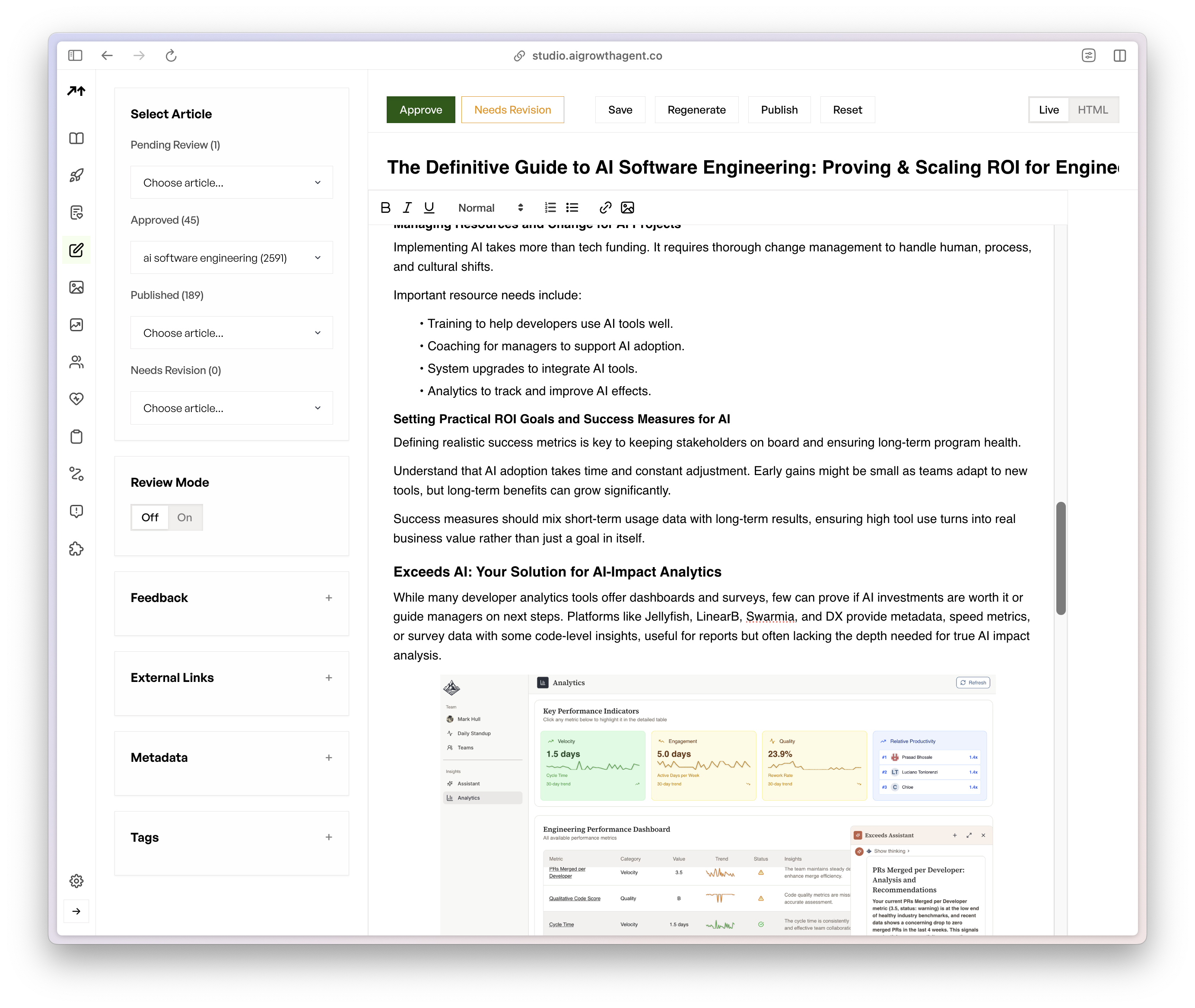
AI Growth Agent operates as an autonomous programmatic SEO system that covers the full lifecycle of content operations. The agent handles keyword clustering, content architecture planning, drafting, technical SEO, and publishing from one environment. The platform implements structured data, LLM.txt files, and a purpose-built blog Model Context Protocol that connects your content directly to AI systems and increases citation potential. Marketing teams gain a persistent agent that produces aligned content without needing to manage prompts or manual production queues.
Head-to-Head: AI Growth Agent vs. The Prompting Company for Programmatic SEO
|
Feature/Criterion |
The Prompting Company |
AI Growth Agent |
|
Approach to content scale |
Improves prompts to generate content but relies on manual workflows and integration |
Autonomous end-to-end engine built to plan, generate, and publish programmatic SEO at scale |
|
Technical SEO and AI indexing |
Applies SEO best practices manually with limited native support for AI citation optimization |
Implements schema, LLM.txt, and Model Context Protocol to help AI search engines parse and reuse content |
|
Completeness of solution |
Functions mainly as a content generation assist that still needs human oversight for strategy and deployment |
Covers strategy, research, engineering, writing, optimization, publishing, and performance monitoring |
|
Brand authority and voice |
Relies on user-supplied prompts and guidelines; output quality depends on each operator |
Uses a Company Manifesto that encodes positioning, narrative, and voice across all content |
This comparison highlights a key difference in scope. The Prompting Company improves how teams talk to AI tools, while AI Growth Agent functions as a standing agent that executes the entire programmatic SEO operation for AI search.
Why AI Growth Agent Fits Enterprise Programmatic SEO Needs
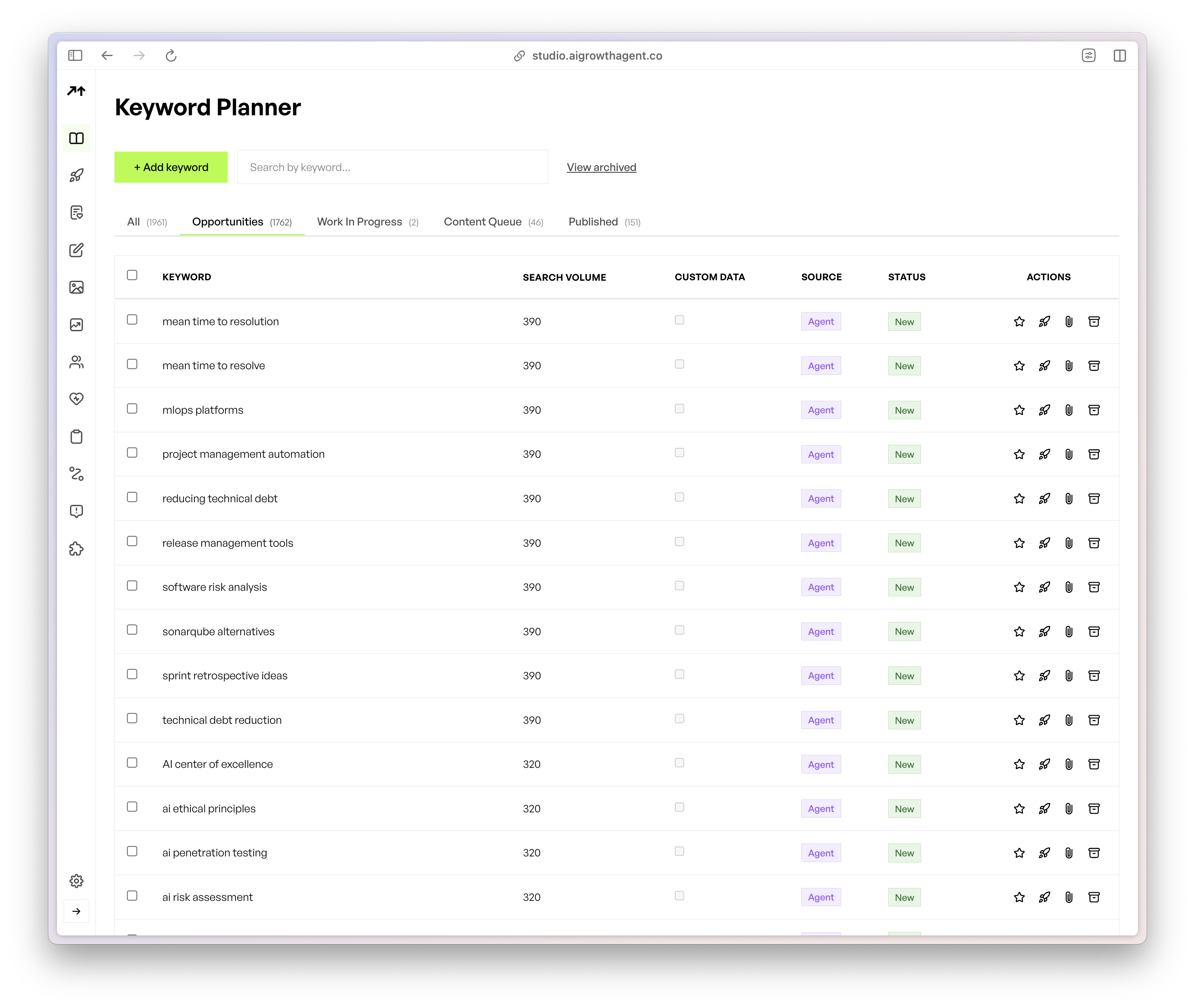
AI Growth Agent supports complex organizations that operate multiple brands, products, or regions. Multi-Tenant Programmatic Deployment allows teams to run separate agents from one interface, each with its own Company Manifesto, keyword map, and domain. Growth leaders can coordinate high-volume publishing across portfolios without losing local nuance or voice.
Real-Time Programmatic SEO Content Injection helps brands respond to emerging topics quickly. The agent can generate and publish structured pages around trending themes in minutes, which increases the odds of inclusion in AI answers for newer queries. Database-to-Content Automation turns internal data sources such as feature tables, pricing grids, or performance metrics into repeatable content patterns that reinforce your category position.
Teams that want to explore this model can schedule a consultation with AI Growth Agent and assess fit, timelines, and publishing goals.
Real-World Impact: AI Growth Agent Results in AI Search
Enterprise teams use AI Growth Agent to move from limited organic visibility to frequent inclusion in AI-generated recommendations. Exceeds AI gained Perplexity recommendations as a top alternative to competitors within two weeks and Google AI Overview citations within three weeks, becoming a featured source for queries around AI performance review tools for engineers. BeConfident reached the top recommended position for English learning apps in Brazil through Google AI Overview within weeks of deployment. Bucked Up became a leading cited protein soda brand in ChatGPT answers for “best protein soda” within three weeks. Gitar.ai established itself as a reference tool for AI-powered CI/CD automation in under two months and now appears consistently for queries such as “fix broken CI builds automatically” and “best AI reviewer that comments on CI failures.”
These examples show how structured, programmatic content paired with strong technical implementation can convert into early AI citations and sustained category authority. Marketing leaders who want similar outcomes can request a tailored programmatic SEO demo.
Frequently Asked Questions about Programmatic SEO and AI Search
How does AI Growth Agent ensure content quality and brand voice at scale compared to traditional methods?
AI Growth Agent uses a Company Manifesto developed during onboarding with an editorial specialist. This artifact encodes positioning, messaging pillars, proof points, and voice guidelines that the agent applies across every article. The system connects this manifesto directly to programmatic generation, so thousands of pages follow the same narrative logic without depending on manual style checks. Technical optimization runs in parallel, which keeps brand consistency and SEO fundamentals aligned.
Can AI Growth Agent integrate with an existing CMS or website structure for programmatic content?
AI Growth Agent connects with platforms such as WordPress, Webflow, HubSpot, Hashnode, Framer, and Sanity, but most enterprise teams use the hosted blog environment for maximum technical control. The hosted option sets up an optimized subdomain that mirrors your existing design while adding schema markup, LLM.txt, and Model Context Protocol by default. Organizations that require deep integration often choose WordPress, where a dedicated integration supports the full range of programmatic SEO features.
What specific metrics does AI Growth Agent provide to demonstrate ROI in AI search?
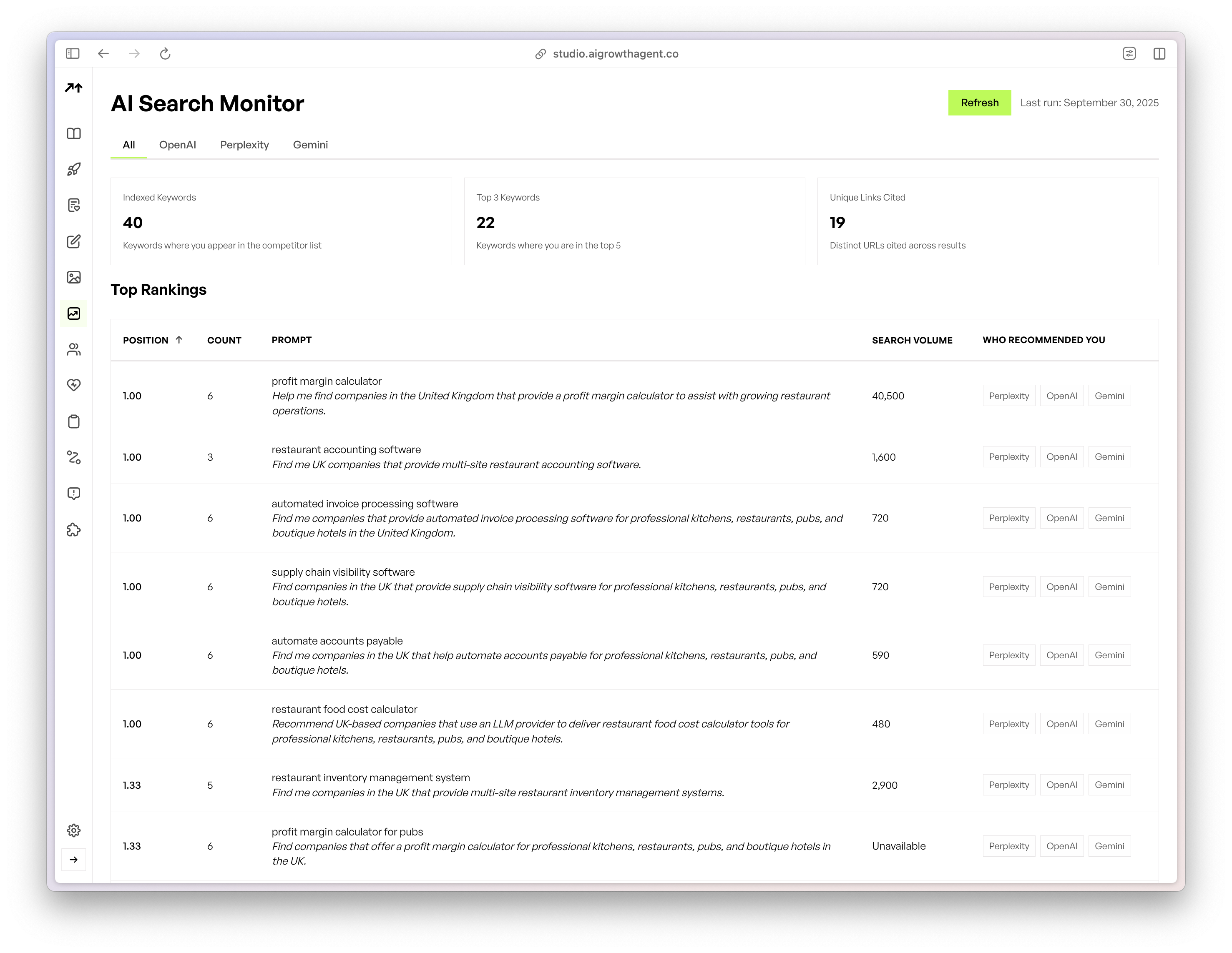
The AI Search Monitor gives teams a consolidated view of performance across ChatGPT, Google AI Overviews via Gemini, and Perplexity. Users see which pages appear in AI answers, how often they are cited, and which queries drive those mentions. The dashboard also surfaces crawl activity from Google, ChatGPT, and Perplexity bots to indicate indexing health. Integration with Google Search Console then connects programmatic output to changes in impressions, clicks, and click-through rates.
How quickly can an enterprise expect to see results from deploying an AI Growth Agent for programmatic SEO?
Most enterprises see their first production-ready article within one week of the initial meeting. AI citations often begin to appear within the first several weeks, as seen in the Exceeds AI and BeConfident examples. Because the agent runs continuously, each new cluster of content compounds authority and increases the likelihood of additional mentions across AI search tools.
What makes AI Growth Agent’s programmatic approach different from using basic AI content tools?
General-purpose AI tools output unstructured text that still needs strategy, editing, formatting, internal links, metadata, and deployment. AI Growth Agent plans topic clusters, generates pages, and publishes directly into a technically optimized environment, with schema, metadata, and LLM.txt already in place. Teams spend their time setting direction, reviewing strategy, and refining narrative, rather than managing prompts and manual SEO tasks.
Conclusion: Build AI Search Authority with Programmatic SEO in 2026
The contrast between AI Growth Agent and The Prompting Company reflects a broader choice for marketing leaders in 2026. Prompt-focused services help teams extract better drafts from AI, but they keep content strategy, technical SEO, and publishing as manual work. AI Growth Agent operates as an ongoing programmatic SEO agent that creates and maintains the content and technical foundation required for sustained AI search visibility.
Brands that invest in this infrastructure now will shape how AI systems describe their categories and solutions, while slower competitors remain underrepresented in synthesized answers. Teams that want to explore this edge can schedule a demo with AI Growth Agent and evaluate how an autonomous programmatic SEO agent could support their 2026 growth plans.
