


Executive summary
- AI search engines now evaluate website authority using structured data, topical depth, and third-party validation, not just backlink volume.
- Traditional agencies and generic AI tools cannot produce the speed, coverage, and technical quality that AI systems require at scale.
- Programmatic SEO offers a systematic way to build large, structured content architectures that AI search engines can parse, trust, and cite.
- AI Growth Agent automates this programmatic approach, from research and content creation to schema, metadata, and AI-specific indexing.
- Brands that adopt programmatic authority building early strengthen their visibility in AI search, while slower competitors see their digital footprint shrink.
The Problem: Traditional Backlink and Authority Building Fails in the AI Era
AI’s New Rules for Trust: Beyond Raw Backlink Quantity
AI search engines such as Google AI Overviews and Perplexity have changed how website authority is evaluated and rewarded. This shift moves focus away from simple backlink counts toward relevance, structure, and context.
The new authority model centers on content that AI systems can easily interpret and verify as credible. Traditional search algorithms could be influenced by link farms or manipulative tactics. AI engines give more weight to demonstrated expertise, transparent sourcing, and consistent topical coverage.
Marketing teams face clear implications. Investments in traditional backlink acquisition, including guest posting networks, directory submissions, and paid link placements, now deliver limited impact in AI search results. Priority moves to content and authority signals that AI systems can confidently cite and recommend.
The Shrinking Digital Footprint: Why Velocity Matters More Than Ever
Digital footprints are shrinking as AI-generated content rapidly increases online. Brands that maintain traditional publishing schedules see their relative visibility decrease over time. Content volumes that once kept pace with competitors now fall short in an AI-driven environment.
High-quality content still matters, but it is not enough without sufficient volume and publishing speed. Large language models need many data points to build confidence in a source across a topic area.
Brands that publish only a few strong articles each month compete against thousands of new pieces in the same category. Their content becomes a smaller share of the available information. This dilution makes it harder for even excellent work to reach the citation frequency needed for AI recommendation.
Velocity now includes recency, depth, and structural consistency across an entire content library. AI systems reward brands that show sustained expertise through broad topical coverage, regular updates, and fast responses to new questions and trends. Manual processes struggle to meet this demand for comprehensive, current content.
Limitations of Current Solutions: Agencies and Generic AI Tools
Traditional SEO agencies bring useful expertise, but their operating model limits scale. Most agencies follow a stepwise process of strategy development, keyword research, content briefing, writing, editing, technical optimization, and publishing. Each step takes time and depends on human capacity and budget.
This model can produce strong individual articles. It rarely produces the volume of technically consistent, schema-optimized content required to cover an entire domain or category in depth.
Generic AI content tools create a different bottleneck. These tools mainly output raw text that often lacks structure, schema, or AI-specific technical elements. Strategy, technical implementation, and publishing remain manual. Internal teams must still handle keyword research, content planning, schema implementation, metadata, CMS integration, and quality control.
Most brands end up stuck between manual quality and automated scale. They either get carefully crafted but slow content or fast but unstructured output. Premium brands need both expert-level technical implementation and enough volume to compete in AI search.
Schedule a consultation session to identify gaps between your current approach and AI search requirements.
The Solution Categories: Rebuilding Authority for AI Search Engines
Marketing leaders can choose from several approaches to rebuild authority and backlink signals for AI search. Each option has different strengths, resource needs, and timelines. A clear understanding of these categories helps in selecting a path that matches internal capacity and growth goals.
Enhanced Authority Signals and Structured Data for AI Clarity
Authority in AI search depends on signals that clearly demonstrate expertise and trustworthiness. AI systems must be able to read, interpret, and validate these signals across your content.
Structured data plays a central role. Schema markup for organizations, authors, products, reviews, and other entities helps AI understand who is speaking, what is being described, and how it connects to a broader topic.
Technical work extends to metadata and content organization. Clear topic hierarchies, internal linking, and descriptive titles and descriptions help AI engines extract information with less ambiguity. These elements need regular maintenance as content libraries grow and company details change.
Improved authority signals increase the value of individual pieces, but they do not resolve the velocity challenge. Brands still need enough structured, high-quality content to cover their domain and earn consistent AI citations across many queries.
Strategic Digital PR and Third-Party Validation: Quality Over Quantity
Third-party validation sends strong authority signals to AI systems. Mentions and citations from reputable sources act as external proof that a brand and its content are trusted.
Focused digital PR can support this goal. Positioning subject-matter experts for interviews, reports, guest columns, and speaking engagements creates natural mentions and backlinks. These appearances build recognition that AI engines can detect across the web.
The emphasis shifts from raw link counts to relationships and visibility in respected industry channels. Customer case studies and testimonials that appear on partner or client websites add weight, because they reflect real outcomes and independent confirmation.
Digital PR and third-party validation can be highly effective but often move slowly. Relationship building, outreach, and editorial cycles require time. For brands that need faster traction in AI search, this approach works best as part of a broader strategy, not as the only lever.
Programmatic Content Architecture: The New Baseline for AI Authority at Scale
Programmatic content provides a path to both scale and technical precision. This approach focuses on engineering large volumes of structured, high-quality content that AI systems can easily crawl, interpret, and cite.
Programmatic systems generate content libraries that cover hundreds or thousands of related topics, subtopics, and long-tail queries. Instead of treating each article as a one-off project, they build interconnected content architectures that reinforce topical authority.
Technical elements such as schema markup, metadata, and AI-specific files can be automated across the library. This consistency reduces errors and supports clearer communication with AI engines.
Programmatic content addresses the scale versus quality tradeoff by automating repeatable technical and structural tasks. Human input focuses on strategy, brand guidance, and oversight, while the system handles execution at speed.
Advanced implementations also add AI-oriented indexing protocols that clarify how models should access and interpret the content.
To explore how programmatic content can support your authority and backlink strategy, schedule a demo to see if you are a good fit.
The AI Growth Agent Difference: Autonomous Authority Engineering for AI Search
AI Growth Agent is a programmatic SEO platform that builds high-authority content architectures designed for AI search. The system focuses on creating complete content ecosystems with consistent technical quality, rather than isolated articles.
Addressing Scale and Quality with Programmatic SEO Automation
Marketing leaders often face a tradeoff between content volume and technical quality. AI Growth Agent addresses this by automating the key stages of the SEO content lifecycle through a specialized Programmatic SEO Content Agent. The agent executes strategy development, keyword research, content creation, technical optimization, and publishing with minimal manual effort.
Onboarding begins with a one-hour kickoff session to create a Company Manifesto that defines brand voice, positioning, and expertise areas. This document guides the agent so that generated content stays aligned with brand standards while meeting AI-focused technical requirements.
Autonomous research protocols ingest company information and analyze tens of thousands of relevant queries. The system builds a Programmatic Content Strategy organized into topical pillars and clusters that reflect how AI search engines group and surface information. Each content asset supports specific AI citation opportunities and strengthens domain authority.
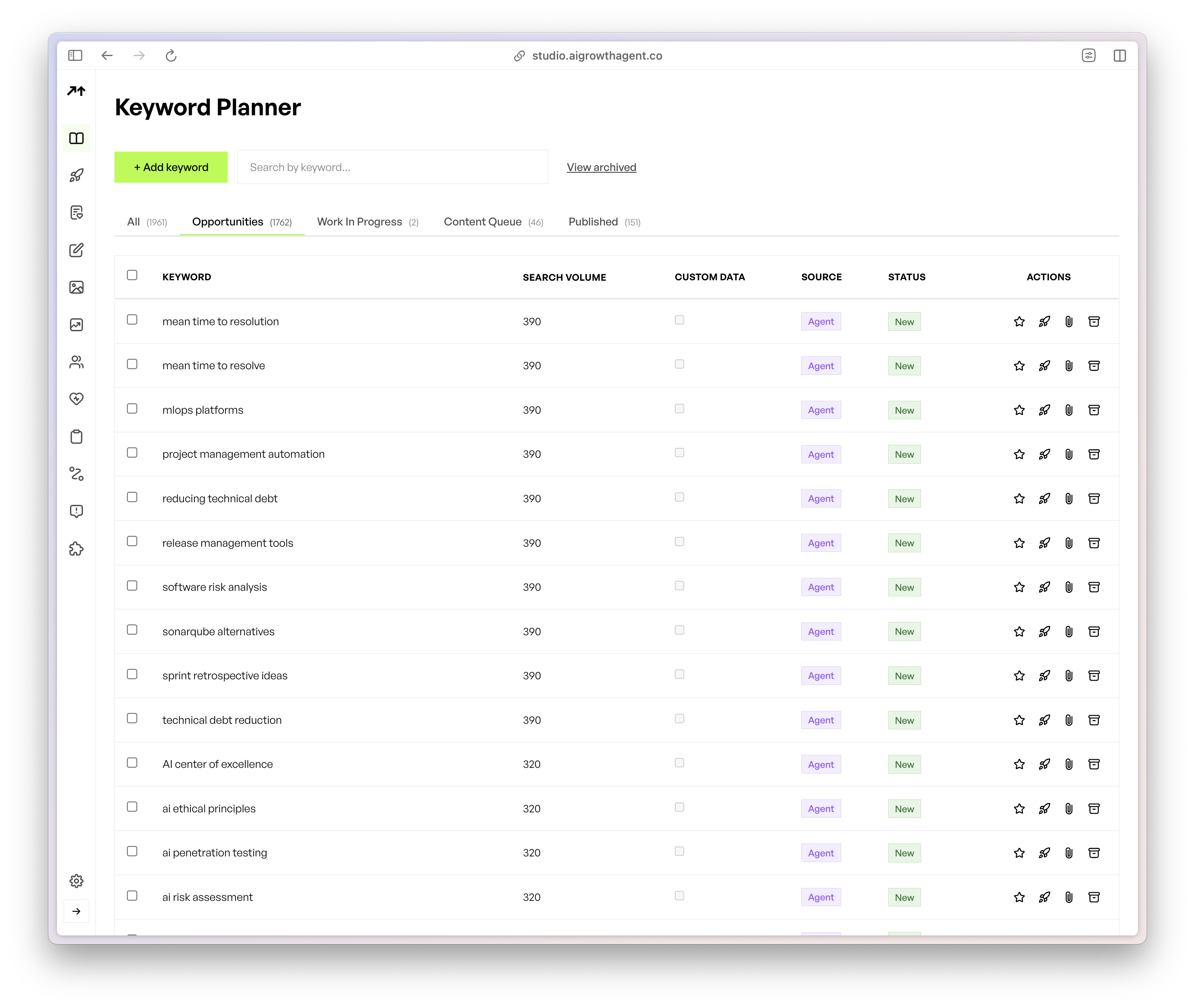
Technical implementation runs on a hosted blog architecture that matches existing brand design while delivering a strong foundation for programmatic SEO. The system applies schema markup, metadata optimization, and AI-specific indexing protocols without requiring support from internal development teams.
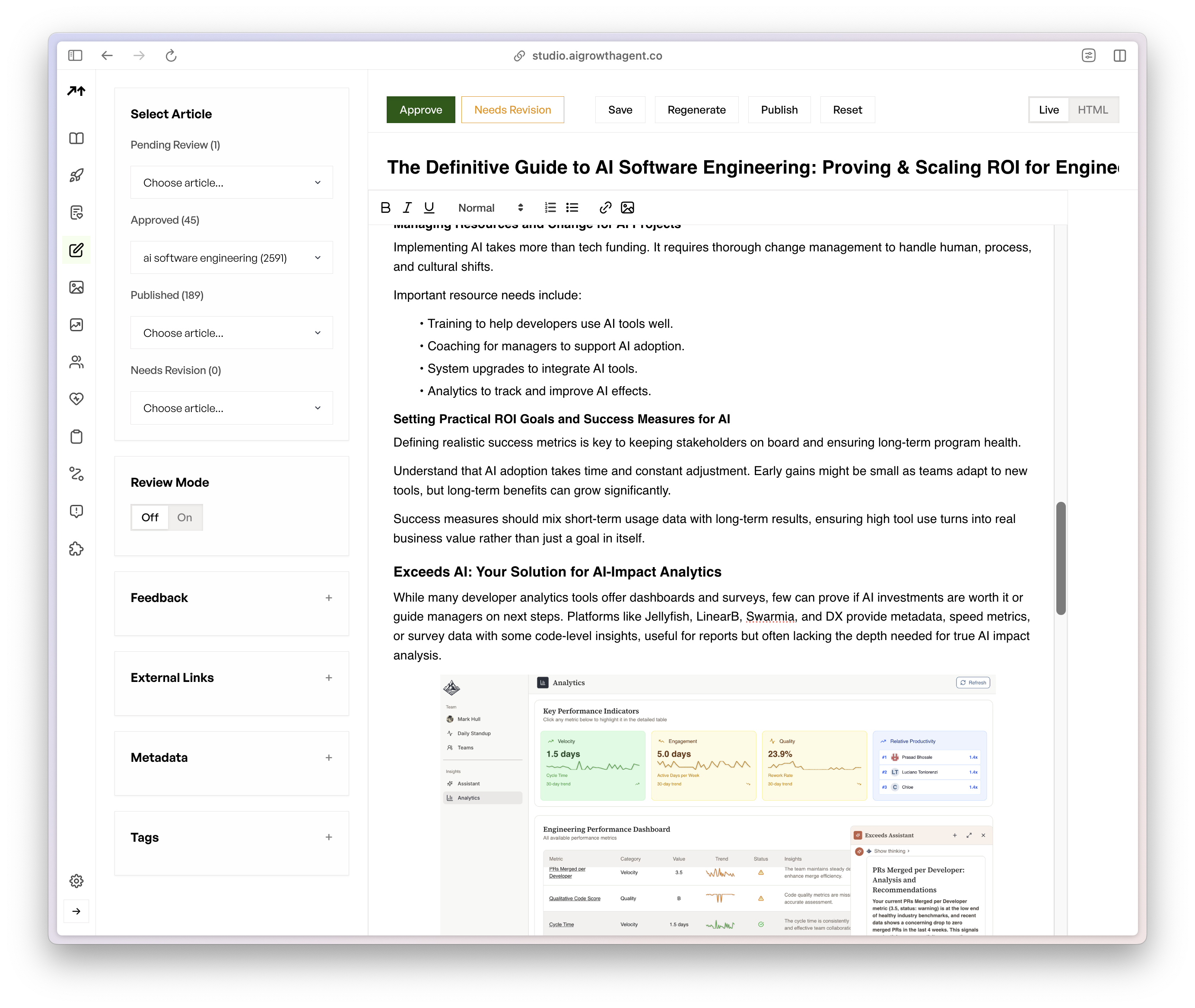
Content generation, fact-checking, and technical optimization run through the agent to produce unique, brand-aligned articles ranging from short tactical pieces to in-depth pillars of around 2,000 words. These pieces are structured to meet AI engine expectations for clarity, sourcing, and depth. Teams can also review and refine drafts directly when needed.
Capabilities for Consistent AI Authority and Citation
AI Growth Agent includes capabilities tailored to the demands of AI search optimization. These features support both operational efficiency and long-term authority building.
Multi-tenant programmatic deployment enables enterprise organizations to run multiple Programmatic SEO Content Agents from a single interface. Each agent maintains its own Manifesto, keyword strategy, and brand voice, and can publish to different domains or subdomains. This structure helps portfolio companies, multi-brand organizations, and agencies manage complex programmatic strategies from one place.
Real-time programmatic SEO content injection supports rapid responses to emerging topics. By providing a single reference link, the agent can generate comprehensive, optimized articles that include brand context and expertise. This helps capture demand for trending queries in hours rather than weeks.
Database-to-content automation turns existing data assets into structured content. Companies with product catalogs, recommendation engines, or research datasets can automatically generate SEO-focused articles for individual records. This process turns internal systems into additional discovery channels.
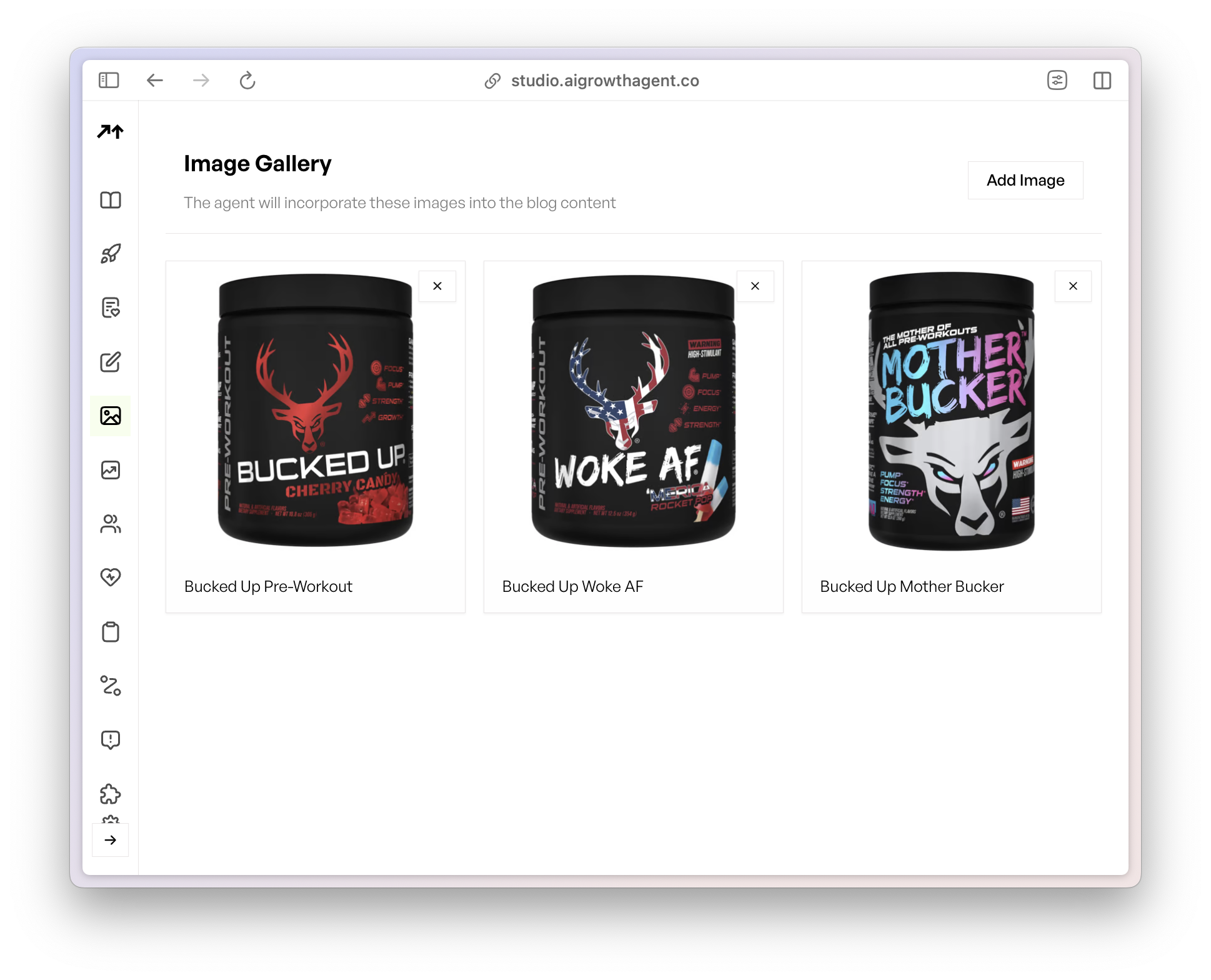
Intelligent image and asset placement selects and optimizes visuals from brand libraries or generates new images with AI. Each asset receives appropriate metadata and is placed in context to support both user experience and technical SEO. Teams can supply images and brand visuals that the agent incorporates into new content.
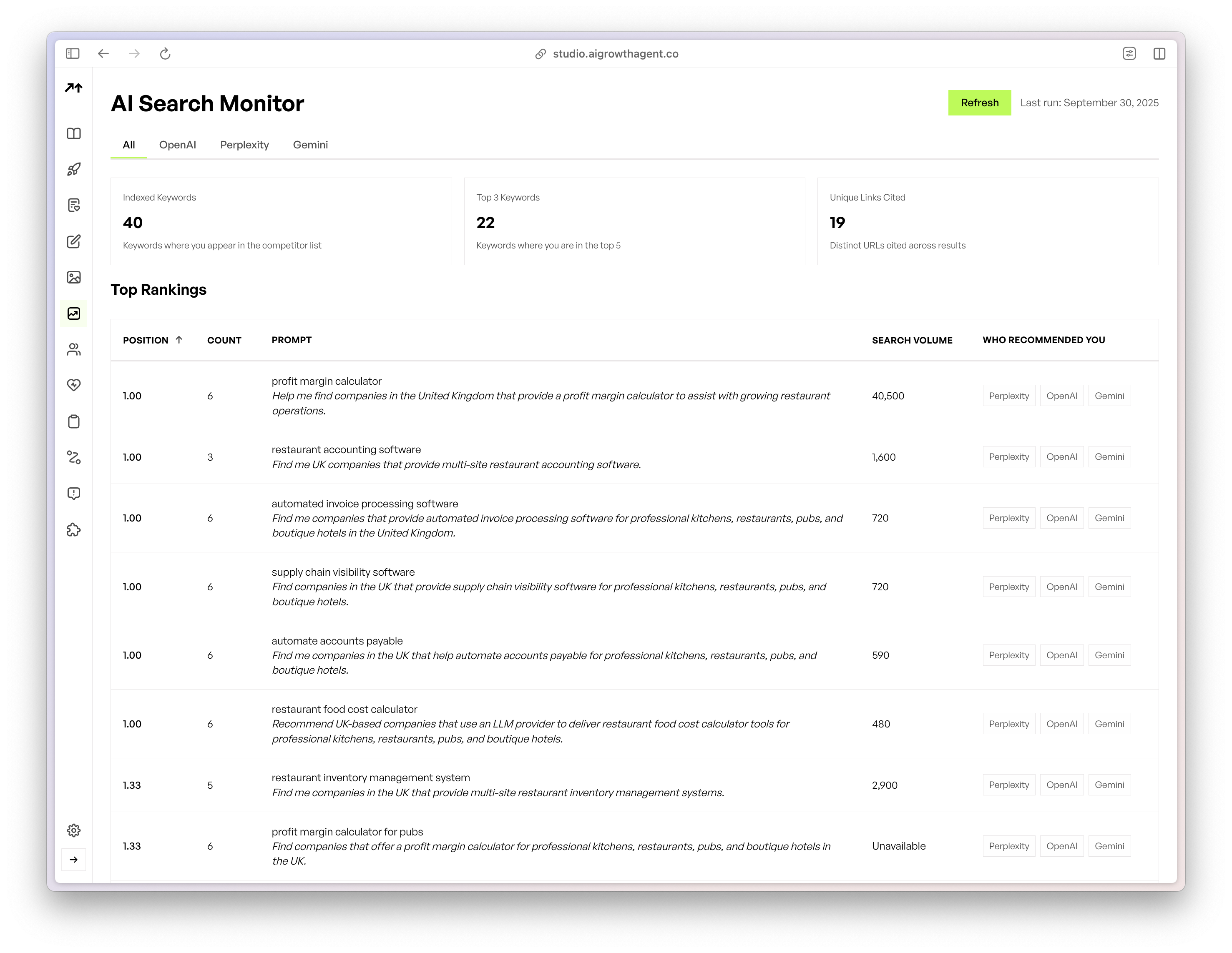
The AI Growth Agent Studio provides visibility into AI search performance across Google AI Overviews, Perplexity, and other systems. Clients can monitor which URLs drive AI visibility, review direct quotes and citations within AI responses, and view crawl statistics from major AI engines.
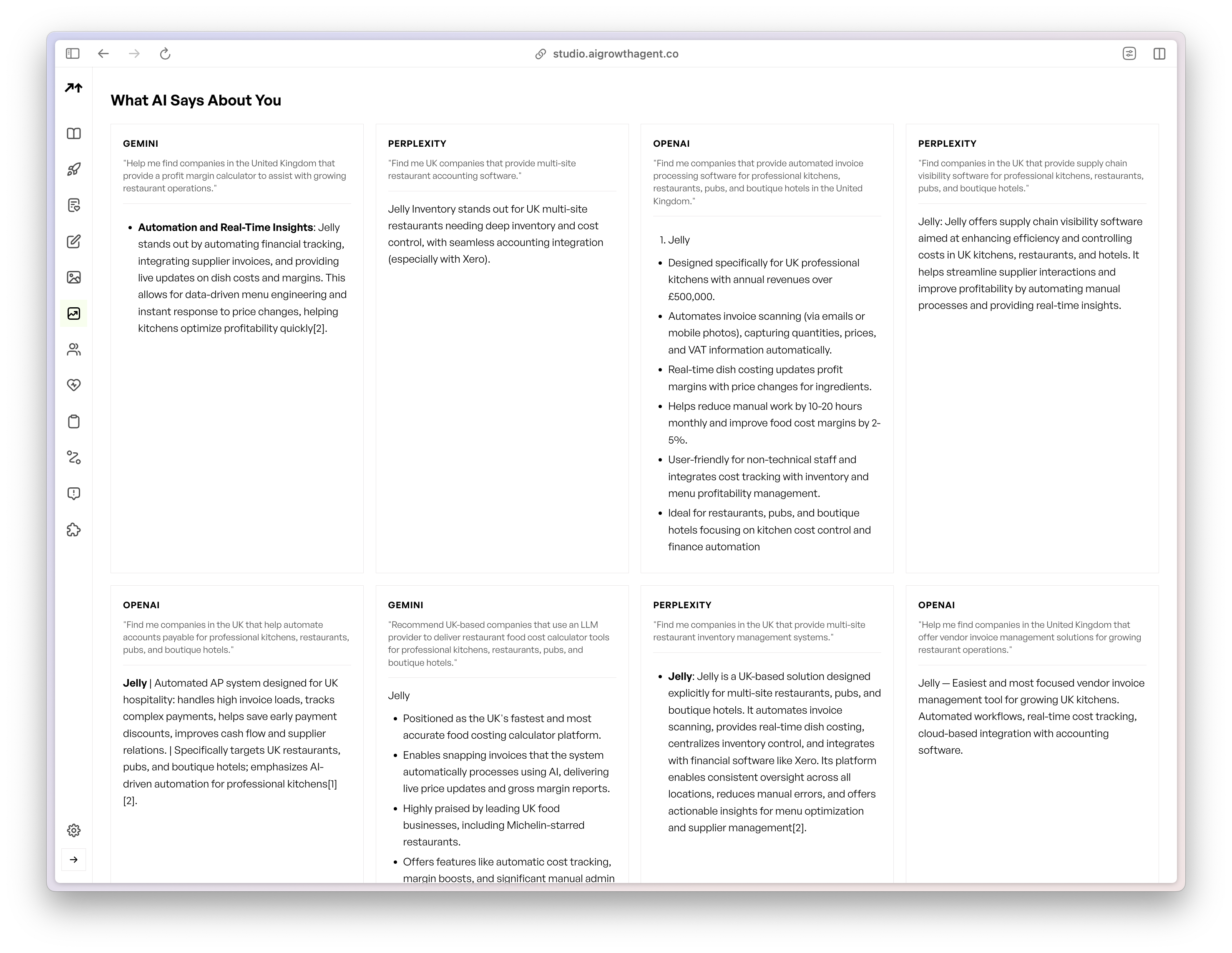
Client results across different industries show how this type of programmatic system can improve AI search visibility and authority over time.
Comparison: Traditional vs. Programmatic Authority Building for AI Search
|
Feature |
Traditional SEO Agency |
Self-Service AI Tools |
AI Growth Agent |
|
Content Velocity |
Slow; limited by manual processes and headcount |
Moderate; requires manual input for strategy and technical setup |
High; autonomous generation of high-volume, technically optimized content |
|
Technical SEO Implementation |
Basic, manual implementation; often incomplete |
Unstructured text; users handle schema and advanced configuration |
Automated schema, metadata, LLM.txt, and Model Context Protocol setup |
|
Backlink Acquisition Focus |
Quantity-driven; may include low-value tactics |
No direct backlink strategy; focuses on text production |
Quality-driven mentions and citations earned through authoritative content |
|
AI Citation Potential |
Low; limited depth and technical clarity for AI models |
Low; unstructured output often reduces AI interpretability |
High; content and architecture designed for AI search engine citation |
This comparison highlights the different roles that traditional agencies, self-service tools, and programmatic platforms play in AI search. Agencies remain suited to bespoke work and selective projects. Self-service tools help with drafting but expect teams to manage strategy and technical details.
AI Growth Agent combines automation with AI-focused technical standards to support authority building at scale. Features such as LLM.txt configuration, Model Context Protocol integration, and AI performance monitoring align with how AI systems search and retrieve content.
Cost structures also differ. Agencies often work on retainers tied to limited deliverables. Self-service tools require ongoing internal effort to plan, implement, and maintain content. AI Growth Agent provides a programmatic model where much of the execution is automated, which can make ROI easier to measure.
Frequently Asked Questions (FAQ) about AI Search Authority
How do AI search engines define website authority?
AI search engines assess website authority using signals that go beyond traditional backlink metrics. They weigh expertise, content depth, topical coverage, and organizational trust indicators.
Technical implementation quality is also important. Clear schema, structured data, and organized content make it easier for AI to extract, rank, and cite information. Sites that maintain clean architecture and consistent metadata offer fewer barriers to AI systems.
Does backlink quantity still matter for AI search?
Backlink quantity still plays a role but has less influence than in traditional SEO. Quality, context, and relevance are more important than raw counts.
Content that earns organic mentions, brand citations, and contextual references from reputable sources provides stronger signals. Creating resources that others naturally reference as helpful or authoritative remains a sound strategy.
What strategic content investments are most impactful for AI citation?
Content investments that show clear expertise and comprehensive coverage have the greatest impact on AI citation. Case studies, step-by-step guides, and in-depth explainers give AI systems more reasons to treat a site as a reference.
Building complete topic clusters rather than isolated articles helps establish topical authority. Long-form resources linked to supporting pieces give AI models a structured map of your expertise.
Technical structure matters as well. Schema, detailed metadata, and consistent formatting help AI engines extract specific facts, steps, and definitions, which improves citation potential.
How does AI Growth Agent increase the likelihood of AI citations?
AI Growth Agent increases citation potential through technical implementation and structured content design. The platform applies schema markup, LLM.txt files, and Model Context Protocol integration so AI engines have clear access and guidance.
Programmatic content architectures cover a wide range of related topics with consistent depth and structure. Interconnected articles and clear hierarchies help AI systems understand how individual pieces fit into a larger body of expertise.
Monitoring tools track citations and references in Google AI Overviews, Perplexity, and similar systems. Feedback from this data guides ongoing refinements to content and technical setup.
What makes programmatic SEO different from traditional content marketing for AI search?
Programmatic SEO automates much of the content lifecycle, including strategy, creation, and technical deployment. Traditional content marketing depends heavily on manual work, which limits how many topics a team can cover.
Programmatic SEO treats technical implementation as a built-in requirement. Every piece of content receives structured data, metadata, and AI-specific indexing instructions as part of the process instead of as an optional step.
Strategy also shifts. Programmatic SEO focuses on building full content ecosystems that cover an entire domain or product category. The goal is not just to rank a single article but to establish consistent authority across many related queries.
Conclusion: Build Sustainable AI Search Authority with Programmatic SEO
The direction of website authority and backlinks is moving toward programmatic approaches. Brands that rely only on manual processes or generic tools will find it harder to maintain visibility as AI search becomes the primary discovery layer.
Effective authority building now requires comprehensive content architectures and reliable technical execution at scale. AI search engines reward brands that present structured, well-organized information and demonstrate expertise across a topic area.
AI Growth Agent offers a programmatic option for brands that want to address content velocity, technical precision, and AI citation in a single system. Automation supports sustained domain coverage while preserving brand voice and quality standards.
Programmatic SEO already shows strong results in categories where detailed, structured content matters most. Brands that invest early in this model create durable advantages that are difficult for slower competitors to match.
Marketing leaders face a clear decision. They can adapt to AI search by adopting programmatic authority building, or they can accept gradual erosion of visibility as others expand structured content at scale. The opportunity to establish AI search authority remains open to those who act with focus and urgency.
If you are a premium brand looking to strengthen AI citations and authority, schedule a demo with AI Growth Agent to see if you are a good fit.
