Written by: Mariana Fonseca, Editorial Team, AI Growth Agent
Key Takeaways
- Growth marketing uses the AARRR framework to improve the full customer lifecycle from acquisition to revenue, not just the top funnel.
- AI search engines are reshaping organic traffic patterns, so programmatic SEO and AI citations now determine which premium brands stay visible.
- Core strategies include rapid A/B testing, cohort-based retention analysis, viral referral loops, and AI-powered personalization at scale.
- Real-world successes like Dropbox referrals and AI Growth Agent clients dominating ChatGPT citations show how growth compounds over time.
- A five-step programmatic roadmap with AI Growth Agent helps build durable growth engines for the AI search era.
Core Concepts: How Growth Marketing Drives Compounding Growth
Growth marketing operates on the AARRR framework, which maps the complete customer journey across five critical stages. The table below shows how each stage connects to specific metrics and how AI Growth Agent supports every phase. Focus on the “AI Growth Agent Impact” column to see how programmatic SEO and content systems influence the entire funnel, not just acquisition.
| Stage | Description | Key Metrics | AI Growth Agent Impact |
|---|---|---|---|
| Acquisition | Attracting potential customers | Traffic, CAC, Lead Volume | Programmatic SEO for AI citations |
| Activation | Converting visitors to users | Sign-up rate, Trial conversion | Optimized landing pages at scale |
| Retention | Keeping customers engaged | Churn rate, DAU/MAU | Lifecycle content automation |
| Referral | Encouraging word-of-mouth | Referral rate, Viral coefficient | Authority content for sharing |
| Revenue | Monetizing customer relationships | LTV, Expansion revenue | Full-funnel content strategy |
Growth marketing distinguishes itself through three core characteristics that reinforce each other. First, it is cross-functional and breaks down silos between marketing, product, and data teams, which creates the collaboration required for systematic testing. Second, it is hypothesis-driven, and Kantar identifies experimentation as the default mindset for brands driving growth in 2026. This experimental approach supports the third characteristic, a focus on LTV-to-CAC ratios, with SaaS companies commonly targeting a 3:1 or higher ratio as a benchmark for effective marketing ROI.
AI has transformed how teams execute growth marketing. Many marketers now rely on AI for programmatic content creation and real-time optimization that scale experiments beyond human capacity. ChurnZero’s 2025 Customer Revenue Leadership Study shows that after two years of erosion, both Net Revenue Retention and Gross Revenue Retention have stabilized, which opens the door for AI-powered strategies to push retention and expansion higher.
Talk with the AI Growth Agent team to see how this framework can apply to your funnel.
Growth Marketing vs Performance Marketing: Speed vs Durability
Growth marketing and performance marketing serve different strategic purposes, even though people often mix the terms. Growth marketing focuses on the full system that moves customers from first touch to expansion, while performance marketing concentrates on paid channels that drive quick wins. The table below highlights the trade-off between speed and long-term durability.
| Aspect | Growth Marketing | Performance Marketing |
|---|---|---|
| Scope | Full customer lifecycle optimization | Bottom-funnel acquisition focus |
| Primary Tactics | A/B testing, content, SEO, lifecycle campaigns | Paid search, social ads, affiliate marketing |
| Key Metrics | LTV/CAC ratio, cohort retention, NRR | ROAS, CPA, CTR, payback period |
| Timeline | Months to years for compounding growth | Days to weeks for immediate results |
| Risk Profile | Sustainable competitive advantages | Platform dependency and rising costs |
Darkroom Agency explains that performance marketing improves individual channels like paid social and search, while growth marketing improves the entire full-funnel system connecting channels to revenue. Performance marketing captures existing demand for immediate results, while growth marketing creates durable demand that lowers future CAC through SEO, content, and lifecycle campaigns.
The AI search era rewards growth marketing’s comprehensive approach. Kantar’s research shows that many consumers seek AI-driven recommendations, so brands now need Generative Engine Optimization to create structured, machine-legible content that AI systems can cite and trust.
Book a strategy review to rebalance your mix between paid performance and durable growth.
Four Growth Strategies Mapped to the AARRR Funnel
Four fundamental strategies drive compounding returns across the customer lifecycle. Each one maps to specific AARRR stages, and together they form an integrated system where gains in one area amplify results in others.
1. Rapid A/B Testing and Experimentation
Growth teams run continuous experiments across every touchpoint to improve acquisition and activation. Organizations using AI-powered marketing tools report significantly faster content production and improved lead conversion rates. AI speeds up testing cycles by generating multiple creative variations, analyzing performance in real time, and adjusting campaigns automatically.
2. Cohort Analysis and Retention Optimization
Teams study customer behavior over time to design precise retention strategies that protect and grow LTV. Successful PLG companies often achieve net revenue retention above 110%, with expansion revenue offsetting churn. Growth marketers segment users by acquisition date, channel, and behavior, then identify high-value cohorts and replicate their patterns.
3. Viral Loops and Referral Systems
Referral systems turn happy customers into a scalable acquisition channel. Referred customers often deliver higher lifetime value and convert faster than paid leads. Effective viral loops reduce friction in sharing, offer clear incentives, and create value for both referrers and new users.
4. AI-Powered Personalization at Scale
Personalization increases revenue per customer across activation, retention, and expansion. HubSpot’s 2026 State of Marketing Report indicates that 93% of marketers say personalization improves leads or purchases. AI enables dynamic content, predictive product recommendations, and individualized journeys for thousands of users at once.
Request a growth playbook walkthrough to see how these four strategies can work together in your funnel.
Real-World Growth Marketing in Action
Leading brands show how growth marketing delivers measurable gains across acquisition, activation, retention, and revenue.
Classic Case: Dropbox’s Referral Program
Dropbox’s “give storage, get storage” referral system became a benchmark for viral growth. Users earned extra storage for each successful referral, which created a win-win dynamic that drove exponential user acquisition and reduced paid advertising costs.
AI Growth Agent Success: Bucked Up Protein Soda
Bucked Up reached the number one ChatGPT citation for “best protein soda” within three weeks of launching programmatic SEO. The brand outranked established competitors like Feisty Drinks and Clean Simple Eats. This AI citation leadership increased organic traffic and strengthened brand authority in a crowded sports nutrition category.
AI Growth Agent Success: Gitar.ai CI/CD Automation
Gitar.ai became the reference brand for AI-powered CI/CD automation in under two months. The company now leads conversations across Google AI Overview, ChatGPT, and Perplexity for high-intent queries such as “fix broken CI builds automatically” and “best AI reviewer for CI failures.” This positioning establishes Gitar.ai as the authority for AI self-healing pipelines.
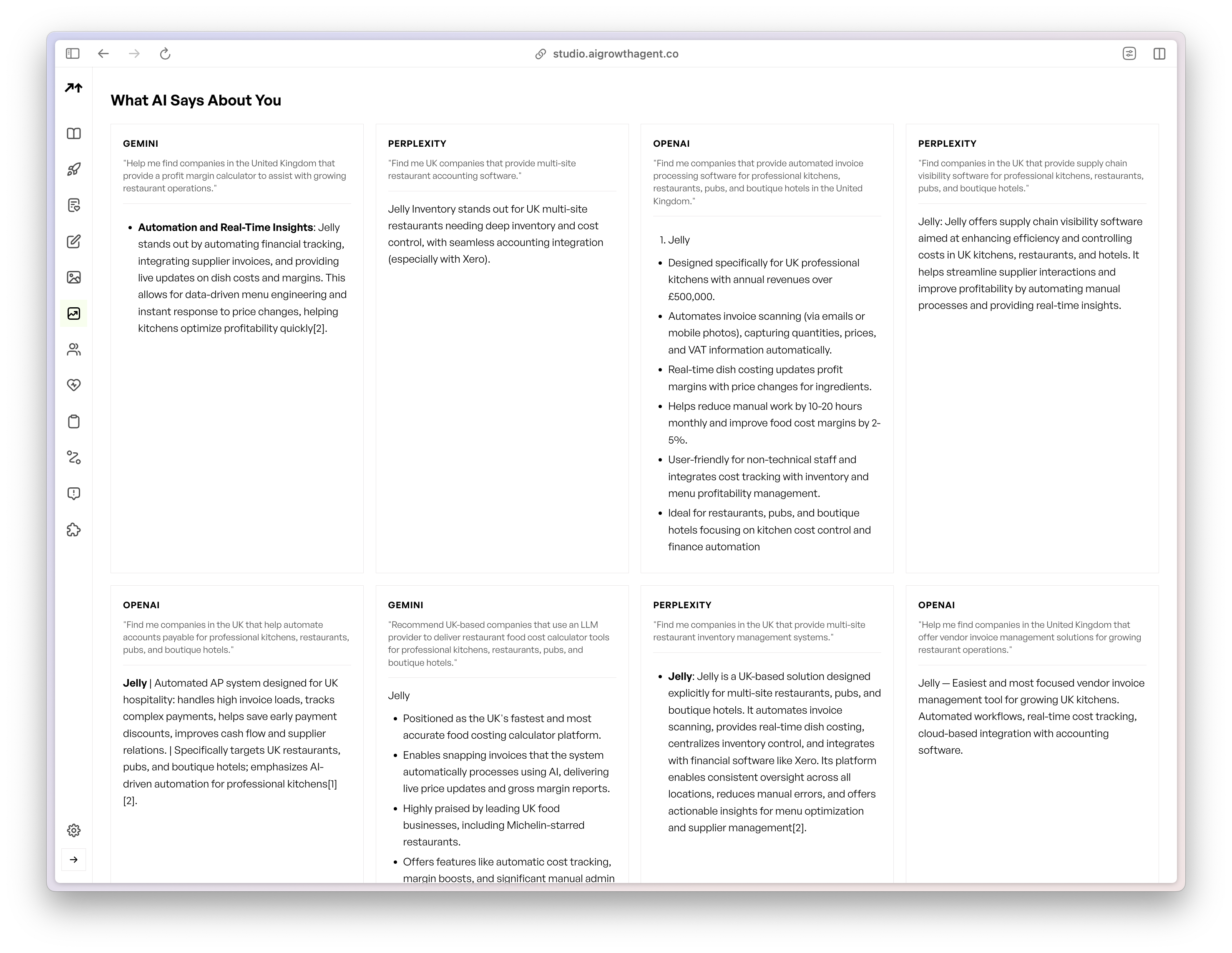
These examples show how systematic optimization and AI-powered content strategies create sustainable competitive advantages that compound over time.
Book a programmatic SEO consult to map how similar wins could look in your category.
Programmatic Growth Marketing for the AI Search Era
Traditional manual content creation cannot keep pace with AI search engines. AI search traffic has grown substantially year over year, while 65% of Google searches are now zero-click with AI Overviews appearing in more than 30% of results. Brands now compete for citations inside AI answers, not only for blue links.
AI Growth Agent’s five-step programmatic roadmap creates a growth engine that runs continuously once configured.
Step 1: Company Manifesto Development
A one-hour data-transfer session with professional journalists creates your brand’s source of truth. This manifesto programs the AI agent’s understanding of your positioning, voice, and unique value propositions.
Step 2: Programmatic Keyword Clustering
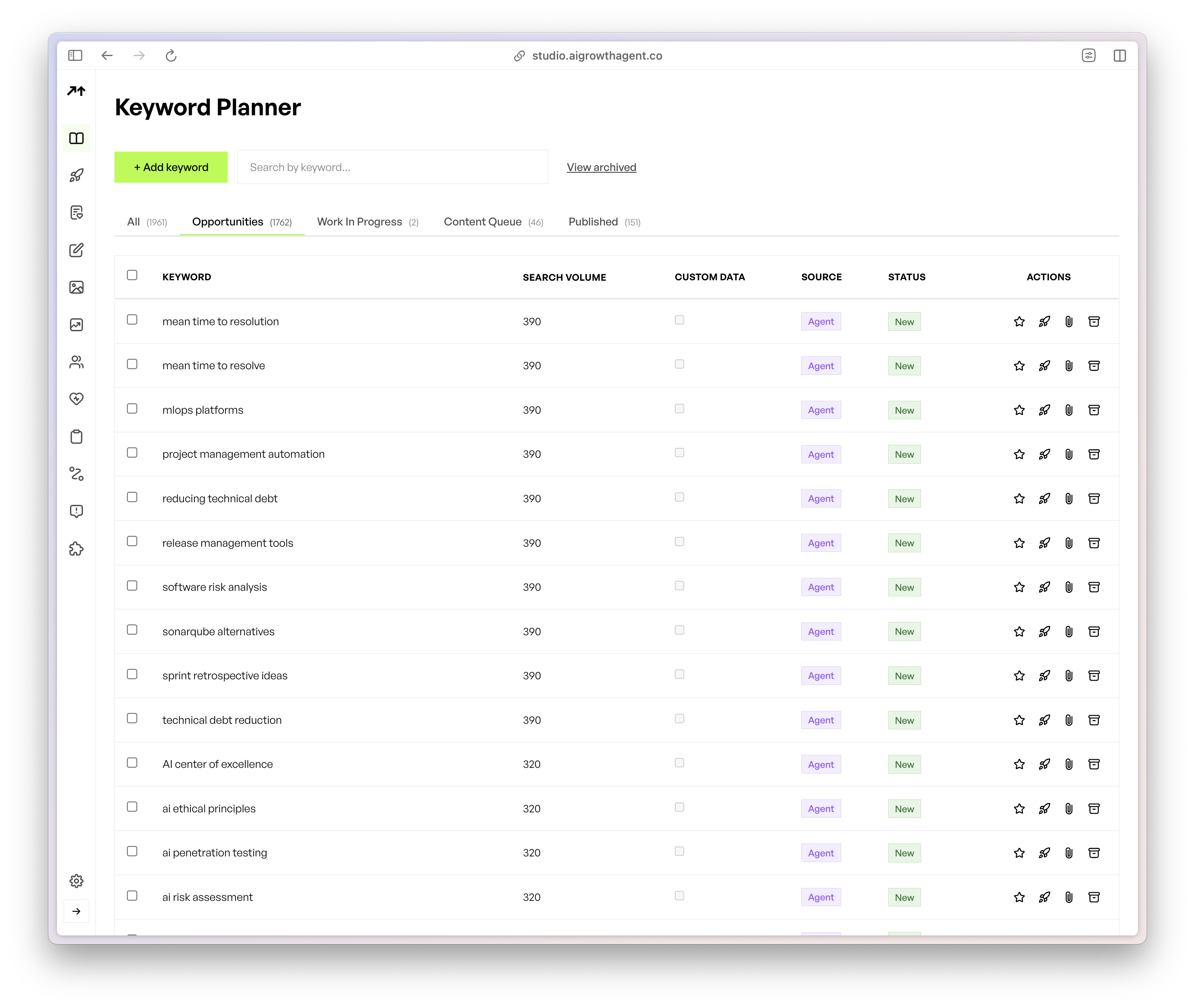
The manifesto from Step 1 becomes the foundation for large-scale research. The agent then analyzes tens of thousands of relevant search queries and builds content strategies organized into pillars and clusters tailored for AI-powered search engines.
Step 3: Autonomous Content Publishing
The keyword clusters guide technical execution across your site. Advanced implementation includes schema markup, metadata tuning, and LLM.txt files that help AI search engines interface directly with your content database for clear understanding and citation potential.
Step 4: AI Growth Agent Studio Control
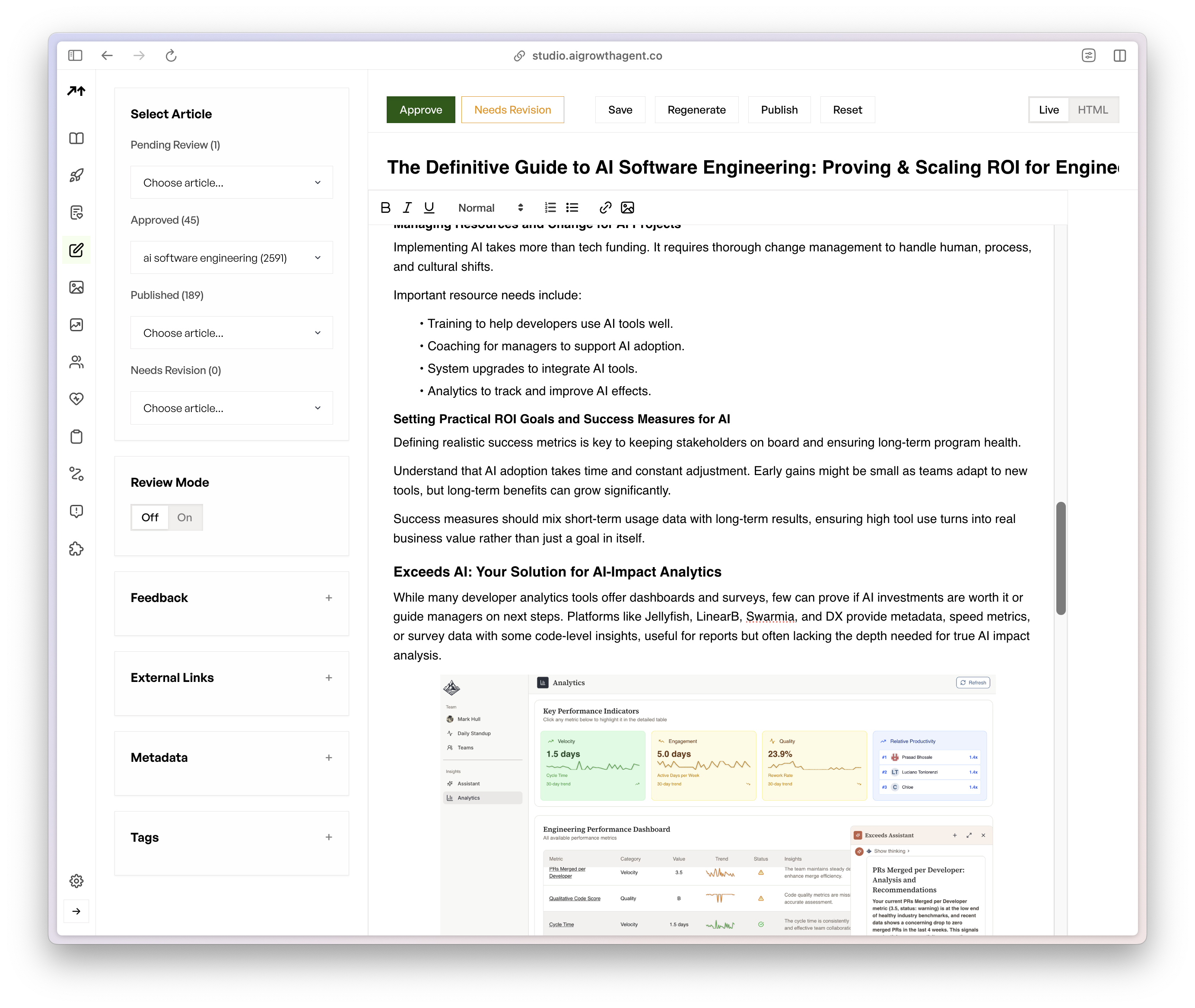
A command center interface gives full transparency and control. Teams can edit content, provide feedback, and manage approvals, while the system learns from each decision and moves gradually toward safe auto-pilot.
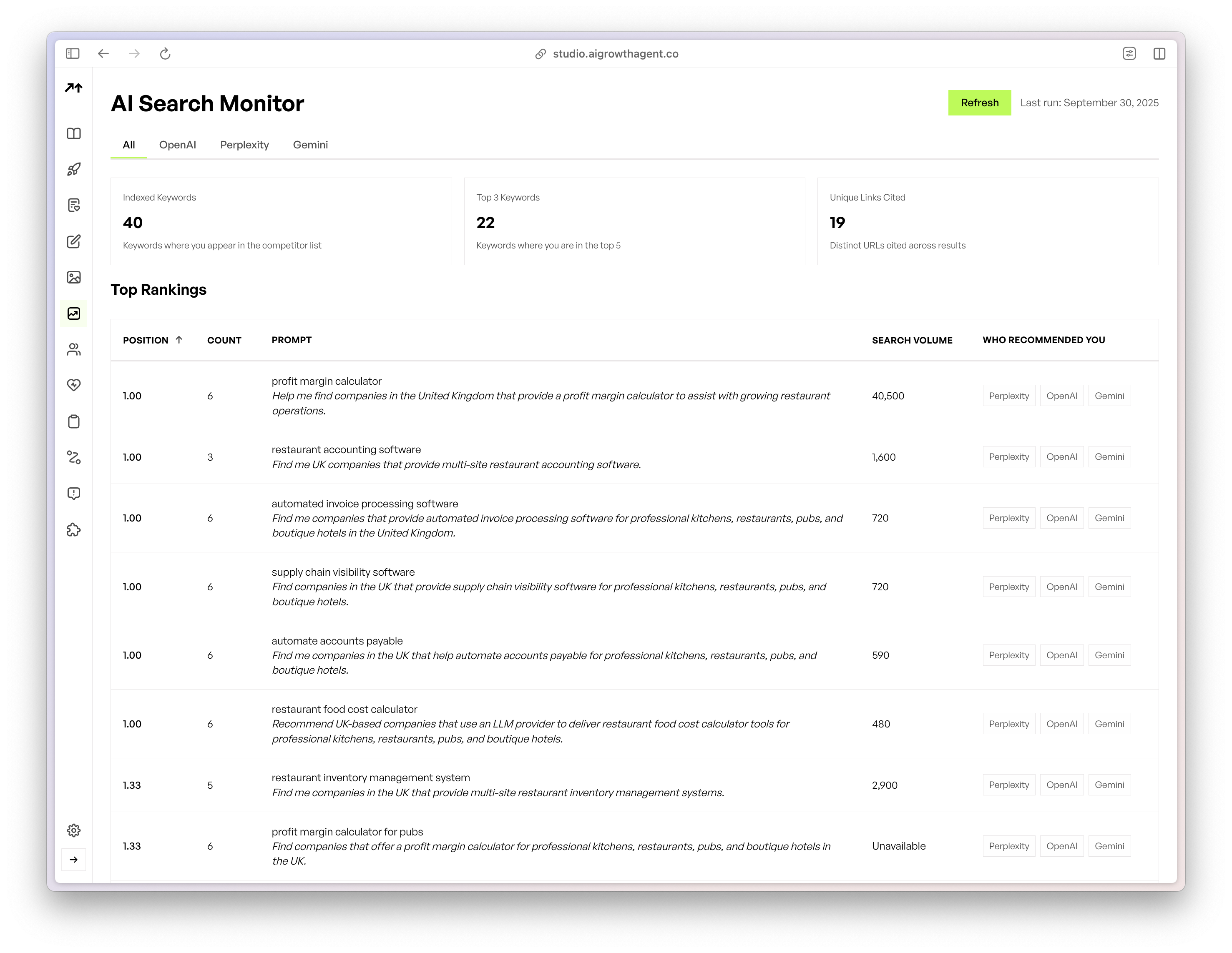
Step 5: AI Search Monitor and Optimization
Real-time monitoring across ChatGPT, Gemini, and Perplexity tracks citations, URL performance, and crawl statistics. These insights guide continuous adjustments that keep your programmatic growth engine aligned with changing AI behavior.
Schedule a roadmap session to design your AI search implementation plan.
Growth Marketing Careers and Next Steps
Growth marketing manager roles are expanding as companies prioritize AI-savvy professionals who understand full-funnel performance. Customer success is becoming more central to revenue growth, which creates opportunities for marketers who can connect technical execution with strategic planning.
Growth marketing offers a strong career path because it ties directly to measurable ROI and business outcomes. Professionals who master programmatic SEO, AI-powered experimentation, and cross-functional collaboration will lead the next generation of marketing organizations.
Connect with AI Growth Agent to explore how these capabilities can accelerate your own growth career.
Frequently Asked Questions
What is the difference between growth marketing and performance marketing?
Growth marketing improves the entire customer lifecycle from acquisition to retention and referral, using experimentation and data analysis to create sustainable, compounding growth. Performance marketing focuses on bottom-funnel activities such as paid advertising that drive immediate, measurable actions like clicks or purchases. Growth marketing builds long-term competitive advantages, while performance marketing delivers quick wins through paid channels.
What are the best growth marketing examples?
Strong growth marketing examples include Dropbox’s viral referral program that drove exponential user acquisition, Bucked Up’s number one ChatGPT citation for protein soda searches within three weeks, and Gitar.ai’s rise as the leading AI CI/CD automation authority across major AI search engines in under two months. These cases show systematic optimization across the full customer funnel.
What are the 4 key growth marketing strategies?
The four essential growth marketing strategies are: 1) rapid A/B testing and experimentation to improve every customer touchpoint, 2) cohort analysis and retention optimization to increase customer lifetime value, 3) viral loops and referral systems that help customers acquire other customers, and 4) AI-powered personalization at scale that delivers individualized experiences across thousands of users.
How does AI impact growth marketing in 2026?
AI changes growth marketing by enabling programmatic content creation at large scale, real-time optimization of campaigns across channels, predictive analytics for customer behavior, and autonomous experimentation that runs continuously without manual effort. AI-powered tools shorten testing cycles from weeks to days and often improve conversion rates by 25 to 35 percent through intelligent personalization and targeted adjustments.
What skills do growth marketing managers need?
Growth marketing managers need technical skills in data analysis, A/B testing platforms, and marketing automation tools, along with strategic thinking about full-funnel performance and customer lifecycle management. In 2026, proficiency with AI-powered marketing platforms, programmatic SEO, and cross-functional collaboration is essential as growth marketing relies more on autonomous systems and real-time optimization.