


Marketing leaders need higher content velocity and stronger authority in an AI-first search landscape where traditional SEO methods deliver diminishing results. The working model between businesses and search engines has shifted from manual keyword targeting and occasional publishing to continuous, programmatic content that earns citations inside large language models such as ChatGPT, Google AI Overviews via Gemini, and Perplexity.
Your company’s digital presence, the effective “pixel” it occupies on the internet, shrinks as AI multiplies content volume. Without a tailored programmatic strategy, brands risk becoming less visible to the AI indexers that now shape discovery.
Modern AI tools automate content research, scheduling, approval, media management, and multi-format publishing, reducing manual effort while increasing consistency and velocity. What you’ll see in this article:
- AI-first search shifts visibility from traditional SEO to programmatic content that large language models can understand and cite reliably.
- Manual content workflows cannot keep pace with AI-generated volume, so marketing teams need automation across research, creation, publishing, and monitoring.
- AI Growth Agent provides a programmatic SEO platform that automates research and publishing to help brands build consistent authority in AI search.
- Additional tools, including AI research assistants, contextual authoring platforms, intelligent CMS integrations, and AI search monitoring systems, complete a scalable automation stack.
- Organizations that adopt these systems early can create stronger AI search visibility, reduce operational friction, and make their content strategies more resilient over time.
Why Programmatic Automation is Crucial for AI Search: The New Imperative
Publishing one or two manually crafted posts per month no longer keeps pace with the speed of information. The stakes are high for brands that lack enough relevant data points for AI systems to reference. In those gaps, AI surfaces competitors instead.
They receive citations and recommendations, and their narrative informs AI-generated answers. Traditional SEO agencies follow a manual model that is slower and more expensive, and they often lack the engineering depth needed for full programmatic SEO. Internal marketing teams also rarely have the resources to build and maintain a system that scales metadata, including advanced schema, robots.txt, and LLM.txt files, for optimal AI indexing.
1. AI Growth Agent: Programmatic Research and Publishing for AI Search Authority
AI Growth Agent focuses on engineering content architectures that help companies build durable authority in AI search. The platform operates as a programmatic SEO agent that designs structured content systems so brands can appear more frequently as cited sources in AI-driven results.
Instead of acting as a basic AI writer that outputs unstructured text, AI Growth Agent delivers an end-to-end programmatic solution. The platform starts with a structured onboarding process that includes a one-hour kickoff session with a professional journalist. Together, you create a Company Manifesto, a living source of truth that guides the Programmatic SEO Agent. This document captures your positioning and narrative, and it programs the agent to generate consistent, brand-aligned content.
The agent then activates research workflows. It ingests your company’s context and evaluates tens of thousands of relevant search queries. It assembles a Programmatic Content Strategy organized into pillars and clusters that align with query-based search behavior. Each content item targets a defined opportunity for visibility in AI-powered search engines.
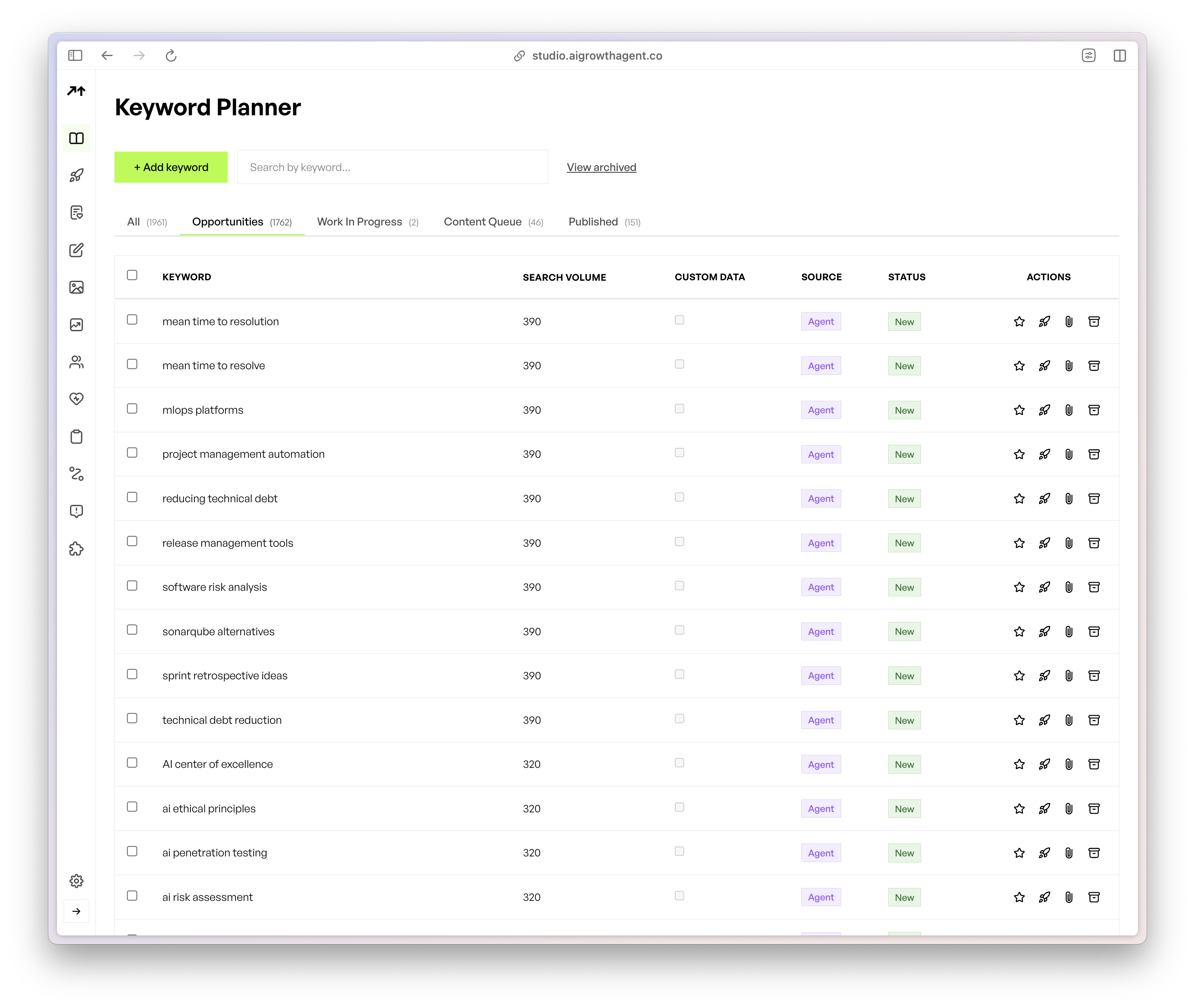
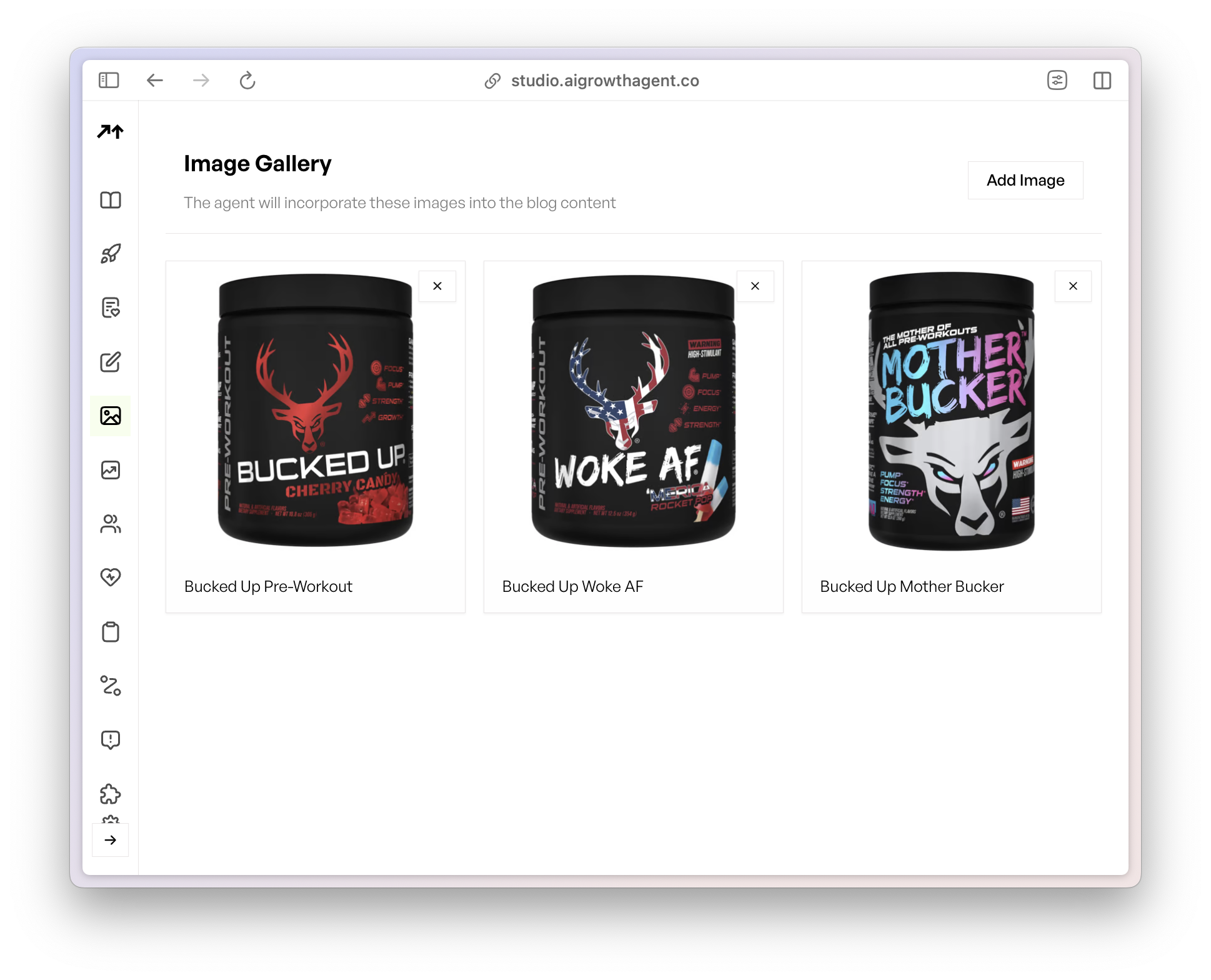
The platform also provides its own technical infrastructure to reduce engineering friction. It deploys an optimized blog architecture as a subdomain of your site, matching your existing design while providing a clean technical base for programmatic SEO. The Programmatic SEO Content Agent then manages the full content engineering lifecycle, including strategy development, research, drafting, fact-checking, and technical implementation with schema markup, metadata, and image optimization.
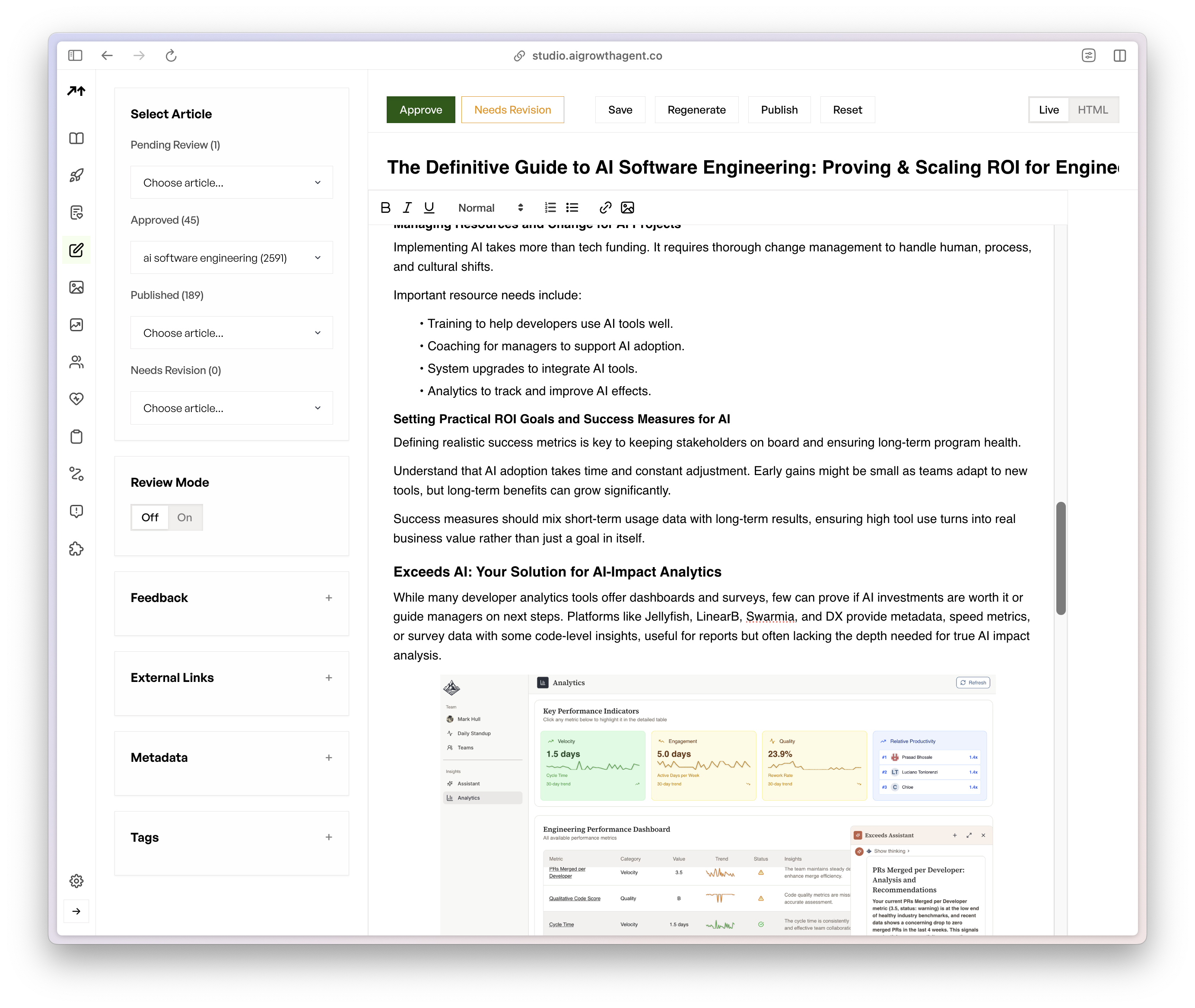
AI Growth Agent implements an advanced LLM.txt file and a blog Model Context Protocol (MCP). These elements help AI search engines interface directly with your blog database so they can interpret and index content more clearly. Through the AI Growth Agent Studio, clients retain visibility and control. Teams can edit drafts, provide feedback, or enable an Auto-Pilot mode for more autonomous operation with defined guardrails.
2. AI-Powered Research Assistants for Hyper-Targeted Content Strategy
AI research assistants help teams create more relevant, timely content strategies for AI search. These tools extend beyond manual keyword research by automating topic discovery, sentiment analysis, and competitor gap analysis at scale. They review search patterns across multiple AI engines to highlight emerging opportunities before they become crowded.
Advanced AI research systems also automate programmatic keyword clustering and strategy development so each article, guide, or landing page supports a clear search objective. Modern AI CMS platforms provide internal “knowledge assistants,” automating research, fact-finding, and content discovery across enterprise libraries within compliance guardrails. These tools connect topic selection to your broader brand narrative and competitive positioning.
The primary advantage of AI research lies in its ability to process datasets that exceed human capacity. These systems can correlate search trends, seasonality, and competitor activity to forecast content opportunities weeks or months ahead. They also scan social channels, news sources, and competitor sites to show how conversations evolve, which helps teams respond quickly to new narratives.
Implementation works best when research connects directly to planning and production. The most effective AI research platforms offer APIs that feed insights into content calendars, brief templates, and production queues. This creates a pipeline where discovered opportunities move smoothly into creation and publishing.
3. Contextual AI Authoring and Engineering Platforms for Technical SEO
Contextual AI authoring platforms combine writing support with technical SEO engineering. The shift from simple AI writing tools to full content engineering platforms changes how organizations create search-ready content at scale. Basic tools such as general-purpose chatbots output text that still needs substantial manual formatting and optimization. In contrast, advanced systems apply technical SEO structure while content is being drafted.
These platforms embed schema markup, metadata, and image tags directly into content without requiring engineering skills from marketing teams. AI supercharges content workflows by automating drafts, translations, and analysis, while CMS governance, approvals, compliance, and brand consistency remain human-led. Many systems also implement protocols that help AI search engines query content databases more effectively, which supports clearer indexing and citation.
Technical engineering extends beyond basic on-page optimization. These platforms often generate XML sitemaps, maintain internal linking structures, and improve Core Web Vitals, all of which influence AI search visibility. Emergent AI solutions handle advanced automation such as multi-language and multi-platform publishing while using self-learning for continuous optimization aligned with search algorithms.
Self-learning capabilities are an important differentiator. Performance data feeds back into the system so it can refine heading structures, meta descriptions, and schema patterns based on what performs best in search. Over time, each new content asset benefits from the lessons of previous pieces, which strengthens overall authority more efficiently than manual experimentation.
4. Intelligent Publishing and CMS Integration Systems
Intelligent publishing systems integrate AI into CMS workflows so teams can scale content distribution without losing control. The evolution of CMS platforms to support AI-powered processes has become a key infrastructure decision for organizations building programmatic content strategies. API-first and headless CMS architectures enable AI tool integration for programmatic content engineering, including real-time content injection and multi-tenant deployment, while preserving editorial workflows.
Modern AI-aware CMS platforms automate routine tasks such as approvals, media handling, and multi-format publishing, while preserving governance and compliance. AI-enhanced CMS platforms support automated tagging, content optimization for rankings, predictive analytics, and adaptation to voice and conversational search. Rules-based routing can send content through specific approval paths based on audience, topic, or regulatory risk.
The primary benefit of these systems is consistent publishing across channels with aligned technical optimization. Content can be repurposed automatically into formats suited for blogs, social posts, email, or documentation while preserving SEO elements and brand standards. Some platforms also schedule publishing windows based on engagement data and search trend patterns.
Modern AI-enabled CMS platforms provide flexibility so teams can tailor AI workflows by client, industry, and regulatory requirement. For enterprises with multiple brands or portfolios, multi-tenant architectures allow separate AI agents to operate under shared governance, analytics, and security policies.
5. AI Search Monitoring and Advanced Feedback Loops
AI search monitoring tools close the loop between publishing and performance. They track how content appears, or fails to appear, across AI search engines and conversational interfaces. These systems scan environments such as ChatGPT, Google AI Overviews via Gemini, and Perplexity to show whether and how your brand is being cited.
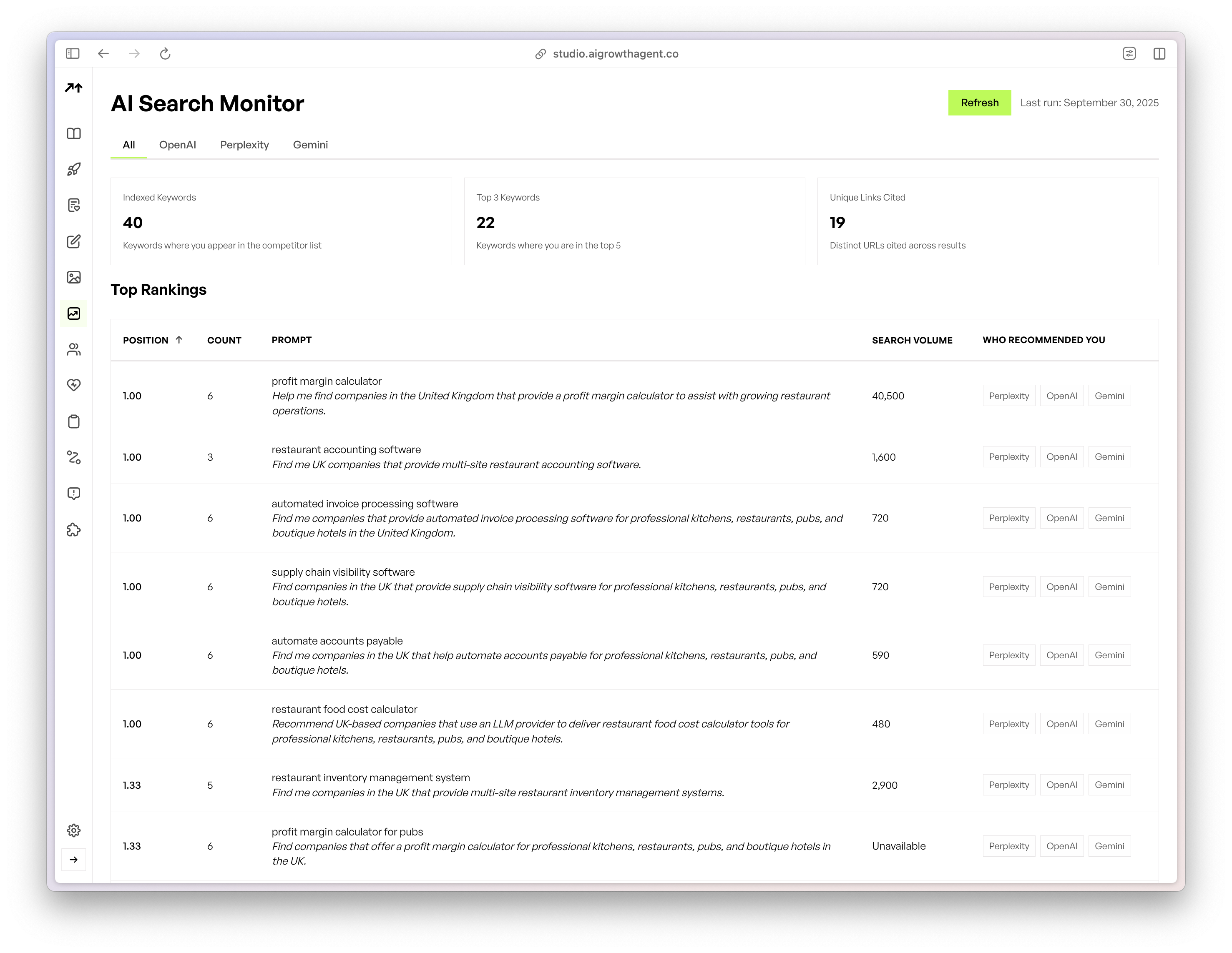
Real-time content tracking allows publishers to refine AI-driven experiences continuously, creating feedback loops that improve future content performance and visibility. Advanced monitoring platforms provide detailed views of keyword indexing, URLs that drive AI visibility, and example citations or passages where AI systems reference your content. These details help teams understand which assets and structures signal authority.
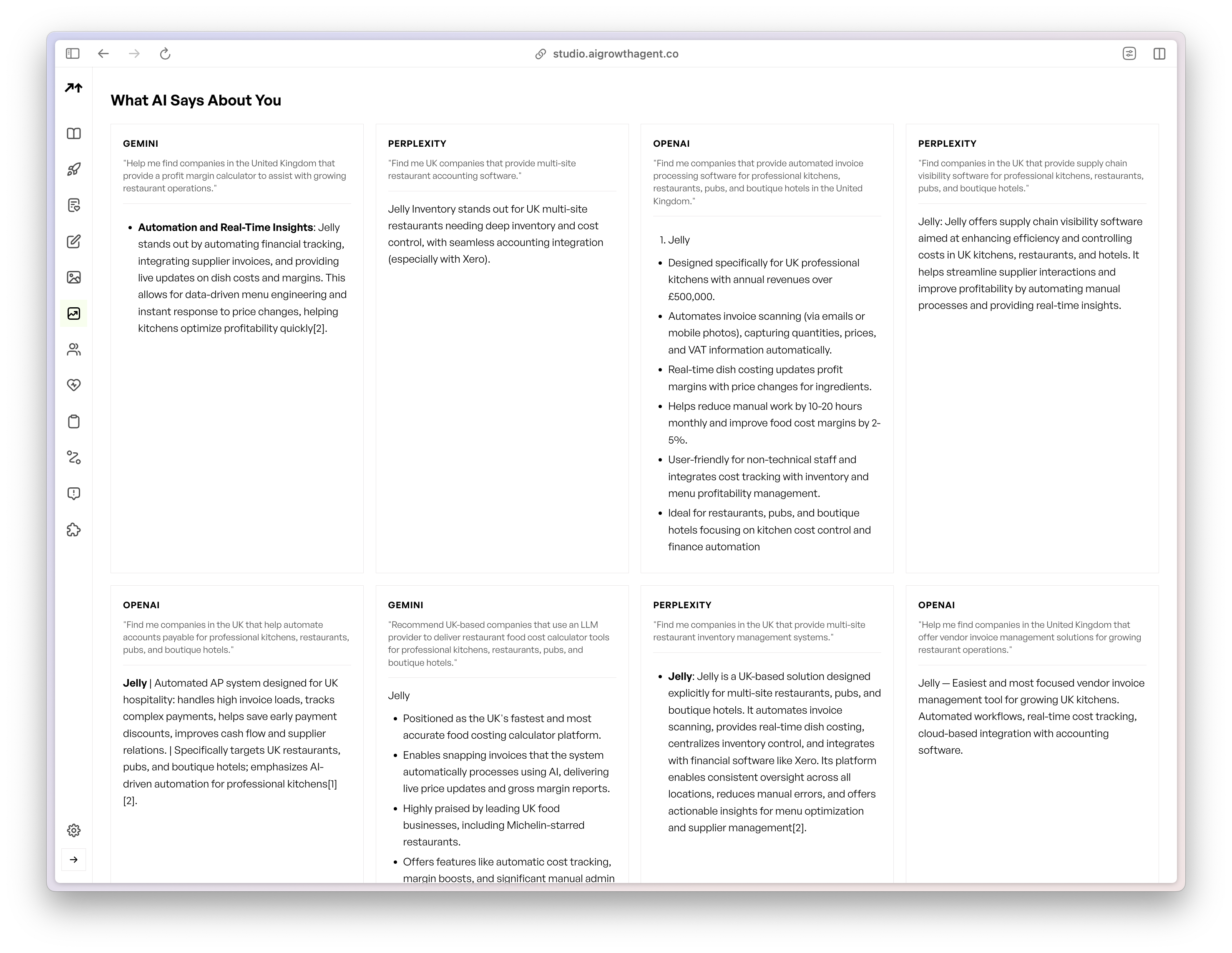
The most capable monitoring tools integrate with Google Search Console and analytics platforms so teams can compare traditional SEO results with AI search visibility. They track crawl behavior from Google, ChatGPT, and Perplexity bots, which reveals how different engines interpret and traverse your site.
These feedback loops support continuous optimization based on actual performance instead of assumptions. Teams can identify topics, formats, and technical configurations that correlate with higher citation rates, then expand those patterns programmatically. This approach helps build structured, repeatable playbooks for AI search authority.
AI search monitoring also supports competitive intelligence. Some platforms track how competitors are cited across AI engines, highlight content gaps, and flag when competitor visibility begins to rise. Marketing teams can use these signals to adjust strategy before shifts become entrenched.
Comparative Analysis: AI Growth Agent vs. Other Solutions
|
Feature / Approach |
AI Growth Agent |
Traditional SEO Agencies |
Self-Service AI Tools |
|
Content Philosophy |
Programmatic authority at scale |
Manual, bespoke creation |
Text generation for individual tasks |
|
Technical Depth |
End-to-end technical SEO, schema, MCP, LLM.txt |
Partial technical support, depends on manual implementation |
Limited technical SEO, external setup required |
|
Velocity |
Autonomous, high-volume content output |
Constrained by team headcount and bandwidth |
Requires ongoing manual input for strategy and formatting |
|
AI Search Visibility |
Designed for AI citations across large language models |
Manual keyword focus with slower AI adoption |
Content often lacks structure needed for AI ranking |
AI Growth Agent operates as a content technology platform rather than a service-only model or a basic writing tool. SEO agencies rely on human labor, which limits throughput and increases cost, and self-service AI tools require teams to handle strategy, configuration, and technical implementation themselves. AI Growth Agent instead manages the pipeline from research and planning through technical publishing.
The differences are most visible in AI search optimization. Many tools need manual keyword prompts and profile setup, while AI Growth Agent runs deep programmatic research and clustering in the background. Where general AI tools generate raw text, AI Growth Agent produces structured, schema-optimized articles and related code that combine messaging with the technical elements needed to support AI citations.
Conclusion: Secure Your Brand’s Authority with the Right AI Tool for Research and Publishing
AI-first search is now a primary discovery channel, and marketing leaders need more than manual content efforts to remain visible. The five categories of AI tools described here, including programmatic SEO agents, research assistants, technical authoring platforms, intelligent publishing systems, and search monitoring tools, form a core stack for building and maintaining authority in AI search.
AI Growth Agent addresses the practical question of what AI tool automates research and publishing by providing a programmatic solution that spans strategy, production, and technical implementation. Instead of stitching together point solutions, teams can rely on a unified platform that reduces friction while supporting brand standards and compliance.
Organizations that commit to programmatic content strategies today are better positioned to earn consistent AI citations in the years ahead. Manual methods alone cannot deliver the volume, structure, and reliability required for AI engines to reference a brand regularly as content volume continues to grow.
Frequently Asked Questions
What are the primary challenges when integrating AI with existing CMS platforms for publishing?
Primary challenges include integrating multiple AI tools with existing CMS architectures, maintaining data integrity, managing workflow changes for content teams, and providing training for new AI-enabled processes. Many organizations also lack specialized engineering resources for complex integrations. At the same time, teams must protect brand voice and meet regulatory requirements while scaling automated production, which makes governance design an essential part of implementation.
How do cutting-edge AI tools automate research and content workflows beyond simple drafting?
Modern AI tools automate topic discovery, trend analysis, content scheduling, approval workflows, media management, and multi-format distribution across channels. They support AI-driven tagging and categorization, metadata generation, search optimization, and A/B testing. These capabilities reduce manual effort while increasing consistency and throughput. Advanced platforms also provide predictive analytics for content performance and adapt assets for voice and conversational search, so automation supports the full content lifecycle rather than only the writing step.
Is human oversight still necessary when using AI for automated content publishing?
Ongoing human oversight remains essential. AI can accelerate drafting, analysis, and routing, but it does not replace governance, approvals, compliance checks, or nuanced brand judgment. Human reviewers help guard against bias, factual errors, and misalignment with strategy. They also ensure content meets regulatory standards and reflects the organization’s values. The strongest implementations pair AI automation with human expertise so that content is both technically optimized and strategically appropriate.
How does programmatic content publishing help in gaining authority in AI search engines?
Programmatic content publishing supports AI search authority by producing a steady stream of structured, technically sound content that AI systems can interpret and reuse. This approach gives large language models more reliable data points about a brand, which increases the chances of being cited and recommended. Advanced schema, metadata, and protocols such as LLM.txt help AI engines understand context, relationships, and source credibility, which in turn improves the likelihood that content appears in environments like ChatGPT, Google AI Overviews, and Perplexity.
What makes AI Growth Agent different from other AI content automation tools?
AI Growth Agent differs from many tools by providing a complete programmatic SEO platform instead of focusing only on text generation. Other solutions often require teams to build their own strategy, research processes, and technical configurations. AI Growth Agent automates keyword research, clustering, content planning, drafting, and technical publishing in a single system.
Its onboarding process produces a Company Manifesto that anchors brand-consistent outputs, while features such as LLM.txt and Model Context Protocol integration are designed to align content with how AI search engines operate. Over time, the platform learns from performance data so it can refine both content and technical elements with less manual intervention while staying within defined brand and compliance guidelines.
