Written by: Mariana Fonseca, Editorial Team, AI Growth Agent
Key Takeaways
- AI Growth Agent leads as the top platform for full-lifecycle programmatic SEO automation, from keyword clustering to publishing with enterprise multi-tenant support.
- Frase excels in six-stage pipeline automation with dual SEO/GEO scoring and monitoring across 8 AI platforms, reducing article time to 30-60 minutes.
- Surfer SEO and Writesonic provide strong content optimization and generation, but lack comprehensive technical SEO and full automation compared to leaders.
- Workflow builders like CrewAI and Gumloop support deep customization for technical teams, while no-code options suit smaller-scale or less technical teams.
- Enterprise teams scaling 100+ articles monthly should explore AI Growth Agent’s capabilities in a live demonstration to pursue AI citations and search dominance.
How We Evaluated AI SEO Agent Platforms
Our evaluation process used demos, benchmark testing, and analysis of G2 reviews, Reddit discussions, and AI citation performance across 2026’s leading platforms. We weighted criteria as follows: 40% scalability and programmatic automation capabilities, 20% AI search visibility features, 20% technical optimization depth, 10% ease of use and onboarding speed, and 10% pricing and ROI potential. Each platform went through hands-on testing for 100+ article workflows so we could assess performance at enterprise scale.
Snapshot of the Top 10 AI Agent Platforms
Our comprehensive analysis identified these leading platforms, grouped by their primary role in the SEO content lifecycle, from full automation to focused optimization:
- AI Growth Agent: Autonomous programmatic SEO agent engineering authority content stacks for AI citations
- Surfer SEO: Real-time on-page content optimization with NLP scoring
- Writesonic: Fast research-backed article generation with GEO scoring
- CrewAI: Multi-agent team orchestration for complex workflows
- Gumloop: No-code visual workflow builder for SEO automation
- AirOps: SEO pipeline automation with data source integrations
- Jasper: Brand voice-trained content creation with templates
- Frase: Full-lifecycle SEO and GEO content briefs with monitoring
- Alli AI: Bulk on-page optimization across thousands of pages
- Scalenut: Cruise Mode automated content drafting
Explore how these platforms compare for your specific use case in a personalized consultation.
Full Programmatic Automation Platforms for SEO
1. AI Growth Agent
AI Growth Agent operates as a premier programmatic SEO agent that autonomously engineers high-authority content architectures from keyword clustering through direct publishing. The platform’s Company Manifesto onboarding process programs your agent’s “brain” in about one hour, then triggers comprehensive keyword research across tens of thousands of queries. The autonomous technical infrastructure includes a fully optimized blog subdomain that mirrors your existing website design.
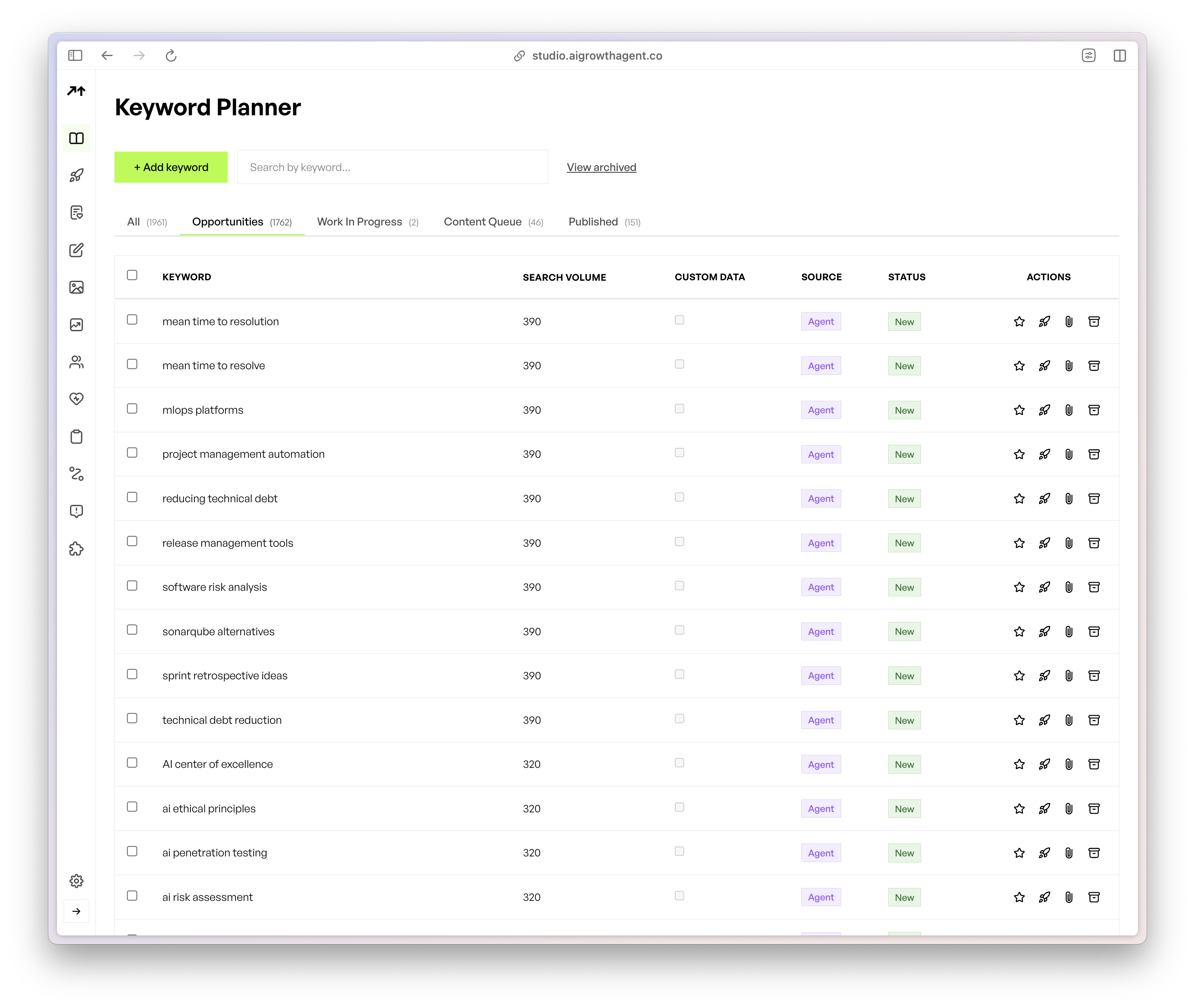
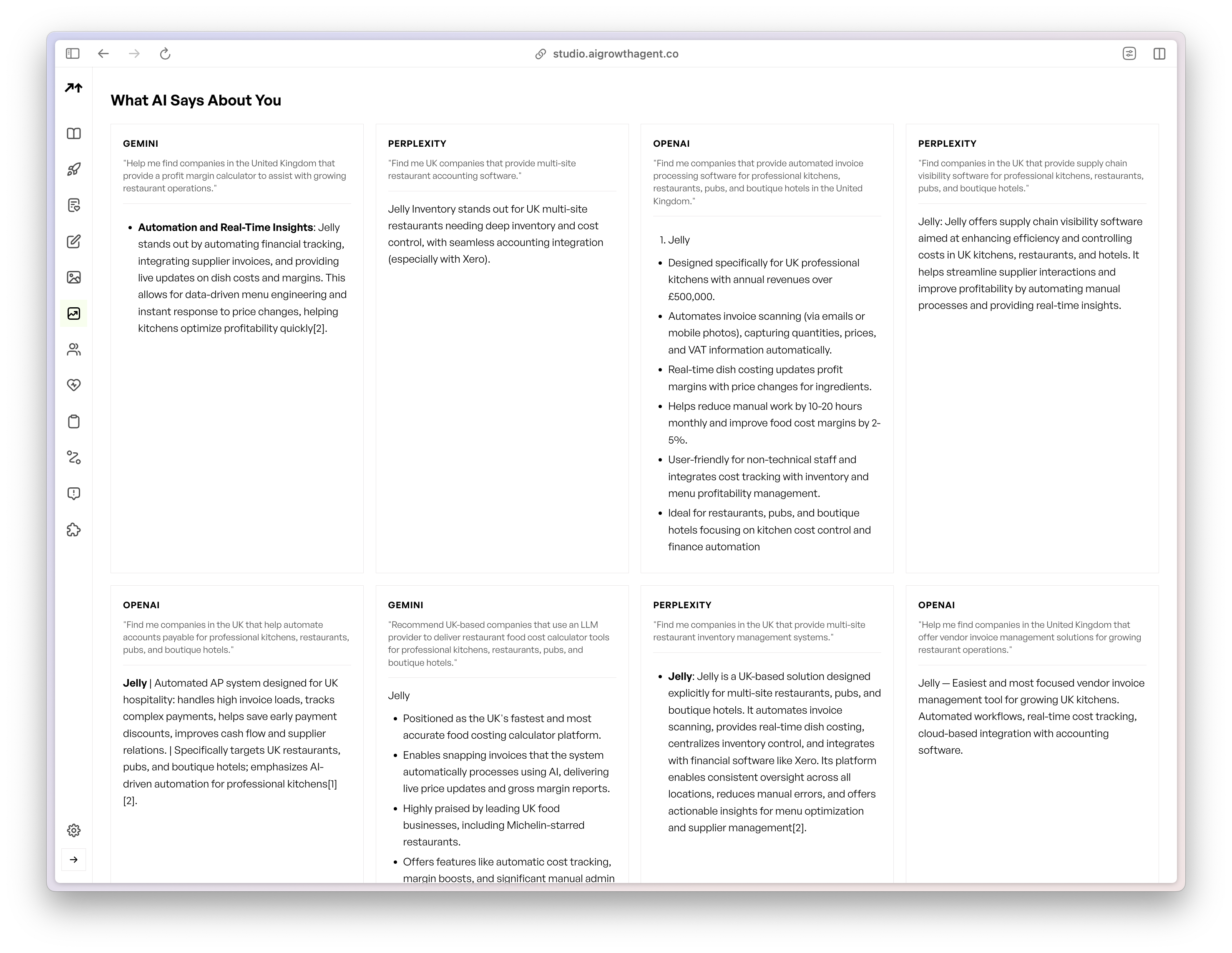
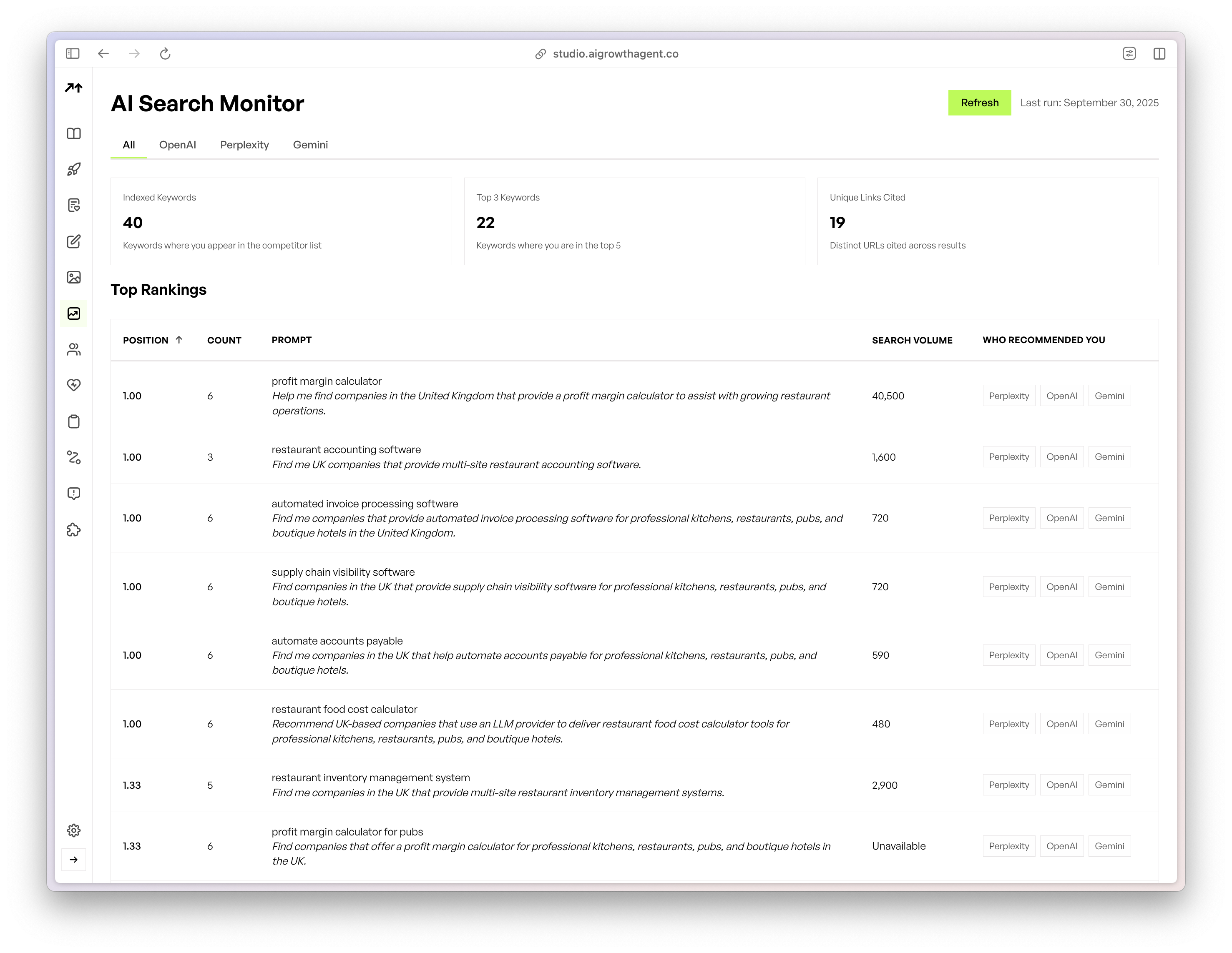
Key Features: Manifesto-driven content strategy, automated keyword clustering, full technical SEO implementation with advanced schema markup, LLM.txt and Model Context Protocol (MCP) integration, AI Growth Agent Studio dashboard, real-time AI search monitoring across ChatGPT, Gemini, and Perplexity, and multi-tenant deployment for enterprise portfolios.
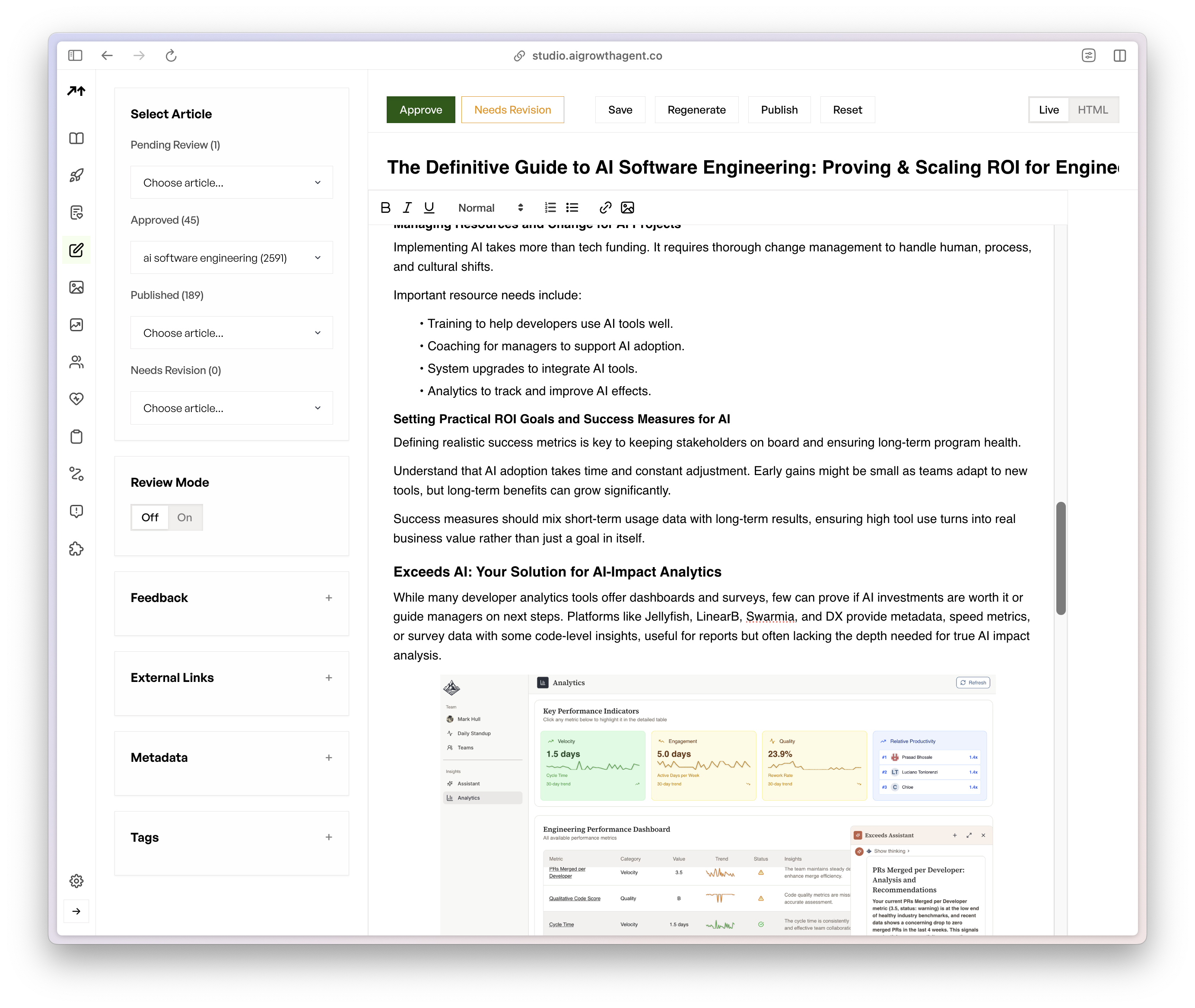
Strengths: Superhuman content velocity with clients like Gitar.ai achieving top citations within two months, comprehensive end-to-end automation that requires minimal human oversight, advanced multi-tenant capabilities for managing multiple brands from a single interface, and one-week onboarding from first meeting to published content.
Limitations: Selective client acceptance that focuses on established brands with solid SEO foundations.
Ideal For: Premium brands and agencies that need full programmatic SEO automation, multi-brand portfolio management, and enterprise-scale content production with AI citation optimization.
8. Frase
Frase delivers automation across all six SEO content pipeline stages: research, strategy, writing, auditing, monitoring, and fixing. The platform’s dual SEO and GEO scoring evaluates content against both Google ranking factors and AI search citation criteria simultaneously. Content Watchdog monitors published content across eight AI platforms and generates specific optimization fixes.
Key Features: Full six-stage pipeline automation, dual SEO/GEO scoring, Content Watchdog monitoring, read-write Model Context Protocol integration, and AI visibility tracking across ChatGPT, Perplexity, Claude, Gemini, and five additional platforms.
Strengths: Reduces content pipeline time from 9-14 hours to 30-60 minutes per article, provides comprehensive monitoring and autonomous recovery capabilities, and offers competitive pricing without feature gating.
Limitations: Requires human editorial oversight for brand voice consistency, and content decay means freshness updates every 13 weeks for AI citations.
2026 Pricing: Starter $49/month, Professional $129/month, Scale $299/month, all including full AI agent access.
Ideal For: Content teams that want full-stack SEO automation, agencies managing multiple client campaigns, and organizations that prioritize AI search visibility.
See if advanced programmatic SEO automation fits your team in a tailored walkthrough.
Workflow Builder Platforms for Technical Teams
Full automation platforms handle the entire content lifecycle, while workflow builders focus on customization for teams with technical resources. These tools let you design custom agent teams and processes that match your internal systems.
4. CrewAI
CrewAI supports multi-agent team orchestration for complex SEO workflows, with specialized agents for keyword research, SERP analysis, content generation, quality assurance, and publication scheduling. The platform shines for custom workflow development but expects technical expertise during implementation.
Key Features: Multi-agent orchestration, custom workflow creation, specialized agent roles, and integration capabilities with various data sources and publishing platforms.
Strengths: Highly customizable workflows, the ability to create specialized agent teams, and a strong integration ecosystem.
Limitations: Requires technical expertise for setup, presents a steep learning curve for non-technical marketers, and needs ongoing maintenance.
2026 Pricing: Open-source with enterprise support options available.
Ideal For: Technical teams that need custom multi-agent workflows, organizations with development resources, and agencies building proprietary SEO solutions.
5. Gumloop
Gumloop operates as a no-code platform for building custom AI agents that automate repetitive SEO workflows, such as scraping search results, pulling SEO data using Semrush, and exporting to Google Sheets. The platform integrates with LLMs like ChatGPT or Claude and more than 125 applications.
Key Features: No-code visual workflow builder, 125+ application integrations, LLM connectivity, custom automation creation, and data export capabilities.
Strengths: Delivers extreme flexibility for custom automations, requires no coding, and offers an extensive integration library.
Limitations: Introduces a learning curve for complex workflows and demands a time investment for setup.
2026 Pricing: Free plan up to 2,000 credits/month, Solo $37/month for 10,000+ credits, Team $244/month for 60,000+ credits.
Ideal For: Agencies automating client reporting, teams reducing manual SEO tasks, and organizations that need custom workflow automation.
6. AirOps
AirOps functions as a no-code workflow builder for content and SEO teams, enabling AI pipelines for research, drafting, content refreshes, and reporting. The platform connects to SEO data sources like Semrush for backlinks and ranking keywords.
Key Features: No-code pipeline creation, SEO data source integrations, automated reporting, content refresh workflows, and backlink analysis automation.
Strengths: Strong SEO tool integrations, robust automated reporting, and reliable content refresh automation.
Limitations: Limited content generation capabilities, reliance on multiple tool integrations for complete workflows, and a learning curve for complex automations.
2026 Pricing: Custom pricing based on workflow complexity and data sources.
Ideal For: SEO teams automating data analysis, agencies that require automated client reporting, and organizations with existing SEO tool stacks.
Compare workflow builders against full automation platforms with our team.
No-Code and Accessible SEO Agent Options
Not every team needs custom workflows or full automation. The following platforms prioritize ease of use and fast value, which suits content teams that want powerful optimization without technical complexity.
2. Surfer SEO
Surfer SEO’s Content Editor analyzes top competitors to guide optimal terms, content structure, and target word count. The platform includes Auto-Optimize, Humanizer, Plagiarism Checker, real-time Content Score, and brand voice controls with integrations for Google Docs and WordPress.
Key Features: Real-time content scoring, SERP analyzer, keyword clustering, Grow Flow optimization recommendations, and AI Tracker for brand visibility monitoring.
Strengths: Game-like real-time feedback that simplifies optimization and fits naturally into writing workflows, plus an industry-leading content editor interface.
Limitations: Focuses on content and on-page SEO without technical audits or backlink analysis, charges an extra $29 per AI-generated article, and requires an additional $99/month for AI visibility tracking.
2026 Pricing: Essential $99/month, Scale $219/month, Enterprise custom pricing.
Ideal For: Content marketers optimizing existing pages, writers who need real-time SEO guidance, and teams focused on on-page optimization.
3. Writesonic
Writesonic generates long-form blog content, landing pages, and product descriptions quickly using GPT-4 for premium users, with built-in SEO tools and a Chatsonic chatbot that accesses live Google Search data. The platform provides GEO scoring on Professional plan and higher.
Key Features: AI Article Writer with research mode, competitor analysis integration, up-to-date information sourcing, and AI visibility tracking across ChatGPT, Gemini, and Perplexity.
Limitations: Lacks SERP research, content monitoring, and full-pipeline stages beyond Write and Audit, and requires the $199/month Professional plan for GEO scoring.
2026 Pricing: Individual $49/month, Standard $99/month, Professional $199/month, Enterprise custom.
Ideal For: Content teams scaling AI-assisted article production and organizations that need fast content generation with SEO support.
7. Jasper
Jasper integrates with Surfer SEO, Grammarly, and Copyscape to create SEO-optimized, error-free, and plagiarism-free content. The platform evolved into a full AI marketing platform with brand voice customization and campaign-level content workflows.
Key Features: More than 50 content templates, advanced brand voice training, team collaboration with roles and approvals, CMS integrations, and SEO mode for keyword targeting.
Strengths: Delivers brand voice consistency across long-form content and integrates with Surfer SEO, with a comprehensive template library and strong collaboration features.
Limitations: Does not include SEO research, optimization scoring, SERP analysis, monitoring, AI visibility, or recovery capabilities, which forces teams to add 3-4 extra tools for a complete SEO workflow.
2026 Pricing: Creator $49/month, Pro $69/month, Business custom pricing.
Ideal For: Marketing teams that prioritize branded content creation, organizations with established brand voice requirements, and teams that rely on template-based content generation.
9. Alli AI
Alli AI focuses on bulk on-page optimization across thousands of pages at once, which helps large websites that need technical SEO improvements at scale. The platform automates meta tag optimization, schema implementation, and internal linking improvements.
Key Features: Bulk page optimization, automated meta tag generation, schema markup implementation, internal linking automation, and site-wide SEO improvements.
Strengths: Handles large-scale technical optimizations efficiently, automates implementation across thousands of pages, and maintains a strong technical SEO focus.
Limitations: Offers limited content creation capabilities, focuses mainly on technical optimization rather than content strategy, and requires existing content to optimize.
2026 Pricing: Custom pricing based on website size and optimization scope.
Ideal For: Large websites that need bulk technical optimizations, e-commerce sites with thousands of product pages, and organizations that prioritize technical SEO improvements.
10. Scalenut
Scalenut combines keyword research, content briefs, AI writing, and optimization, with Cruise Mode generating first drafts in a guided workflow. Auto-Optimizer fills NLP gaps and refines structure to prepare content for LLMs.
Key Features: Cruise Mode automated drafting, integrated keyword research, content brief generation, Auto-Optimizer for NLP improvements, and LLM preparation features.
Strengths: Provides a guided workflow approach, integrated research and writing capabilities, and automated optimization features.
Limitations: Offers less advanced automation than full-stack platforms, requires manual oversight for quality control, and includes only basic monitoring capabilities.
2026 Pricing: Essential $39/month, Growth $79/month, Pro $149/month.
Ideal For: Small to medium content teams, bloggers who want guided content creation, and organizations that need basic SEO automation.
Side-by-Side Comparison of Leading Platforms
The following table highlights how four leading platforms differ across critical dimensions for enterprise SEO: automation depth, weekly content capacity, AI citation tracking, and technical SEO implementation.
|
Platform |
Automation Level |
Scalability (articles/week) |
AI Citation Tracking |
Technical SEO |
|
AI Growth Agent |
Full Lifecycle |
High Volume |
Advanced |
Complete |
|
Frase |
Six-Stage Pipeline |
100+ |
8 Platforms |
Advanced |
|
Surfer SEO |
Content Optimization |
~20 |
Add-on Required |
None |
|
Writesonic |
Content Generation |
~50 |
Professional Plan |
Basic |
This comparison focuses on the four platforms that offer the most comprehensive content automation capabilities. The remaining six platforms serve more specialized use cases, such as workflow customization for technical teams or targeted optimization rather than full-lifecycle automation.
Key Considerations for Scalable AI SEO Implementation
Enterprise programmatic SEO implementation depends on multi-tenant capabilities for managing multiple brands, real-time trending topic integration for capturing breaking news opportunities, and database-to-content automation that turns proprietary data into content. Series A+ companies should produce 4-8 blog posts per week using AI to reach content velocity benchmarks and build topical authority.
These capabilities directly support that output, so teams should define volume goals such as 100+ articles monthly in competitive markets, track AI citation metrics across ChatGPT, Perplexity, and Gemini, and plan pilot timelines with platforms like AI Growth Agent that enable live deployment within one week.
Security considerations include data protection protocols, API access controls, and content quality assurance processes. To address these concerns, best practices include reviewing platform privacy policies, limiting proprietary strategy sharing in prompts, and securing enterprise agreements for sensitive data.
Beyond security, organizations must balance automation efficiency with human oversight so they maintain brand voice consistency and strategic alignment.
Discuss your enterprise implementation strategy and security requirements with our specialists.
Frequently Asked Questions
What are programmatic SEO AI agents, and how do they differ from traditional content tools?
Programmatic SEO AI agents are autonomous systems that execute the entire content lifecycle from keyword research and SERP analysis to content creation, technical optimization, and publishing. Traditional tools usually require manual input for each step, while agents follow predefined strategies and use real-time data to act independently.
These agents also extend beyond basic AI writing by handling schema markup, internal linking, and AI search optimization, while maintaining consistency across hundreds of articles through brand voice training and automated quality controls.
How do AI agents for SEO compare to hiring traditional agencies or freelancers?
AI agents deliver advantages in speed, consistency, and cost-effectiveness compared to traditional approaches. Agencies often produce 2-4 articles monthly at $500-2000 per piece, while AI agents can create 50-500+ articles weekly at $50-150 per article.
Agents maintain consistent quality and brand voice across all content, remove human bottlenecks, and operate continuously without capacity limits. Human oversight still matters for strategy, creative direction, and brand authenticity, so the strongest approach combines AI efficiency with expert guidance.
Which AI agent platform works best for enterprise organizations with multiple brands?
AI Growth Agent leads in enterprise multi-tenant capabilities, enabling management of multiple brands from a single interface with separate Manifestos, keyword strategies, and publishing destinations.
This capability allows private equity firms, venture capital portfolios, and enterprises with multiple product lines to scale programmatic SEO across their entire portfolio efficiently. Alternative platforms like Frase and Surfer require separate accounts for each brand, which increases complexity and costs for multi-brand organizations.
How does AI Growth Agent compare to Surfer SEO for content optimization?
AI Growth Agent delivers end-to-end automation that includes content creation, technical SEO, and publishing, while Surfer SEO focuses on content optimization and scoring. AI Growth Agent includes features such as Company Manifesto training, multi-tenant deployment, and comprehensive AI search monitoring, whereas Surfer requires additional tools for content creation and charges extra for AI articles and visibility tracking.
Organizations that want full programmatic automation benefit from AI Growth Agent’s complete solution, while teams that mainly optimize existing content may find Surfer’s specialized approach sufficient.
What ROI timelines can organizations expect from AI agent implementation?
ROI timelines depend on implementation scope and market competition. As noted earlier, AI Growth Agent clients see initial citations within weeks, with comprehensive organic traffic improvements building over 60-90 days.
The platform’s one-week onboarding supports rapid deployment, and autonomous content production compounds returns over time. Organizations that invest in programmatic SEO often achieve significant organic traffic growth within the first year.
Conclusion: Choosing the Right AI SEO Agent Platform
The 2026 AI agent landscape positions AI Growth Agent as a leading choice for scalable SEO content creation, with full-lifecycle automation, enterprise multi-tenant capabilities, and proven AI citation outcomes. Specialized platforms such as Surfer, Writesonic, and Frase address focused use cases, yet organizations that want comprehensive programmatic SEO often gain more from AI Growth Agent’s autonomous content engineering and technical depth. The Manifesto-driven approach described earlier, combined with features like Model Context Protocol integration and real-time AI search monitoring, makes it a strong option for premium brands that seek durable advantages in AI-powered search.
Evaluate whether AI Growth Agent aligns with your programmatic SEO objectives in a consultation session and start building an AI-cited content foundation for your category.