Written by: Mariana Fonseca, Editorial Team, AI Growth Agent
Key Takeaways
- ChatGPT answers come from existing web content, so brands must publish authoritative, structured content instead of chasing direct submissions.
- Consistent third-party descriptions across reviews, press, and directories give AI models confidence to cite your brand.
- Answer-first content with BLUF structure and comprehensive schema markup helps AI crawlers trust and reuse your content.
- Real-time indexing, external consensus through reviews and coverage, and living self-healing content sustain visibility in AI results.
- AI Growth Agent replaces the traditional agency stack with one autonomous engine, and you can see incremental citations at scale in a live demo.
Why Your Brand Cannot “Submit” to ChatGPT
Step 1: Understand Why Direct Submission Does Not Exist
There is no portal, form, or paid placement that inserts a brand into a ChatGPT answer. Large language models generate responses by retrieving and synthesizing content they have already crawled, indexed, and evaluated for trustworthiness. The only lever a brand controls is the content that exists on the open web and the signals that tell AI crawlers whether that content is authoritative enough to cite.
This reality shifts the focus from submission to narrative. The real question becomes what the web currently says about your brand and whether that record is structured so AI surfaces can find it, trust it, and repeat it. Brands that chase a submission shortcut lose time. Brands that treat this as a content and authority problem start winning citations.
The practical implication is clear. Every step in this playbook focuses on producing the right content, in the right structure, with the right external validation, so AI surfaces have no reason to cite anyone else. The first move is accepting that control lives in your content and signals, not in a hidden form.
See if you are a fit and get your first article live within a week in a working session.
How to Get Listed in ChatGPT Search
Step 2: Build Consistent Third-Party Descriptions
AI surfaces synthesize brand descriptions from every source they can find, including review platforms, press coverage, directory listings, forum discussions, and competitor comparisons. When those sources disagree, the model hedges or skips the brand entirely. When they align, the model gains a confident, citable description to repeat.
Building consistent third-party descriptions starts with an audit of what the open web currently says about the brand. The next step identifies gaps and contradictions, then fills them with content that establishes a single authoritative narrative. This approach goes beyond reactive reputation management. It creates upstream narrative control by placing the right descriptions in the right places before a customer asks the question.
AI Growth Agent maps your full universe of seed terms and long-tail queries using real-time Google and ChatGPT data, then produces authoritative content that validates every claim and source. The result is a consistent external record that AI surfaces can cite with confidence.
Book a consultation to see how your brand’s narrative currently appears across AI surfaces.
How to Structure Content AI Models Want to Cite
Step 3: Structure Answer-First Content with BLUF and Schema
AI surfaces favor content that answers the question immediately, without forcing the model to sift through preamble. The BLUF (Bottom Line Up Front) structure places the direct answer in the first sentence or paragraph, then follows with supporting evidence. This structure matches how AI models prefer to extract and cite information.
Schema markup forms the second half of this step. Rich schema across article, FAQ, organization, product, review, and author types tells AI crawlers exactly what each piece of content is, who produced it, and which claim it supports. Without schema, a model must infer structure from prose. With schema, explicit machine-readable signals replace guesswork and speed up trust and citation.
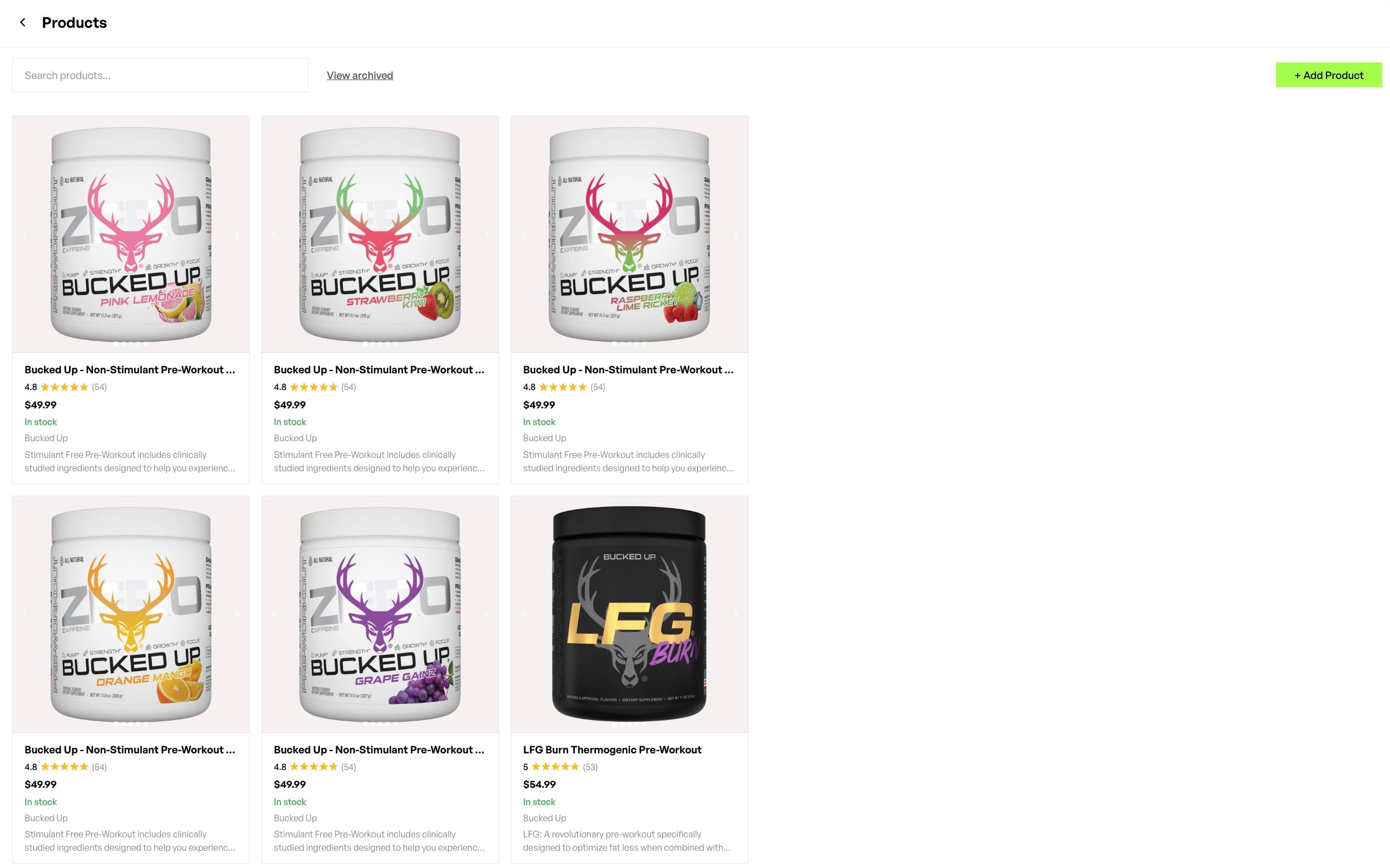
AI Growth Agent provisions a complete schema suite automatically, including article, FAQ, local business, organization, review, product, author, and software application schema on every article and every site it publishes. Clients do not need to handle any technical implementation.
Join a live demo to watch the full schema stack deploy in real time.
How to Appear in ChatGPT Results via Indexing
Step 4: Optimize for Real-Time Indexing Across Bing and Google AI Mode
ChatGPT’s web search relies heavily on Bing’s index. Google AI Mode and AI Overviews rely on Google’s index. A brand that is not indexed, or indexed slowly, remains invisible to both surfaces regardless of content quality. Real-time indexing, instant submission through IndexNow and Google Search Console, and a technically sound sitemap.xml form the baseline for appearing in AI results at all.
AI Growth Agent ships instant indexing, autoredirects, 404 tracking, a proper sitemap.xml, and a dedicated web-stories sitemap on every site it launches. These elements help new content enter the index as quickly as crawlers allow, which shortens the gap between publishing and first citation.
Request an indexing posture review to understand how quickly your content currently enters search.
How to Be Mentioned in ChatGPT Through External Proof
Step 5: Earn External Consensus Through Reviews and Coverage
AI surfaces weight external consensus heavily. A brand that appears only on its own domain is simply making claims about itself. A brand that appears across review platforms, industry publications, forum threads, and third-party comparisons gives the model multiple angles to triangulate and trust.
Earning external consensus in 2026 starts with identifying which communities, forums, and creators shape the conversation in a given market. The next move is producing content and outreach that places the brand’s narrative in those spaces. AI Growth Agent’s Search Intelligence surfaces the top-ranking URLs, YouTube videos, Reddit threads, and forum discussions in a client’s space every week, giving the brand a data-backed map of where to earn coverage instead of guessing.
Leva Sleep is now the most mentioned retailer for adjustable beds in Canada, with ChatGPT citing its content over 10,000 times per month. That position came from content that earned external consensus across the queries that matter to its buyers.
Schedule a session to get a data-backed map of where your brand needs external consensus.
How to Stay Visible in ChatGPT Over Time
Step 6: Deploy Living, Self-Healing Content
Content that is published and forgotten decays. AI surfaces run continuous training sweeps and citation passes. A brand whose content was accurate in January but stale by June eventually loses citations to fresher sources. Living content that updates and self-heals over time provides the only sustainable answer to this problem.
Self-healing goes far beyond annual refreshes. It uses Google Search Console signals and bot-traffic data to spot articles that are losing ground, then updates them before the decay becomes a citation loss. It refreshes every article in a sector automatically when the year turns. It centralizes each article’s relationships, performance data, and indexing signals so authority compounds instead of fragmenting.
AI Growth Agent’s living content system self-heals and updates over time, with every article’s relationships, performance, and bot and Search Console data centralized so the brand’s presence keeps compounding rather than decaying.
See how living, self-healing content works in practice during a walkthrough.
How to Track Your Progress in ChatGPT Results
Step 7: Measure Only Incremental Visibility
Most brands cannot tell whether their content investment works because they measure total visibility instead of incremental visibility. Total visibility includes everything the brand already had before any new effort began. Incremental visibility isolates exactly what a new effort generated, week over week, separate from the baseline.
Incremental measurement requires four data pillars working together. Search Intelligence maps the traditional landscape, including positioning, competition, and search volume. AI Analytics tracks brand value and consumer behavior across the full journey, which shows how visibility turns into action. Bot Tracking captures every crawl, citation, and training sweep by each bot type, revealing what AI surfaces actually index. AI Ranking measures order of mention and citation context week over week, replacing the old blue-link leaderboard with the metric that now matters.
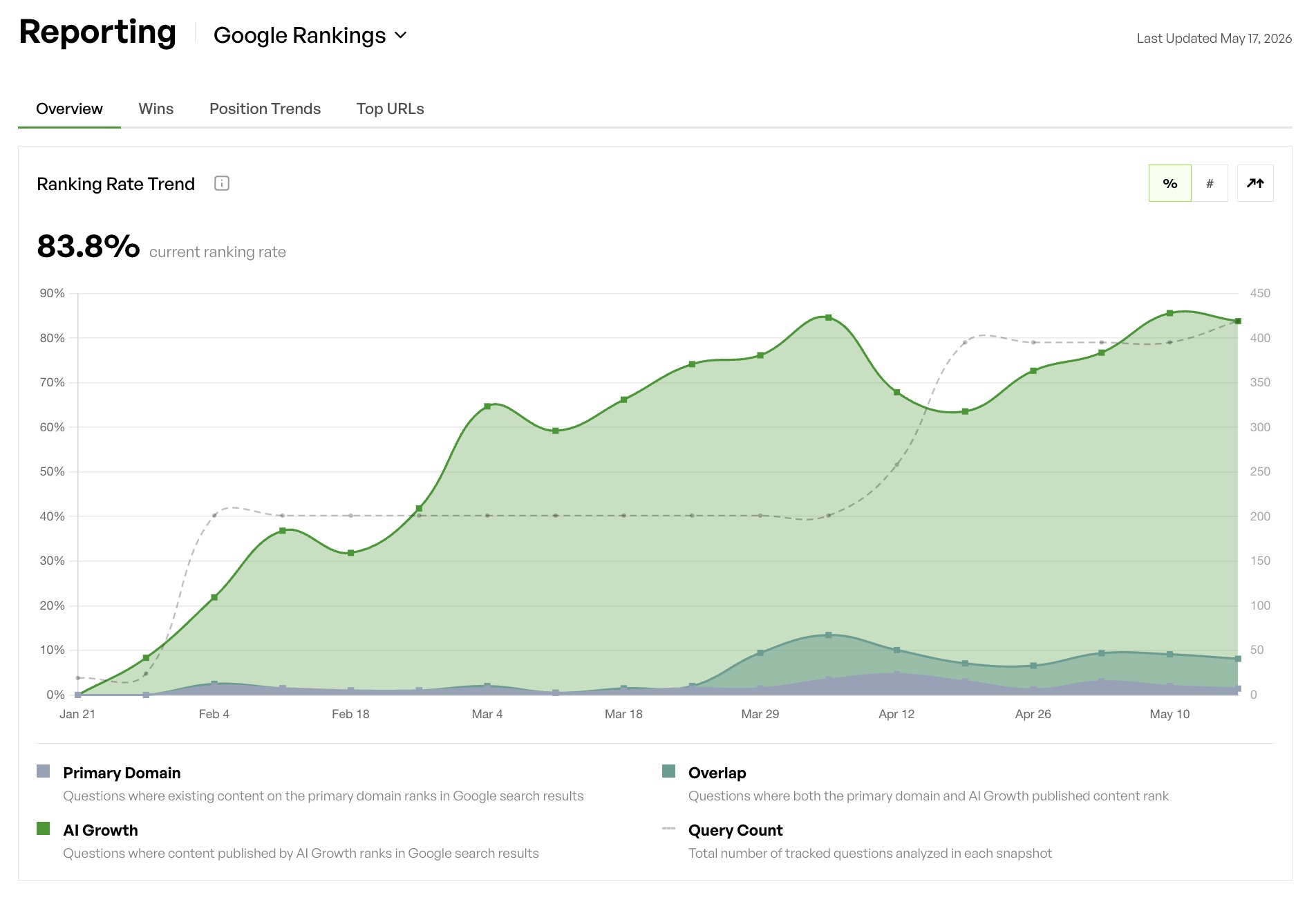
Explore the incremental visibility dashboard in a guided review of your own data.
Headless Marketing: One Engine Instead of an Agency Stack
The seven steps above describe what needs to happen. The question most CMOs and founders face is who actually does the work. The traditional answer is a stack that includes an SEO agency for keyword research and rankings, a content tool for article production, a web agency for the site, a GEO monitor for AI search tracking, a schema plugin for structured data, an analytics stack for reporting, and a PR firm for earned coverage. Each piece adds a separate contract, briefing cycle, and dependency. Together, they often take close to a year to produce the first results.
Headless marketing replaces that entire stack with one engine. The architecture mirrors headless commerce. The brand keeps its curated main site, and AI Growth Agent stands up a separate, fully optimized blog the brand owns, connected through a reverse proxy rewrite under a subdirectory or subdomain. The engine writes, publishes, monitors, self-heals, and reports. The brand states what it wants to win, in plain language, and the engine pursues those wins.
These seven steps require a technical foundation that most brands do not have today. AI Growth Agent delivers this through four integrated layers. Content Topology maps every query your customers ask using real-time Google and ChatGPT data. Search Intelligence tracks the full competitive landscape weekly. Citation context tracking shows where you appear in AI answers and which brands you are grouped with. Agentic technical SEO, including Blog MCP, llms.txt, llms-full.txt, natural language query parameters, and Markdown served to agent crawlers, ensures AI surfaces can read your content the way they need to.
Breadless went from 387,000 to 12.3 million Google Search Console impressions in six months using this architecture, with ChatGPT now citing eatbreadless.com over 45,000 times per month. The brand has become one of the most recommended healthy franchises in the US within its search universe.
Talk with the team about replacing your current agency stack with a single autonomous engine.
Frequently Asked Questions
How does ChatGPT decide which brands to mention in its answers?
ChatGPT generates answers by retrieving and synthesizing content from sources it has crawled and evaluated for authority and relevance. Brands that appear consistently across multiple external sources, with structured, answer-first content and validated claims, are more likely to be cited. There is no submission process. The deciding factors include content quality, structural clarity, schema markup, external consensus across reviews and coverage, and freshness. Brands that publish authoritative content at scale across the long-tail queries their customers actually ask appear most often in AI answers.
What is the difference between traditional SEO and large language model optimization?
Traditional SEO focuses on a ranked list of blue links. Large language model optimization (LLMO) focuses on citation in a generated answer, where no static ranked list exists and the brand’s position is measured by order of mention and citation context. LLMO works natively in natural language, uses answer-first content structures, requires full schema markup, and relies on agentic technical SEO elements such as Blog MCP and llms.txt plus consistent external validation. Traditional SEO remains table stakes, but it no longer suffices on its own for AI search visibility in 2026.
How long does it take to start appearing in ChatGPT answers?
With AI Growth Agent, the first article is typically live within one week of kickoff, and content has indexed in as little as ten days. The standard engagement runs as a three-month pilot because indexing timelines vary by industry and domain authority. Clients like Jelly received their first citation within three weeks, and Exceeds.ai received its first citation within two weeks. Brands that see results fastest start with a clear Content Topology, publish consistently across their full query universe, and have the technical SEO stack in place from day one.
Why do monitoring tools alone not solve the problem of appearing in AI answers?
Monitoring tools track whether a brand appears for a capped set of prompts. They show what is happening but do not change it. They remain blind to per-article bot tracking, centralized Google Search Console signals, and the cross-referenced data that determines what to do next. Appearing in AI answers requires producing the content, publishing it with the right technical structure, earning external consensus, and keeping it fresh over time. Monitoring looks in the rearview mirror. Narrative control happens upstream and requires an engine that produces and self-heals content, not one that only reports on its absence.
What does headless marketing mean for a brand that already has an agency?
Headless marketing does not force an immediate replacement of an existing agency relationship. It adds an autonomous engine that handles content production, technical SEO, schema, bot tracking, and incremental visibility reporting that the agency either cannot deliver or delivers too slowly. AI Growth Agent connects to the brand’s domain through a reverse proxy rewrite or subdomain and does not alter the existing site structure. The brand owns the property outright. Many clients run AI Growth Agent alongside existing agency relationships and use incremental visibility data to decide where their budget actually performs.
Conclusion: Control the Narrative
The seven steps in this playbook operate as a single system rather than isolated tactics. Each step builds on the previous one, from establishing authority through third-party consensus to maintaining it through living content and incremental measurement. Together, they create a durable presence inside AI answers.
Every step requires content production, technical infrastructure, and ongoing maintenance. The brands winning AI search in 2026 are not the ones with the largest budgets or the most agencies. They are the ones with a single autonomous engine that covers their full query universe, publishes authoritative content at scale, ships agentic technical SEO, self-heals over time, and reports only what it actually generated.
AI Growth Agent is built to deliver all seven steps without adding headcount, replacing the SEO agency, content tool, web agency, GEO monitor, schema plugin, analytics stack, and PR firm with one fixed-fee engine that moves from kickoff to first published article in about one week.
The brands cited in AI search this year are training the next generation of models with their own story. The brands that wait train those models with whatever already sits on the open web. Request a consultation or join a demo to see whether this system fits your brand.