Written by: Mariana Fonseca, Editorial Team, AI Growth Agent
Key Takeaways for AI-Driven Brand Consistency
- Consistent brand messaging counters the AI authenticity crisis. Today, 33% of consumers view AI negatively and 59% notice robotic tones, which hurts engagement and ROI.
- Follow a 7-step framework: create AI-ready brand docs, train models with approved content, engineer contextual prompts, standardize multi-channel deployment, add governance, use proprietary data, and audit performance.
- Tools like Typeface, Emma, and AI Growth Agent provide concrete brand controls, and programmatic solutions can enforce brand rules across channels without manual intervention.
- Measure success with engagement metrics, conversion rates, AI search citations, and organic traffic growth. Strong governance can deliver up to 7.2x higher AI performance.
- Speed up implementation with an AI Growth Agent demo that applies your manifesto for consistent brand voice at scale.
Prerequisites for AI-Ready Brand Messaging Systems
Set a clear foundation before you roll out AI brand consistency systems. Your team needs basic familiarity with AI prompting tools like ChatGPT or Claude, current brand guideline documents, and access to your content management systems. You also need 5–10 examples of your strongest on-brand content across formats, such as emails, social posts, blog articles, and ad copy. These samples serve as training data for AI pattern recognition and shape how the system writes in your voice.
Once you have these prerequisites in place, you can choose between manual or programmatic implementation approaches. Programmatic approaches remove traditional friction points by automating technical implementation, while human oversight still guides strategy and quality control.
7 Steps to Train AI for Consistent Brand Messaging
Effective AI brand messaging follows seven tactical steps that move from foundation to deployment and then to ongoing optimization. Steps 1 and 2 build your foundation, Steps 3 and 4 handle implementation, and Steps 5 through 7 focus on governance and continuous improvement.
Step 1: Create AI-Ready Brand Documentation
Turn traditional brand guidelines into formats AI can read and apply consistently. Specify precise rules like tone descriptors, preferred terminology, banned phrases, and output patterns. Organize these rules into a single checklist that covers voice characteristics, vocabulary preferences, sentence structure patterns, and formatting requirements. Store this documentation in accessible tools like Notion or Google Docs so AI systems and your team can reference it quickly.
| Component | Example | Format | Source |
|---|---|---|---|
| Tone Rules | “Calm, direct, professional” | 3-5 adjectives | Monigle |
| Banned Phrases | “Game-changing, revolutionary, synergy” | Explicit list | Monigle |
| Output Patterns | “Headlines ≤ 8 words, bullets 2-3 each ≤ 18 words” | Structural rules | Monigle |
Step 2: Train Models with Approved Content
Upload comprehensive libraries of approved content, voice documentation, and clear examples of on-brand versus off-brand messaging to support accurate pattern recognition. Use platforms like Jasper, Copy.ai, and Typeface that allow custom model training on your material. Provide at least 10 high-quality examples for each content type so the model learns your patterns without overfitting to a single piece.
Step 3: Engineer Contextual Prompts
Design prompt templates that bring your brand manifesto into every AI interaction. Add contextual instructions for nuance, such as “If prompt references clinicians → use formal, evidence-based tone. If prompt references patients → use warm, accessible tone.” Use tools like Promptfoo to test these prompts across many scenarios and confirm that outputs stay consistent with your voice.
Step 4: Standardize Multi-Channel Implementation
Extend your trained AI into advertising, social media, email, and content marketing channels with the same rules. Platforms like Emma provide AI copy suggestions with locked templates and centralized brand controls for franchise networks and multi-location brands. This step creates a single standard for AI-generated ads, emails, and social content so audiences experience one coherent voice everywhere.
| Tool | Multi-Channel Support | Brand Controls | Governance Features | Source |
|---|---|---|---|---|
| Typeface | Yes | Basic | Manual review | Industry analysis |
| Emma | Email focus | Locked templates | Centralized controls | Campaign Monitor |
| AI Growth Agent | Full programmatic | Manifesto-driven | Autonomous enforcement | Company data |
Step 5: Implement Governance and Human Oversight
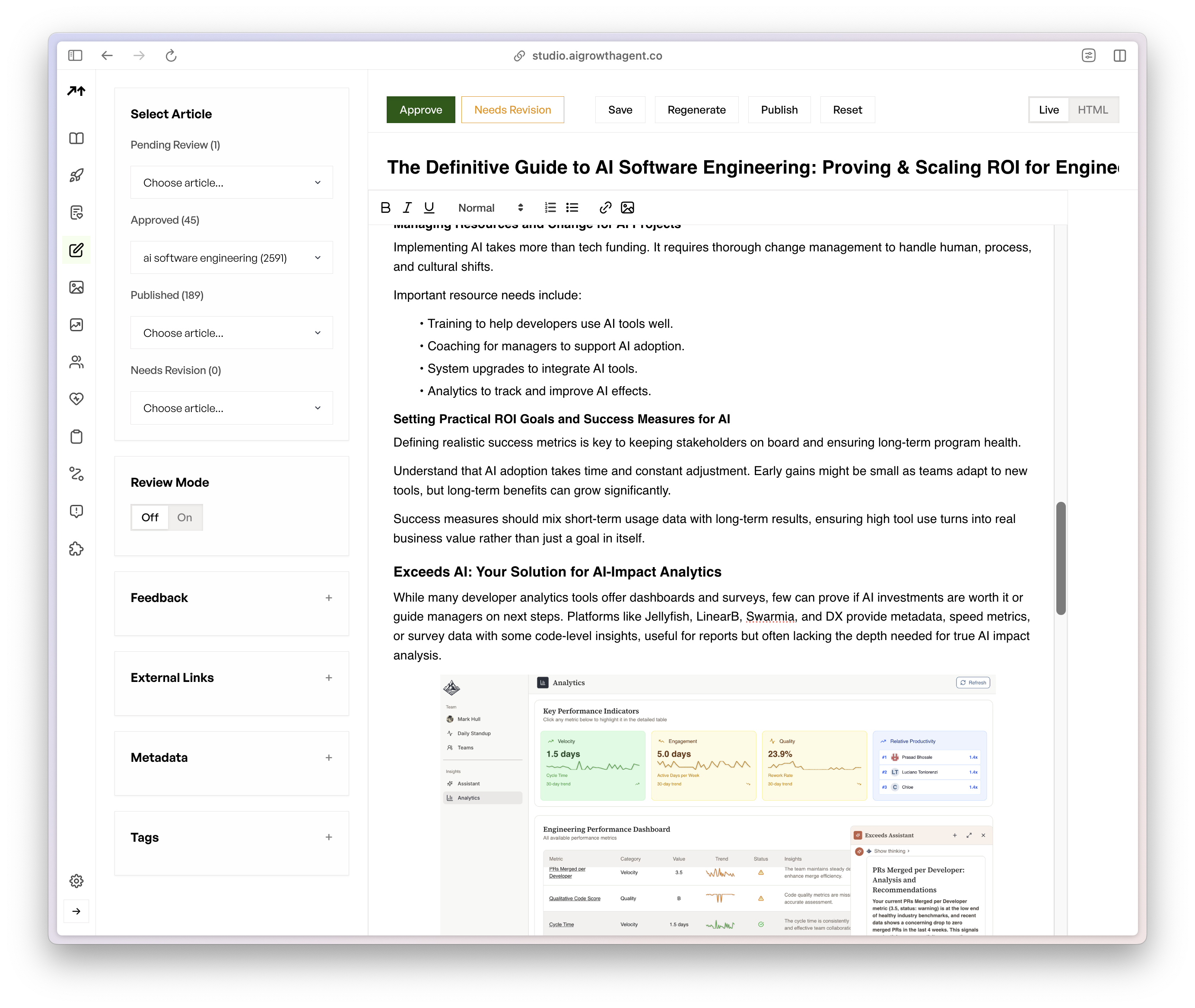
Create oversight processes that include fact validation, brand review, and compliance checks while treating AI as a co-pilot that still needs human direction. Build approval workflows that balance speed with quality control so reviewers focus on high-impact checks instead of rewriting everything. See how AI Growth Agent’s Studio streamlines these approval workflows while maintaining strict quality standards.
Step 6: Maintain Authenticity with Proprietary Data
Keep your content authentic by feeding AI your own insights and stories. Inject company perspectives, customer stories, and proprietary research into prompts and training sets. Fine-tune models with first-party data such as customer records, campaign history, and product information to produce more relevant, consistent outputs. This approach prevents a generic AI voice and still supports large-scale content production.
Step 7: Audit and Iterate Performance
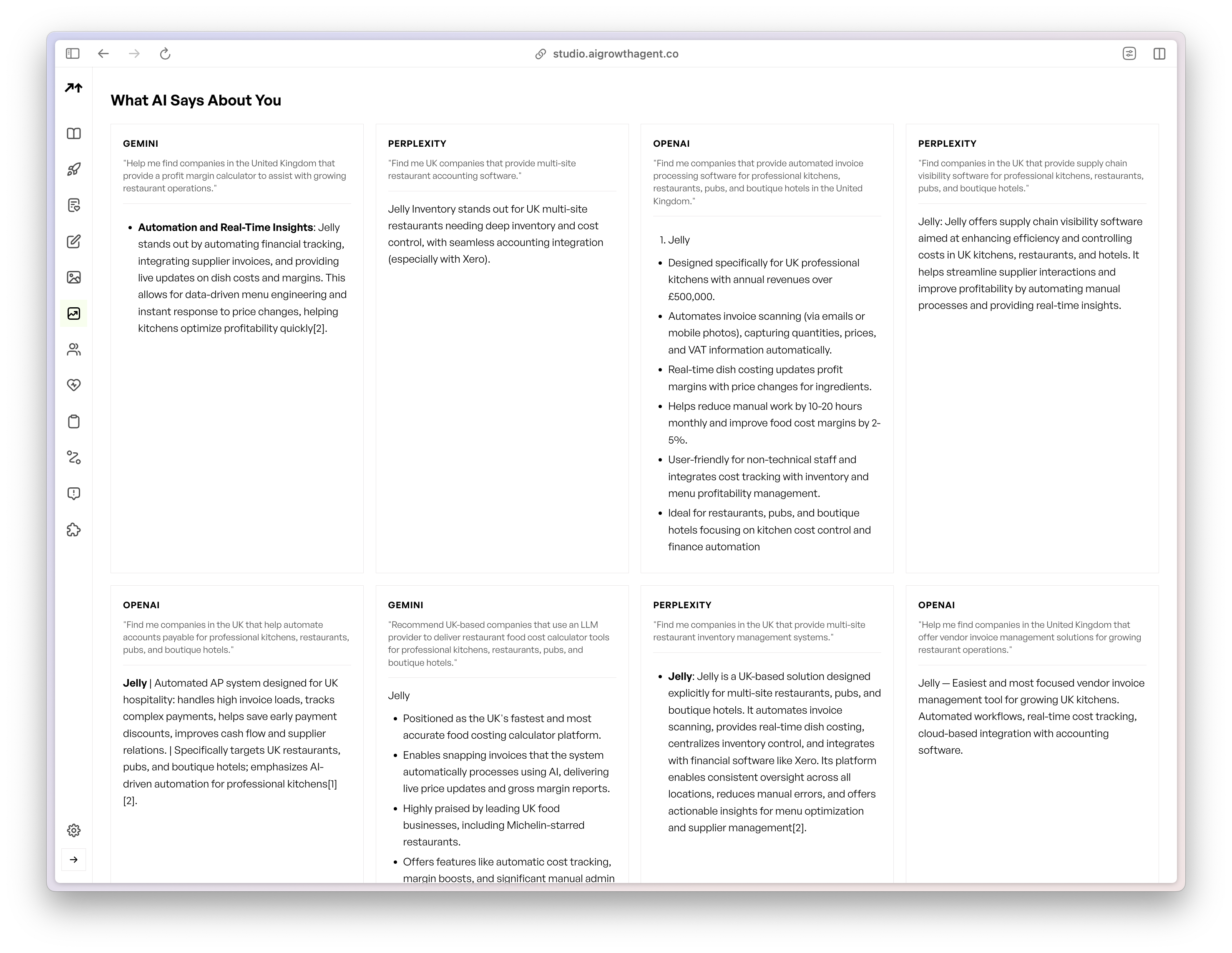
Run ongoing reviews that check both voice and results. Use voice audit prompts and performance metrics to evaluate outputs on a regular schedule. Compare weekly AI outputs against your brand voice standards and track audience feedback for continuous refinement. Monitor AI search citations in tools like ChatGPT, Perplexity, and Google AI Overviews to understand how your authority grows over time.
Common Brand Consistency Mistakes and Fixes
Teams often rely on vague brand documentation that gives AI little usable guidance. Many also ignore multi-brand needs or skip planning for AI search citations. When you see inconsistent outputs, first review your manifesto documentation for clarity and specificity, then check how often AI systems cite your content in Perplexity and similar tools. Use a focused five-point checklist that covers voice consistency, factual accuracy, brand compliance, technical SEO, and audience fit to prioritize fixes.
Verifying Outcomes and Measuring Results
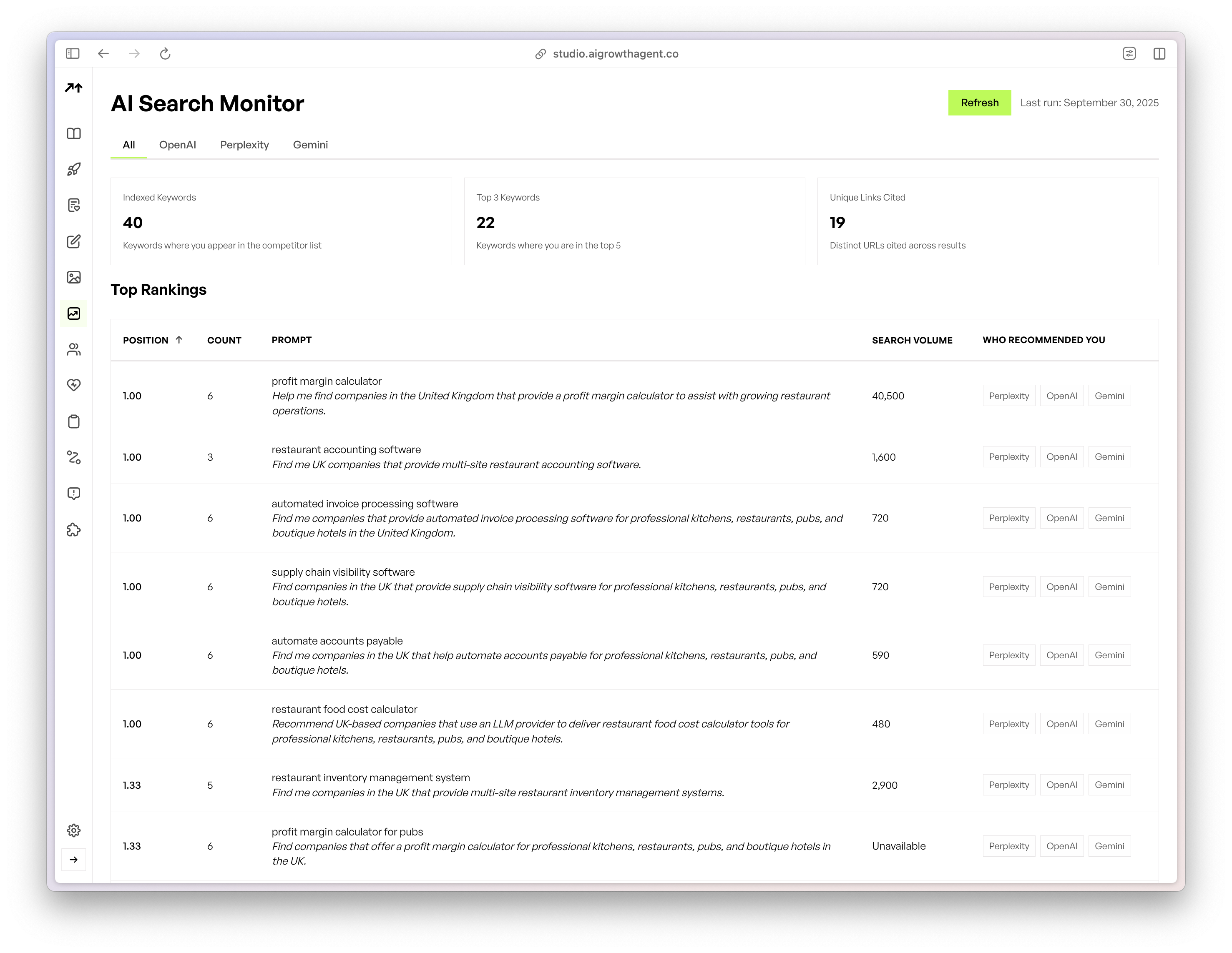
Measure brand consistency with hard data, not just intuition. Track engagement metrics, conversion rate changes, and AI search citations across your priority topics. Leading companies achieve 7.2 times higher AI-driven performance when they use documented governance frameworks. Monitor Google Search Console for organic traffic growth and use specialized tools to track citations in AI-powered search engines. Learn how AI Growth Agent automates citation tracking across ChatGPT, Perplexity, and Google AI Overviews so your team can focus on strategy.
Advanced Multi-Brand and Enterprise Scenarios
Complex organizations need more than a single-brand setup. Multi-brand operations benefit from tenant management systems that keep brand contexts separate while still allowing central oversight. Private equity firms and enterprises with several product lines often require programmatic SEO that scales across entire portfolios. AI Growth Agent’s multi-tenant architecture supports these scenarios with autonomous brand enforcement and systematic citation optimization for each brand.
Frequently Asked Questions
How do you maintain brand voice in AI-generated content?
Maintaining brand voice starts with strong training data and clear prompts. Create detailed voice documentation that includes tone descriptors, vocabulary preferences, and structural patterns. Train AI models on at least 10 examples of excellent brand content for each format, then use contextual prompts that bring your manifesto into every request. Add regular audits to catch voice drift and refine outputs based on reviewer and audience feedback.
What are the best AI tools for brand voice consistency?
Effective tools combine content generation with real governance features. Typeface and Jasper provide basic brand training capabilities, while platforms like Emma offer centralized controls for multi-location brands. AI Growth Agent focuses on manifesto-driven autonomous enforcement and programmatic scale. The key difference lies in end-to-end workflow automation instead of simple one-off content generation.
How do you scale brand consistency across multiple brands?
Scaling across multiple brands requires tenant-separated systems that preserve distinct brand contexts. Each brand needs its own manifesto, keyword strategy, and voice parameters that the AI respects. Advanced platforms run parallel content agents that operate independently while sharing governance frameworks. This structure lets small teams manage complex multi-brand strategies without sacrificing quality.
What timeline should you expect for achieving brand consistency?
Most teams spend about one week on manifesto creation and initial AI training. Consistent outputs usually appear within two to three weeks as models learn from feedback. Fully autonomous operation often develops over four to six weeks of iterative refinement. Programmatic approaches that automate technical implementation and feedback loops can shorten this timeline significantly.
How do you measure ROI from AI brand consistency efforts?
Measure ROI with a mix of performance and efficiency metrics. Track engagement rates, conversion lifts, content production speed, and AI search citations. Many companies report 159–192% ROI from AI programs that include strong governance. Watch organic traffic trends, time saved through automated workflows, and the quality of brand mentions across AI-powered search engines. Citation tracking in ChatGPT and Perplexity gives a direct view of authority growth.
How do you maintain authenticity while using generative AI?
Authenticity comes from your own data and perspective, not from generic AI text. Train models on your specific brand examples and keep humans in charge of strategic decisions. Add proprietary data, customer insights, and unique company stories to prompts and training sets. Use AI to scale the voice you already have, then audit outputs regularly for brand alignment and factual accuracy.
Conclusion: Turning AI Into a Consistent Brand Channel
Consistent brand messaging in the AI era depends on a clear system that balances authenticity with scale. The seven-step framework in this guide gives you a practical path to maintain brand voice while reaching the content volume required for AI search visibility. Success rests on detailed documentation, strong training data, and governance that supports autonomous operation without lowering quality.
Brands ready for programmatic brand consistency can use AI Growth Agent to combine manifesto-driven training with autonomous enforcement at superhuman scale. Schedule a demo to see how programmatic SEO agents can position your company as the definitive authority in your category while maintaining consistent citations across AI-powered search engines.