Written by: Mariana Fonseca, Editorial Team, AI Growth Agent
Key Takeaways
- AI search engines like Google AI Overviews (48% of queries) and ChatGPT (900M weekly users) now require content velocity that manual SEO cannot match.
- Programmatic SEO automation runs through 8 steps, from agent manifesto programming to AI citation monitoring, to create thousands of high-authority pages.
- Advanced infrastructure with llms.txt, MCP, and schema markup increases AI visibility and can lift CTR by 20-40% while preserving Core Web Vitals.
- Autonomous systems deliver fast outcomes, with clients earning top AI citations in 2-6 weeks across ChatGPT, Perplexity, and Google.
- Deploy AI Growth Agent’s autonomous pSEO system for end-to-end automation from research through monitoring without technical bottlenecks.
Key Steps to Automate pSEO at Scale
Programmatic SEO content creation becomes reliable and scalable when you follow eight clear steps that replace manual work with autonomous systems.
- Program agent Manifesto with brand guardrails and strategic direction
- Execute automated keyword and entity clustering across 10,000+ queries
- Build schema-ready infrastructure with LLM.txt and MCP integration
- Deploy autonomous content drafting with research and fact-checking protocols
- Inject technical schema, metadata, and optimized images automatically
- Implement Studio approval workflows with auto-pilot capabilities
- Execute multi-tenant publishing and scaling operations
- Monitor AI citations and performance across search engines
Prerequisites: What You Need Before Starting
Successful programmatic SEO automation depends on a few basics. You need core SEO knowledge, access to keyword research tools like Ahrefs or Google Search Console data, a content management system such as WordPress or Webflow, and clear strategic inputs for agent programming.
Most traditional implementations also require heavy technical expertise and development resources, which slows execution and raises costs. AI Growth Agent removes these barriers with a streamlined one-hour onboarding that skips technical complexity while still setting the strategic foundation for autonomous operation. Book a consultation to see how onboarding works for your team.
Five Phases That Structure Your AI pSEO Automation
The automation framework runs through five connected phases that guide every decision. Manifesto programming sets strategic guardrails and brand voice parameters. Research and clustering uncover content opportunities and keyword relationships. Infrastructure build creates the technical base for scalable publishing. Content engineering and publishing handle autonomous creation and deployment. Monitor and feedback then drive continuous improvement and performance tracking.
This structured approach protects quality while still delivering the speed needed to compete in AI-heavy search environments where AI-sourced traffic from ChatGPT, Perplexity, and Google’s AI Overviews will overtake traditional Google search by the end of 2027. The five phases map directly into the eight implementation steps that follow, where each step turns a phase into concrete actions.
Step-by-Step Guide: How to Build Your Programmatic SEO Pipeline
Step 1: Program Agent Brain via Manifesto
Autonomous programmatic SEO starts with programming the agent’s strategic understanding through a detailed Company Manifesto. This document encodes your brand voice, positioning, unique value propositions, and content quality standards, which then act as guardrails for every piece of content.
Because the Manifesto functions as a living source of truth, it keeps thousands of generated pages consistent while preserving brand authenticity. Professional journalists guide this process through structured interviews that capture nuanced brand elements often missed in traditional briefs. The finished Manifesto becomes the agent’s strategic brain and aligns autonomous decisions with business goals.
Step 2: Automated Keyword Clustering and Research
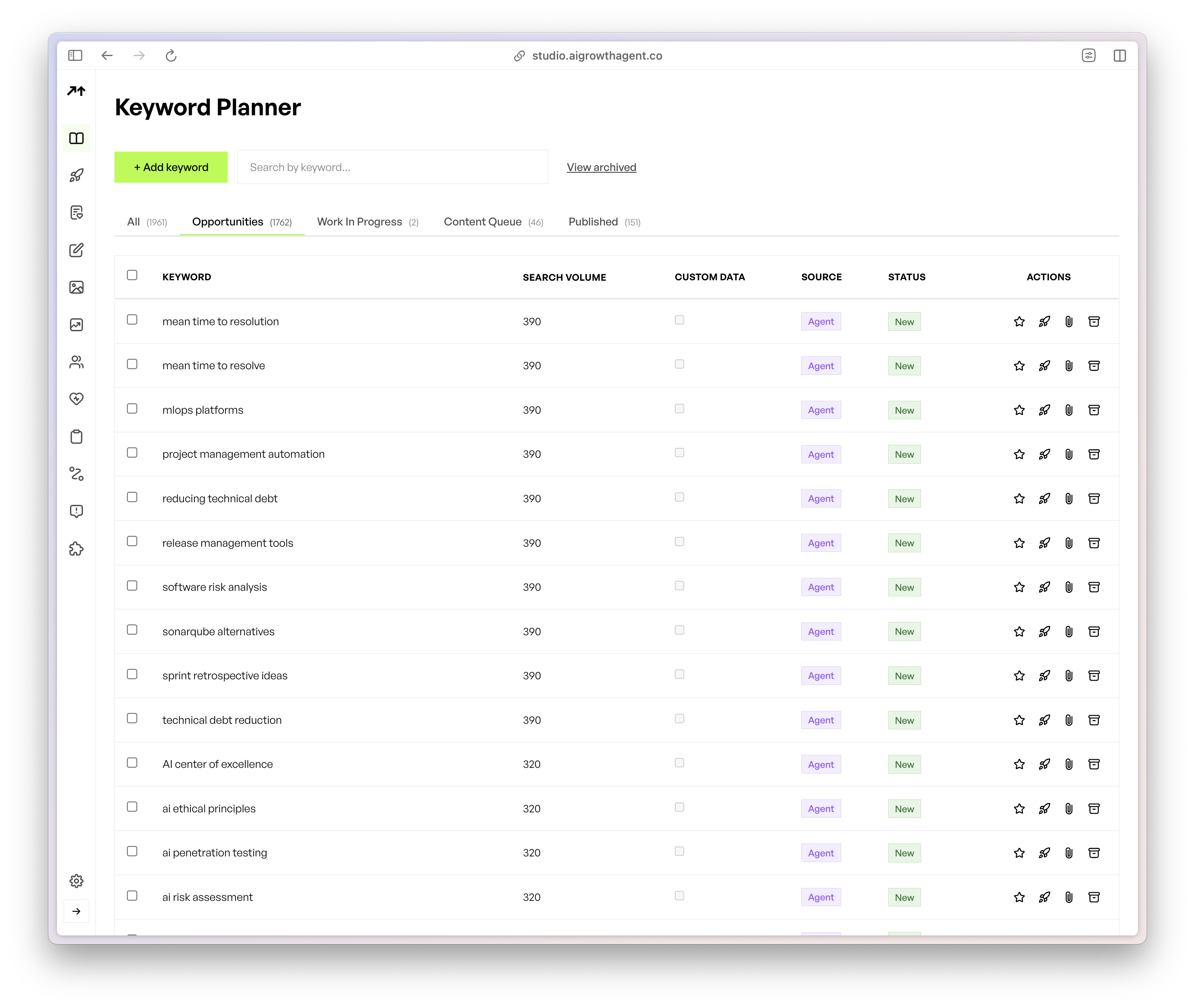
Advanced programmatic SEO systems run large-scale keyword research and clustering across tens of thousands of queries, uncovering content opportunities that manual workflows never reach. Long-tail keywords drive 3.3% of search traffic and work especially well for pSEO scale, since 1,000 pages targeting 50 searches per month can generate 50,000 visits with relatively low competition.
The following table shows how AI Growth Agent’s automated research approach compares to traditional keyword tools across core capabilities.
| Capability | Traditional Tools | AI Growth Agent |
|---|---|---|
| Keyword Volume | Manual research, 100-500 keywords | Autonomous clustering, 10,000+ queries |
| Intent Analysis | Manual categorization | AI-powered intent mapping |
| Content Strategy | Human-developed frameworks | Automated pillar and cluster organization |
Step 3: Optimized Blog Infrastructure with Advanced Protocols
Technical infrastructure provides the backbone for scalable programmatic SEO. Modern setups rely on advanced protocols such as llms.txt files. Only about 0.011% of the top million websites implement valid llms.txt files, compared to 0.015% of the Majestic Million websites (15 sites) that had valid llms.txt files at the start of 2025. These files help AI search engines connect directly with your content, which improves citation accuracy and visibility.
The infrastructure also includes Model Context Protocol (MCP) integration so AI systems can interpret your content with high precision. This technical base supports the creation and management of thousands of pages while still meeting Core Web Vitals standards and keeping content accessible to search engines. With this infrastructure in place, the system can move into autonomous content creation at scale.
Step 4: Autonomous Content Drafting and Optimization
Autonomous content systems handle research, drafting, and fact-checking without day-to-day human input. These systems pull from Company Manifestos, trusted web sources, and proprietary databases to produce unique, high-quality content that outpaces manual production in both speed and consistency.
Client deployments show how quickly this approach can work. One company reached top AI search positions within weeks, and another surpassed Perplexity rankings as the leading alternative to key competitors within two weeks of launch. These results highlight the velocity advantage of autonomous content engines.
Step 5: Technical Schema and Metadata Injection
Advanced programmatic SEO platforms automatically apply deep technical enhancements such as schema markup, metadata, and image optimization. Sites with schema markup-enabled rich results see CTR lifts of 20-40% compared to standard listings, and sites with comprehensive Organization schema are 3.7x more likely to earn Knowledge Panels.
The table below explains how automated technical injection compares with manual implementation across key elements.
| Technical Element | Manual Implementation | AI Growth Agent |
|---|---|---|
| Schema Markup | Developer-dependent, inconsistent | Automated, comprehensive coverage |
| Metadata Optimization | Template-based, limited variation | Dynamic, intent-optimized |
| Image SEO | Manual alt text, basic optimization | AI-generated descriptions, full optimization |
Step 6: Studio Approval and Auto-Pilot Mode
The AI Growth Agent Studio gives teams clear control and visibility over every programmatic workflow. Users review content, share feedback, and define approval rules that allow the system to run on auto-pilot once quality thresholds are met.
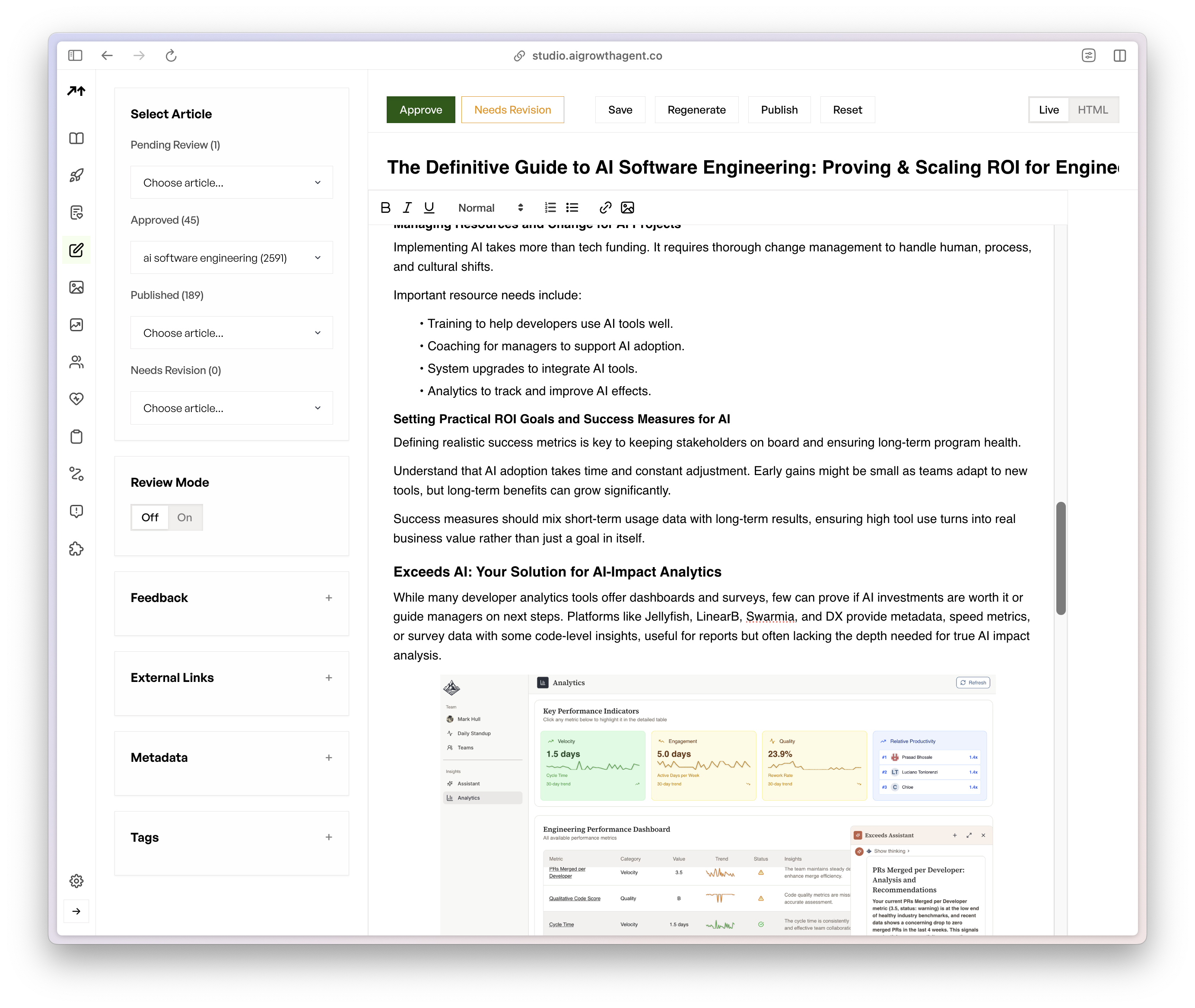
The platform learns from early feedback, improves drafts over time, and eventually operates independently while still matching brand standards. This setup keeps humans in charge of strategy and guardrails while the agent handles execution.
Step 7: Multi-Tenant Publishing and Scale
Modern systems support multi-tenant deployment so you can manage several brands or product lines from a single interface. This structure lets portfolio companies and enterprises scale programmatic SEO across many properties while preserving distinct brand voices and strategies.
Real-world use shows the upside. Companies like Gitar reached recognition as the reference brand for AI-powered CI/CD automation across Google AI Overview, ChatGPT, and Perplexity within two months of deployment.
Step 8: AI Search Monitoring and Performance Tracking
Comprehensive monitoring tracks performance across both traditional and AI search engines. These systems watch citations, rankings, and traffic, including ChatGPT, Gemini, and Perplexity mentions, while also pulling data from Google Search Console for a full view.
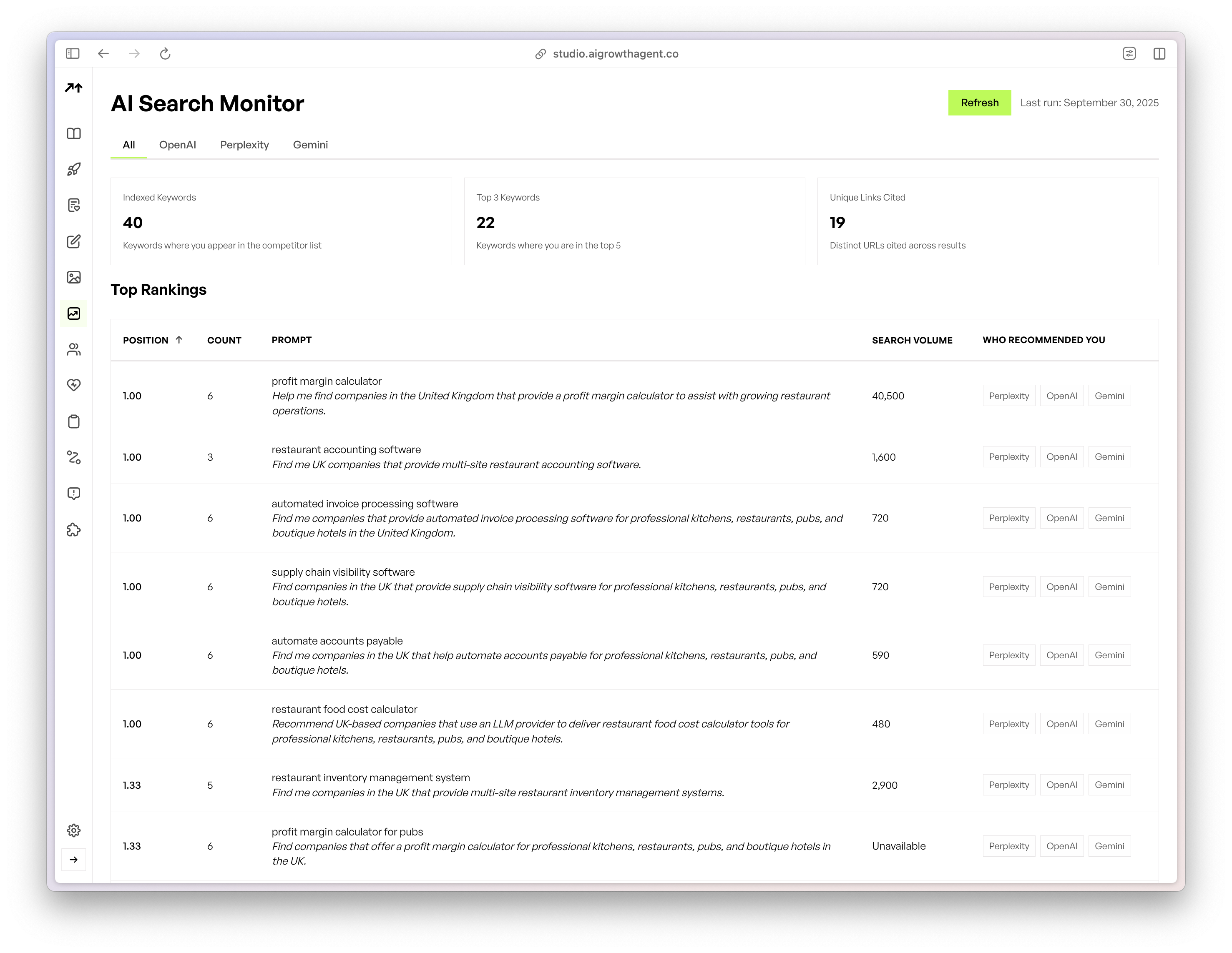
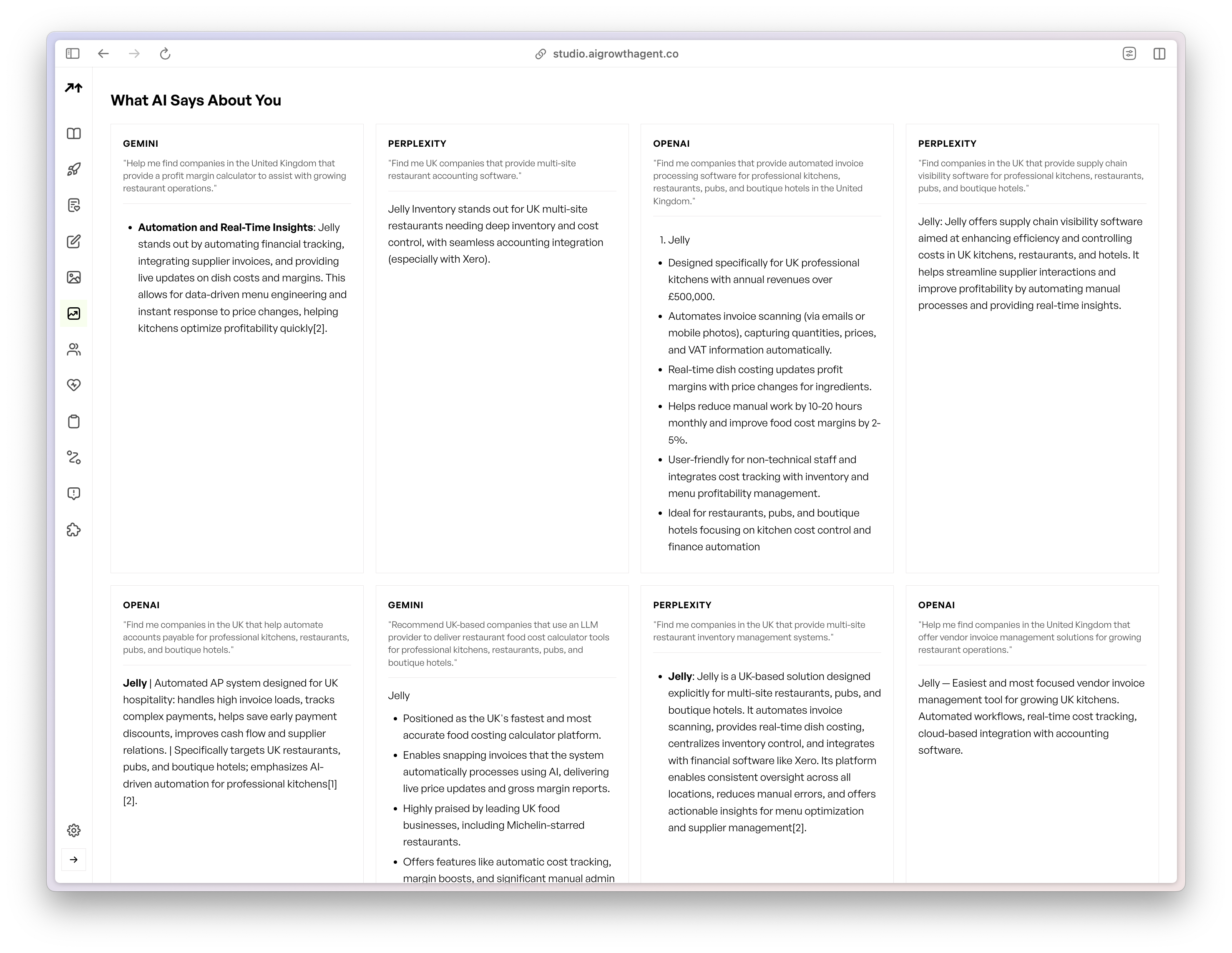
Successful implementations often earn citations quickly. For example, Bucked Up gained ChatGPT citations as a top protein soda brand within three weeks of publishing programmatic content. See how our monitoring tracks AI citations and performance in real time.
Common Mistakes, Troubleshooting & Client Wins
Teams often stumble when they rely on manual content feeds that cannot scale, skip MCP and other advanced protocols, or chase vanity metrics instead of business outcomes. Key red flags that signal a need to pause scaling include indexation ratios below 40%, engagement metrics 50% below site averages, and duplicate content affecting 20% of pages.
Effective troubleshooting uses structured audits in Google Search Console, tight feedback loops, and ongoing improvements to content quality and technical performance. Successful client rollouts prove the value of this discipline. Beyond the Gitar results mentioned earlier, BeConfident became the #1 app in Brazil to learn English through Google AI Overview within weeks of launch.
The table below highlights three frequent mistakes, their impact, and how AI Growth Agent addresses each one.
| Common Mistake | Impact | AI Growth Agent Solution |
|---|---|---|
| Manual content feeds | Limited scalability, high costs | Autonomous research and generation |
| Missing MCP implementation | Poor AI search visibility | Advanced protocol integration |
| Vanity metric focus | No business impact measurement | Revenue and citation tracking |
Discover whether your current setup is ready for programmatic automation and avoid these common pitfalls.
Verifying Outcomes & Advanced Scenarios
Outcome measurement centers on AI citations, organic traffic growth, and business impact instead of rankings alone. Brands that combine Programmatic SEO with AI Experience Optimization capture far more AI-driven traffic than those using only traditional SEO, with visible AI search gains often appearing within 30 days.
Advanced use cases include multi-tenant deployment for portfolios, real-time content injection for trending topics, and database-to-content automation that turns proprietary data into search assets. These scenarios unlock sophisticated programmatic strategies that go well beyond simple page generation.
Conclusion: Deploy Your pSEO Agent Today
The framework in this guide gives you a clear path to automate programmatic SEO content creation at scale. Manual methods cannot keep up with the speed and consistency that 2026’s AI-driven search landscape demands.
AI Growth Agent’s autonomous system resolves the long-standing tradeoff between scale and quality that limited earlier pSEO efforts. When you implement these systems, your company gains the content velocity needed for AI search dominance while still meeting strict quality standards.
The mix of strategic programming, technical automation, and continuous optimization creates an advantage that manual processes cannot match. Take the first step toward autonomous SEO with a personalized demo and position your company as the definitive authority in its category.
Frequently Asked Questions
What are the best tools for programmatic SEO in 2026?
AI Growth Agent currently offers one of the most advanced programmatic SEO solutions, with autonomous content generation, technical optimization, and multi-tenant deployment that go beyond tools like Frase and Zapier. Unlike basic AI writers that need constant manual setup and lack deep technical SEO support, AI Growth Agent delivers end-to-end automation from strategy through publishing and monitoring.
The platform also includes features such as MCP integration, LLM.txt implementation, and real-time AI search monitoring that standard tools do not provide.
How effective is programmatic SEO for startups?
Programmatic SEO works especially well for startups that have structured data and clear content angles. Companies like Gitar show this potential by becoming the reference brand for AI-powered CI/CD automation across major AI search engines within two months.
Startups gain from programmatic SEO’s ability to build topical authority quickly and capture long-tail traffic that would take years with traditional content marketing. The main requirement is enough unique data and a strong focus on quality while scaling.
What timeline should I expect for AI search citations?
As mentioned earlier, citations usually appear within the 2-6 week window once you deploy well-structured programmatic SEO content. Timing still depends on content quality, technical setup, brand authority, and how often search engines crawl your site.
Companies using AI Growth Agent often see first citations within 2-3 weeks, with broader visibility across ChatGPT, Perplexity, and Google AI Overview building over 30-90 days.
How does programmatic SEO compare to agencies and tools like Jasper?
Programmatic SEO automation offers clear advantages over agencies and basic AI writing tools. Agencies rely on manual work, which limits scale and raises costs, often delivering only one or two articles per month at $300-1000 each.
Tools like Jasper help with writing but lack the strategic framework, technical SEO, and publishing automation needed for true pSEO. AI Growth Agent closes this gap by combining autonomous strategy, content generation, technical implementation, and performance monitoring in one system that runs without constant manual effort.
Can programmatic SEO scale to 1000+ pages effectively?
Modern programmatic SEO platforms handle thousands of pages while still protecting quality and performance. Success depends on solid infrastructure, strong quality controls, and phased rollout plans.
Companies like Zapier already prove this at scale with more than 70,000 programmatic pages driving millions of visits. AI Growth Agent’s multi-tenant architecture and automated quality checks support safe scaling to 1000+ pages through engagement monitoring, pruning of weak content, and continuous optimization based on search feedback.
How do I measure ROI from programmatic SEO investments?
ROI tracking focuses on organic traffic growth, AI search citations, lead volume, and revenue attribution instead of rankings alone. The AI Growth Agent Studio offers analytics that include AI citation tracking, organic traffic attribution, conversion monitoring, and revenue impact.
Key metrics include citation frequency in AI responses, traffic growth rates, lead quality and conversion rates, and lower customer acquisition costs. Most programs show measurable gains within 30-90 days, with compounding growth over 12-18 months.
Which CMS platforms integrate best with programmatic SEO?
AI Growth Agent connects with major CMS platforms such as WordPress, Webflow, Hashnode, Framer, Sanity, and HubSpot, although many clients choose the hosted option for smoother performance and simpler operations. WordPress still offers the broadest technical SEO benefits when self-hosting is required.
The hosted solution removes technical overhead while ensuring strong performance, schema coverage, and AI search readiness. When you choose a platform, prioritize technical SEO strength, scalability, and support for protocols like MCP and LLM.txt instead of familiarity alone.
What advanced scenarios does programmatic SEO support?
Advanced programmatic SEO supports use cases such as database-to-content automation for monetizing proprietary data, real-time content for trending topics, multi-brand portfolio management, and dynamic personalization based on user behavior.
AI Growth Agent can, for example, turn mobile app databases into SEO assets, generate content for breaking news, manage pSEO across several portfolio companies from one interface, and create location-specific content variations. These capabilities extend programmatic SEO into full-funnel content strategy automation.