Written by: Mariana Fonseca, Editorial Team, AI Growth Agent
Key Takeaways
- Choosing the right B2B marketing automation platform shapes your workflows, ABM programs, and ability to prove incremental value in 2026.
- Leading platforms differ in pricing, setup time, AI depth, and ABM or intent-data integrations, so teams must match them to company size and technical capacity.
- A structured 7-step selection framework helps teams define MQL and SQL criteria, audit CRM integration, score vendors objectively, and validate AI scoring before full deployment.
- Winning strategies for 2026 favor owned organic content, real-time search-universe mapping, self-healing content engines, and unified data infrastructure instead of paid-media-only plans.
- AI Growth Agent pairs with any B2B marketing automation platform and turns its data into owned, continuously updated blog content that compounds visibility in search and generative AI answers. See how this works for your platform stack and book a consultation to map your current data to a compounding content strategy.
How B2B Marketing Automation Platforms Work
B2B marketing automation platforms are software systems that turn customer behavior signals, such as email opens, site visits, and content downloads, into automated decisions. These decisions trigger relevant messages across channels, update lead scores in real time, synchronize data with CRM systems, and orchestrate account-based marketing programs across the full revenue cycle.
Quick Comparison of Leading B2B Marketing Automation Platforms
This comparison highlights a core trade-off. Platforms with deeper AI personalization and enterprise ABM capabilities usually demand longer implementations and heavier operations support. Faster-to-deploy tools reduce setup friction but often sacrifice some advanced ABM depth and customization. Use this table to match platform complexity to your team’s current headcount, technical capacity, and appetite for long implementations.
The table below compares ten platforms across four dimensions: pricing signals, typical implementation timeline, AI personalization depth, and ABM or intent-data integration. Every data point is drawn from cited sources. Pricing figures reflect publicly available signals and vendor-reported ranges, and enterprise contracts vary and require direct negotiation.
| Platform | Pricing Signals | Implementation Timeline | AI Personalization Depth | ABM / Intent-Data Integration |
|---|---|---|---|---|
| HubSpot Marketing Hub Enterprise | ~$800–$2,500/mo + $3,000–$6,000 onboarding | Moderate, dedicated marketing ops recommended | Breeze agentic suite, AI-assisted content across blog, email, paid | Native CRM reduces Salesforce sync complexity, ABM via integrations |
| Adobe Marketo Engage | Custom pricing, contact sales | Six-month setups common, dedicated marketing ops required | 2026 update adds agentic journey optimization and brand-safe content generation | Revenue Cycle Analyzer, Salesforce source of truth for revenue ops |
| Salesforce Marketing Cloud (SFMC) | From $400/mo (SMB), enterprise pricing on request | Complex, separate AI implementation track required | Einstein agent integration, unified Data Cloud profile layer | Native Salesforce CRM, Data Cloud unifies account signals |
| Salesforce Pardot (Marketing Cloud Account Engagement) | $1,250–$15,000/mo billed annually | Complex, integration dependencies surface late | Einstein AI scoring, path of least resistance for Salesforce-native orgs | Deep Salesforce CRM native, limited standalone ABM |
| Oracle Eloqua | Enterprise custom pricing, contact sales | Longest timelines, granular asset governance and data residency setup | 2026 update adds Oracle AI Agent Studio integration | Highly programmable logic, strict regional data residency for global enterprise |
| 6sense | Custom pricing, contact sales | ABM overlay, deploys on top of existing MAP | Revenue AI agent suite, leads on predictive modelling | Intent data and account targeting overlay, strongest predictive ABM |
| Demandbase | Custom pricing, contact sales | ABM overlay, deploys on top of existing MAP | AI-driven account identification and ad targeting | Leads on integrated advertising and account identification accuracy |
| Oracle Eloqua (see above) / Klaviyo | Volume-based, competitive at scale vs. HubSpot | Weeks for core flows, months for full B2B orchestration | Predictive analytics, behavioral segmentation | Limited native ABM, best suited for high-volume B2C-adjacent B2B |
| Braze | Custom enterprise pricing | Moderate, cross-channel orchestration setup required | Real-time event-based personalization, agentic journey triggers | Intent overlay via integrations, strong mobile and in-app channel coverage |
| Clay (AI-native, emerging) | Usage-based, scales with enrichment volume | Days to weeks for core outbound flows | AI-driven data enrichment and hyper-personalized outreach at scale | Intent signal aggregation from multiple sources, GTM automation focus |
Note on total cost of ownership: A 3–5 year TCO perspective is essential because sliding-scale pricing, training, and add-ons can escalate costs rapidly beyond base subscription fees.
Ready to align your platform selection with an autonomous content strategy? Book a consultation to see how AI Growth Agent turns your platform’s data into owned visibility.
7-Step Platform Selection Framework
- Define company-size fit before shortlisting. Mid-market teams should prioritize ease of use, short implementation timelines, and real-time lead scoring over complex enterprise features, as platforms like Marketo or HubSpot Enterprise often require dedicated marketing operations resources and six-month setups. A six-month setup with a small operations team creates a hidden cost that can exceed the subscription fee, so match platform complexity to your current headcount and technical capacity, not just your feature wishlist.
- Align on MQL and SQL definitions before any demo. Sales and marketing teams must agree on specific MQL and SQL definitions, such as “downloaded two or more resources AND visited the pricing page within 30 days,” before implementing any platform, because these shared lifecycle definitions form the foundation for sales-marketing alignment.
- Audit CRM integration depth, not just compatibility. AI tools within marketing automation platforms that fail to sync with CRM systems in real time produce recommendations based on stale data, so robust CRM integration becomes a critical selection criterion that outweighs having no AI at all.
- Score vendors against a structured scorecard. A practical selection framework should use a scorecard built around fit, implementation risk, support, security, and total cost instead of only a flat feature checklist. Document must-haves, nice-to-haves, and knockout criteria before demos so the shortlist stays objective.
- Evaluate composable-stack fit. Determine whether the platform functions as a standalone system or requires ABM overlays such as 6sense or Demandbase. 6sense and Demandbase function as ABM overlays rather than core marketing automation platforms, providing intent data and account targeting on top of systems like Marketo or HubSpot.
- Run a parallel scoring validation before full cutover. A recommended validation practice is to run rule-based scoring and AI-assisted scoring in parallel for 30 to 60 days before switching, then compare outputs to confirm that the AI model produces consistently reliable results aligned with agreed MQL and SQL definitions.
- Build forward-looking AI workflow criteria into the evaluation. Enterprise B2B marketing automation platforms in 2026 support workflow and journey orchestration that allows marketers to branch on event data, profile attributes, and predictive scores within the same canvas, along with native experiments, holdouts, and progressive rollouts. Evaluate whether the platform’s AI roadmap aligns with where your buyer journey is heading, not just where it is today.
5 Strategic Considerations for 2026 Success
- Paid media does not build durable awareness. The economics of a typical marketing budget, with roughly 80% allocated to paid media, create a structural visibility problem. The moment spend stops, visibility disappears. 96% of B2B marketers report using AI in their roles in 2026, and this creates a structural challenge because resource constraints and tight budgets still force teams to choose between paid visibility today and owned assets that compound over time. A mid-market SaaS company that allocates its entire discretionary budget to paid acquisition rents attention instead of owning it. Organic content keeps working long after it is published and builds authority that paid channels cannot replicate.
- Owned organic content compounds inside AI answers. LLMs now shape a growing share of B2B searches, so AI-driven discovery has become a new competitive moment where organizations with clear, AI-understandable content gain early visibility in buyer research. Many B2B organizations plan to create content that directly answers customer questions, yet fewer invest in tactics that help content surface in AI-generated answers and recommendations. This gap between intent and execution creates room for early movers to win.
- Real-time search-universe mapping replaces capped monitoring tools. Monitoring tools report on the small set of prompts a team already thought to ask about and act as a rearview mirror. A complete picture of the search universe, covering dozens of seed terms and hundreds of long-tail queries refreshed weekly from live Google and ChatGPT data, gives decision-makers a steering wheel instead of a rearview mirror. This approach addresses the root cause behind why many B2B marketers cite data-related issues as a barrier to confident decisions, because most teams have dashboards that report on what already happened rather than infrastructure that shows what to do next. The solution is not more dashboards, it is unified data infrastructure that acts on the full picture.
- Living, self-healing content stays current without manual updates. B2B organizations that implement generative AI for content can reduce cost per asset and improve time to market, but these gains come with a trade-off that includes increased quality oversight demands and a higher risk of factual inaccuracies or hallucinations. The cost problem and the accuracy problem connect, because manual oversight at scale becomes expensive and cutting oversight to save cost increases hallucination risk. An autonomous content engine that validates every claim against live sources, applies anti-hallucination checks at scale, and refreshes every article in batches removes this trade-off by making accuracy automatic instead of manual.
- Unified data infrastructure turns platform outputs into measurable visibility lifts. 68% of IT organizations or technology leaders plan to consolidate vendors or their vendor landscape, typically targeting a 20% reduction, while many also expect to invest in new data and analytics capabilities. Fragmented stacks that rely on a rank tracker, a separate AI-answer monitor, crawler logs, and Google Search Console, none of which talk to each other, cannot drive confident decisions. A single engine that unifies Search Intelligence, AI Analytics, Bot Tracking, and AI Ranking into one infrastructure, and uses that data to decide what content gets produced next, creates measurable and isolated visibility lifts week over week.
AI Growth Agent delivers on this unified infrastructure by converting platform data into owned, continuously updated content without adding headcount. Book a consultation to see how this unified engine would work with your current stack.
Frequently Asked Questions
How long does it take to implement a B2B marketing automation platform and start seeing results?
Implementation timelines vary significantly by platform complexity and organizational readiness. Basic workflows can launch within two to four weeks, while comprehensive enterprise deployments typically require three to six months. Platforms like Marketo and Pardot commonly require dedicated marketing operations resources and six-month setup periods. The most common implementation failure occurs when teams go live before foundational work such as data hygiene, process mapping, and agreed MQL and SQL definitions is complete. A phased rollout that starts with high-confidence use cases such as automated email campaigns and lead routing, followed by AI-driven scoring validation over 30 to 60 days, reduces deployment risk. Results from lead scoring and nurture programs usually require a full buyer-journey cycle, often six months, before pipeline impact can be measured reliably.
Who owns the content and assets generated through an autonomous content engine like AI Growth Agent?
With AI Growth Agent, clients own all content outright. The blog is stood up as a branded property connected to the client’s domain through a reverse proxy rewrite or subdomain, with no agency in the loop and no platform lock-in. This structure differs from many traditional agency arrangements, where the agency often controls the CMS and the client has no direct ownership of the site or its assets. Pricing is a flat fee with no per-article or per-prompt charges, and every article produced belongs to the client from the moment it is published.
Can AI Growth Agent integrate with an existing WordPress site without disrupting the current blog or main website?
Yes. AI Growth Agent stands up a top-of-funnel blog that matches the client’s existing brand styling and connects through a reverse proxy rewrite, typically under a subdirectory or a subdomain. It does not touch the client’s curated main site or existing brand blog. The setup is infrastructure-agnostic, compatible with Cloudflare, Vercel, and other providers, and requires no technical work from the client’s team. The WordPress plugin included in the setup covers bot traffic tracking, Blog MCP, Web MCP, advanced robots.txt, sitemap.xml, and full schema coverage out of the box. Nothing in the existing site structure changes.
How does AI Growth Agent isolate its results from visibility the brand already had before starting?
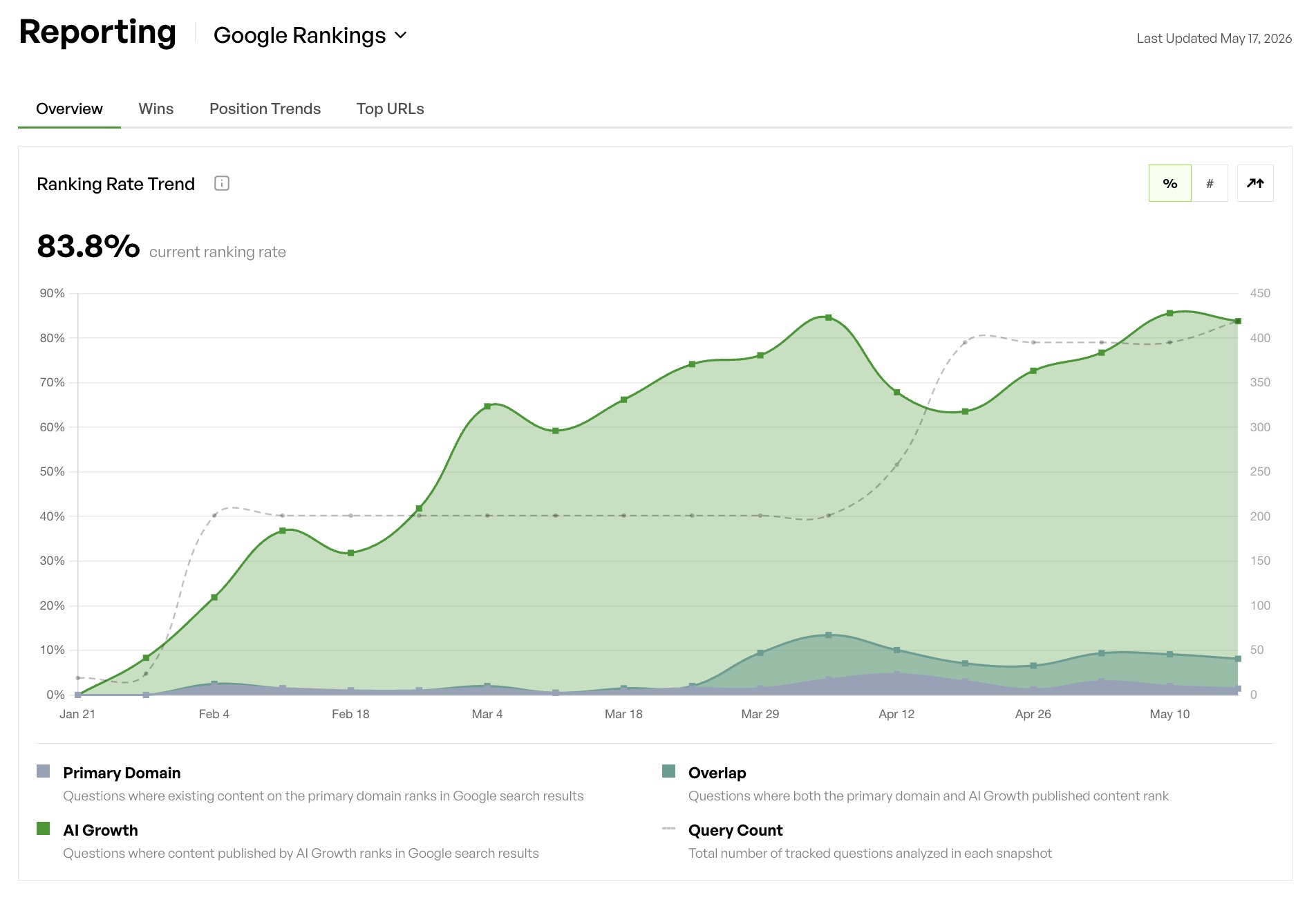
AI Growth Agent’s incremental visibility reporting is built specifically to answer this question. It publishes into a separate environment and reports week over week with a clear separation between primary domain pages, overlapped pages, and AI Growth Agent pages, so the client sees exactly what the engine contributed versus what the brand already owned. The reporting cross-references bot traffic via the WordPress plugin, impressions via Google Search Console, and visibility in Google Rankings, Google AI Overviews, and ChatGPT via AI Growth Agent’s proprietary dashboard. Clients who measure conversion also capture lead source at their conversion moments, which enables direct attribution of organic leads to AI Growth Agent content. No other platform integrates all four measurement layers into a single subscription.
Conclusion: Connect Your Platform Choice to a Compounding Content Engine
The right B2B marketing automation platform creates the operational foundation for sales-marketing alignment, ABM execution, and AI-driven personalization. Many businesses report benefits from AI-driven personalization at scale, and most leading businesses invest in AI to drive revenue growth. The platform alone does not build durable awareness, because it generates data, signals, and workflows that remain invisible to buyers unless teams convert them into authoritative, indexable content that surfaces in search and generative AI answers.
AI Growth Agent is the autonomous content engine built for that job. It maps the brand’s full search universe from real-time Google and ChatGPT data, produces authoritative and search-ready content at scale, stands up a fully owned blog in as early as one week, and self-heals every article so authority compounds instead of decaying. Across the first three months, clients average more than 12,000 additional AI citations and mentions, over 100,000 additional bot visits, and a 20% or greater lift in impressions in Google Search Console.
The platform decision and the content engine decision are not the same decision, yet they belong in the same conversation. Book a consultation to align both decisions and turn your platform data into owned, compounding visibility.