Written by: Mariana Fonseca, Editorial Team, AI Growth Agent
Key Takeaways for Google I/O 2026 AI Search
-
Google I/O 2026 confirmed AI Mode has crossed one billion monthly users with Gemini 3.5 Flash as the global default, which makes authoritative, schema-rich content essential for visibility.
-
93% of AI Mode searches end without a click, but brands cited in responses see significantly more organic and paid clicks than non-cited competitors.
-
Effective preparation means mapping your full search universe, producing validated schema-rich content with E-E-A-T signals, and refreshing weekly to maintain citation authority.
-
Agentic booking, information agents, and custom generative UI all rely on the same citation logic: validated primary sources with full schema coverage and dynamic structured data.
-
AI Growth Agent delivers incremental visibility by mapping your search universe and producing living content that earns AI citations, so schedule a demo today.
How Google AI Mode Works in 2026
AI Mode is a conversational search experience powered by Gemini that preserves context across an entire session. Users can start from an AI Overview, ask follow-up questions, and continue deepening the conversation with increasingly relevant links. Queries in AI Mode have more than doubled every quarter since launch, and last quarter set an all-time high in volume on Google’s new Gemini 3.5 Flash default.
The zero-click rate sits at 93%, which makes citation placement critical. Most AI Mode searches end without a click to any external website, so only cited brands gain traffic. Cited brands see measurably more organic and paid clicks than non-cited competitors, which creates a compounding gap between brands that earn citations and those that do not.
Citation context now functions as the primary visibility metric. Where a brand appears in an AI answer, who it is grouped with, and what claim it is cited for all shape perception. Content that earns those citations must be structured so bots can parse it, backed by validated primary sources, and refreshed frequently enough that the next model sweep finds the brand’s current narrative.
Three-Step Plan to Prepare for Google I/O AI Changes
Step 1: Map your full search universe
Most brands track a handful of head terms and lose the rest of the conversation by default. The actual battleground is the long tail, the hundreds of specific prompts real customers ask. Users now employ an average of 5.48 words in ChatGPT searches versus 3.4 words on traditional Google, which means the queries that drive AI citations are far more specific than the terms most brands currently defend. Start with seed terms that anchor your market. Then extract every long-tail prompt beneath them from real-time Google and ChatGPT data.
Step 2: Produce schema-rich, validated content
Properly implemented schema markup, including Article, HowTo, Organization, and related types, has become essential infrastructure for AI citation eligibility in 2026 because it makes your content machine-readable. Machine-readable content still needs to be trustworthy, so every claim must be validated against live primary sources, not a model’s training data. This validation supports Google’s E-E-A-T requirements and shows who created the content, how it was produced, and why it exists to help users.
Step 3: Refresh weekly
Living content, updated continuously so authority compounds rather than decays, keeps a brand’s narrative current across model retraining cycles. Publishing once and stopping trains the next generation of AI with a stale narrative that drifts further from reality over time.
Content Requirements for Agentic Booking and Local Services
The three-step preparation framework applies across all Google I/O features, but agentic booking introduces specific technical requirements that deserve closer attention. Agentic booking has been extended to local services, from home repair to pet care. Information agents operating 24/7 surface pricing, availability, and direct booking links through the provider of choice.
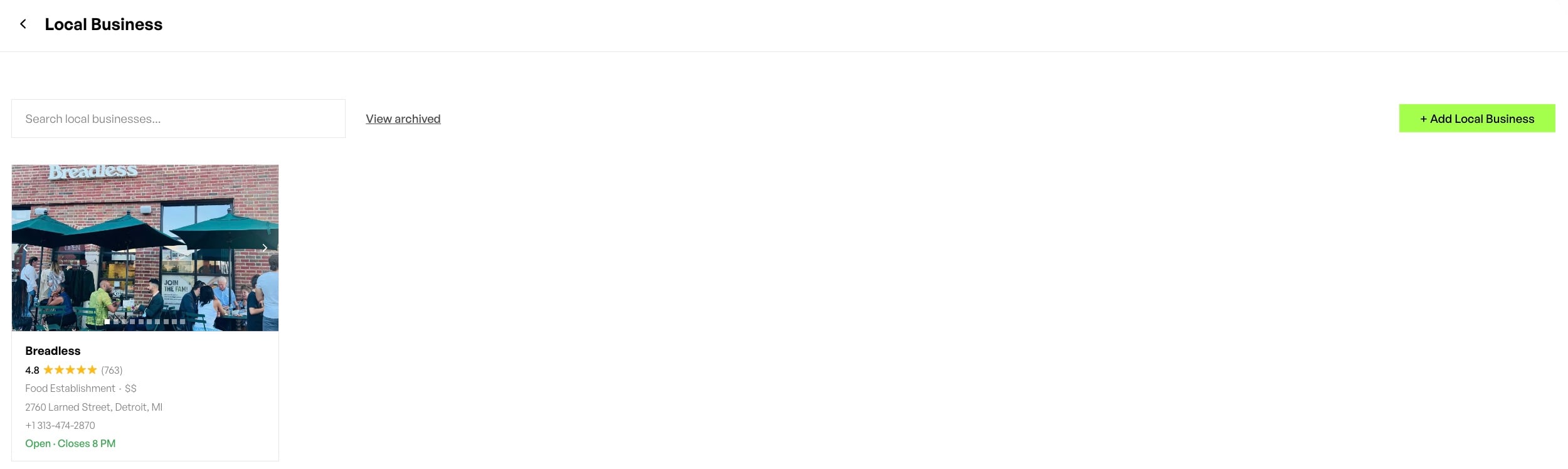
For brands in these categories, the content requirements are specific and strict. Local Business schema must be complete and accurate, including service area, hours, and category. Real-time availability signals, structured data that reflects current inventory or scheduling, guide information agents when they decide which provider to surface. A page that looks polished to a human visitor but lacks machine-readable availability data remains invisible to an agent making a booking decision on a user’s behalf.
FAQ schema attached to service pages, combined with direct answers to the implicit sub-questions agents decompose from complex queries, earns placement in agentic results. Clear responses on price, availability, and service scope give agents everything they need to select your brand.
Technical Foundations for Information Agents and Custom Generative UI
Information agents launching this summer for Google AI Pro and Ultra subscribers will monitor the web 24/7. They will reason across web content, news, social posts, and real-time data to send synthesized updates with action options. Custom generative UI, including interactive visuals, tables, graphs, and simulations assembled on the fly using Google Antigravity and Gemini 3.5 Flash, will be available to all Search users this summer at no charge.
Both surfaces share the same citation logic and pull from whatever the model can find, trust, and render. Supplying validated primary sources with full schema coverage functions as the entry requirement. Dynamic elements, structured data that updates as the brand’s product, pricing, or positioning changes, allow a brand to appear inside a persistent dashboard or custom mini-app instead of being summarized away.
Making your content accessible to information agents requires a complete technical foundation. An LLM.txt file tells agents what content exists. A proper sitemap.xml maps your site structure. Advanced robots.txt directives control crawl behavior. Model Context Protocol (MCP) endpoints expose real-time data that agents can query. Together, these elements ensure agents can discover, parse, and trust your content. Brands without this infrastructure are not being evaluated and rejected; they are simply not being read.
Shifting from Reactive Monitoring to Narrative Control
Publishers have voiced concerns that AI Overviews and AI Mode threaten referral traffic. The industry response has largely been to add monitoring tools. But monitoring only tells a brand where it stands, functioning as a rearview mirror.
Upstream narrative control takes the opposite approach. Brands produce the content the models will use to describe them, in the formats and structures the models can read, with the validation that earns the citation. The shift to AI search means publishers must focus on becoming sources that are named and cited, rather than just summarized.
AI Growth Agent operates as a digital brand manager rather than a monitoring add-on. The engine begins with a Company Manifesto, a journalist-led deep dive into the brand’s unique positioning, then derives a Content Topology mapping every seed term and long-tail query in the brand’s search universe. Content is produced, published with full technical SEO, and self-healed over time. The result is a living content system that steers what AI says about the brand, not a dashboard that reports it after the fact.
Playbook and Table for Claiming Long-Tail Queries
The table below maps each major Google I/O 2026 announcement to the required content structure, schema type, and freshness standard brands must meet to earn citations on that surface.
|
I/O 2026 Feature |
Required Content Structure |
Schema Type |
Freshness Requirement |
|---|---|---|---|
|
AI Mode (Gemini 3.5 Flash default, context-preserved sessions) |
Answer-first paragraphs, question-based H2s, topic clusters with internal linking |
Article, FAQ, HowTo |
Weekly refresh; see Step 3 for the living content approach |
|
Service pages with direct answers to price, availability, and scope sub-queries |
LocalBusiness, Service, Offer |
Real-time availability signals, updated as inventory or scheduling changes |
|
|
Information Agents (24/7 web monitoring, synthesized updates) |
Validated primary-source content, structured data readable by crawlers and training agents |
Organization, Article, NewsArticle |
Continuous; bots and agents are now a primary audience for websites |
|
Custom Generative UI and Mini-Apps (Antigravity, persistent dashboards) |
Dynamic structured data, MCP endpoints, LLM.txt, sitemap.xml, advanced robots.txt |
SoftwareApplication, Product, Review |
Synced to product and pricing changes, since static pages are not rendered in dynamic UI |
Based on AI Growth Agent client data, brands average more than 12,000 additional AI citations and mentions, over 100,000 additional bot visits, and a 20%+ lift in impressions in Google Search Console across the first three months. All of these gains are reported as incremental visibility, isolated from the brand’s existing presence.
How AI Growth Agent Proves and Grows Incremental Visibility
Incremental visibility reporting isolates exactly what AI Growth Agent content generated, week over week, separate from the visibility the brand already had. The engine cross-references four data pillars: bot traffic via a WordPress plugin that captures every crawl, including GPTBot, impressions via Google Search Console, appearance in Google AI Overviews and ChatGPT via a proprietary dashboard, and traditional organic rank against competitors.
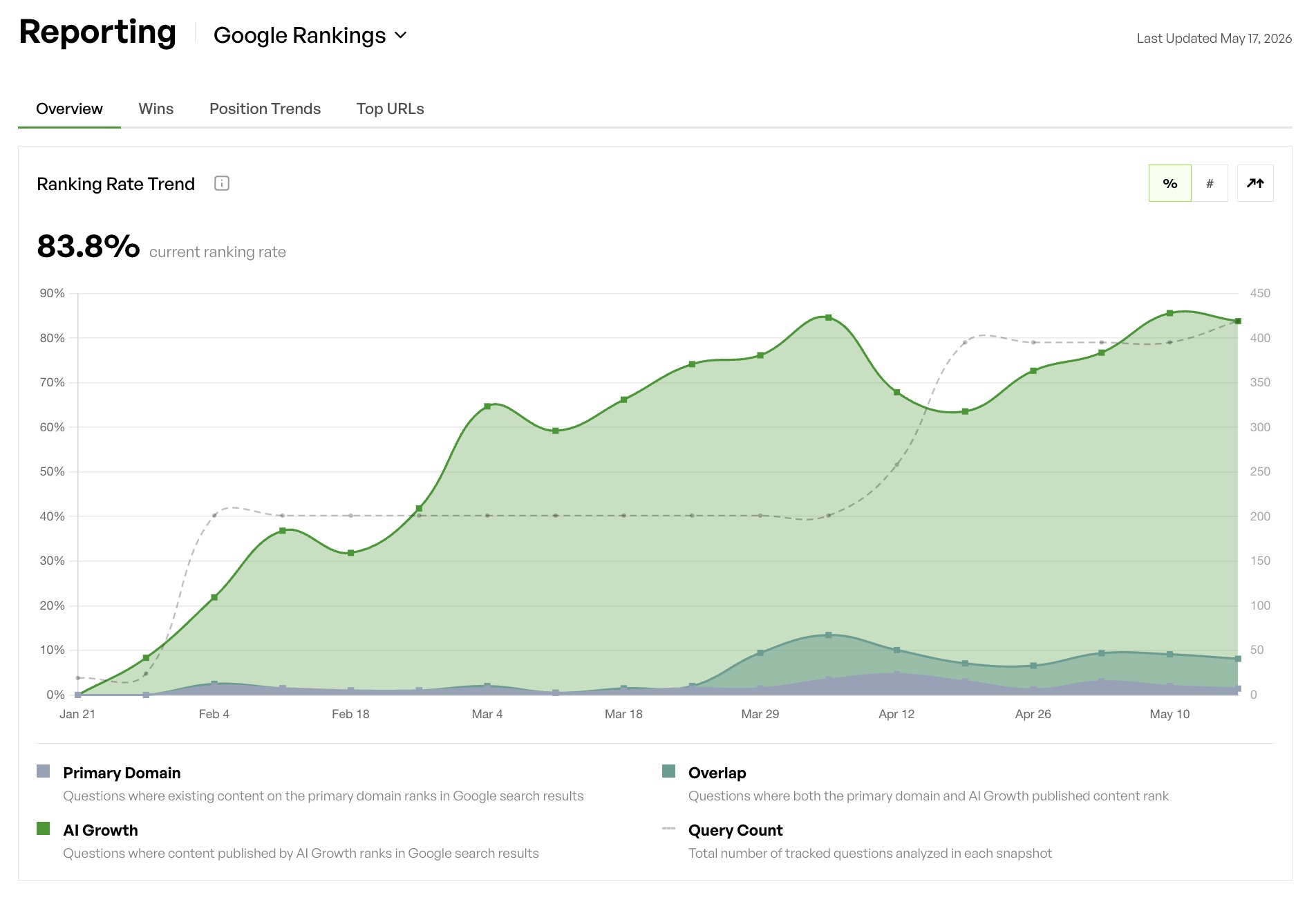
This setup does not function as a stack of disconnected tools. It operates as one centralized data infrastructure where the same data that proves results decides what gets produced next. Monitoring tools cap clients at a small set of self-inputted prompts. AI Growth Agent tracks dozens of seed terms and hundreds of long-tail queries beneath them, refreshed every week, with prompt count never treated as a billed metric.
Brands evaluating whether to use Claude or an internal team instead need to consider process, not just output. A chatbot can produce one article. Producing the second requires running the entire process again, including the schema to maintain, the legal language to get right, and the quality that drifts over time.
AI Growth Agent is the system around the model: Company Manifesto, Content Topology, full technical SEO, and self-healing content that compounds rather than decays.
Frequently Asked Questions
How fast will content index after Google I/O updates?
AI Growth Agent goes from kickoff to first published article in as early as one week. Content has indexed in as little as two weeks, though indexing timelines vary by industry and domain authority. The standard engagement is a three-month pilot because compounding visibility, the kind that earns consistent AI citations, builds across multiple model retraining cycles, not a single publication event. Living content that refreshes continuously re-signals freshness to crawlers and training agents, which accelerates and sustains indexing over time.
What schema is now required for AI Mode citations?
The schema requirements outlined in Step 2 apply across all content types, with specific additions for different surfaces. LocalBusiness, Service, and Offer support agentic booking. SoftwareApplication or Product support technology and commerce brands. Author schema adds credibility signals that support E-E-A-T evaluation. AI Growth Agent’s WordPress plugin provisions all of these automatically, including schemas built from the client’s own product features, target audiences, and verified reviews. No technical skill is required from the client’s side.
Why does living content outperform one-time publishing?
AI models are retrained on sweeps of the open web. A page published once and left static trains the next model generation with whatever narrative existed at publication, including outdated positioning, superseded product details, and stale competitive context. The living content approach from Step 3 works because continuous updates ensure every training sweep finds the brand’s current narrative. These updates also re-signal freshness to Google’s crawlers, which supports ongoing indexation. Authority compounds instead of decaying, and each refresh reinforces the brand’s topical depth and citation eligibility across an expanding set of queries.
How is this different from using monitoring tools alone?
Monitoring tools show where a brand currently appears for a capped set of prompts the client already thought to ask about. They function as a rearview mirror and do not produce content, apply schema, set up a blog, validate claims, or self-heal stale articles. Some monitoring platforms have begun adding node-based agents that an engineer can configure for simple automated actions, but enterprise-grade, brand-aware content tied to live data requires a precisely configured knowledge base and far more complexity than a handful of nodes. It still requires the client to build and maintain the configuration.
AI Growth Agent deploys the equivalent agents automatically, with nothing for the client to wire. The engine acts on data and uses monitoring as one of several layers to prove its incremental results, not as the product itself.
Conclusion: Put Narrative Control on Autopilot
Google I/O 2026 did not adjust the rules of search visibility; it rewrote them. AI Mode at one billion monthly users, information agents monitoring the web around the clock, agentic booking calling businesses on a user’s behalf, and custom generative UI assembling interactive experiences on the fly all run on cited, validated, schema-rich content. Brands that produce this content earn the citation. Brands that do not are training the next model generation with whatever happens to be sitting on the open web.
Reactive monitoring tells you the score after the game. Upstream narrative control, a living content system built on a Company Manifesto, a full Content Topology, and self-healing articles refreshed weekly, is what changes the score. AI Growth Agent is that system, one autonomous engine that maps your search universe, produces authoritative content at scale, and delivers measurable incremental visibility across Google AI surfaces and ChatGPT without adding headcount.