Written by: Mariana Fonseca, Editorial Team, AI Growth Agent
Key Takeaways for Perplexity AI Citations
- Perplexity citations increase when pages use answer-first formatting, deliver a direct response in the first 50 words, and pack each section with specific, verifiable data.
- A seven-step autonomous framework maps your full search universe, generates brand-aligned content, applies technical enhancements, and maintains living documents that grow authority over time.
- Content generation blends the Company Manifesto with real-time search results and live-source validation, then structures each section using the Answer-Evidence-Depth pattern for easy extraction.
- Self-updating content systems with batched weekly refreshes prevent citation decay, as pages not updated within 13 weeks see a 50% citation drop compared to recently refreshed pages.
- AI Growth Agent runs the autonomous engine that maps search universes, generates validated content, and maintains living documents so your brand becomes the default answer across AI search platforms. Schedule a demo to see how this engine would work for your site.
How to Improve AI Citations
Traditional SEO alone no longer delivers AI citation success. By 2026, search discovery has shifted from ranked links toward synthesized AI answers, so visibility depends on citation inclusion rather than page position. Traditional crawlers index content, while LLMs interpret, rank, and predict answers.
AI systems reward extractability, verifiability, and contextual clarity instead of keyword density. Perplexity AI prioritizes quantified data and verifiable facts over vague statements, which makes claims like “the market grew 23% in 2025” more likely to be cited than general assertions. Pages need complete, standalone answers with supporting evidence in every section.
Autonomous systems now outperform traditional agency models on cost, scale, and refresh cadence. Manual production cannot keep pace with the volume and update frequency required for sustained AI visibility. Only systems that combine search universe mapping, anti-hallucination validation, and automated publishing can compete in the AI citation landscape, which is exactly what the following seven-step framework delivers.
Perplexity Citation Strategy: The Seven-Step Autonomous Framework
Successful Perplexity optimization uses a seven-step autonomous framework that replaces fragmented agency and DIY approaches. This system maps the complete search universe, generates brand-aligned content, applies full technical enhancements, and maintains living documents that compound authority over time.
The framework closes the gap between slow, expensive agencies and scattered DIY tools that cannot produce authoritative content at scale. Traditional approaches miss embedded intelligence at the beginning with real-time search data, in the middle with fact validation and legal compliance, and at the end with optimized hosting and incremental measurement.
Each step builds on the previous one to create a self-reinforcing system. Content quality, technical implementation, and performance measurement work together to raise citation probability and strengthen brand authority across AI platforms.
Step 1: Map the Full Search Universe
Full search universe mapping pulls seed terms and long-tail queries from real-time Google and ChatGPT data without prompt caps. In 2026, prompts and intent clusters replaced keywords as the main focus for optimization in AI-driven search, so comprehensive universe mapping now anchors strategic positioning.
The system analyzes competitor signals, “people also ask” boxes, forum discussions, and content gaps to uncover winnable spaces. This approach moves beyond traditional keyword research and captures the specific questions and intent behind each user search. Mature implementations track more than 1,500 queries refreshed weekly, which provides real-time visibility into market movements and competitor activity.
Universe mapping reveals the full battleground instead of a narrow list of self-selected terms. When competitors flood the web with thousands of pages or algorithm updates shift citation patterns, brands see those changes immediately and respond faster than teams relying on legacy monitoring tools.
Step 2: Build a Company Manifesto for Brand-Safe Content
A Company Manifesto captures unique brand positioning through a journalist-led interview process and ingestion of unstructured materials such as brand guidelines, marketing PDFs, and product pages. This documentation becomes the foundation for all content generation, which keeps messaging consistent and reduces hallucinations at scale.
The manifesto solves the problem of generic AI content by creating brand-specific context that chatbots cannot easily copy. It includes detailed feature descriptions, approved messaging, target audiences, and competitive differentiators that guide every generated article.
This step shifts content from generic industry commentary to authoritative brand expertise. The manifesto becomes the preferred source for all articles and is referenced constantly to check external information, filter out dissonant claims, and maintain a consistent voice across hundreds of pieces.
Step 3: Generate Authoritative Content with Anti-Hallucination Validation
Content generation blends the Company Manifesto with real-time search results and live-source validation. Cited content on Perplexity often uses explicit concepts and clear Q&A formatting, which increases citation rates.
Multi-agent orchestration deploys research agents across the web for each article, analyzing current Google and ChatGPT results, competitor signals, and forum discussions. These agents feed raw research into a validation layer that checks every claim and source against live data instead of model training data, while memory systems save feedback to prevent the same hallucinations from appearing in future articles.
Once validated, the system structures content using the Answer-Evidence-Depth pattern. Each section starts with a direct, self-contained answer in the first 50 words, follows with 100 to 150 words of supporting data and citations, then expands into context and examples. This structure aligns with Perplexity’s preference for immediately extractable factual content during its RAG-based synthesis process and improves citation odds.
Schedule a consultation session to see how this validation workflow maintains quality while scaling content output.
Step 4: Apply Schema, MCP, Robots.txt, and Sitemaps for AI Parsing
Technical implementation covers Article, FAQ, Author, Organization, and Product schema along with advanced WordPress plugin deployment. Correct schema markup can drive measurable citation lifts in AI Overviews and Perplexity.
The WordPress plugin provides bot traffic tracking, Blog MCP, Web MCP, advanced robots.txt, proper sitemap.xml, and automatically generated web stories. These features support the schema implementation that drives citation visibility. FAQPage, Article with author attribution, Organization, and HowTo rank among the highest-priority schema types for AI citation visibility because they map closely to the question-and-answer format AI systems prefer.
These schema types are implemented in JSON-LD format, which separates structured data from HTML for cleaner processing by AI systems and easier validation during generation. Schema markup converts ambiguous prose into explicit, machine-readable facts that LLMs can parse, verify against defined relationships, and cite with higher confidence.

Step 5: Publish to a Client-Owned Blog Without Dependency
Blog setup connects through reverse proxy rewrite or subdomain configuration so the client owns the property outright with no agency dependency. The blog matches the client’s existing design and supports both traditional search and AI-driven discovery.
Generated articles move into a review queue and publish automatically on set cadences instead of in large bulk releases. This approach maintains consistent publishing velocity while preserving room for human review. The setup remains infrastructure-agnostic and works with Cloudflare, Vercel, or any hosting provider.
The blog functions as a top-of-funnel property that does not interfere with existing curated content. The system applies technical SEO best practices automatically, including heading hierarchy, meta descriptions, and internal linking structures that support both rankings and citations.
Step 6: Implement Batched Weekly Refreshes to Prevent Citation Decay
Living content systems run batched updates where every article refreshes automatically to maintain authority and indexation. Pages not updated within 13 weeks see a 50% citation decay compared to recently refreshed pages, which shows how strongly AI systems favor recent content.
Many pages cited by AI are recently updated, so regular refresh cycles become essential for sustained visibility. The system updates statistics, examples, and recommendations while keeping the dateModified field current in Article schema.
Refresh triggers rely on signals such as competitor content gains, citation losses on high-value queries, product changes, new research data, and platform algorithm updates. This proactive approach prevents visibility decay and helps pages compound momentum once they start earning citations.
Step 7: Track Incremental Visibility from AI Search
Unified dashboard reporting separates the impact of the autonomous system from existing brand visibility. Measurement covers bot traffic via the WordPress plugin, impressions via Google Search Console, and citations across Google AI Overviews, ChatGPT, and Perplexity through proprietary tracking.
The system reports week-over-week indexing with clear separation between primary domain pages, overlapped pages, and new content. This structure solves the challenge of proving incremental results instead of claiming credit for visibility you already had.
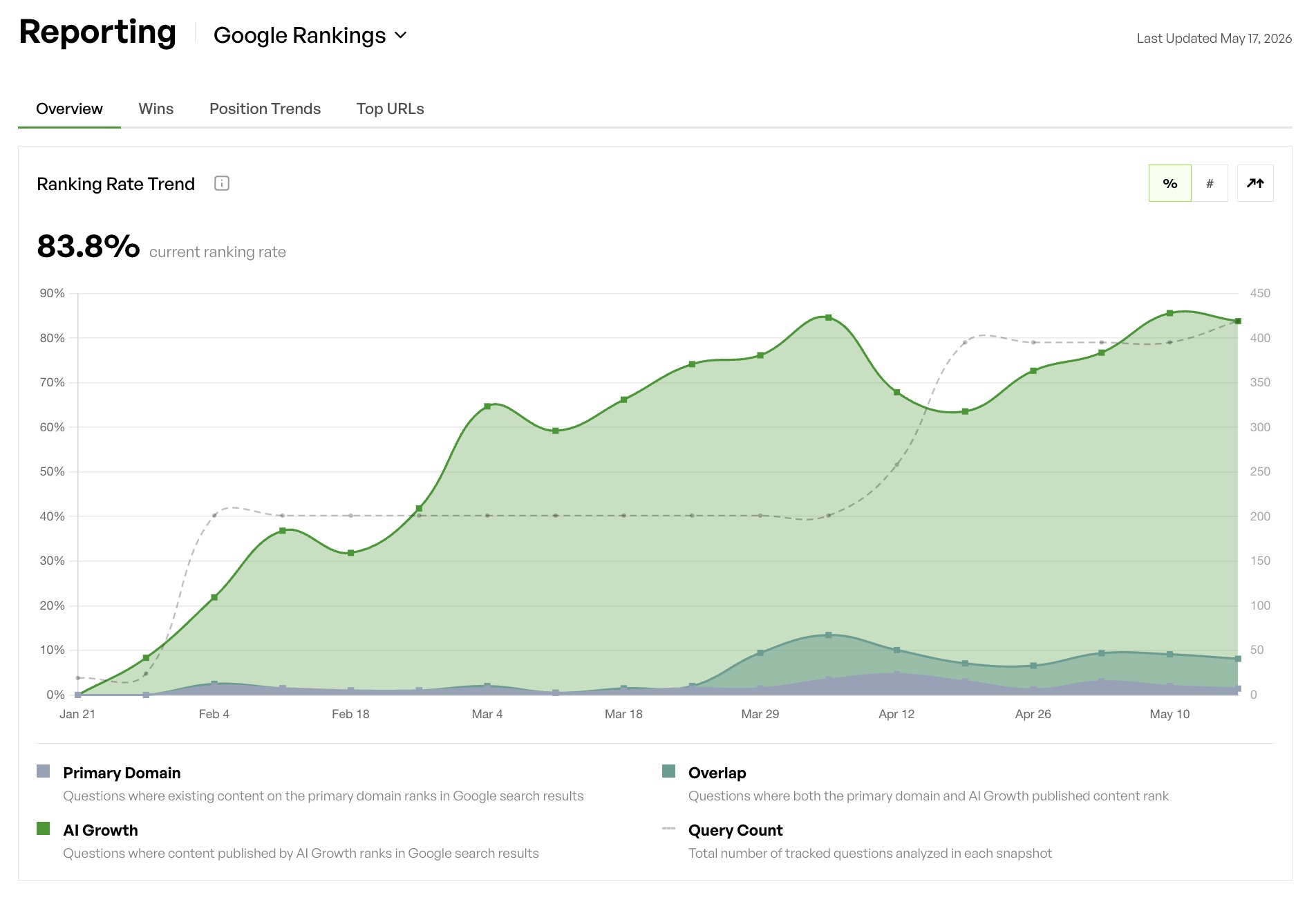
Real-time crawler identification shows which bots, including GPTBot, access the site. AI referral traffic converts at 4.4x the rate of traditional organic search despite representing just 1.08% of total website visits, so precise measurement becomes critical for ROI calculations.
Structured Data for Perplexity: Where Schema Delivers the Biggest Lift
Schema implementation creates measurable citation improvements across AI platforms. The data below highlights how Product schema delivers the strongest citation lift, outperforming generic schema by 18 percentage points, while FAQ and Article schema provide steady, reliable gains across editorial and support content.
| Content Type | Without Schema | With Valid Schema | Improvement |
|---|---|---|---|
| Editorial Articles | Baseline citation rate | Improved with author attribution | Positive lift |
| FAQ Content | Standard citation levels | Enhanced with FAQPage schema | Increased likelihood |
| Product Pages | 59.8% citation rate | 61.7% with rich Product schema | Outperforms generic schema (41.6%) by 18 points |
| Overall AI Visibility | Baseline performance | Higher citation probability with valid schema | Positive improvement |
AI systems often show higher accuracy when content includes structured data instead of only unstructured text. Schema gives models a cleaner signal about entities, relationships, and page purpose.
Factual density that improves citation probability includes specific statistics (“the market grew 23% in 2025”), named entities with context (“Perplexity AI’s Sonar models prioritize high-confidence snippets”), and quantified comparisons (“pages with FAQ sections receive more citations”). Each type of detail creates a different extractable signal for AI systems.
Schedule a demo to see your current schema gaps, missed citation opportunities, and the impact of automated implementation.
Refresh Content for AI Search at Scale
Self-updating content systems solve the challenge of maintaining hundreds of articles without hiring a full-time optimization team. AI-cited content is 25.7% fresher than organic Google results, which makes traditional 6–12 month refresh cadences insufficient.
The refresh checklist prioritizes structural extractability and evidence attribution before recency signals. Pages with clean structure and clear citations often earn more AI visibility than messy pages that cover the same topics.
Tiered refresh cadences help teams allocate effort efficiently. Core revenue content receives full refreshes every 90 days, high-traffic educational content updates quarterly, and long-tail evergreen content refreshes annually unless citation decay appears. High-velocity industries double these frequencies.
Automated systems handle updates, validation, and publishing without manual intervention, which addresses common objections about content staleness, proof requirements, and technical complexity. The system protects content authority while reducing operational overhead.
Frequently Asked Questions
How quickly can we expect to see AI citation results?
The first article can go live within one week of kickoff, and content can index in as little as two weeks. Most brands see initial citation improvements within four to eight weeks, with Perplexity responding fastest because of its recency bias. The standard engagement runs as a three-month pilot since indexing timelines vary by industry and competition.
Do we own all the content and the blog property?
You own the blog property outright with no agency dependency. The system launches a branded blog connected through reverse proxy rewrite or subdomain and styles it to match your existing site. All generated content belongs to your company, and the blog operates independently of any external platform or agency control.
How does this scale without adding technical headcount?
The autonomous engine manages all technical requirements, including WordPress plugin deployment, schema markup, robots.txt configuration, and sitemap generation. Your team provides feedback in plain language to our team or directly to the engine. No one on your side needs to write or maintain code, and all optimizations apply automatically to future content.
Can you prove the results are incremental to our existing visibility?
The system publishes into a separate environment and reports incremental visibility, isolating exactly what it generated week over week. Measurement includes bot traffic via the WordPress plugin, impressions via Google Search Console, and citations across multiple AI platforms through proprietary tracking. This setup ensures accurate attribution of new visibility versus your existing presence.
How do you handle legal compliance and industry-specific requirements?
The engine supports dynamic legal disclaimers, claim prioritization from internal documentation, and validation against credible sources instead of model training data. Requirements are configured once during setup and then applied automatically to every future generation. The system supports regulated industries through customizable compliance frameworks and approval workflows.
Conclusion: Turn Brand Positioning into Perplexity Citations
The seven-step autonomous engine replaces fragmented agency and DIY approaches with a complete system that maps search universes, generates validated content, applies technical enhancements, and maintains living documents that build authority over time. Many brands still lack a complete GEO strategy, which creates a meaningful opportunity window for early adopters.
Traditional approaches cannot match the scale, consistency, and refresh cadence required for durable AI visibility. Only autonomous systems that combine real-time search intelligence, anti-hallucination validation, and automated publishing can compete effectively in the AI citation landscape.
The shift from rankings to citations changes how brands earn visibility and trust. Success now depends on systems that do more than monitor what is happening and instead actively change what is happening. AI Growth Agent helps your brand become the answer across AI search platforms.
Schedule a demo to see if you are a strong fit for the autonomous engine that turns brand positioning into consistent Perplexity AI citations and compounding organic presence.