Written by: Mariana Fonseca, Editorial Team, AI Growth Agent
Key Takeaways
- Robots.txt controls which crawlers and AI training bots can access specific paths, while llms.txt guides AI agents to the right content and context.
- Both files are required in 2026 for brands that want consistent visibility across search and AI answers, because they handle access and comprehension separately.
- Robots.txt is nearly universal among large brands, but llms.txt adoption remains low and most current implementations fail basic specification checks.
- Manual upkeep of both files creates real operational risk at scale, especially when engineering, SEO, and content teams update them in isolation.
- AI Growth Agent provisions, maintains, and measures both files automatically with full bot tracking as part of its agentic technical SEO stack, so you can schedule a consultation to see how it works.
Eight Criteria for Managing Crawlers and AI Agents
CMOs and builders at scale need a practical way to judge how robots.txt and llms.txt fit into their stack. Eight dimensions determine whether any file-management approach works in the real world.
- Implementation complexity. How much engineering time does initial deployment require, and what can break during setup?
- Scalability across hundreds of pages. Does the file stay accurate as the site grows, or does it demand constant manual curation?
- Workflow fit with existing site architecture. Does the file integrate cleanly with your CMS, reverse proxy, and subdirectory structure, or does it need a separate deployment pipeline?
- Technical requirements. What server-level, DNS, or plugin dependencies does the file introduce?
- Governance and compliance. Can the file be audited, versioned, and updated quickly when regulations or brand policies change?
- Reporting visibility into bot activity. Does the file generate measurable signals, and can you see which bots read it and follow it?
- Maintenance burden. How often does the file need updates, and what events trigger those changes?
- Long-term adaptability to evolving AI surfaces. Will the file still matter as new AI agents, crawlers, and agentic browsing standards appear?
These eight criteria frame every trade-off in the category-by-category analysis below. First, a side-by-side comparison clarifies how the two files differ structurally.
Side-by-Side Comparison of Llms.txt and Robots.txt
| Dimension | Robots.txt | Llms.txt |
|---|---|---|
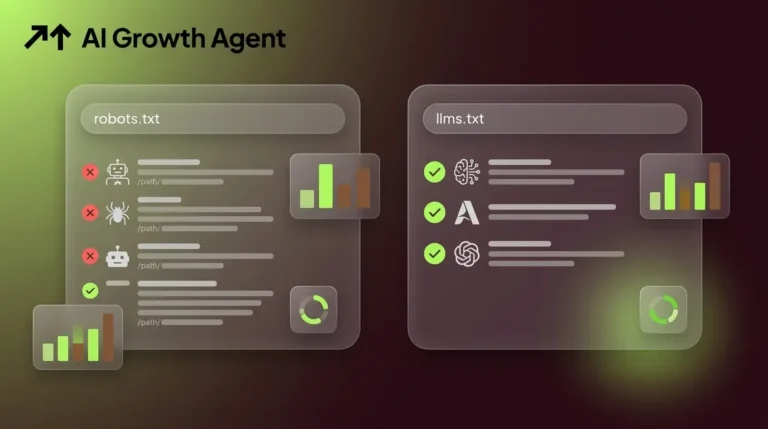
| Primary purpose | Access control: instructs crawlers which paths to fetch or skip | Content guidance: provides AI agents a curated Markdown map of site purpose and priority pages |
| File format | Plain text with User-agent, Allow, and Disallow directives | Markdown with H1 site name, blockquote summary, H2 Core section, and optional H2 sections listing URLs |
| Placement | Root of each domain or subdomain (e.g., example.com/robots.txt) | Root path of the site (e.g., example.com/llms.txt) |
| Enforcement mechanism | Honored by compliant crawlers, and 30% of AI crawler requests violated robots.txt rules in Q4 2025 | Advisory only, with no blocking directives, and no major LLM provider has formally adopted it as part of its crawler protocol as of 2026 |
| Adoption rate (2026) | 92.8% of Fortune 500 companies | 7.4% of Fortune 500 companies (37 of 500); 5.86% of Tranco Top 10,000 domains in a May 2026 crawl |
| Companion file | Sitemap.xml for URL discovery | Llms-full.txt, which embeds complete content directly for AI systems with larger context windows |
| AI crawler support | GPTBot, Google-Extended, ClaudeBot, PerplexityBot all honor robots.txt directives | Advisory signal, and OpenAI, Anthropic, Google, and Meta have not confirmed crawler-level usage |
| Google’s position | Authoritative, because Googlebot reads and enforces it | Google’s May 2026 AI optimization guide states machine-readable files like llms.txt are not needed for generative AI search, yet Chrome Lighthouse added an llms.txt audit in May 2026 |
| Primary use case in 2026 | Governing traditional crawlers and AI training bots, and protecting private paths | Providing AI agents a low-noise, structured entry point to brand content, and supporting agentic technical SEO |
Category-by-Category Analysis
Setup and Implementation Complexity
Robots.txt has a long implementation history, and every major CMS, CDN, and hosting provider supports it natively. The file uses plain text, and its directives are well-documented. The primary risk is precision, because a single character error can break crawl access across an entire site. Subdomain deployments also require a separate file per subdomain, which multiplies the maintenance surface for large organizations.
Llms.txt is newer and simpler in structure, yet its value depends on content quality rather than syntax alone. A May 2026 crawl of the Tranco Top 10,000 found that valid llms.txt files appeared on fewer than 6% of domains, which means most implementations that exist are technically broken. A file that returns a 200 status but fails the specification provides no useful signal to AI agents and may mislead them. Llms-full.txt adds a second file that embeds complete content directly and must stay synchronized with the live site.
Operational Efficiency and Maintenance Burden
Robots.txt remains stable once configured correctly, yet it still requires review after every major site restructure, CMS migration, or new subdirectory launch. AI crawler directives such as Google-Extended, GPTBot, and ClaudeBot also need explicit management, and in late 2024, AI bots led by GPTBot and Claude accounted for 28% of Googlebot traffic, which makes AI crawler governance a material operational concern.
Llms.txt requires active curation because its value depends on content quality, not just technical correctness. Best practice is to organize it around user journeys rather than site hierarchy, prioritizing the content that answers 80% of questions in the first 20% of the file. That structure must evolve as the content library grows. The file needs updates for new priority pages, deprecated content, and structural changes, which creates a recurring manual task that most marketing teams deprioritize without automation.
Quality Control and Governance
Robots.txt governance is binary, because a path is either allowed or disallowed. Compliance by major crawlers is high, yet studies show AI crawlers violated robots.txt on 72% of UK sites per Cloudflare data, with non-compliance rates for requests ranging from 12.9% to 30% in 2025 analyses. Effective governance therefore requires log monitoring to detect violations instead of assuming full compliance.
Llms.txt governance is qualitative and depends on both format and message. A March 2026 study of 105,002 hotel websites found that 7.3% of llms.txt files misused the format by serving robots.txt-style User-agent, Allow, and Disallow rules instead of content descriptions. Misuse does not trigger an error, yet it fails to deliver the intended signal. Governance therefore requires format validation and regular content accuracy review.
Technical Depth and Agentic Technical SEO
Robots.txt and llms.txt sit on different layers of an agentic technical SEO stack. Robots.txt acts as the access layer and determines what bots can reach. Llms.txt acts as the comprehension layer and shapes what AI agents understand about the content they can reach. Robots.txt rules override llms.txt, so disallowed paths in robots.txt prevent AI bots from fetching content even when that content appears in llms.txt. The two files therefore require coordination rather than isolated management.
Llms-full.txt extends the comprehension layer by embedding complete content directly, which removes the need for an AI agent to follow links and fetch additional pages. Fern reports reducing token consumption by over 90% compared to parsing full HTML pages by serving clean Markdown through llms.txt and llms-full.txt. For brands with large content libraries, llms-full.txt becomes the mechanism that makes the full library usable for AI agents working within context-window limits.
Scalability Across Growing Content Libraries
Robots.txt scales cleanly because adding new content rarely requires file changes unless new paths need explicit allow or disallow rules. Llms.txt does not scale passively. Every new priority page, product update, or content category can trigger an update to the file. Recommended use cases for llms.txt include complex B2B sales cycles, regulated industries, multi-location brands, and API-driven platforms, which all involve large, frequently changing content surfaces. Without automated provisioning, llms.txt becomes a liability at scale rather than an asset. Understanding which organizations face this scaling challenge most directly clarifies who benefits most from automated management of both files.
Best-Fit Use Cases for Dual-File Management
Enterprise CMOs Running Multi-Brand Portfolios
Enterprise CMOs managing multiple brands across many domains need both files maintained accurately without adding engineering headcount. Robots.txt errors at this scale can suppress entire site sections from crawl. Llms.txt gaps push AI agents back to raw HTML, which usually highlights navigation, scripts, and boilerplate instead of authoritative content. These teams need automated provisioning and self-healing for both files, with bot tracking that reveals when AI agents read the files and act on them.
Founders and Builders Requiring Fast Launch
Founders or CEOs acting as CMOs need both files live and correct from day one, without a long agency RFP cycle. Their risk profile differs from enterprise, because a single misconfigured robots.txt can block a new site from indexing before it gains any authority. A correctly deployed llms.txt in the first week positions the brand for AI agent discovery as soon as content starts indexing. Speed and correctness matter more than deep customization.
PR Agencies Managing Many Client Sites
PR agencies that run AI Growth Agent for clients need both files provisioned per client, maintained as content libraries expand, and measured for bot activity. Their value proposition depends on proving incremental visibility across AI surfaces, which requires bot tracking at the file level and the page level. Automated provisioning across many client sites removes the per-client engineering overhead that makes manual management unscalable.
Operational and Long-Term Considerations
Onboarding Effort and Team Dependencies
Robots.txt changes usually require engineering sign-off because a single error can suppress crawl access across the site. Llms.txt changes carry lower technical risk yet demand content team input to stay accurate. In practice, both files sit at the intersection of engineering, SEO, and content, which means they rarely receive the timely updates they need when managed manually.
Infrastructure and Reverse Proxy Alignment
Brands running headless marketing architectures with blogs connected through reverse proxy rewrites under subdirectories must serve both files correctly at the domain root. A subdirectory blog that serves its own robots.txt or llms.txt without coordination with the root domain creates conflicting signals. The reverse proxy configuration must route both files correctly, and the files must describe the full content surface, including the subdirectory blog.
Adaptability to New AI Surfaces
Google added an llms.txt audit to Chrome Lighthouse under a new Agentic browsing audits section on May 5, 2026, which signals that agentic browsing standards are moving into mainstream infrastructure. The Fortune 500 adoption rate mentioned earlier reflects a broader trend, because valid llms.txt adoption in the Tranco Top 1,000 grew from 0.3% in June 2025 to 7.50% by May 2026, a 25x increase in under a year. Brands that establish correct implementations now sit ahead of the adoption curve instead of scrambling when major AI providers formalize their usage.
Risks, Limitations, and Common Misconceptions
Robots.txt Risks to Watch
Accidental over-blocking is the most common robots.txt risk. A catch-all Disallow directive intended for one section can suppress the entire site when placed incorrectly. Google stopped supporting the unofficial noindex directive in robots.txt as of September 1, 2019, yet outdated CMS plugins still generate it. AI crawler governance through robots.txt also remains imperfect, because aggressive harvesters like Bytespider and CCBot are often blocked by default due to zero referral traffic, while compliant AI answer engines that do drive referral traffic require deliberate allow rules.
Llms.txt Risks and Misconceptions
The most significant misconception is that llms.txt functions like robots.txt for AI agents and can block access. It does not, because the file is purely advisory as noted in the comparison above. A second misconception is that publishing the file guarantees AI agents will read it. A 90-day experiment found that AI bots made only 84 requests to /llms.txt out of more than 62,100 total AI bot visits, representing about 0.1% of AI bot traffic. The file’s value is directional and cumulative rather than immediate. A third misconception is that any file returning HTTP 200 is valid, yet the low validation rate mentioned earlier confirms that most published files fail specification requirements.
The Coordination Risk Between Files
If a catch-all Disallow rule is in place in robots.txt, the llms.txt file itself must be explicitly allowed, such as Allow: /llms.txt, or AI bots will be blocked from reading it. Managing both files in isolation creates silent failures that remain hard to diagnose without server-log analysis.
Decision Framework: If-Then Checklist
- If you need to block specific paths from traditional search crawlers and AI training bots, then robots.txt is the required file, and it must be reviewed after every major site change.
- If you want AI agents to understand your site’s purpose and priority content without processing raw HTML, then llms.txt is the required file, and it must stay current as your content library grows.
- If you have a large content library that exceeds typical AI context windows, then llms-full.txt is the required companion file, embedding complete content for AI systems that can ingest it.
- If you use a catch-all Disallow rule in robots.txt, then you must explicitly allow /llms.txt and /llms-full.txt or AI agents will be blocked from reading your guidance files.
- If you are running a headless marketing architecture with a subdirectory blog, then both files must be coordinated at the domain root and reflect the full content surface including the blog.
- If you cannot maintain both files manually without adding technical headcount, then automated provisioning with self-healing becomes an operational requirement.
- If you need to measure whether AI agents are reading your files and acting on them, then bot tracking at the file and page level is required, not just aggregate traffic reporting.
- If you need both files live, correct, and measured from day one without an agency or engineering dependency, then AI Growth Agent provisions, maintains, and measures both files automatically as part of its full agentic technical SEO stack.
Frequently Asked Questions
How long does it take to implement both llms.txt and robots.txt correctly?
Robots.txt can be configured in hours when the site architecture is well-documented, although validating it against all crawl paths and AI crawler directives usually takes longer. Llms.txt requires content curation that reflects real priority pages, which depends on how organized the content library is. The larger time investment comes from ongoing maintenance, because both files need updates whenever site structure or content priorities change. AI Growth Agent provisions both files automatically during site setup, with the first article live within about one week of kickoff and content indexing in as little as ten days, so your team avoids manual configuration and ongoing maintenance.
Do you need technical expertise to maintain both files?
Robots.txt requires enough technical understanding to avoid accidental over-blocking that suppresses entire site sections from crawl. A single misplaced directive creates real risk. Llms.txt requires content judgment more than technical skill, yet format validation still matters because many published llms.txt files fail specification requirements despite returning valid HTTP status codes. AI Growth Agent removes both requirements by provisioning valid robots.txt and llms.txt automatically. The only client-side integration step is the reverse proxy rewrite that connects the blog to a subdirectory under the brand’s domain.
Can llms.txt replace robots.txt for controlling AI agents?
No. As established earlier, llms.txt is a guidance file without blocking capability, not an access-control mechanism. Robots.txt remains the only way to instruct crawlers, including AI crawlers like GPTBot, ClaudeBot, and Google-Extended, to skip specific paths. The two files serve complementary functions, because robots.txt governs access and llms.txt governs comprehension. Both are required in 2026 for complete governance of traditional crawlers and AI agents.
How do you measure whether llms.txt is working?
Direct measurement remains limited because most major AI providers have not confirmed that they read llms.txt as part of their crawler protocol. The practical approach uses server-log analysis to track requests to /llms.txt and /llms-full.txt by bot type, combined with bot tracking at the page level to monitor AI agent activity across the content library. AI Growth Agent’s bot tracking surfaces every bot interaction, including traditional crawlers and AI training agents, across every crawl, citation, and training sweep. This cross-referenced signal shows whether AI agents engage with the content the files highlight, instead of relying on file-level request counts alone.
What happens if llms.txt and robots.txt conflict?
Robots.txt rules take precedence. When a path is disallowed in robots.txt, an AI bot will not fetch it even if it appears in llms.txt. The most common silent failure involves a catch-all Disallow rule that blocks the llms.txt file itself, which prevents AI agents from reading the guidance file. Coordinating both files requires explicit allow rules for /llms.txt and /llms-full.txt whenever broad disallow rules exist. AI Growth Agent manages this coordination automatically so the files stay consistent and llms.txt remains accessible to compliant AI crawlers.
Conclusion: Control Your Narrative Across AI Answers
Robots.txt and llms.txt work together as complementary layers of a complete bot governance strategy. Robots.txt controls what crawlers can access. Llms.txt tells AI agents what your site contains and where to find the content that matters. In 2026, operating without both files means either leaving AI agents to parse raw HTML for brand information or failing to govern which paths traditional crawlers and AI training bots can reach.
The real challenge lies in maintaining both files accurately at scale, coordinating them with each other and with the broader technical SEO stack, and measuring their impact through bot tracking instead of assumption. That challenge grows as content libraries expand, site structures evolve, and new AI surfaces appear with their own crawl behaviors.
AI Growth Agent provisions both files automatically as part of its headless marketing engine. Every site it launches ships with a valid robots.txt, llms.txt, and llms-full.txt, coordinated with the full agentic technical SEO stack including Blog MCP, agent discovery via /.well-known/, schema, sitemaps, and real-time bot tracking. The files self-heal as the content library grows, and bot tracking surfaces every AI agent interaction across every crawl, citation, and training sweep. Your team provides feedback in plain language, and the engine handles the rest.
Clients average more than 12,000 additional AI citations and mentions, over 100,000 additional bot visits, and a lift of more than 20% in impressions across the first twelve weeks. The first article typically goes live within about one week of kickoff.