Written by: Mariana Fonseca, Editorial Team, AI Growth Agent
Key Takeaways
- Schema markup boosts AI citations indirectly by strengthening Googlebot indexing and the knowledge graphs that feed AI Overviews and agentic systems, not by direct LLM consumption.
- Organization, Article, FAQPage, Author, and Product schema with sameAs links deliver the highest citation rates because they establish brand identity, authorship credibility, and clear, extractable answers.
- Valid JSON-LD must be server-side rendered in raw HTML, validated through Google Rich Results Test, refreshed with accurate dateModified values, and kept free of nesting errors to avoid suppressing AI visibility.
- Deploying schema at scale without engineering overhead requires a reverse-proxy blog architecture paired with an agentic technical SEO stack that includes llms.txt, bot tracking, and living content that self-heals.
- AI Growth Agent automates the entire schema workflow so mid-market and enterprise teams achieve measurable citation lifts without manual effort; see how the platform works for your team.
Phase 1: How AI Actually Reaches Your Schema
AI search systems do not read your JSON-LD directly, so schema must influence them through search indices. Major AI web-search systems follow a multi-step retrieval pipeline in which the model issues a web-search tool call, retrieves results from a SERP API, and generates answers while maintaining an ephemeral citation index for the session. OpenAI, Google, and Anthropic obtain search results primarily through SERP APIs provided by major search engines rather than by directly parsing page markup.
The practical implication is clear: schema’s value for AI citations flows through improved Googlebot indexing, not through direct LLM consumption. Structured data exerts an indirect effect on AI Overview performance by strengthening traditional search indexing and knowledge graphs, which then feed the retrieval-augmented generation (RAG) process used by AI Overviews. Many AI crawlers cannot reliably access client-side rendered schema markup, reinforcing this indirect mechanism.
Given this indirect mechanism, the first step is to verify your schema is positioned to strengthen that indexing signal. The required input for this phase is a clear audit of how your schema is currently rendered: server-side static HTML versus JavaScript-rendered. AI parsing success rates are significantly higher for static HTML with schema than for JavaScript-rendered content. Validation checkpoint: confirm your JSON-LD is present in the raw HTML response, not injected post-render.
Phase 2: Schema Types That Drive AI Visibility
Only a subset of schema types consistently influence the search indices that feed AI systems. For enterprise brands, Organization, WebSite, WebPage, Article, Person, and FAQPage schema matter most because they establish brand identity, authorship credibility, page intent, and extractable answers that AI systems rely on when generating summaries and recommendations.
The evidence for specific types is substantial and repeatable. Research indicates that websites with author schema are more likely to appear in AI answers. FAQPage markup makes pages 3.2x more likely to appear in Google AI Overviews, while sites adding FAQ blocks saw an increase in AI search citations. Product schema combined with AggregateRating makes products 3x more likely to appear in AI-generated recommendations than basic markup alone.
Entity linking amplifies every type by tying your brand into the broader graph. According to Semrush’s April 2026 coverage, how a brand is represented in Google’s Knowledge Graph directly influences whether and how it appears in AI Overviews, AI Mode, and other Gemini-powered surfaces because Gemini AI is trained on the Knowledge Graph. Sites with comprehensive Organization schema are more likely to earn Knowledge Panels, which further reinforce AI visibility.
Validation checkpoint: every priority page carries Article or WebPage, FAQPage where Q&A content exists, Author with sameAs linking to authoritative profiles, and Organization with sameAs pointing to Wikidata, LinkedIn, and Crunchbase.
Phase 3: Page-Specific Prompts That Output Clean JSON-LD
Generating valid JSON-LD at scale requires page-type-specific prompt templates, not a single generic instruction. Each template must draw from three core inputs: the page’s primary entity type, the content’s factual claims, and the brand’s primary-source URLs. These inputs shape different specifications depending on the page type.
For an article page, the prompt template should specify Article type, headline, datePublished, dateModified, author with sameAs, publisher with logo, and a FAQPage block if the article contains Q&A sections. Product pages require a different set: Product type, name, description, AggregateRating, Offer with price and availability, and Brand with sameAs.
Marketers can ask ChatGPT or Claude to generate schema markup by describing their content, such as requesting JSON-LD for a product schema, but the output must be validated against primary sources before deployment. The critical discipline is anti-hallucination. Every property value must be verified against the page’s actual content. A model generating schema from memory rather than from the live page will introduce errors that undermine the confidence signal schema is meant to provide.
Brands with strong Organization schema plus sameAs coverage experience fewer AI hallucinations, which means accurate schema reduces the risk of AI systems misrepresenting your brand in citations. Validation checkpoint: run every generated block through Google’s Rich Results Test and Schema.org validator before deployment.
Phase 4: Fixing Schema Errors Before They Suppress Citations
The most common schema generation mistakes fall into four categories. First, missing primary-source validation means properties like author, datePublished, and price are populated from model memory rather than the live page, producing values that contradict the actual content. Second, incorrect schema nesting places FAQPage blocks inside Article blocks rather than as sibling types at the page level, causing parsers to ignore the FAQ entirely.
Third, failure to refresh stale markup hurts freshness. Pages updated within 2 months earn 28% more citations from AI engines than older pages, with dateModified schema serving as the freshness signal AI systems use, so markup that does not reflect the actual modification date actively suppresses citation eligibility. Fourth, generic minimal implementations underperform. Generic or minimal schema implementations achieve only a 41.6% AI citation rate, compared to 61.7% for attribute-rich schema.
The validation checklist for every deployment covers JSON-LD present in raw HTML response, no nesting errors flagged by Schema.org validator, dateModified matching the actual last-edit timestamp, sameAs properties linking to live authoritative external profiles, FAQPage questions matching verbatim headings on the page, and AggregateRating values matching the live review data source.
Phase 5: Reverse-Proxy Blog and Agentic SEO Stack in Practice
Scaling schema without an internal engineering team requires a decoupled architecture. This setup separates the brand’s curated main site from the content engine while keeping everything under the same domain. AI Growth Agent stands up a fully optimized blog the brand owns, connected through a reverse proxy rewrite under a subdirectory or subdomain, so nothing in the existing site structure changes.
Every article and every site ships with the full agentic technical SEO stack live on day one. The stack includes Blog MCP for direct interoperability with AI search, OpenAI discovery and Agent Card guidance served via /.well-known/, natural language query parameters via /?s={query} that auto-trigger personalized internally linked responses, Markdown served to agent crawlers, and llms.txt and llms-full.txt published so AI surfaces can read the brand the way they need to. Andrea Volpini, CEO and Co-founder of WordLift, states that the rise of agentic AI makes structure and standards essential, recommending structured data everywhere along with machine-readable standards such as llms.txt and SEOntology to optimize for AI retrieval channels.
Chris Green, Technical Director at Torque, recommends pairing schema markup with clean lightweight HTML, minimized JavaScript reliance, and simplified information architecture, and advises site audits using multiple crawlers to ensure weaker LLM crawlers can access and understand content. The reverse-proxy deployment satisfies all of these requirements without touching the brand’s existing infrastructure. Validation checkpoint: confirm the subdirectory resolves correctly, the sitemap.xml includes all published URLs, and the robots.txt exposes the blog to all major AI crawlers.
Phase 6: Measuring Incremental AI Visibility
Standard analytics cannot isolate what schema and agentic technical SEO actually generated, so a dedicated measurement framework is required. The framework relies on three parallel data streams. First, per-article bot tracking identifies every crawl by ChatGPT’s citation bot, Google’s AI Overview crawler, and training agents. Second, Google Search Console acts as an independent audit of impressions and click data tied to specific URLs.
Third, citation-context monitoring tracks where the brand appears in AI answers, what claim it is cited for, and how that position evolves week over week. Incremental visibility reporting then isolates exactly what the engine generated, separate from visibility the brand already had, so the weekly snapshot review shows only the lift attributable to new schema deployments and content.
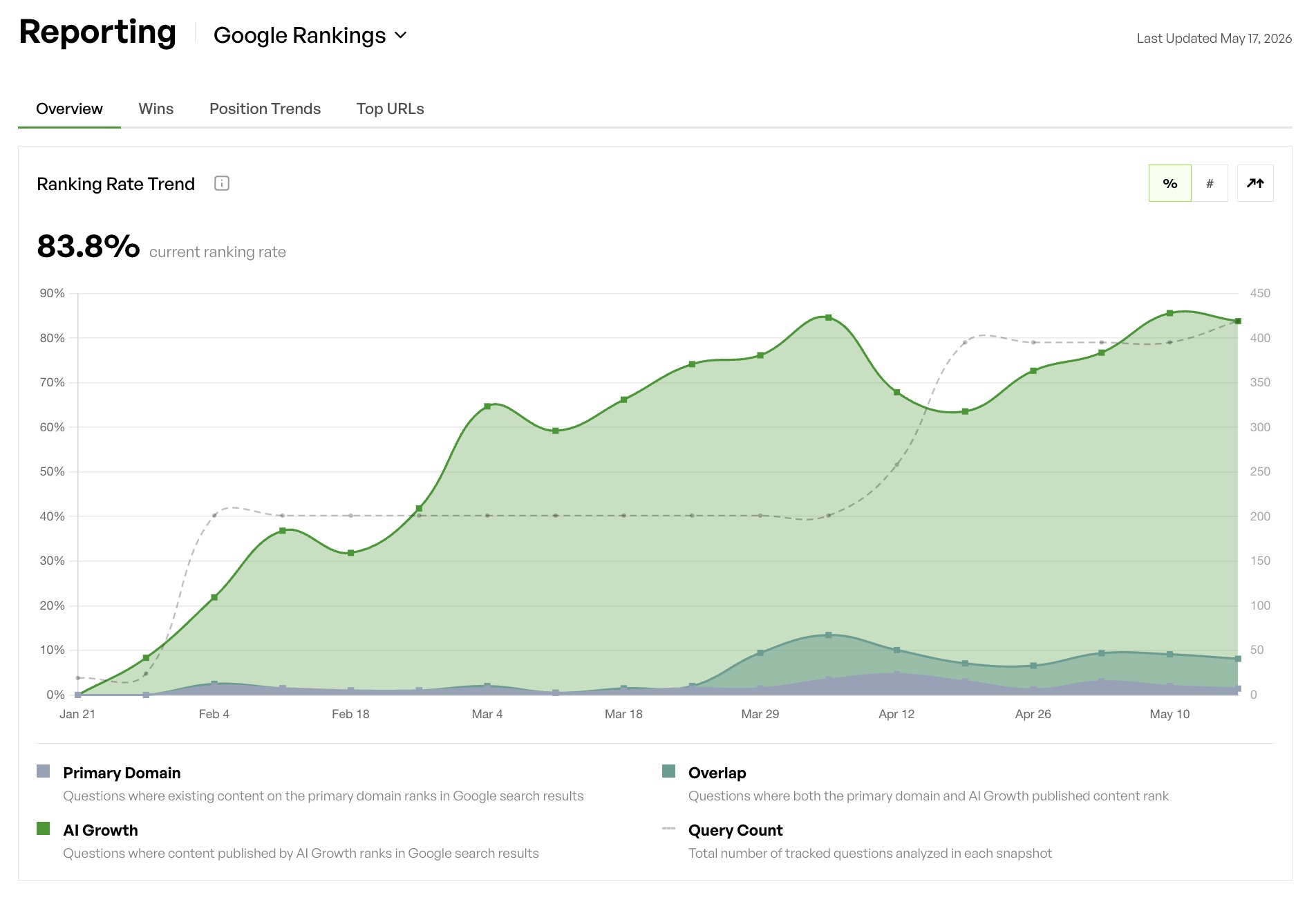
The weekly cadence covers new bot visits by crawler type, new URLs entering Google’s index, AI Overview impression share for target queries, and citation-context changes showing whether the brand moved up or down in AI answer order of mention. Advanced scenarios for multi-brand portfolios require per-property segmentation so each brand’s incremental visibility is reported independently.
Phase 7: Keeping Schema Fresh with Living Content
Static schema that never updates becomes a liability as AI systems favor fresh signals. Freshness is a structural requirement, not a nice-to-have. Living content addresses this by automatically refreshing articles when Google Search Console signals a drop in impressions, when bot-traffic data shows a crawl gap, or when the calendar year turns.
The self-healing workflow triggers a re-generation of the article’s schema block whenever the underlying content changes, ensuring dateModified, claimReviewed values, and AggregateRating data stay synchronized with the live page. Every article’s relationships, performance, and bot and Search Console data are centralized so authority compounds instead of decaying.
Validation checkpoint for living content: confirm that every article refresh triggers a schema re-validation pass, that the updated URL is submitted for instant indexing, and that the bot-tracking dashboard reflects the new crawl within 48 hours of publication.
How to Troubleshoot Schema and AI Citation Issues
Teams should troubleshoot AI citation drops by walking the seven phases in reverse. Start at Phase 6 and confirm bot-tracking data shows the target URLs are being crawled by AI citation bots. If crawl frequency has dropped, move to Phase 5 and verify the reverse-proxy configuration and robots.txt have not been altered.
If crawls are occurring but citations are absent, move to Phase 4 and re-validate the schema blocks for nesting errors and stale dateModified values. If schema validates but citation rates remain low, move to Phase 2 and audit whether the page carries the attribute-rich schema types associated with higher citation rates rather than a minimal implementation.
Google Senior Search Analyst John Mueller stated at the Google Search Central Live conference that structured data remains critical for AI search because it improves how AI systems interpret content, which means the troubleshooting goal is always to strengthen the indexing signal, not to attempt direct communication with the LLM. In July 2025, 76% of pages cited in AI Overviews also ranked in Google’s top 10 for the same query, but by March 2026 that figure had dropped to 38%, with nearly a third of cited pages not ranking in Google’s top 100 at all, indicating that strong schema and entity signals can now compensate for lower traditional rankings in some citation scenarios.
Verifying Outcomes
Outcome verification runs on a weekly snapshot cadence across three independent data sources. Google Search Console provides impression and click data segmented by URL, confirming which pages gained search visibility after schema deployment. Per-article bot tracking identifies the specific crawlers visiting each URL, with ChatGPT’s citation bot and Google’s AI Overview crawler as the primary signals of citation eligibility.
Citation-context monitoring tracks order of mention and the specific claims the brand is cited for, replacing the old concept of a ranking number with a richer picture of narrative position. For multi-brand portfolios, each property requires its own incremental visibility baseline established at launch so week-over-week reporting isolates each brand’s gains independently. Large query universes of 1,600 or more queries require automated snapshot refreshes running more than 3,000 searches per week to maintain a current picture of the competitive landscape.
Frequently Asked Questions
Does schema markup directly tell ChatGPT what to cite?
No. ChatGPT and other AI search systems retrieve content through SERP APIs connected to search indices rather than by parsing page markup directly. Schema markup’s role is to strengthen how Googlebot and Bing’s crawler index and understand your pages, which improves your eligibility to enter the candidate pool that AI systems draw from when generating answers. The path is indirect: better schema leads to stronger indexing, stronger indexing leads to higher search visibility, and higher search visibility leads to more frequent AI citations.
How long does it take to see AI citation improvements after deploying schema?
Timelines vary by domain authority, content freshness, and schema implementation quality. AI Growth Agent clients typically see content indexed in as little as ten days and often within two weeks of the first article going live. Citation-rate improvements tied specifically to schema upgrades on existing pages can appear within days on high-authority domains and within a few weeks on newer properties. The freshness signal from dateModified schema is one of the fastest-acting levers: pages updated within 60 days are measurably more likely to appear in AI answers than stale pages with identical content.
Which schema types should a mid-market brand prioritize first?
The highest-leverage starting point is a complete Organization schema block with sameAs properties linking to Wikidata, LinkedIn, and Crunchbase, combined with Article or WebPage schema on every content page and FAQPage schema on any page containing question-and-answer content. Author schema with sameAs linking to authoritative author profiles is the next priority, followed by Product and AggregateRating schema for any pages with commercial intent. This sequence addresses brand identity, content credibility, and extractable answers in the order that AI systems weight them when deciding what to cite.
Can a non-technical marketing team manage schema at scale without engineering support?
Manual methods rarely stay accurate at scale. Schema generation, validation, deployment, and refresh across hundreds of articles requires automation to remain consistent. The common failure mode is a team that deploys schema correctly on the first ten pages and then lets it drift as new content is published and existing content is updated. AI Growth Agent’s agentic technical SEO stack provisions valid schema automatically on every article, runs validation before publication, and refreshes markup when the underlying content changes, removing the engineering dependency entirely. The only integration step required from the client is the reverse proxy rewrite connecting the blog to their domain.
How does schema fit into a broader agentic technical SEO strategy?
Schema forms one layer of a stack that also includes llms.txt and llms-full.txt for AI surface readability, Blog MCP for agent interoperability, OpenAI discovery and Agent Card guidance served via /.well-known/, natural language query parameters that return personalized responses to agents, Markdown delivery to agent crawlers, and living content that self-heals as the world changes. Schema establishes the structured identity and claim signals that make the rest of the stack credible. Without accurate schema, the other agentic signals lack the verification foundation that AI systems use to decide which sources to trust and cite.
Conclusion: Turn Schema into an Always-On AI Growth Engine
Schema markup does not feed ChatGPT directly. It strengthens the search indices and knowledge graphs that AI Overviews and agentic systems read, and the brands winning citations in 2026 are the ones treating schema as a continuous, automated discipline rather than a one-time deployment. The seven-phase workflow above covers the full path: mapping the indirect mechanism, selecting the right schema types, generating valid JSON-LD by page type, validating before deployment, deploying through a scalable agentic stack, measuring incremental visibility through bot tracking and Search Console, and keeping content alive so the freshness signal never decays.
AI Growth Agent automates the entire process as a single headless marketing engine, replacing the SEO agency, the schema plugin, the content tool, the GEO monitor, and the analytics stack with one system that generates, validates, deploys, and self-heals schema and content at scale. This automation delivers measurable outcomes discussed throughout this guide: clients average more than 12,000 additional AI citations and mentions in the first twelve weeks, content indexes in as little as ten days, and the first article goes live within a week of kickoff.
Traditional search tools show you where your brand stands. AI Growth Agent makes your brand the answer. Talk with the team to see if you’re a good fit and get your first article live within a week.