Written by: Mariana Fonseca, Editorial Team, AI Growth Agent
Key Takeaways for 2026 Agent Pricing
- Agent-enabled site pricing shapes monthly spend volatility, content ownership, and narrative control in AI search results.
- Three primary cost components define total cost of ownership: platform fees, LLM/API usage, and integration plus maintenance.
- Usage-based, subscription-plus-API, and outcome-based models all create unpredictable scaling costs as interaction volume grows.
- AI Growth Agent uses a flat-fee structure that removes per-token, per-prompt, and per-interaction charges while providing native self-healing content and full site ownership.
- Explore how AI Growth Agent can replace your SEO, content, and GEO stack at a predictable cost.
Five Criteria That Decide Agent-Enabled Site ROI
Marketing leaders need a consistent lens before comparing platforms. These five criteria separate deployments that scale from those that penalize growth.
- Implementation complexity. How many engineering hours, vendor contracts, and integration steps stand between kickoff and a live agent? This determines time-to-value and the internal resources required to launch.
- Speed to first published page. How quickly does the deployment produce indexed, citable content? A platform that takes six months to publish its first article cannot respond to market shifts in real time.
- Scalability to 10,000 to 100,000 interactions. Does cost grow linearly, exponentially, or stay flat as traffic increases? This reveals whether the pricing model rewards or penalizes success.
- Total cost of ownership at scale. What does the full bill look like at 12 months, including hidden token, memory, and API charges? The advertised base price is rarely the number that appears on the invoice.
- Ownership of site and content. Does the brand own the property outright, or does an agency or vendor control it? Without full ownership, the brand cannot migrate, customize, or exit without vendor permission.
Head-to-Head Pricing Comparison Table
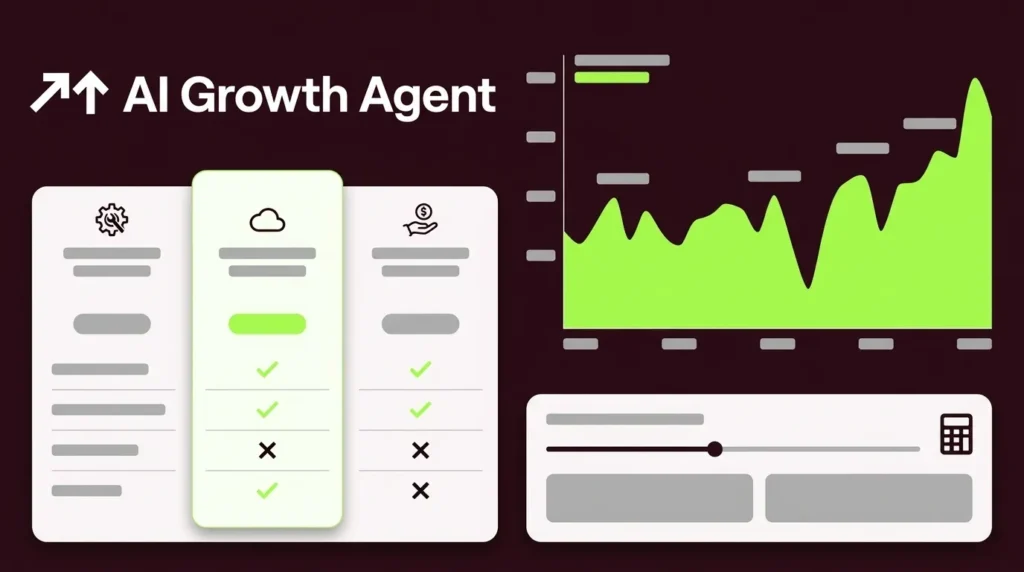
The table below compares eight platforms across six critical dimensions: base pricing model, per-interaction costs, hidden charges, embedding method, and self-healing capability. Focus on the “Hidden Token / Memory / API Costs” column, where the real long-term spend often appears.
| Platform | Base Pricing Model | Per-10k-Run Estimate | Hidden Token / Memory / API Costs | Site-Embedding Method | Self-Healing Capability |
|---|---|---|---|---|---|
| AWS (Bedrock Agents) | Pay-per-use, billed by input/output tokens and API calls against underlying foundation models | Varies by model; GPT-4-class models run $0.01–$0.03 per 1,000 tokens, placing 10k interactions at $500–$3,000+ depending on context length | Separate charges for knowledge base retrieval, embedding generation, guardrails, and CloudWatch monitoring | API integration, client engineers build and maintain the embedding layer | None native, requires custom orchestration |
| Google Conversational Agents (Vertex AI Agent Builder) | Usage-based tied to Google Cloud consumption; no standalone free tier | Scales by API calls, compute, and data processed; no published flat per-10k rate | Separate billing for Vertex AI Search, Dialogflow CX sessions, and Cloud Run compute | Webhook or SDK integration, client manages hosting | None native |
| Salesforce Agentforce | Three simultaneous models: conversation-based, Flex Credits per AI action, and per-user licensing | Flex Credits billed per Agentic Work Unit; Salesforce delivered 2.4 billion AWUs in Q4 fiscal 2026, with per-unit cost dependent on contract tier | Data Cloud consumption, Einstein add-ons, and CRM integration licenses billed separately | Embedded via Experience Cloud or external site SDK, requires Salesforce org | None native, requires Flow or Apex customization |
| Agno / open-source frameworks | Free to self-host; SaaS observability tools start at $50–$200/month | Model API costs pass through directly; 10,000 successful daily calls can reach $18,000/month in model API costs alone once failure rates are factored in | Vector database (Pinecone, Weaviate) adds $2,000–$7,000/month, hosting adds $3,000–$5,000/month | Custom, client engineers build and own the full stack | None native, fully custom |
| FlowHunt / n8n-class workflow builders | Starter tier with scalable pricing based on workflow executions and team size; Pro and Enterprise tiers available | Execution-based, cost scales with run volume and connected model APIs | Underlying LLM API costs billed separately per connected provider | Webhook embed or iframe, no native SEO stack | None native |
| DronaHQ / low-code builders | Subscription tiers by user count and feature set, enterprise pricing on request | Agent runs billed against connected API quotas; no published per-10k rate | External LLM and database API costs pass through to client | Embedded app or portal, not a content publishing engine | None native |
| Wireclaw | Subscription, pricing not publicly listed | Not publicly disclosed | Not publicly disclosed | Widget or API embed | Not documented |
| AI Growth Agent | Flat fee; no per-article charges, credit limits, or per-prompt billing | Flat, cost does not increase with interaction or publication volume | None, prompt count is never a billed metric | Reverse proxy rewrite under client subdirectory or subdomain; client owns the site | Native, living content updates and self-heals automatically |
Usage-Based Pricing Models in 2026
Usage-based pricing ties every dollar to a consumption metric such as tokens processed, API calls made, or actions executed. A 2025 L.E.K. Consulting study found that 85% of SaaS companies are now using or implementing usage-based pricing, which makes it the dominant model across the agent platform market.
The math at scale becomes punishing. A workload of 10,000 conversations per month with 20 exchanges and 200 tokens per exchange consumes about 40 million tokens monthly, which can create notable model costs at GPT-4-class rates. At 50,000 conversations, model costs can rise to several thousand euros per month before infrastructure, monitoring, or maintenance are added. Zylo’s 2026 SaaS Management Index found that 78% of IT leaders reported unexpected charges tied to consumption-based or AI features in the past year, so these hidden costs appear frequently.
Architectural choices can magnify this exposure. MCP operations consume 800–6,400 tokens compared with ~200 tokens for CLI-style agent workflows, which means a design decision during embedding can multiply token spend without any change in traffic volume.
See how a flat-fee model removes usage-based exposure entirely.
Subscription Plus API Pricing Models in 2026
Where usage-based pricing charges for every token consumed, subscription plus API models split the bill into two parts. A recurring platform fee buys access, and pass-through API costs still scale with usage. The platform fee covers entry, while the API meter runs continuously in the background.
Ongoing API usage for AI agents typically runs from under $50 to around $8,000 per month depending on scale from solo to enterprise, and cloud hosting adds $2 to $500 per month for AI agents, depending on platform and scale on top of that spend.
Monitoring and maintenance add further recurring cost, and annual maintenance can represent a large share of the original development investment. For a platform with a significant build cost, this can total thousands of dollars per year before a single interaction is processed. Year-one operations for AI agents can reach tens of thousands of dollars after the initial build phase, a figure most subscription pricing pages never mention.
Legacy API platforms with per-call licensing cause costs to escalate as API traffic grows, and monthly volumes of AI-driven traffic increased sharply from January to December 2025. The traffic baseline that drives these costs is rising, so the variable portion of the bill grows even faster.
Find out if your traffic volume fits a model where the platform fee covers the entire stack.
Outcome-Based Pricing Models in 2026
Outcome-based pricing ties billing to a defined result such as a resolved ticket, a qualified lead, or a completed workflow. The model aligns incentives in theory but introduces a different kind of unpredictability at scale.
Zendesk charges per automated resolution, defined as a ticket resolved by AI without human escalation. HubSpot Breeze Customer Agent charges $0.50 per resolved conversation, and Breeze Prospecting Agent charges $1.00 per lead recommended for outreach. Intercom’s Fin AI Agent charges $0.99 each time it fully resolves a customer issue.
At high volumes of monthly resolutions, outcome-based models can produce substantial monthly bills from outcome fees alone before platform access or integration costs appear. For content-publishing and narrative-control use cases, outcome pricing rarely appears, so marketing leaders usually end up with usage-based or subscription structures.
Compare your outcome-based exposure against AI Growth Agent’s flat-fee structure.
Agent Enabled Sites Pricing Calculator
After reviewing usage-based, subscription plus API, and outcome-based models separately, this calculator shows what each model costs at three realistic interaction volumes. The pattern reveals how usage-based and outcome-based pricing can reach five or six figures per month at scale while AI Growth Agent’s flat fee stays constant. The table below models three realistic monthly interaction volumes against the cost structures documented above, using figures from published vendor data and independent analyses cited throughout this article.
| Monthly Interactions | Usage-Based Estimate (token + infra) | Subscription + API Estimate | Outcome-Based Estimate ($1.50/resolution) | AI Growth Agent |
|---|---|---|---|---|
| 10,000 | €2,200–€4,500/month | $3,200–$7,500/month | $15,000/month | Flat fee, no per-interaction charge |
| 50,000 | €5,000–€13,000/month | $8,000–$20,000/month | $75,000/month | Flat fee, no per-interaction charge |
| 100,000 | $18,000–$36,000/month in model API costs alone | $15,000–$40,000+/month | $150,000/month | Flat fee, no per-interaction charge |
AI Growth Agent’s flat-fee model removes per-prompt billing, credit limits, and per-article charges. The entire universe of seed terms and long-tail queries sits under the same fixed cost, regardless of how many interactions, publications, or bot visits the site generates. Clients average more than 12,000 additional AI citations and mentions and over 100,000 additional bot visits across the first twelve weeks, and none of that volume triggers an extra charge.
Get a cost-of-ownership projection for your traffic volume.
Real User Questions from Reddit
Reddit threads on agent-enabled site pricing surface three recurring complaints: token creep, integration friction, and the gap between advertised and actual monthly spend.
Token creep describes a pattern where a deployment that costs $500 per month at launch reaches $4,000 per month within two quarters as conversation depth, context windows, and retry rates grow. As noted earlier, architectural choices like MCP can multiply token consumption by an order of magnitude, which turns a single upgrade into a permanent cost increase.
Integration friction turns directly into engineering cost. Data preparation and knowledge structuring account for 60–75% of total project effort in AI initiatives and require repeated cleanup, validation, and reindexing throughout the agent’s lifetime. Users who budgeted for a platform subscription discover that the real cost is the engineering team required to keep the integration current.
The gap between advertised and actual spend is confirmed by enterprise data. The majority of IT leaders report unexpected consumption-based charges, as noted earlier, so sticker prices rarely match the final invoice.
Site-Embedding Choices and Technical Ownership
The way an AI agent connects to a live site determines both the technical SEO outcome and who owns the property. Three embedding approaches dominate in 2026.
Reverse proxy rewrite under a subdirectory passes agent-generated content through the brand’s own domain, which preserves domain authority and lets the content inherit the root domain’s trust signals. This is the architecture AI Growth Agent uses, connecting a fully optimized blog to the client’s domain so that the client owns the site outright with no agency dependency.
Subdomain deployment separates the agent environment from the root domain, which can dilute authority but avoids conflicts with existing CMS infrastructure. AI Growth Agent supports this configuration when subdirectory rewrites are not feasible.
Widget or iframe embed appears most often among chatbot and low-code platforms. It adds an interactive layer to an existing page but contributes nothing to crawlable content, schema, or indexable surface area. Bots read the underlying page, not the widget.
Full technical ownership requires more than a domain connection. Every production deployment needs valid schema markup, a proper sitemap.xml, a detailed robots.txt, MCP endpoints, llms.txt and llms-full.txt files, and bot tracking that distinguishes AI training crawlers from standard indexers. AI Growth Agent provisions all of this automatically, including Blog MCP, agent discovery via /.well-known/, instant indexing, autoredirects, and 404 tracking, with no technical action required from the client.
Platform Fit for Different Teams
Lean marketing teams without engineering resources need a platform that ships the full technical stack without custom integration work. Open-source frameworks and API-first platforms demand engineering hours that lean teams do not have. Workflow builders like n8n reduce some complexity but still pass through LLM API costs and provide no content publishing or SEO capability.
Enterprise CMOs managing portfolio brands need predictable spend, narrative control, and proof that the investment generates incremental visibility rather than riding existing brand equity. Usage-based and outcome-based models introduce budget volatility that is difficult to defend to a CFO. Salesforce Agentforce integrates with existing CRM infrastructure but adds Flex Credit consumption on top of existing licensing costs.
PR agency owners running multiple client brands need a single engine that scales across accounts without multiplying per-client API costs. Usage-based platforms charge for every client’s interactions separately, which makes multi-client deployments significantly more expensive than a flat-fee model that covers the full universe for each account.
AI Growth Agent serves all three groups. The first article is live within one week of kickoff, content indexes in as little as ten days, and the engine replaces the SEO agency, content tool, web agency, GEO monitor, schema plugin, analytics stack, and PR firm in a single flat-fee engagement.
Total Cost and Operational Ownership at Scale
Three-year TCO for a medium-complexity AI agent project can reach hundreds of thousands of euros, and operational costs often account for most of the total spend. DIY AI agent deployments carry a three-year TCO of $380K–$1.1M versus $21K–$90K for done-for-you platforms.
Staffing and time add further weight. A customer service AI agent that handles thousands of interactions per month at a high success rate still requires significant human review for failure cases, which can translate into substantial staffing costs. Hidden costs in the first 12 months, including employee training, unplanned integrations, and security audits, can add tens of thousands of euros.
Headless marketing removes most of the staffing equation. The engine handles publishing, schema, bot tracking, self-healing, and reporting. The client’s team gives feedback in plain language and the system learns, so no engineering dependency remains on the brand’s side.
If This, Then That Decision Framework
If your organization needs a customer support chatbot that resolves tickets and integrates with a CRM, then Zendesk AI or Intercom Fin fit that workflow with outcome-based pricing tied to ticket resolution volume.
If your organization needs a workflow automation layer that connects internal tools and APIs, then n8n or a low-code builder provides the execution environment with usage costs tied to run volume.
If your organization needs to control the narrative in AI search, publish living content that earns citations across ChatGPT, Perplexity, and Google’s AI Mode, own the site and content outright, and do all of this without per-prompt billing, headcount, or an agency stack, then AI Growth Agent is the only flat-fee, headless engine that replaces the entire stack and delivers incremental visibility at a predictable cost.
Map your universe and see your first article live within a week.
Risks and Limitations Across All Options
Every platform in this comparison carries external LLM pricing risk. Model providers change token rates, deprecate models, and introduce new pricing tiers on their own schedules. Usage-based and subscription plus API deployments pass that risk directly to the client, so a model price increase of 20% becomes a 20% increase in the variable portion of the monthly bill.
No platform removes the risk of content going stale. Static deployments that are not actively maintained decay as the world changes, and AI surfaces cite whatever is current, not whatever was authoritative six months ago. Self-healing content provides the only structural answer to this problem, and it appears natively only in AI Growth Agent among the platforms compared here.
Open-source frameworks offer cost control at low volumes but require engineering ownership that grows with scale. Year-two operating costs for a production AI agent can remain in the tens of thousands of dollars annually even after initial integration work finishes, driven by ongoing refinement, monitoring, and human oversight that do not disappear once the system is live.
Frequently Asked Questions
How long does implementation take for an agent-enabled site?
Implementation timelines vary significantly by platform and architecture. Open-source and API-first AI deployments can typically reach production in 2–12 weeks depending on scope and complexity, while traditional enterprise projects often take 3–18 months. Agency-led engagements add RFP and onboarding time, which often pushes the first live asset past the twelve-month mark.
AI Growth Agent compresses this to about one week from kickoff to the first published article, with content indexing in as little as ten days. The only integration step on the client’s side is a reverse proxy rewrite that connects the blog to a subdirectory under their domain.
What internal resources are required to run an agent-enabled site?
Usage-based and subscription plus API platforms require engineering resources for integration, prompt tuning, monitoring, and maintenance. The ongoing staffing cost is material because human oversight for failure cases, security audits, and unplanned integration work accumulates throughout the deployment’s lifetime.
AI Growth Agent is designed for teams with no technical background. The engine provisions schema, the WordPress plugin, robots.txt, sitemaps, MCP endpoints, llms.txt, instant indexing, autoredirects, and 404 tracking automatically. The client’s team provides feedback in plain language, and the system learns and applies it to every future generation.
How does cost scale from 10,000 to 100,000 monthly interactions?
For usage-based platforms, cost scales with every interaction. Token consumption, infrastructure, and monitoring all grow as traffic increases, and the relationship often becomes nonlinear because failure rates, retry logic, and context window depth add overhead that compounds at higher volumes.
Outcome-based platforms multiply the per-resolution fee by total resolutions, which produces bills that grow in direct proportion to success. AI Growth Agent’s flat-fee model does not change with interaction volume. The same fixed cost covers the full universe of seed terms and long-tail queries regardless of how many bot visits, publications, or interactions the site generates.
What integration concerns should marketing leaders anticipate?
The most common integration surprises involve unplanned costs for knowledge base retrieval, vector database services, embedding generation, and security audits. Data preparation and knowledge structuring consistently account for most project effort and require repeated cleanup throughout the agent’s lifetime.
Schema maintenance, sitemap management, and MCP endpoint configuration add further technical overhead that most platform pricing pages never surface. AI Growth Agent includes the full technical and agentic SEO stack in every package, with no separate integration contracts required.
How do I calculate true monthly spend for an agent-enabled site?
Start with the platform’s base fee, then add the variable components such as token or API costs at your expected interaction volume, infrastructure and hosting, monitoring and observability tools, prompt tuning and maintenance labor, and security and compliance overhead. For outcome-based models, multiply the per-resolution fee by your expected monthly resolution volume.
Apply a 15–30% buffer for unplanned integration work and model price changes. For AI Growth Agent, the calculation is the flat fee. There are no variable components, no per-prompt charges, and no credit limits to include.
Conclusion: Choose Predictable Ownership Over Usage Penalties
Usage-based, subscription plus API, and outcome-based pricing models all penalize scale. As site traffic grows, the bill grows with it, and the hidden costs of integration, maintenance, and staffing compound on top of every metered charge.
Marketing leaders who need narrative control in AI search without per-prompt billing, extra headcount, or an agency stack gain that outcome only with AI Growth Agent’s flat-fee, headless engine, which delivers the entire stack at a predictable cost.