Written by: Mariana Fonseca, Editorial Team, AI Growth Agent
Key Takeaways
- AI search competitive analysis maps every query where competitors earn citations in AI answers and flags gaps where your brand is absent across ChatGPT, Perplexity, and Google AI Mode.
- Traditional competitive analysis breaks in AI search because discovery is zero-click and monitoring tools diagnose problems without a production system that closes gaps.
- The five-step framework covers mapping the full query universe, auditing competitor citations, prioritizing gaps, producing structured content, and measuring incremental AI visibility week over week.
- Real-time data from Google and ChatGPT surfaces replaces static keyword lists and reveals hundreds of long-tail queries and citation context that traditional tools miss.
- AI Growth Agent turns these insights into living content that earns citations at scale. Schedule a demo to map your universe and start closing gaps today.
Why Traditional Competitive Analysis Fails in AI Search
Traditional competitive analysis was built for a world of blue links. A brand tracked ten to twenty head terms, watched a rank tracker move up or down, and called it a strategy. That model is structurally broken in AI search for two core reasons.
First, discovery is increasingly zero-click. When a customer asks ChatGPT which adjustable bed retailer to trust, the answer appears directly in the surface. Roughly 83% of people say they are skeptical of AI answers, yet only about 8% ever click through to verify them. For most users, whatever the model says becomes the answer. The source rarely gets visited, so a rank tracker that measures click-through position is measuring the wrong outcome.
Second, monitoring-only tools observe but do not act. The dominant tools in this space track whether a brand appears for a capped set of prompts and stop there. They tell a marketing team it is losing the AI conversation and then leave the team to solve it with no system behind the diagnosis. The gap between knowing you are absent and producing the content that makes you present is exactly where most competitive analysis workflows collapse.
The result is a category of tools that function as a rearview mirror. They are accurate about where the brand has been and silent about how to change where it goes next.
AI Search Competitive Analysis Framework and Template
The five-step framework for AI search competitive analysis moves from diagnosis to action in a structured way. Steps one and two establish the competitive landscape, while steps three through five close the gaps.
Step one is universe mapping. The starting point is a set of seed terms, the strategic anchor topics that organize a brand’s market. Each seed term spawns dozens of long-tail queries underneath it. A new AI Growth Agent account typically starts with three to four hundred queries and expands as it goes after more of the universe, with mature clients reaching universes of 1,600 or more queries and the system running 3,000 or more searches every week just to refresh the snapshot. A template built on a handful of manually chosen head terms will miss most of the conversation by design.
Step two is competitor citation auditing. For each query in the universe, the analysis identifies which domains are cited, in what order, and for what claim. This is citation context, and it replaces the old idea of a ranking number because position alone no longer tells the full story. A competitor cited first in response to “best adjustable bed for back pain” holds a fundamentally different position than one cited fourth in a list of alternatives, because the first citation usually answers the core query while later citations often appear as options or counterpoints. That is why the audit must capture both dimensions. Presence shows whether you are in the conversation, and context shows what role you play inside it.
Real-time Google AI Overview and ChatGPT search results serve as the objective function for which queries are worth pursuing. Static keyword databases reflect what was true months ago. AI surfaces reflect what is being cited today.
Step three is gap prioritization, covered in the Citation Gap Analysis and Brand Positioning section below. Step four is content production, detailed in Turning Insights into Living Content. Step five is measurement, explained in Measuring Incremental AI Visibility. The rest of this section focuses on steps one and two, which depend most heavily on real-time data.
Mapping the Full Universe with Real-Time Google and ChatGPT Data
The universe is the full set of queries and prompts that describe a brand’s market, head terms and long tail together. Most brands track a handful of head terms and lose the rest of the conversation by default. Robots search the long tail. Agents reason on top of user queries and fan out into hundreds of related prompts that no brand pre-decided to defend.
Capturing the universe requires running real searches, not modeling them. AI Growth Agent runs hundreds of real searches in a client’s space and has agents process the signals: title structures, forum discussions, “people also ask,” query fan-out, and who is competing for each result, refreshed every week. Those searches feed a multi-signal analysis that processes title patterns, forum threads, “people also ask” boxes, query fan-out, and competitive presence for each result. The output is a topology, a hierarchy of seed terms backed by evidence, with long-tail queries ranked by the AI surfaces’ own citation behavior.
The practical implication is that universe mapping is not a one-time exercise. AI surfaces update their citation patterns as new content enters the web and as model weights shift. A snapshot taken at kickoff is a starting point, not a permanent map. The competitive analysis that wins is the one that refreshes the universe continuously and then acts on what changes.
What You Can Do with Free AI Search Competitive Analysis
Free approaches to AI search competitive analysis are possible but bounded. A team can manually query ChatGPT and Google’s AI Mode for a set of seed terms, record which competitors appear and in what context, and build a citation gap log in a spreadsheet. This approach covers steps one and two of the framework at small scale.
The ceiling arrives quickly. Manual querying cannot cover hundreds of seed terms and their long-tail derivatives on a weekly refresh cycle. It cannot cross-reference citation data with bot tracking, Google Search Console signals, and AI ranking movement at the same time. It also produces a diagnosis with no production system behind it.
Free tools and manual processes are a valid starting point for teams that need to understand the landscape before committing to a system. The four pillars that structure a complete analysis are Search Intelligence, AI Analytics, Bot Tracking, and AI Ranking. A free audit can approximate the first pillar. The remaining three require instrumentation that manual processes cannot match at the speed AI surfaces move.
Citation Gap Analysis and Brand Positioning in AI Answers
A citation gap is any query in the universe where a competitor earns a citation and the brand does not. Gap analysis converts the universe map into a prioritized action list by scoring each gap against query volume, buyer intent, and the brand’s existing authority in adjacent topics.
Positioning within AI answers is not binary. A brand can be cited but cited poorly. It might be grouped with low-authority alternatives, cited for a peripheral claim rather than a core value proposition, or mentioned after three competitors in a way that signals secondary status. Citation context analysis surfaces these positioning problems alongside pure absence gaps.
Breadless used this approach to move from absent to dominant: it is now the most recommended healthy franchise in the US ahead of CAVA, Rush Bowls, and Sweetgreen in its search universe, with an 84% citation rate against competitors and a 72% recommendation rate versus Sweetgreen’s 13% within 90 days. The gap analysis identified which franchise development and category queries competitors were winning and then produced authoritative content against each one in a systematic sequence.
Owned AI answer real estate is built query by query. Each piece of content that earns a citation in a high-intent query becomes a position held. The goal of gap analysis is to identify which positions are worth holding and in what order to pursue them.
Turning Insights into Living Content That Earns Citations
Production is the step that separates AI search competitive analysis from AI search competitive monitoring. Insights without content are a diagnosis without treatment.
Producing content that earns AI citations requires three things that generic content tools do not provide together. First, you need brand intelligence from a manifesto that gives the model accurate, validated facts about the brand, because without this foundation AI-generated content drifts toward generic claims that do not differentiate you in citations. Second, you need structured output that AI surfaces can parse, including full schema, proper sitemaps, MCP endpoints, and llms.txt, because even strong content will not be cited if models cannot extract and verify it efficiently. Third, you need anti-hallucination controls that validate every claim and source before the article ships so that the content AI surfaces cite remains factually defensible when users verify it.
Living content prevents the analysis from going stale. When the competitive landscape shifts, when a competitor earns a new citation position, or when a query’s AI Overview changes, the content self-heals. Stale articles are refreshed in response to Google Search Console signals and bot-traffic awareness. The brand’s citation positions do not decay because the content behind them does not decay.
Free AI Competitor Analysis vs Production Systems
The tools-versus-systems distinction is the most useful frame for evaluating free and paid options in AI competitor analysis. Tools observe. Systems act.
Monitoring platforms track whether a brand appears for a capped set of prompts. They are accurate within their scope and genuinely useful for understanding the current state of a brand’s AI presence. The limitation is structural. They stop at the diagnosis. A team that learns it is absent from 60% of its target queries still has to produce the content, publish it with the right technical structure, monitor the result, and refresh it over time. None of that work is included in a monitoring tool.
Free SEO suites provide keyword and rank data. They do not produce AI search content, do not publish, and do not refresh what is live. A team using a free SEO suite for AI competitor analysis is applying a blue-link instrument to a zero-click problem.
The practical assessment of free options is that they are useful for scoping the problem and building the case for investment. They are not sufficient for closing citation gaps at the speed AI surfaces move, because closing gaps requires production, and production at scale requires a system.
How to Track Competitors in AI Search Across Four Pillars
Tracking competitors in AI search requires instrumentation across all four intelligence pillars at the same time. Movement in one pillar without context from the others produces incomplete signals.
Search Intelligence provides the traditional search landscape. It shows which domains are winning each query, which URLs are ranking, and where white space exists. It forms the baseline competitive map, refreshed weekly so that when a competitor makes a significant move, such as publishing a large volume of new content targeting a specific query cluster, the change is visible quickly.
AI Analytics covers brand value and consumer behavior across the full journey, from external touchpoints like Google and AI-tool queries through content consumption, demographics, and sentiment. It answers whether citation gains are translating into brand consideration movement.
Bot Tracking records every bot interaction, traditional crawlers and AI training agents alike, including every crawl, citation, and training sweep. This granular visibility matters because AI citation volume can dwarf traditional traffic metrics. Leva Sleep’s content is cited by ChatGPT over 10,000 times per month, a figure that is only visible through per-article bot tracking, not through a standard analytics stack. Without bot tracking, a team cannot tell whether its content is being read by the AI surfaces that matter, so it measures pageviews while missing the citations that drive zero-click discovery.
AI Ranking tracks order of mention and citation context as the new leaderboard. Where a brand appears in an AI answer, and how that position evolves week over week against the content plan, becomes the competitive signal that replaces the traditional rank number.
Measuring Incremental AI Visibility That Your Content Generates
Incremental visibility reporting isolates exactly what a new content effort generated, separate from the visibility the brand already had. This distinction matters because brands with existing authority will see AI citations regardless of new content investment. If you do not separate baseline visibility from new gains, you cannot tell whether your investment is working. Crediting that existing visibility to a new program produces inflated results that make every initiative look successful, which obscures whether the program is actually generating the incremental citations that justify its cost.
AI Growth Agent publishes into a separate environment so it can report only on the visibility it generates. The reporting cross-references bot traffic, Google Search Console, and citation data week over week. When content indexes well, the engine doubles down on adjacent queries. When content underperforms, internal linking is used to lift it before a refresh is triggered.
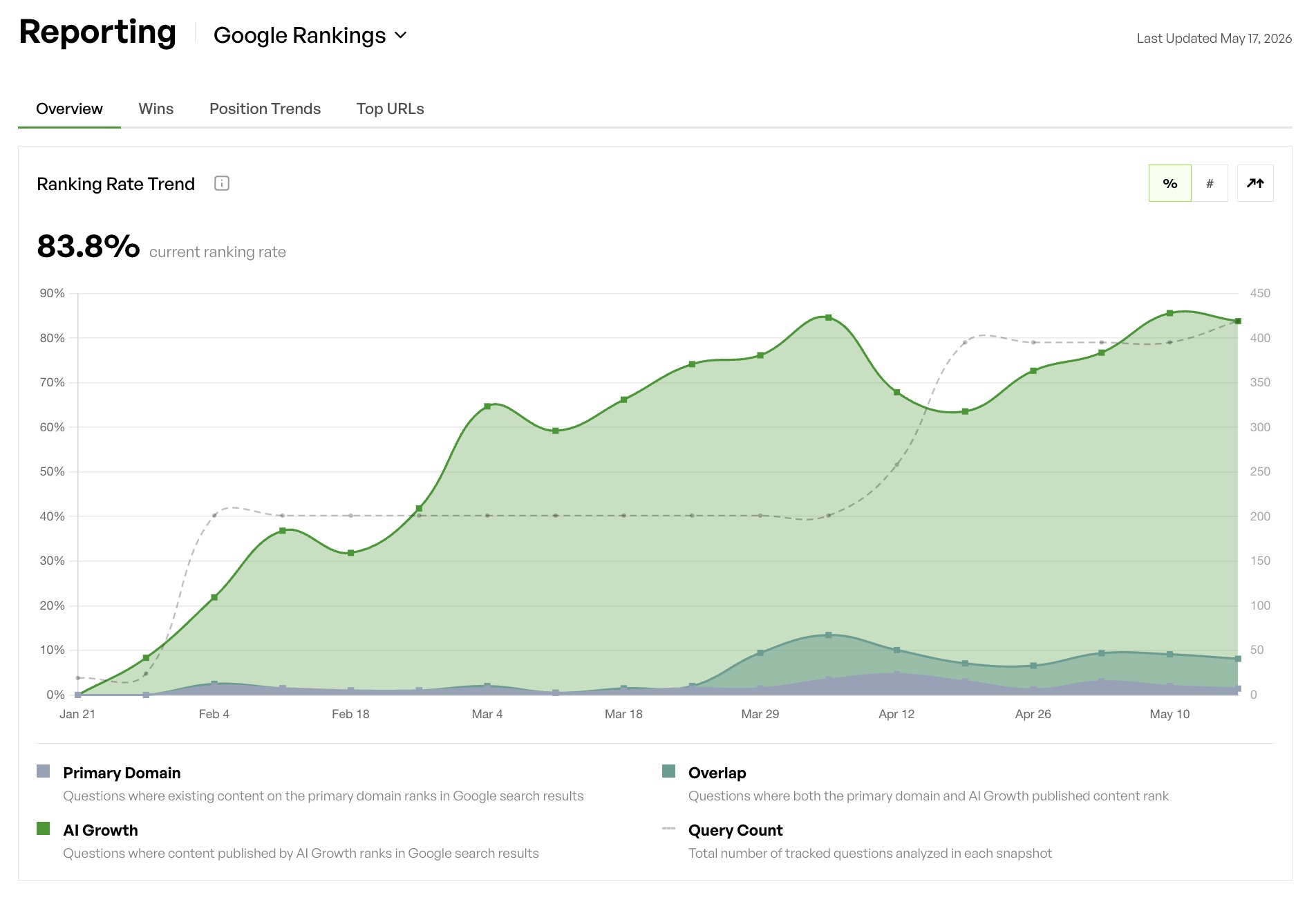
Bisutti’s incremental visibility is concrete: AI Growth Agent drives 71% of its brand mention visibility, and Bisutti is now the second most recommended events brand by AI in Brazil, with its corporate pages the most cited domains in the sector. That figure is meaningful precisely because it is isolated to what the system generated, not the brand’s total AI presence.
What Reddit Conversations Reveal About AI Search Competitive Analysis
Community discussions about AI search competitive analysis on Reddit and similar forums surface a consistent set of objections and questions that are worth addressing directly.
The most common objection is that AI search is too volatile to support a strategy. Volatility actually favors brands that publish authoritative, structured content continuously over brands that publish once and wait. Content that responds to competitive shifts and query evolution, rather than remaining static, is structurally better suited to a volatile environment.
A second common question is whether AI citations actually drive revenue. Leva Sleep closed $40,000 to $50,000 in deals in under three weeks from buyers who walked into the store carrying the blog and asking about specific features they had discovered through AI Growth Agent content. In a zero-click world, attribution requires capturing source at the conversion moment. Brands that do this consistently see a lift in organic leads after establishing AI citation positions.
A third question is whether the approach works for smaller brands without existing domain authority. The evidence from early-stage clients suggests it does, because AI surfaces prioritize content structure and factual density over domain age when they evaluate citation-worthiness. Jelly earned its first citation within three weeks and reached the number one cited solution for “Restaurant Inventory Management in the UK” with a 20% or greater impression lift within 28 days. This result shows that properly structured, authoritative content can overcome domain authority gaps in AI search faster than in traditional SEO.
30-Day Action Plan for Launching AI Search Competitive Analysis
Week one. Conduct a brand manifesto interview to capture voice, factual references, and deny lists. This foundation ensures that all subsequent content represents the brand accurately. With that foundation in place, build the seed term list from real-time Google and ChatGPT data, then run the initial universe map across three to four hundred queries to reveal the full competitive landscape. Use that map to identify the top twenty citation gaps by intent and volume so you can prioritize where to focus production first. Stand up the owned, technically optimized blog property so it is ready to receive content in week two.
Week two. Publish the first wave of content targeting the highest-priority citation gaps. Confirm indexing through Google Search Console. Activate bot tracking to monitor which AI surfaces are crawling the new content. Begin the competitor citation audit across the full query universe so you can see how positions start to shift.
Week three. Review initial bot traffic and citation data. Identify which articles are indexing well and use internal linking to compound their authority into adjacent queries. Flag underperforming articles for refresh. Expand the universe map based on query fan-out signals from the first two weeks of live content so that your target list reflects how users and agents actually search.
Week four. Produce the second wave of content targeting the next tier of citation gaps. Run the first incremental visibility report, isolating what the new content generated from existing brand visibility. Adjust the content topology based on which seed terms are showing early citation movement. Set the weekly refresh cadence for the universe snapshot so the program becomes a continuous loop rather than a one-off project.
Frequently Asked Questions
How long does it take to see results from AI search competitive analysis?
Most clients see their first article live within one week of kickoff. Timelines for indexing vary by industry and competitive intensity, but content often indexes within ten to fourteen days. Meaningful citation movement is usually visible within the first month, and the standard engagement runs as a three-month pilot so there is enough time to measure real citation shifts. The 30-day action plan above reflects a realistic pace for a brand starting from a clean slate.
Who owns the content and the site that AI Growth Agent builds?
The client owns the site and all content outright. AI Growth Agent stands up a fully optimized blog connected to the client’s domain through a reverse proxy rewrite or subdomain. There is no agency dependency, no lock-in, and no situation where a vendor controls the property. The client can take the site and its content at any point.
What technical resources does our team need to run this?
The only technical requirement is the reverse proxy rewrite that connects the blog to a subdirectory under the brand’s domain. AI Growth Agent provisions schema, the WordPress plugin, robots.txt, sitemaps, automatic web stories, Blog MCP, agent discovery, llms.txt and llms-full.txt, instant indexing, autoredirects, and 404 tracking automatically. The internal team gives feedback in plain language and the system learns from it. No ongoing engineering hours are required on the client’s side after the initial integration step.
How is incremental AI visibility measured and reported?
AI Growth Agent publishes into a separate environment so it can isolate exactly the visibility it generates, separate from visibility the brand already had. Reporting cross-references per-article bot tracking, Google Search Console, and citation data week over week. The four pillars, Search Intelligence, AI Analytics, Bot Tracking, and AI Ranking, feed a single reporting view that shows where new content is indexing, where it is earning citations, and how citation context is evolving against the competitive landscape.
Can this approach scale across multiple brands or client accounts?
Yes. The system is designed for multi-brand and multi-client operation. Each brand runs its own universe map, content topology, and reporting environment. PR agency owners and enterprise CMOs managing brand portfolios use the same engine across accounts, with each account’s manifesto, memories, and deny lists kept separate. Content production scales from two to fifty articles per day per client, up to roughly 500 per month, without quality drift between accounts.
Conclusion: Turning AI Search Analysis into a Production Discipline
AI search competitive analysis is not a monitoring exercise. It is a production discipline. The brands winning AI answer real estate today are not the ones with the most detailed dashboards. They are the ones that mapped their full query universe, identified where competitors hold citation positions they do not, and produced authoritative, structured, living content that closed those gaps in a systematic way.
Monitoring tools show where a brand stands. AI Growth Agent makes the brand the answer, mapping the full universe, closing citation gaps, and turning insights into content that compounds week over week without requiring an agency stack or a technical team to run it.
The leaderboard in AI search is being written now. Brands that establish authoritative content this year are training the next generation of models with their own narrative. Brands that wait leave that narrative to whatever happens to be sitting on the open web.
Book a kickoff with AI Growth Agent and see your first article live within a week.