Written by: Mariana Fonseca, Editorial Team, AI Growth Agent
Key Takeaways for Growing AI Share of Voice
- AI Share of Voice measures how often AI platforms recommend or cite your brand compared to competitors, and every mention is zero-sum.
- A complete prompt universe built from brand data, customer insights, and search queries creates the foundation for accurate measurement and improvement.
- A four-layer diagnostic table reveals visibility, positioning, citation, and topic coverage gaps so each issue has a clear owner and fix.
- Authoritative, schema-marked content published with agent-focused technical SEO drives measurable lifts in brand mentions and citations.
- Book a kickoff with our team to see your first article live within a week and start controlling your AI narrative.
Step 1: Define Your Prompt Universe
Goal: Map every question a buyer might ask an AI platform that could surface your brand or a competitor.
The prompt universe is the full set of queries and prompts that describe your market, including head terms and long-tail questions. Most brands track a handful of head terms and lose the rest of the conversation by default. A complete universe draws from three layers: baseline brand and positioning details, first-party voice-of-customer data from sales calls and support tickets, and search data including People Also Ask boxes and query fan-outs.
To build this universe, gather the following inputs: brand positioning document, CRM call notes, support ticket logs, and existing keyword data. Once you have an initial prompt list, validate completeness by confirming that every prompt maps to at least one buyer intent stage (awareness, consideration, or decision). A three-column table listing prompt, intent stage, and buyer persona makes this validation step visual and auditable.
Step 2: Build Seed Terms and Long-Tail Queries
Goal: Organize the universe into strategic anchor topics and the dozens of long-tail queries beneath each one.
Seed terms act as the strategic anchors that organize the universe. Each seed term spawns dozens of long-tail queries underneath it. Robots search the long tail, so the map should reflect how an ideal customer speaks rather than a generic keyword dump. A balanced prompt set of 100 to 200 prompts produces more reliable AI share of voice results than a much larger but unbalanced set.
To structure this step, start with a seed term list, a competitor domain list, and community sources such as Reddit threads and G2 reviews. Confirm that each seed term has at least ten long-tail queries beneath it, each phrased as a natural conversational question. A seed-term hierarchy with expandable long-tail branches helps you see which topics are well covered and where you still have gaps.
Step 3: Run Real-Time Google and ChatGPT Scans
Goal: Capture a current snapshot of which brands AI platforms are recommending and citing across your prompt universe.
Manual spreadsheet logging cannot keep up because AI responses are non-deterministic and require repeated sampling over time rather than single manual runs. To capture this variance reliably, run scans across ChatGPT, Perplexity, and Google AI Overviews simultaneously. AI share of voice often varies significantly between platforms, so a brand might capture 40% of mentions in ChatGPT but only 15% in Perplexity.
Once you have selected your platforms, gather three inputs: finalized prompt universe, access to each AI platform, and a structured logging template. Confirm that each prompt has been run a minimum of five times per platform to account for response variance. A platform-by-platform heatmap showing brand mention rates per prompt cluster makes it easy to spot where you lead, lag, or fail to appear.
Step 4: Apply the Four-Layer Diagnostic Table
Goal: Break raw scan data into four actionable layers so each gap has a clear owner and a clear fix.
The table below organizes AI share of voice into four diagnostic layers. Each layer maps a specific measurement to its diagnostic signal and primary fix so you can see whether a visibility gap requires more content volume, stronger positioning, structured schema markup, or coverage of missing buyer intent stages. Measuring share of voice alone provides no diagnostic value because the metric does not reveal why a brand appears or fails to appear in AI responses.
| Layer | What It Measures | Diagnostic Signal | Primary Fix |
|---|---|---|---|
| Visibility | Brand mention rate across all tracked prompts | Low rate signals the model does not associate the brand with the category | Expand authoritative content across seed terms |
| Positioning | Where in the answer the brand appears and which competitors it is grouped with | Late-order mentions signal weak entity authority relative to named competitors | Publish differentiated content that defines the brand’s unique position |
| Citation | How often brand-owned URLs are sourced in synthesized answers | Citation-based share of voice reflects influence and trust as a reusable input | Produce structured, schema-marked content that AI crawlers can parse and cite |
| Topic Coverage | Which buyer intent stages and use cases the brand owns versus gaps | Missing coverage on comparison or how-to prompts signals content gaps | Prioritize long-tail queries with no current brand presence |
To use this table, combine scan data from Step 3 with competitor mention logs and your content inventory. Confirm that every prompt in the universe maps to at least one of the four layers so no gap goes unassigned. A color-coded gap matrix with red, amber, and green cells per layer per prompt cluster makes ownership and next steps obvious.
Step 5: Identify Citation Context Gaps
Goal: Determine which claims your brand is being cited for, which claims competitors own, and which high-value claims have no current owner.
Citation context describes where the brand appears in an AI answer, who it is grouped with, and what claim it is cited for. This replaces the old idea of a single ranking number. ChatGPT often cites pages that do not rank highly in traditional search, so citation authority is not determined by blue-link rank alone.
To run this analysis, start with the citation log from Step 3 scans, a competitor content inventory, and a list of high-value claims the brand wants to own. Confirm that each citation gap maps to a specific prompt cluster and a specific content type needed to close it. A three-column table listing claim, current citation owner, and recommended content response keeps this work focused.
Step 6: Prioritize Long-Tail Queries with Evidence
Goal: Rank the long-tail queries from Step 2 by opportunity score so content production effort targets the highest-return gaps first.
Customers can phrase the same need in hundreds of ways in an AI search space, and that surface area expands further when an agent reasons on top of a user query. Real-time AI Overview and ChatGPT search results act as the objective function for deciding which long-tail queries deserve investment. Any competitor whose share of voice rises more than 10 percentage points in a month triggers a 30-day response window before AI engines harden their preference for that competitor’s content.
To build a ranked list, combine the diagnostic table from Step 4, the citation gap list from Step 5, and weekly scan delta data. Confirm that the priority list is sorted by a composite score that blends current brand absence, competitor weakness, and buyer intent strength. A ranked table with opportunity score, current brand share of voice, and recommended content type per query shows exactly where to focus next.
Step 7: Produce Authoritative Content at Scale
Goal: Generate validated, structured content against every prioritized query so AI platforms have a credible brand source to cite.
Publishing original research, surveys, case studies, and industry reports is particularly effective for AI visibility because these assets create unique data that other sources must cite. Content should use clear hierarchical headings, bullet points, FAQs, and schema markup so AI crawlers can parse and reuse it. AI models treat broad overviews as generic and instead reward content that provides deep, detailed answers with examples, data, and nuance to specific user questions.
AI Growth Agent clients average more than 12,000 additional AI citations and mentions across the first twelve weeks, produced through a multi-agent orchestration that validates every claim and source rather than relying on a single model’s training data.
To support this production, provide a prioritized query list from Step 6, a brand manifesto, primary source URLs, and style guidelines. Confirm that every published article has passed anti-hallucination checks against primary sources, carries full schema markup, and targets a specific prompt cluster. A content production tracker showing query, article status, schema type, and citation count keeps the pipeline accountable.
Step 8: Publish with Agentic Technical SEO and Living Content
Goal: Ensure every published article is technically accessible to AI crawlers, agents, and training sweeps from day one.
Traditional technical SEO remains table stakes: structured HTML, full metadata, rich schema markup, internal linking, proper sitemaps, and a detailed robots.txt. On top of that foundation, agentic technical SEO adds the infrastructure AI surfaces need. The full agentic stack includes Blog MCP, OpenAI discovery and Agent Card guidance served via /.well-known/, natural language query parameters that auto-trigger personalized responses for agents, Markdown served to agent crawlers, and llms.txt and llms-full.txt, which help AI crawlers discover and index the most important content on a website. OpenAI instructs publishers to avoid blocking OAI-SearchBot if they want content discovered, summarized, cited, and linked.
These technical layers ensure AI crawlers can discover, parse, and interact with your content. Discoverability alone is not enough, because AI platforms prioritize fresh, up-to-date information, so brands should regularly refresh old content to maintain relevance in AI-generated answers. Treat each article as living content that receives scheduled updates as the market, product, or data changes.
To validate this stack, use published content from Step 7, domain configuration for reverse proxy or subdomain, and a schema suite. Confirm that every article returns valid schema in a structured data testing tool, llms.txt is live, and bot tracking confirms AI crawler access. A technical SEO checklist with green and red status per article keeps this process repeatable.
Step 9: Measure Incremental Visibility Week Over Week
Goal: Isolate the visibility your content program actually generated, separate from brand visibility that already existed.
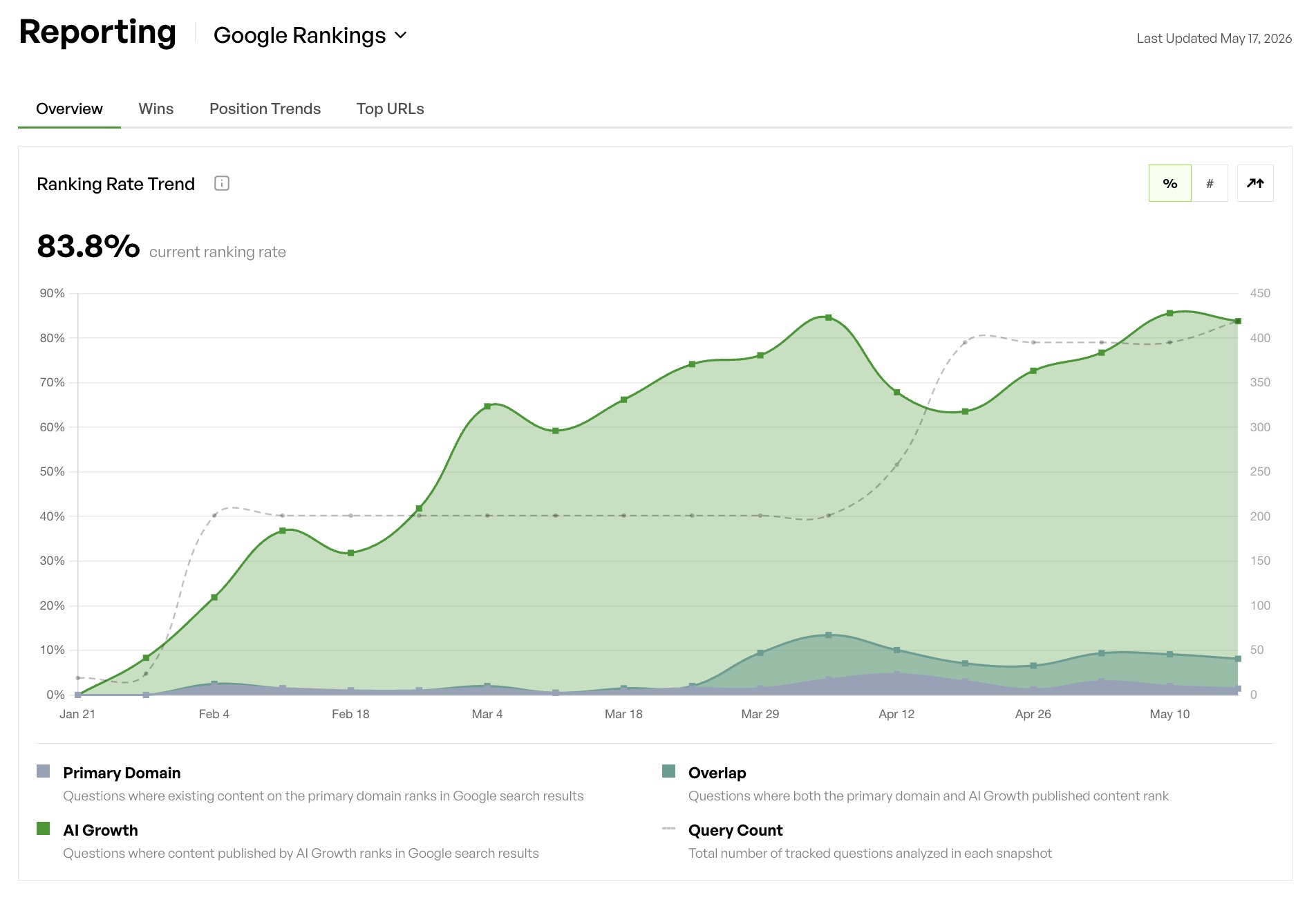
Incremental visibility reporting publishes into a separate environment so results attribute only to new content effort, not to pre-existing brand authority. The metrics that matter are brand mention rate, citation rate, Google Search Console impressions, and bot traffic. Breadless achieved a 30x lift in Google Search Console impressions over six months, growing from 387,000 to 12.3 million impressions, and is now one of the most recommended healthy franchises in the US ahead of CAVA, Rush Bowls, and Sweetgreen.
To keep this measurement clean, combine baseline scan data from Step 3, weekly re-scans across the full prompt universe, Google Search Console access, and per-article bot tracking logs. Confirm that the weekly report separates incremental impressions from baseline and flags any prompt cluster where competitor share of voice has risen more than 10 percentage points. A week-over-week line chart showing incremental citations, bot visits, and impressions against a pre-launch baseline makes progress visible.
Why Monitoring Tools Alone Cannot Move the Metric
Monitoring tools tell you whether your brand appears for a capped set of prompts, but they do not produce content, own publishing, or act on the data. The diagnostic table in Step 4, the citation gap analysis in Step 5, and the incremental reporting in Step 9 all lose value if the organization has no system to execute against the findings.
The structural problem is scope. A monitoring tool might track a defined prompt set for a brand, but it is blind to per-article bot tracking, centralized Google Search Console signals, and the cross-referenced data that determine what to produce next. This scope limitation becomes critical as the competitive landscape accelerates, because AI search engine traffic grew significantly year-over-year and Google AI Overviews now trigger on a substantial portion of queries depending on industry and measurement methodology. The leaderboard is being written at a speed that monitoring-only workflows cannot match.
An execution engine maps the full prompt universe, produces authoritative content against every prioritized gap, publishes with the full agentic technical SEO stack, and reports incremental results week over week. This end-to-end execution is what enabled Leva Sleep to become the most mentioned retailer for adjustable beds in Canada, with ChatGPT citing its content over 10,000 times per month and $40,000 to $50,000 in deals closed in under three weeks from AI-driven buyers. That outcome is not produced by a dashboard tracking mentions. It is produced by a system that converts measurement into owned, self-healing content and then publishes, improves, and refreshes that content continuously.
The difference does not come from data volume. It comes from what happens after the data arrives. Monitoring tools act as a rearview mirror. An execution engine functions as the steering wheel.
Frequently Asked Questions
How long does it take to see measurable improvement in AI Share of Voice?
The first article is typically live within a week of kickoff, and content has indexed in as little as ten days. Meaningful shifts in brand mention rate and citation rate become visible within the first four to six weeks as content accumulates across the prompt universe. The standard engagement is a three-month pilot because indexing timelines vary by industry and competitive density, but clients consistently see movement in bot traffic and Google Search Console impressions before the pilot ends. Brands that move fastest arrive with a complete manifesto and a clear list of seed terms so the engine can begin mapping the full universe immediately.
Who owns the content and the site that AI Growth Agent produces?
The client owns the site and all content outright. AI Growth Agent stands up a fully optimized blog connected to the client’s domain through a reverse proxy rewrite or subdomain. There is no agency dependency, no lock-in, and no situation where a vendor controls the property. The client can take the site and its content at any point. This architecture supports headless marketing, where the brand keeps its curated main site while the engine runs the content infrastructure behind it, and ownership never transfers away from the brand.
What technical dependencies does the client need to manage?
The only integration step on the client’s side is the reverse proxy rewrite that connects the blog to a subdirectory under their domain. Everything else, including schema, the WordPress plugin, robots.txt, sitemaps, Blog MCP, agent discovery via /.well-known/, llms.txt and llms-full.txt, instant indexing, autoredirects, and 404 tracking, is provisioned automatically and included in every package. The internal team requires no technical skill. Setup documentation is generated for the client’s specific host, whether Cloudflare, Vercel, or another provider.
How is AI Share of Voice measured and reported?
AI Growth Agent reports four metrics: brand mention rate, citation rate, Google Search Console impressions, and bot traffic. Reporting is incremental, so results isolate what the content program actually generated rather than riding pre-existing brand visibility. Per-article bot tracking shows exactly when ChatGPT, Perplexity, and other AI crawlers access each piece of content. Google Search Console serves as an independent audit. The prompt universe is refreshed weekly across more than 3,000 searches so the snapshot reflects the current competitive landscape rather than a static baseline captured at kickoff.
How does the system scale across a large prompt universe without quality degrading?
Content production runs as a multi-agent orchestration across major AI providers, with models selected by task and by language. The engine pulls from the brand manifesto, primary source links, product pages, and saved memories, then validates every claim and source before anything publishes. Style memories carry voice rules and apply them to every future generation without re-briefing. Anti-hallucination checks cascade across primary and external sources at the post-draft stage, re-extracting every claim and verifying it before the article moves further down the pipeline. Mature clients reach universes of 1,600 or more queries, with the system producing between 2 and 50 articles per day per client while maintaining consistent quality across the full volume.
Conclusion: Turn AI Visibility Data into Compounding Results
The nine steps above describe a shift from observation to execution. Step 1 through Step 3 establish the measurement foundation with a complete prompt universe, a structured seed-term hierarchy, and real-time scan data across AI platforms. Step 4 through Step 6 convert raw data into a prioritized action list using the four-layer diagnostic table, citation context analysis, and evidence-based query scoring. Step 7 through Step 9 close the loop with authoritative content produced at scale, published with the full agentic technical SEO stack, and measured week over week against an incremental baseline.
Brands that establish authoritative content now are training the next generation of models with their own narrative. Case studies like Breadless and Bisutti show that executing the full playbook, not just monitoring a dashboard, is what drives measurable share of voice gains. That position is earned by consistent execution across the entire system.