Written by: Mariana Fonseca, Editorial Team, AI Growth Agent
Key Takeaways
- Traditional SEO remains essential but cannot win AI citations alone. Agent-enabled optimization now acts as the additive layer that secures visibility in AI answers in 2026.
- Agent-enabled sites compress implementation into roughly one week instead of up to a year and support autonomous scalability with self-healing content that sharply reduces maintenance work.
- Success metrics now focus on citation context, brand mention rate, bot visits, and incremental visibility that separates new gains from existing brand equity.
- Non-technical teams can run the full stack through plain-language feedback while the engine manages schema, MCP endpoints, llms.txt files, and agent discovery behind the scenes.
- Brands ready to add an agent-enabled layer on top of their SEO foundation can book a walkthrough to see the plain-language interface in action and have their first article live within a week.
Executive Summary: From Rankings to AI Citations
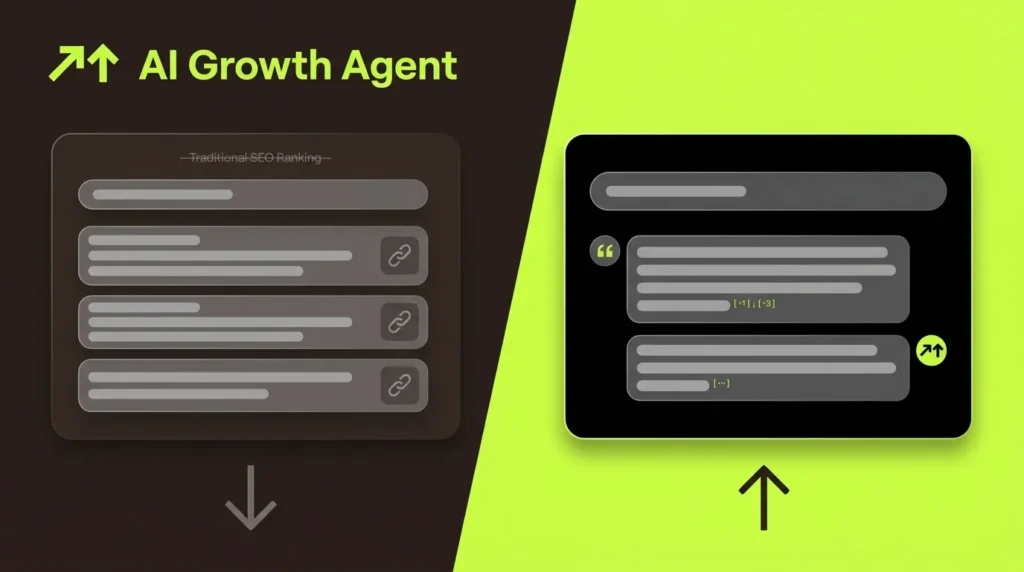
The following table shows how the focus has shifted from ranking in blue links to earning machine citations in AI answers, and how that shift changes goals, metrics, and content formats.
| Attribute | Traditional SEO | Agent-Enabled Sites (LLMO / Agentic Technical SEO) |
|---|---|---|
| Primary goal | Rank in blue-link SERPs | Win machine citation in AI answers |
| Success metric | Ranking position, organic clicks | Citation context, brand mention rate, bot visits |
| Content format | HTML optimized for crawlers and humans | Structured HTML plus llms.txt, llms-full.txt, Blog MCP, /.well-known/ discovery, Markdown for agents |
| Relationship | Foundation layer | Additive layer built on top of traditional SEO |
Evaluation Criteria for CMOs
This guide compares both approaches across eight criteria that matter to mid-market and enterprise CMOs: implementation complexity, scalability, workflow fit, technical requirements, governance, reporting visibility, maintenance burden, and long-term adaptability to zero-click behavior. These criteria surface the practical gaps that most comparison content ignores and set up the detailed comparison that follows.
Side-by-Side Comparison of Traditional and Agent-Enabled SEO
The table below highlights a consistent pattern. Agent-enabled sites trade higher upfront complexity for far lower long-term maintenance and autonomous scalability that traditional SEO alone cannot match.
| Criterion | Traditional SEO | Agent-Enabled Sites |
|---|---|---|
| Implementation complexity | Moderate: keyword research, on-page optimization, link building, schema | Higher upfront: adds Blog MCP, llms.txt, llms-full.txt, /.well-known/ discovery, agent-readable Markdown, and self-healing content pipelines |
| Scalability | Limited by headcount and agency capacity | Scales autonomously; up to 500 articles per month per client without added headcount |
| Workflow fit | Requires SEO specialist, content team, web engineer | Single engine replaces the stack; non-technical teams operate via plain-language feedback |
| Technical requirements | Sitemaps, robots.txt, Core Web Vitals, schema markup, internal linking | All of the above plus MCP endpoints, agent discovery files, server-side rendering for LLM bots, natural language query parameters |
| Governance | Manual audits, periodic reviews | Continuous autonomous monitoring with self-healing updates and anti-hallucination controls |
| Reporting visibility | Rankings, clicks, impressions via Google Search Console | Incremental visibility isolated from existing brand equity, plus per-article bot tracking and citation context |
| Maintenance burden | High: content goes stale, audits required quarterly | Low: living content self-heals, and stale articles refresh automatically on Google Search Console signals |
| Long-term adaptability | Dependent on Google algorithm updates | Built for zero-click AI surfaces that are growing every quarter |
Success metrics comparison: Traditional SEO measures ranking position and organic click volume. Agent-enabled optimization measures citation context, brand mention rate, bot visit volume, and incremental visibility isolated from pre-existing brand equity. Citation frequency, share of model, and AI-generated referral traffic are now required to measure ROI in a synthesis-first environment.
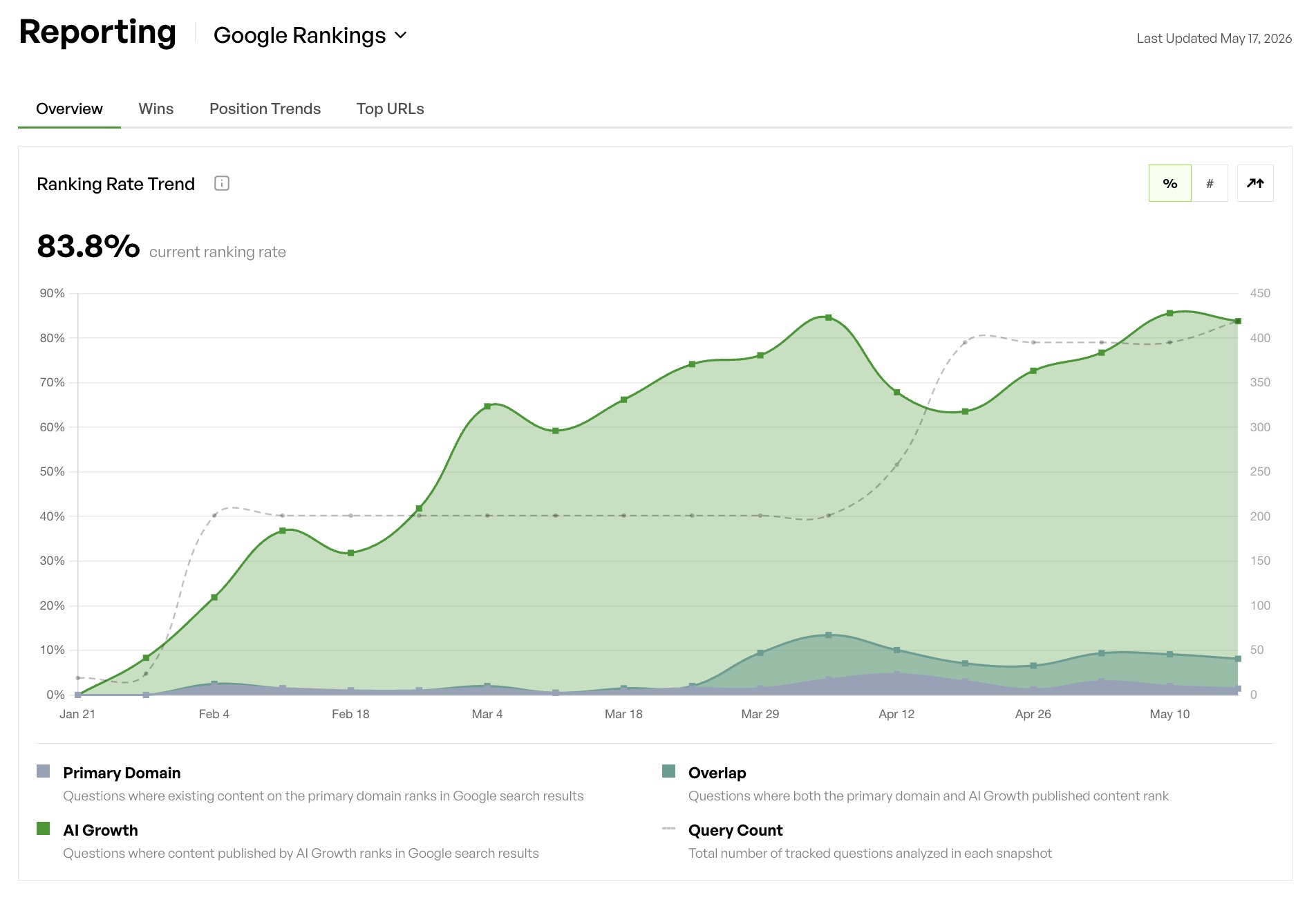
Ready to see where your brand stands across both layers? Get a side-by-side audit of your current SEO foundation and agent-enabled gaps.
Setup and Publishing Speed for Agent-Enabled Sites
Traditional SEO setup often stretches from an agency RFP through onboarding to first assets over nine to twelve months. Agent-enabled sites compress that entire journey into roughly a single week from kickoff to first live article.
The following checklist shows how all eight implementation steps compress into that first week, compared to the three-to-twelve-month timeline typical of traditional SEO agency onboarding:
- Conduct a brand interview to build the manifesto and keyword topology (Week 1).
- Map seed terms and long-tail query universe using real-time Google and ChatGPT data (Week 1).
- Stand up a fully optimized WordPress site styled to match the brand (Week 1).
- Publish first authoritative articles with full schema, metadata, and internal linking (Week 1).
- Connect the blog to the brand domain via reverse proxy rewrite or subdomain (Week 1).
- Deploy llms.txt, llms-full.txt, Blog MCP, and /.well-known/ discovery files (Week 1, automatic).
- Activate instant indexing, autoredirects, 404 tracking, and web stories sitemap (Week 1, automatic).
- Content indexes in as little as ten days, often within two weeks.
Content Structure and Schema Requirements for AI Surfaces
Technical requirements for 2026 AI optimization include entity mapping, semantic HTML, structured data, server-side rendering, and API readiness, because many LLM bots cannot fully render JavaScript and rely on initial HTML. Traditional SEO covers the first three. Agentic technical SEO extends the stack.
Traditional technical SEO elements (still required): Highly structured HTML, Open Graph metadata, rich schema markup (Article, Author, Organization, Product, LocalBusiness, Review, SoftwareApplication), internal linking, sanitized external linking, proper sitemaps, and a detailed robots.txt. Schema markup is commonly used in search results, so it functions as a baseline requirement rather than a differentiator.
Agentic technical SEO elements (the additive layer): Blog MCP with schema, manifest, discovery, and capability guidance exposed to agents; OpenAI discovery and Agent Card guidance served via /.well-known/; natural language query parameters via /?s={query} that return personalized, internally linked responses to agents; Markdown served to agent crawlers; llms.txt and llms-full.txt so AI surfaces can read the brand in the format they require. JSON-LD is the recommended format for agentic schema optimization because it is cleanly separated from HTML and explicitly endorsed in Google’s guidance for AI-optimized content.
Success Metrics Evolution in a Zero-Click World
The metrics that defined SEO success in 2022 no longer cover the full picture in 2026. In a 21.9-million-search study covering Q1 2026, 25.11% of Google searches triggered an AI Overview, and roughly 83% of those Overview-triggered searches ended in no click at all. Position-one CTR can fall significantly when an AI Overview is present, so ranking first no longer guarantees traffic.
Google’s own scale data makes the shift concrete. Google reported at I/O 2026 that AI Mode surpassed 1 billion monthly users with queries more than doubling every quarter. The surface consuming your content now is primarily a model synthesizing an answer, not a human scanning a list of links.
The replacement metrics are citation context, brand mention rate, bot visit volume, and incremental visibility. Brands cited by AI Overviews earn 35% more organic clicks and 91% more paid clicks than non-cited brands, which means citation context functions as a revenue signal rather than a vanity metric.
Team and Agency Involvement for Agent-Enabled SEO
Traditional SEO requires an editor, an SEO specialist, a designer, and an engineer working in coordination, or an agency that replicates that structure at higher cost and slower speed. Successful search optimization in 2026 requires integration of editorial, IT, UX, PR, and product management, a cross-functional demand that most mid-market teams cannot staff.
Agent-enabled sites are built for three specific use cases, each representing a team that needs citation authority but lacks the cross-functional resources traditional SEO demands:
- Enterprise CMO teams: Non-technical brand managers operate via plain-language feedback. The engine handles schema, publishing, bot tracking, and reporting. The CMO receives a defensible answer for the CEO every week.
- Builder operators: Founders and CEOs who need organic reach without managing another tool or agency. One interview goes in, and authoritative content comes out on autopilot.
- Forward-thinking agencies: PR and marketing agencies that layer AI search on top of earned media as a new service line, using the engine’s Search Intelligence to identify which communities and creators shape each client’s space.
Ongoing Maintenance and Living Content
Traditional SEO content starts aging the day it ships. A brand with hundreds of articles faces an unmanageable refresh cycle, and manual audits and human execution cannot keep pace with continuous AI crawl cycles.
Agent-enabled sites rely on living, self-healing content. When the year turns, every article in a sector refreshes automatically. Stale articles update in response to Google Search Console signals and bot-traffic data. Every article’s relationships, performance, and indexing data are centralized so authority compounds instead of decaying. This autonomous scalability, detailed in the comparison table above, enables the self-healing content model to manage hundreds of articles without manual intervention. AI Growth Agent clients average more than 12,000 additional AI citations and mentions and over 100,000 additional bot visits across the first twelve weeks.
Source: AI Growth Agent internal client data (anonymized aggregate).
Operational and Long-Term Considerations for CMOs
Onboarding for traditional SEO through an agency often runs three to six months before the first asset is live. Agent-enabled sites move from kickoff to first published article in about one week. The only integration step on the client side is the reverse proxy rewrite that connects the blog to a subdirectory under the brand’s domain.
Cross-functional dependencies also change. Traditional SEO requires ongoing coordination between content, engineering, and design. Agent-enabled sites remove those dependencies, because the engine provisions schema, the WordPress plugin, robots.txt, sitemaps, web stories, Blog MCP, agent discovery, llms.txt and llms-full.txt, instant indexing, autoredirects, and 404 tracking automatically.
Long-term adaptability favors agent-enabled sites. Gartner predicted that by 2028, AI agents will intermediate more than $15 trillion in B2B spending. Infrastructure built for agent interaction today becomes infrastructure for the dominant discovery channel of the next decade.
The brands cited in AI search this year are training the next generation of models with their own story. See how your brand can start shaping AI training data this quarter.
Source: Gartner research (public forecast).
Risks, Limitations, and Common Misconceptions
Traditional SEO is not dead. Successful SEO in 2026 still begins with a solid technical foundation, including Core Web Vitals, server-side rendering, schema markup, and E-E-A-T authority building. Agent-enabled optimization acts as an additive layer, not a replacement. Brands that abandon traditional SEO foundations in pursuit of AI citation lose both channels.
Monitoring tools alone do not solve visibility. GEO and AI search monitors track whether a brand appears for a capped set of prompts. They do not produce content, own publishing, or act on the data. SEO measurement in 2026 requires context, not just counts, and monitoring without execution leaves the brand with a diagnosis and no treatment.
AI content volume is not the same as AI citation authority. One company produced roughly 300 articles using a chatbot alone. Not one was cited. The gap between what an engineer thinks content should be, what a marketer wants, and what AI surfaces need to cite it is real, and generic content factories do not close that gap.
Decision Framework for Choosing Your Next Step
The decision framework follows a simple hierarchy: foundation first, then the additive agent-enabled layer, then operational independence and clear measurement.
- If your brand has no traditional SEO foundation, build it first, then layer agent-enabled optimization on top.
- If your brand has traditional SEO but no presence in AI answers, the additive layer becomes the immediate priority.
- If your agency controls your site and you cannot publish without them, agent-enabled sites give you an owned property with no agency dependency.
- If your team is non-technical and cannot deliver schema or agentic formats, the engine provisions the full stack automatically.
- If you are tracking a handful of head terms and losing the long-tail conversation, a universe map built from real-time AI Overview and ChatGPT data surfaces the queries you are missing.
- If you need to prove incremental results to a CEO, incremental visibility reporting isolates exactly what the agent-enabled layer generated, separate from existing brand equity.
- If you are an agency whose clients are asking why competitors appear in ChatGPT, Search Intelligence and the content engine turn that question into a new service line.
Frequently Asked Questions
How long does it take to implement an agent-enabled site on top of existing SEO?
The first published article is typically live within one week of kickoff. Content indexes in as little as ten days and often within two weeks. The only integration step on the brand’s side is the reverse proxy rewrite that connects the blog to a subdirectory under the existing domain. The full technical and agentic SEO stack, including Blog MCP, llms.txt, llms-full.txt, /.well-known/ discovery, schema, sitemaps, and bot tracking, deploys automatically as part of setup. A standard pilot runs three months, because indexing timelines vary by industry, but most clients see measurable movement in bot visits and citation context well before the pilot ends.
What expertise does the internal team need to run an agent-enabled site?
No technical expertise is required. The engine provisions schema, the WordPress plugin, robots.txt, sitemaps, web stories, Blog MCP, agent discovery files, instant indexing, autoredirects, and 404 tracking without any action from the client team. Brand managers and CMOs operate via plain-language feedback in a review interface. When a correction is made, the engine saves a memory so the same note is never needed twice. The only skill the team needs is the ability to describe what the brand wants to win, in plain language, and the engine maps and executes against that direction.
How is citation context measured, and how does it differ from traditional rank tracking?
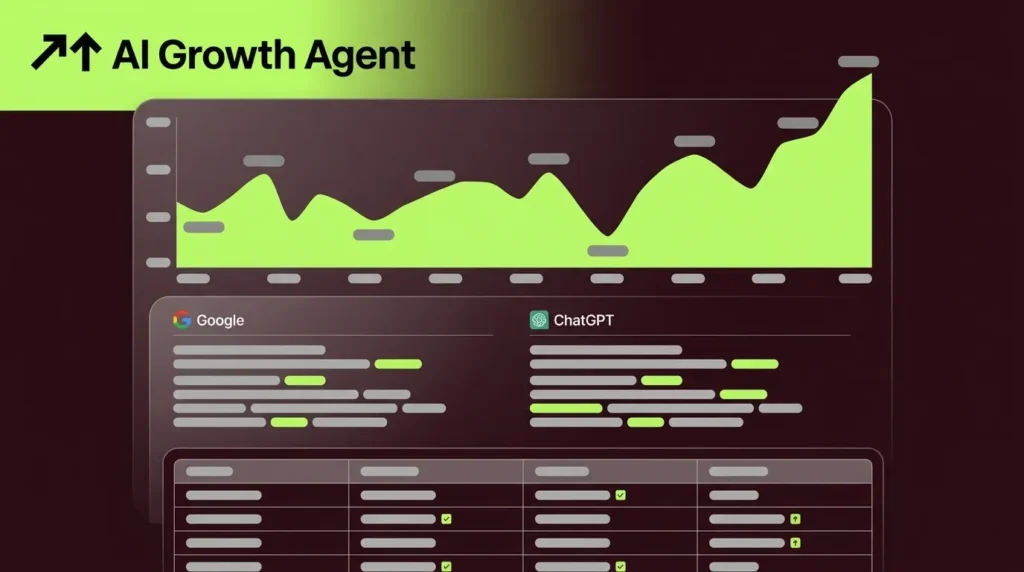
Traditional rank tracking assigns a position number to a keyword on a given day. Citation context measures where a brand appears in an AI-generated answer, what claim it is cited for, who it is grouped with, and how that position evolves week over week. There is no static ordered list in AI answers, so order of mention and the specificity of the citation replace the rank number as the primary signal. Measurement combines per-article bot tracking, Google Search Console impressions, and incremental visibility reporting that isolates what the agent-enabled layer generated versus visibility the brand already had. As noted in the Success Metrics Evolution section, cited brands earn meaningfully more organic and paid clicks, which makes citation context a revenue-connected metric rather than a vanity indicator.
Does agent-enabled optimization require replacing the existing website or CMS?
No. Agent-enabled sites connect to the existing domain through a reverse proxy rewrite, typically under a subdirectory, or through a subdomain. The curated main site and its CMS remain untouched. The agent-enabled blog functions as a separate, fully optimized property the brand owns outright, styled to match the main site. Nothing in the existing structure changes, and no new agency dependency is introduced. The brand owns the site, the content, and the relationship with AI surfaces from day one.
How does quality control work at scale when producing hundreds of articles per month?
Quality is enforced through a multi-stage pipeline rather than a single model behind a prompt. Parallel research agents gather primary-source evidence before any draft is written. Every claim, source, and quote in the draft is re-extracted and checked against the brand manifesto, product pages, primary sources, and verified external sources. Any claim that cannot be backed up is removed or softened before the article advances. Anti-hallucination focus is steerable. The brand tells the engine which claim types deserve the heaviest scrutiny, such as pricing or ingredient claims, and the engine applies that focus to every article. Style memories carry voice rules and terminology preferences so output stays consistent across hundreds of articles without re-briefing.
Conclusion: Making Your Brand the Cited Answer
Traditional SEO remains the foundation. Agent-enabled sites now act as the required additive layer for 2026. The brands winning citation in AI answers have not abandoned rankings, backlinks, or Core Web Vitals. They have added Blog MCP, llms.txt, llms-full.txt, /.well-known/ discovery, and self-healing content on top of those foundations, and they are doing it without added headcount or agency dependency.
The leaderboard in AI search is being written this year. Brands that establish authoritative, machine-readable content now are training the next generation of models with their own narrative. Brands that wait are training the next generation with whatever happens to be sitting on the open web.
Traditional search tools show you where your brand stands. AI Growth Agent makes your brand the answer. Book a session to become the cited source in your category.