Written by: Mariana Fonseca, Editorial Team, AI Growth Agent
What You Gain With AI Growth Agent
- Controlling brand narrative in AI search means publishing structured, validated content that AI models like ChatGPT, Perplexity, and Google AI Mode read, trust, and cite before customers ask questions.
- AI Growth Agent replaces reactive reputation management with upstream content production grounded in four real-time intelligence pillars: Search Intelligence, AI Analytics, Bot Tracking, and AI Ranking.
- The 7-day kickoff process turns a single client interview into a manifesto, keyword topology, and published articles that begin earning citations and bot traffic within days.
- Every article ships with complete traditional and agentic technical SEO including schema, llms.txt, Blog MCP, instant indexing, and self-healing capabilities, with no client technical team required.
- AI Growth Agent delivers measurable incremental visibility and narrative control without added headcount, and you can book a session to map your brand universe and put your story in front of the models that matter.
The Four Intelligence Pillars Powering Weekly Content Topology
Every content decision AI Growth Agent makes is grounded in four pillars of real-time data that work as an integrated intelligence system. Together they replace the disconnected dashboards most marketing teams stitch together manually and feed a single, actionable content strategy.
Search Intelligence produces a complete portrait of the traditional search landscape: positioning, competition, search volume, and the structure of who is already winning each result. To build that portrait, the system runs hundreds of real searches in the client's space every week and has agents process title structures, forum discussions, "people also ask" patterns, and query fan-out to see which angles win. The output is an actionable diagnosis, not a raw data dump, so the team knows what to write next instead of guessing from rankings.
AI Analytics maps brand value and consumer behavior across the whole journey, from external touchpoints like Google and AI-tool queries through content consumption, demographics, and sentiment. It shows where the brand is being described, how it is grouped with competitors, and what claims are being attributed to it across AI surfaces, so narrative gaps and misattributions become visible and fixable.
Bot Tracking records every bot interaction, traditional crawlers and AI training agents alike, including every crawl, citation, and training sweep. 85% of brand mentions in AI answers originate from third-party pages rather than owned domains, which means knowing exactly who is reading the brand's content, and when, is the only way to verify whether the investment is working.
AI Ranking tracks where the brand appears in AI answers and how that position evolves week over week. AI answers have no static ordered list, so order of mention and citation context replace the old ranking number. This pillar becomes the new leaderboard and shows whether the brand is moving toward category ownership in AI responses.
These four pillars feed the Content Topology every week, creating a hierarchy of seed terms backed by real-time Google and ChatGPT data with dozens of long-tail queries beneath each one. A mature client universe reaches 1,600 or more queries, and the system runs 3,000 or more searches weekly to refresh the snapshot. The topology stays evidence-based rather than guessed, because real-time AI Overview and ChatGPT results act as the objective function for which long-tail queries deserve content next.
The 7-Day Kickoff Process That Turns an Interview Into Published Articles
The kickoff is where the engine learns the brand and locks in narrative control. A journalist with more than ten years of experience interviews the client to build the manifesto, the single source of truth that every future article draws from. The manifesto captures brand voice, factual references, deny lists, primary-source URLs, and the personalization controls the engine applies to every generation.
The team then builds the keyword topology from the manifesto, creating a strategic map of seed terms and the long-tail queries beneath them, organized by the questions the brand's ideal customer actually asks rather than the head terms the brand pre-decided to defend. The client and AI Growth Agent jointly review the topology and select which seed terms to pursue first so early content aligns with real demand.
The first articles are generated, reviewed with the client, and tuned together so quality and voice match expectations. By the end of the week, the engine is producing content the client is comfortable approving. The site, a fully optimized blog styled to match the client's own pages, is stood up via reverse proxy rewrite, connecting to a subdirectory under the brand's domain without touching the existing site structure. The client owns the property outright.
The result is a manifesto, a keyword topology, and authoritative first articles within one week, with content indexing in as little as ten days. Across the first twelve weeks, clients average more than 12,000 additional AI citations and mentions, over 100,000 additional bot visits, and a 20% or greater lift in impressions. These are not just publishing milestones, because they translate into measurable visibility gains that prove the engine is working before the pilot period ends.
See what a kickoff looks like for your brand and walk through the manifesto interview, topology build, and first article review.
Agentic Technical SEO Implementation Steps for a Headless Engine
Every article and every site AI Growth Agent publishes ships with the full traditional and agentic technical SEO stack, handled by the engine rather than the client. Each package includes the same foundation so performance does not depend on internal engineering capacity.
At the article level, the stack covers highly structured HTML, Open Graph metadata, full image and video metadata, rich schema markup across article, author, review, local business, product, software application, and the rest of the schema suite. It also includes internal linking that compounds authority across the universe and sanitized external linking marked noindex and nofollow. In March 2025 Microsoft publicly confirmed it uses schema markup for its generative AI features, while Google did so the following month.
At the site level, the stack includes proper sitemaps, a detailed robots.txt, automated web stories with a dedicated web-stories sitemap, real-time bot tracking, instant indexing, autoredirects, and 404 tracking. These elements keep the site crawlable, observable, and resilient as AI surfaces evolve.
The agentic layer is where AI Growth Agent separates from every other system in the market. Blog MCP, also compatible with Chrome 146 and later and other WebMCP-enabled browsers, exposes schema, manifest, discovery, and capability guidance to agents. OpenAI discovery and Agent Card guidance are served via /.well-known/ endpoints. Natural language query parameters via /?s={query} auto-trigger personalized, internally linked responses so an agent passing a query straight into the URL receives a tailored answer. Pages are served in Markdown to agent crawlers. llms.txt and llms-full.txt are published so AI surfaces can read the brand the way they need to.
The only integration step on the client's side is the reverse proxy rewrite that connects the blog to a subdirectory under their domain. Everything else sits inside the engine.
What the First 90 Days Look Like in Practice
Days 1 to 30: Kickoff and First Citations. The first 30 days establish the foundation for everything that follows. The process starts with the client interview, which produces the manifesto as the single source of truth that guides every future article. From the manifesto, the team builds the keyword topology and selects the first seed terms to pursue, then uses those seed terms to generate, review, and publish the first articles once the site is stood up via reverse proxy. With content live, the technical layer activates as llms.txt, llms-full.txt, Blog MCP, /.well-known/ endpoints, the full schema suite, and the web-stories sitemap are configured so AI systems can read the content the way they need to. Bot tracking goes live to record which AI crawlers are visiting, and the baseline for incremental visibility reporting is established across Google Search Console, bot analytics, and AI citation tracking.
Days 31 to 60: Scale and Self-Healing. The second month focuses on expanding coverage and fixing gaps automatically. The content topology grows to cover additional seed terms and long-tail queries identified from the first month's data. Self-healing activates for any articles showing indexing gaps or stale signals so the system refreshes content without manual rewrites. Bot tracking data highlights which content AI training agents crawl most often, and the team doubles down on those topics. Internal linking passes begin to lift content that has not yet indexed, while AI Ranking data shows early order-of-mention shifts week over week.
Days 61 to 90: Incremental Visibility Proof. The third month proves what the engine produced, separate from what the brand already had. New citations, bot traffic, and impressions are isolated from existing brand visibility using the incremental reporting view, then cross-referenced with Google Search Console as an independent audit. The team identifies the seed terms producing the highest citation rates and expands the topology beneath them. Stakeholders see week-over-week visibility gains with data tied directly to the engine's output rather than blended into legacy performance.
Why Monitoring Tools Alone Aren't Enough
Monitoring tools tell a brand it is not showing up in AI answers, but they do not change what the answer is. With most brand mentions coming from third-party pages, as noted earlier, a dashboard that tracks a capped set of prompts is blind to the vast majority of the conversation happening about the brand.
The gap between monitoring and execution is where most brands stall. A GEO monitor surfaces the problem, while a headless engine solves it by producing the authoritative content the models will use to describe the brand, in the formats and structures the models can read, validated against primary sources so the citation is earned rather than hoped for. Bot Tracking inside AI Growth Agent records every crawl, citation, and training sweep, giving the brand a live view of which content is being read by AI systems and when, instead of a lagging report of what appeared in a capped prompt set.
Handling Conflicting Sources and Sentiment Management
Fixing narrative inconsistency requires a sustained process of publishing, reinforcing, and distributing clearer signals while correcting conflicting material until the newer story outweighs the old one. A single correction rarely shifts the broader picture that AI systems synthesize from many inputs.
The manifesto is the primary mechanism for resolving drift. It acts as the single source of truth that every article draws from, and the engine always prefers claims and data from the manifesto and the client's primary sources over anything else. When the engine reaches outside for research, it scrapes, qualifies, and verifies every external source before passing it into the content generation pipeline. After a draft is generated, every claim is re-extracted and checked against product pages, the manifesto, primary sources, and verified external sources. Any claim that cannot be backed up is removed or softened before the article moves further down the pipeline.
Getting the same version of events into multiple trusted sources quickly is critical because AI systems synthesize answers from many inputs, and a single response rarely shifts the broader picture. The Content Topology ensures the brand's narrative is present across the full long tail of queries, not just the head terms it pre-decided to defend, so the signal stays consistent and broad rather than concentrated and fragile.
The Two Wrong Doors and the Headless Alternative
When a leader decides to take AI search seriously, two broken options usually appear first. The first is the agency RFP, which often takes roughly three months to select a vendor and three more months to produce the first assets. Nearly a year can pass before anything is in motion, and that time is spent briefing, onboarding, and chasing, while the agency often controls the site and adds a dependency that outlasts the contract.
The second option is the DIY chatbot. Producing one good article is possible, but producing the second means running the entire process again, with more rounds of review, schema to maintain, legal language to get right, and quality that drifts from one article to the next. One company produced roughly 300 articles this way. Not one was cited, and the articles were full of errors and gaps.
These two doors look like opposites, because one outsources everything and the other keeps it in-house. They are the same trap, because both depend on stitching together a stack of agencies, tools, and people, and both leave the brand with content that goes stale the day it ships. The agency model creates a dependency that is hard to escape, while the DIY model creates a process that is hard to scale, so either way the brand manages complexity instead of controlling narrative.
The headless alternative replaces the entire stack with one engine. The client owns the site, the content, and the relationship with the AI surfaces. The engine handles the technical SEO, the schema, the bot tracking, the publishing, and the self-healing. There is no team to manage on the brand's side.
Measuring Incremental Visibility
Incremental visibility reporting isolates exactly what the engine generated, separate from the visibility the brand already had. AI Growth Agent publishes into a separate environment so it can take credit only for the citations, bot visits, and impressions it actually produced. The reporting view cross-references Google Search Console as an independent audit, per-article bot tracking across every bot type, and AI citation data that no single monitoring tool brings together.
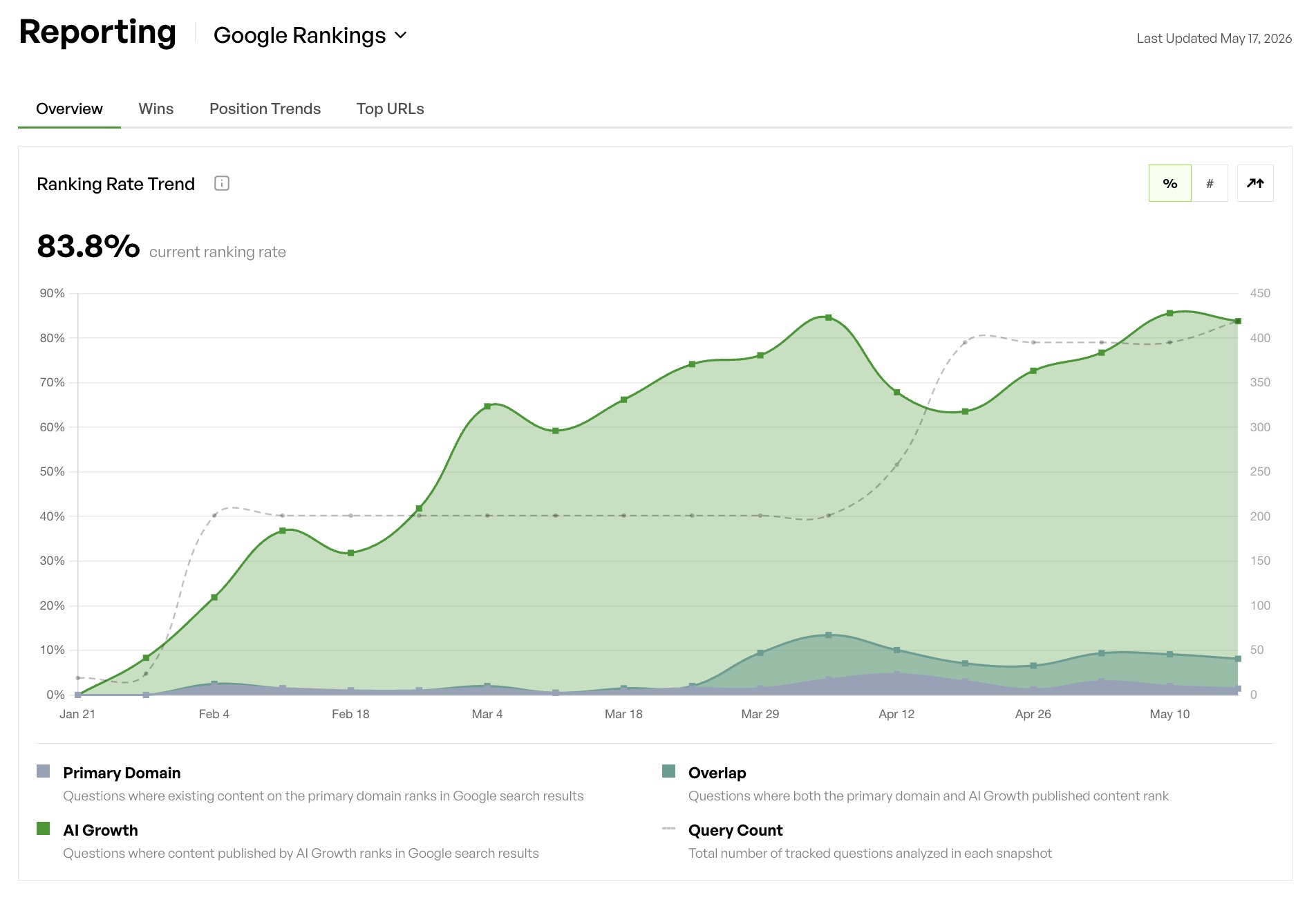
The client results introduced earlier make the method concrete. Across retail, franchise, and events, the pattern is consistent: brands that establish authoritative content early dominate their category in AI answers, and incremental visibility reporting isolates exactly what the engine produced.
In a zero-click world, the brands that measure best capture source at the conversion moment by asking every lead how they found the company and tagging AI-driven discovery separately from traditional search. Across those clients, the pattern is consistent, because a lift in organic leads follows the lift in AI citations, and the incremental reporting makes the connection visible rather than assumed.
See how incremental visibility reporting works for your brand and walk through what the first 90 days look like in practice.
Frequently Asked Questions
How long does it take to see results in AI search after starting with AI Growth Agent?
The first article is typically live within one week of the kickoff interview. Content has indexed in as little as ten days and often within two weeks. The standard engagement is a three-month pilot because indexing timelines vary by industry, but clients consistently see movement in bot traffic, Google Search Console impressions, and AI citations within the first month. Leva Sleep closed $40,000 to $50,000 in deals within three weeks of content going live, and Jelly received its first ChatGPT citation within three weeks. These timelines show that the engine produces visible results quickly rather than requiring months of ramp.
Who owns the site and content that AI Growth Agent produces?
The client owns everything outright, including the site, the content, and the relationship with the AI surfaces. AI Growth Agent stands up a fully optimized blog connected to the client's domain through a reverse proxy rewrite or subdomain. It does not touch the client's existing site structure, and there is no agency dependency to manage. If the engagement ends, the client keeps the property and everything published on it.
Does the client need a technical team to run this?
No technical team is required on the client side beyond the initial connection. The engine provisions schema, the WordPress plugin, robots.txt, sitemaps, automatic web stories, Blog MCP, agent discovery via /.well-known/, llms.txt and llms-full.txt, instant indexing, autoredirects, and 404 tracking automatically. The only integration step on the client's side is the reverse proxy rewrite that connects the blog to a subdirectory under their domain, and AI Growth Agent provides setup documentation for the client's host, whether Cloudflare, Vercel, or another provider. The internal team gives feedback in plain language and the system learns.
How does AI Growth Agent handle brand voice and compliance requirements?
The manifesto built during kickoff acts as the primary source of truth. On top of it, clients configure style memories, which are voice rules the engine applies to every future generation, such as preferred terminology, words to avoid, and house conventions. Legal disclaimers, claim prioritization for sensitive sectors, and anti-hallucination steering are configured once and applied automatically. Every claim, source, and quote is validated against evidence found online rather than a model's training data, so the content holds up under client, regulator, and AI surface reviews. Feedback given during review is saved as a memory so the same correction is never needed twice.
How is AI Growth Agent different from a monitoring tool like Profound?
Monitoring tools track whether a brand appears for a capped set of prompts and stop there, surfacing the problem and leaving the client to solve it. AI Growth Agent is not a monitoring company, because it produces the content, owns the publishing, and acts on the data. Bot Tracking inside the platform records every crawl, citation, and training sweep, including the bot ChatGPT uses to cite sources, and cross-references that data with Google Search Console and per-article performance signals to decide what to publish next. The differentiator is not who has more data, but that AI Growth Agent turns data into published, self-healing content and proves the incremental result week over week.
The Brands Cited Today Are Training Tomorrow's Models
The AI search leaderboard is being written this year. The models consuming content now are building the associations, citations, and narrative patterns that will define how brands are described for the next generation of AI surfaces. Brands that establish authoritative content now are training the next generation of models with their own narrative, while brands that wait are training the next generation with whatever happens to be sitting on the open web.
Traditional search tools show you where your brand stands, while AI Growth Agent makes your brand the answer. One engine replaces the SEO agency, the content tool, the web agency, the GEO monitor, the schema plugin, the analytics stack, and the PR firm, at a flat fee with no per-article charges, credit limits, or per-prompt billing. The first article is live within a week, the content self-heals over time, and the reporting proves what the engine generated, not what the brand already had.
Book a kickoff and start training the models that matter. The brands cited in AI search this year are controlling their narrative deliberately. See how to be one of them.