Written by: Mariana Fonseca, Editorial Team, AI Growth Agent | Last updated: January 10, 2026
Key Takeaways
- AI-powered search engines now shape how people discover brands, so Generative Engine Optimization (GEO) joins traditional SEO as a core growth channel.
- Five tool categories matter most for AI visibility: advanced discovery, technical instrumentation, AI-native content platforms, AI visibility tracking, and programmatic SEO automation.
- Entity-level research, clean technical signals, and structured, citation-ready content help AI systems trust and reference your brand in their answers.
- Programmatic workflows and closed feedback loops let marketing teams scale content output while staying aligned with how AI models crawl, rank, and recall information.
- AI Growth Agent unifies these capabilities in one programmatic SEO platform; you can explore it through an AI search visibility demo at AI Growth Agent.
Schedule a consultation to see how AI Growth Agent can support your AI search strategy.
1. Advanced Discovery And Research For AI-First Content
Shift From Keywords To Entity-Driven Topic Maps
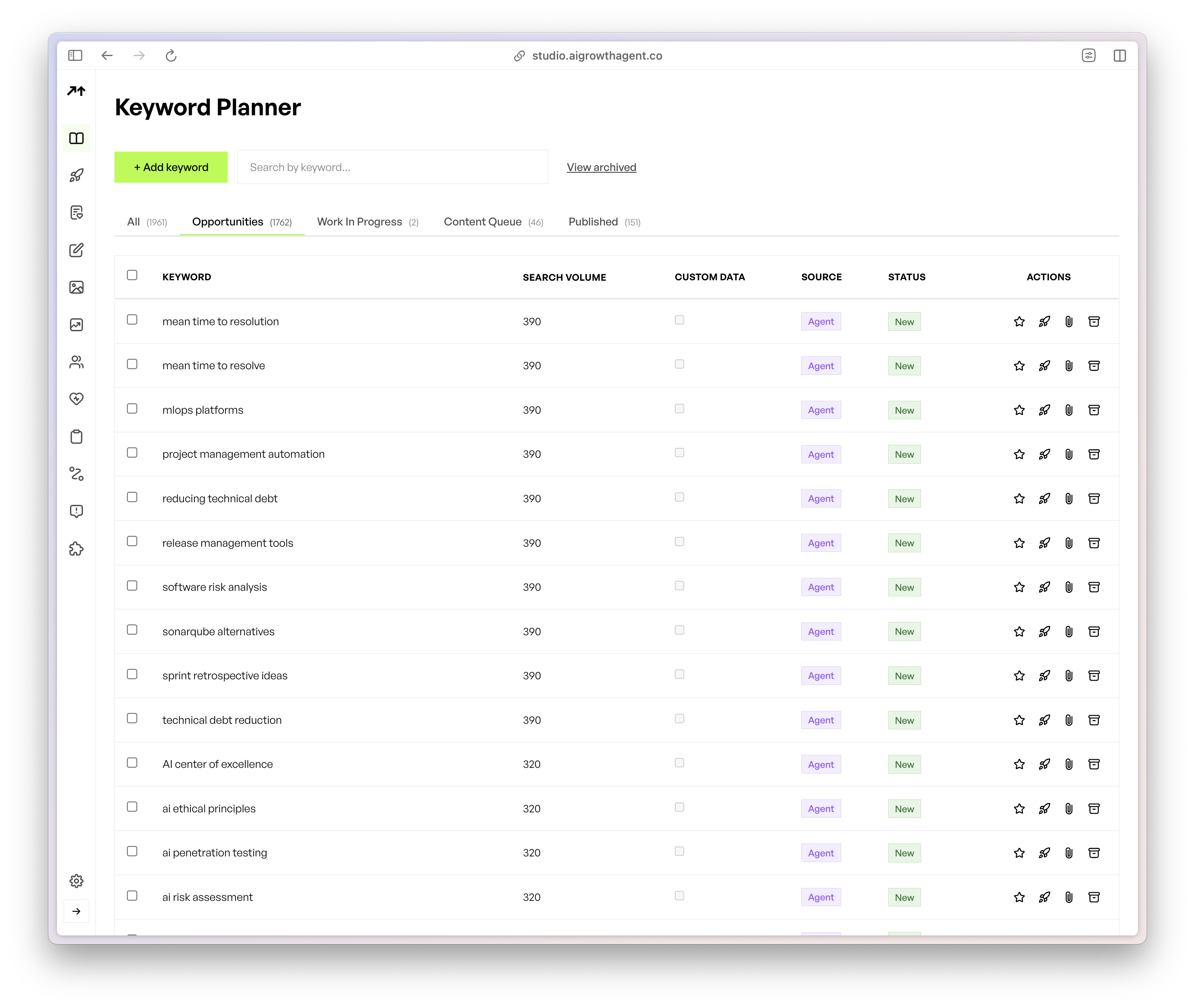
Traditional keyword research is no longer sufficient; AI models group entities, topics, and intents to answer complex queries. Teams now benefit from tools that support entity discovery, semantic embeddings, question mining, and topical clustering. These systems surface the concepts and questions AI systems are likely to use, including long-tail and multi-intent queries.
Advanced discovery platforms use transformer-based NLP to align your content plan with how AI models organize knowledge. This alignment increases the odds that your content appears as a trusted source when models construct answers.
Build Knowledge Graphs That Match AI Concept Spaces
Entity-driven research supports knowledge graphs and content clusters that map cleanly to AI models’ concept spaces. This approach helps you fill gaps in AI conversations, clarify definitions, and reinforce relationships between topics.
Discovery intelligence shifts planning from isolated posts to structured topic networks that AI can crawl, embed, and reuse across many queries.
Actionable Takeaway
Adopt discovery tools that expose entities, questions, and topic clusters, then plan content around knowledge graphs instead of stand-alone keyword lists.
2. Technical Instrumentation And AI-Specific Crawler Management
Make Your Site Easy For AI Crawlers To Read
AI-oriented crawlers from providers like OpenAI, Google, and Anthropic need clear access to key pages and assets. Technical setups that use robots.txt and emerging files such as llm.txt guide AI crawlers toward preferred sources and update signals.
Modern technical tools monitor bot traffic, render key templates, and verify that performance, JavaScript, and security settings do not block AI crawlers or strip important context.
Automate Technical SEO For AI Indexing
Programmatic technical SEO now helps teams manage configuration, internal linking, and crawling at scale for AI search. Automated schema deployment and image optimization strengthen how AI systems index and interpret each page.
Specialized AI audits check feeds, directives, and metadata that older SEO tools may overlook, which keeps your technical foundation in step with new AI crawling standards.
Actionable Takeaway
Use technical instrumentation that validates AI crawler access, monitors AI bot behavior, and automates structured data and directives like llm.txt.
3. AI-Native Content Creation And Optimization Platforms
Design Content For AI Readability And Citation
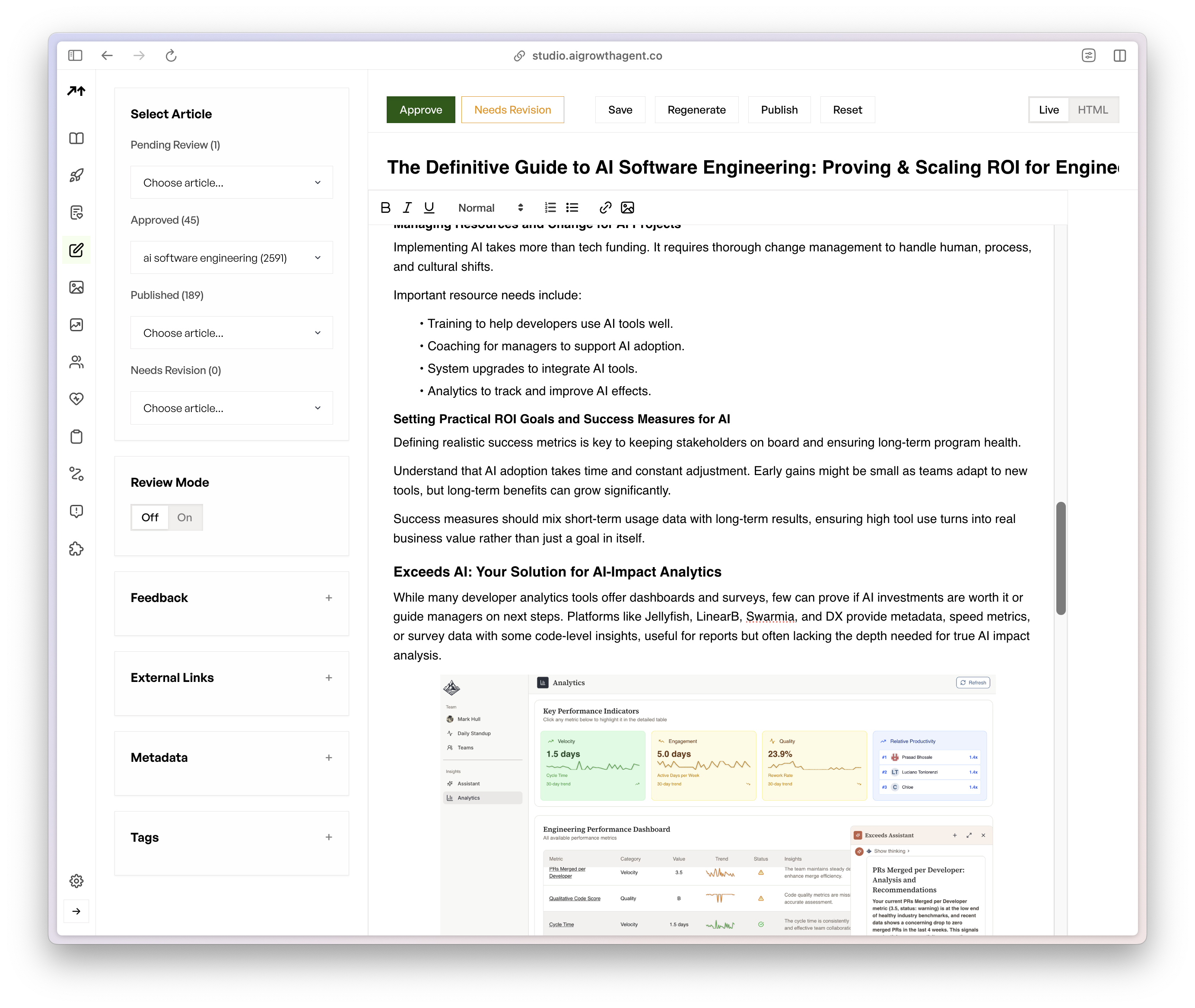
AI-native content platforms apply large language models to generate and optimize content specifically for AI retrieval and citation. These tools layer schema markup, NLP-based content scoring, term suggestions, and structured layouts for GEO.
Effective platforms emphasize clear sections, definitions, consistent entity naming, and concise explanations that AI models can quote with confidence.
Balance Programmatic Scale With Quality
Modern content platforms treat content creation as an engineering workflow. Templates, structured data, and validation checks help teams publish large volumes of entity-dense content without losing clarity or accuracy.
This balance between volume and rigor gives brands a better chance of appearing in AI answers across many related queries.
See how AI Growth Agent supports AI-readable, schema-rich content at programmatic scale.
Actionable Takeaway
Choose AI-native content tools that give real-time optimization guidance, embed schema automatically, and standardize templates for GEO-friendly pages.
4. AI Visibility And Citation Tracking Tools
Track Where Your Brand Appears In AI Answers
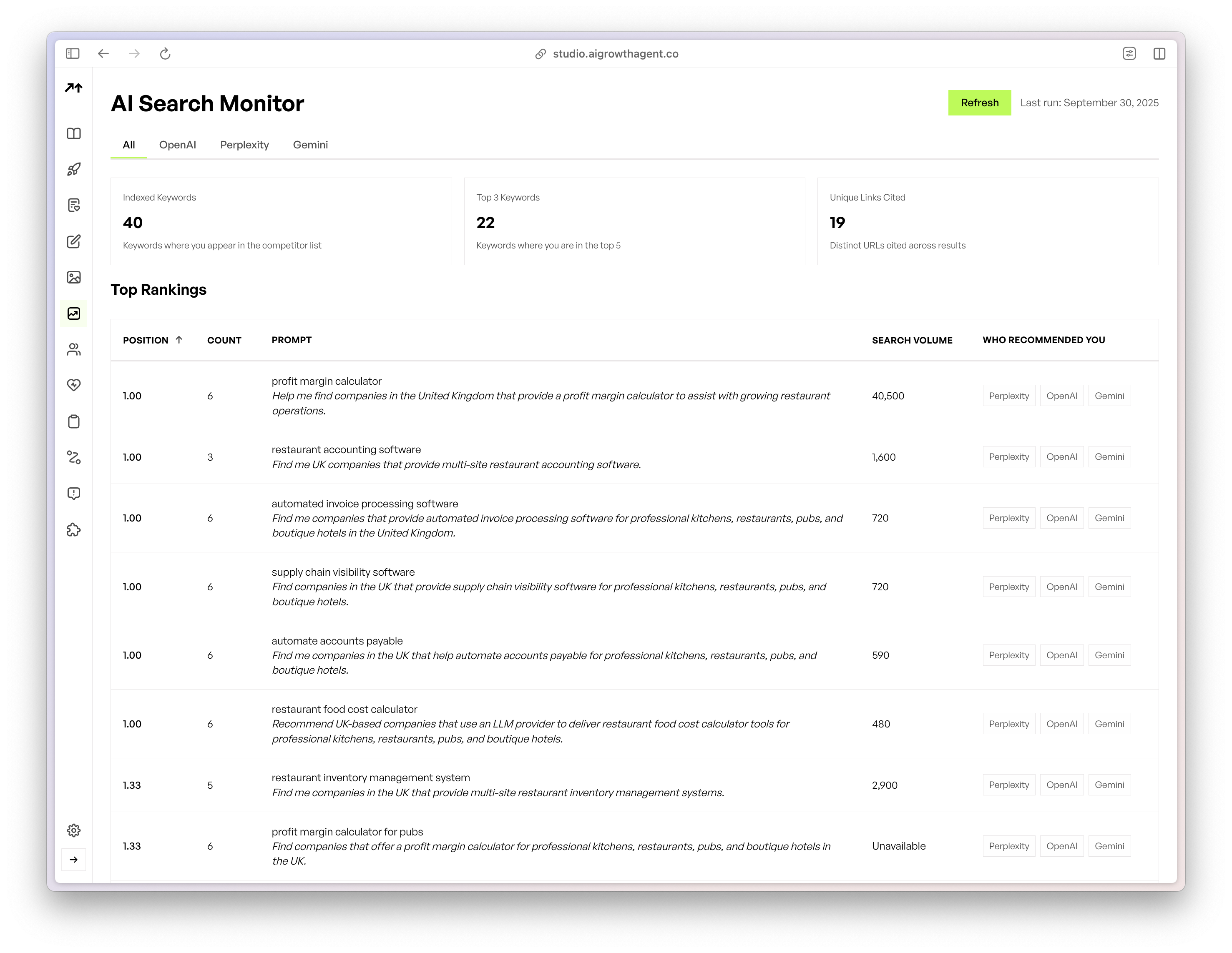
Dedicated AI visibility tools measure how often a brand appears in answers across ChatGPT, Gemini-based AI Overviews, Perplexity, and similar products. These platforms connect specific URLs, facts, and entities to citations and sentiment in AI responses.
Insight at this level helps you understand which pages drive visibility, which angles resonate, and where AI systems misinterpret your information.
Use AI Answer Share As A Core Performance Metric
AI answer share and citation depth provide a clearer view of impact than impressions alone. Platforms now connect these metrics to optimization workflows so teams can adjust content based on real inclusion patterns.
Leading systems also flag misinformation or missing attributions so you can correct the record through updated content and outreach.
Actionable Takeaway
Adopt AI visibility tools that track citations, answer share, and sentiment, then feed those insights into your content roadmap.
5. Comprehensive Programmatic SEO (pSEO) Automation Platforms
Unify Research, Content, And Technical Workflows
Programmatic SEO platforms connect discovery, technical checks, AI-native content creation, and visibility tracking into one workflow. These systems use schema-backed templates and structured data to generate content that AI can easily parse.
Centralization reduces manual handoffs, shortens production cycles, and keeps every page aligned with the same AI-focused standards.
Build Self-Improving Content Systems
Effective pSEO platforms close the loop between performance data and content updates. Visibility signals inform new briefs, technical tools validate changes, and AI answer monitoring confirms whether authority is improving.
This ongoing cycle helps brands earn and maintain a larger share of AI citations over time.
Actionable Takeaway
Implement a programmatic SEO platform that automates research, production, optimization, and measurement so your content engine improves with every AI interaction.
Frequently Asked Questions
How fast is AI search changing, and why does pSEO matter now?
AI search products such as Google AI Overviews, ChatGPT, and Perplexity update features and ranking behavior frequently. Manual content processes struggle to keep up with this pace. Programmatic SEO matters because it helps teams ship technically sound, AI-aware content at the speed and volume required to stay visible.
How does Generative Engine Optimization differ from traditional SEO?
Traditional SEO aims to rank pages in blue-link results for specific keywords. Generative Engine Optimization focuses on inclusion and prominence inside AI-generated answers and summaries. GEO emphasizes entity clarity, structured data, and trustworthy signals so models feel confident citing your content.
Why are basic AI writing tools not enough for AI search visibility?
General-purpose tools like ChatGPT can draft text but do not manage strategy, schema, internal linking, or publishing workflows by default. Teams still need systems that align content with entity maps, enforce technical requirements, and monitor AI visibility. Without that structure, output may stay generic and under-optimized for AI indexing.
How do AI visibility tools measure impact?
AI visibility platforms track how often your brand appears in answers, how many times your content is cited within each response, and how accurately AI systems quote your information. Many tools also connect crawler logs and traffic data so you can see how site architecture and content design influence retrieval by AI models.
Conclusion: Secure Your Brand’s Authority With AI Growth Agent
AI-powered search now shapes how people research products, compare options, and make decisions. Marketing leaders who rely only on legacy SEO risk losing visibility as AI-generated answers become the default discovery layer.
Advanced discovery tools, AI-aware technical instrumentation, AI-native content platforms, visibility tracking, and programmatic SEO automation work best as a unified system. AI Growth Agent brings these capabilities together so brands can build structured, authoritative content libraries that AI models understand and cite.