Written by: Mariana Fonseca, Editorial Team, AI Growth Agent
Key Takeaways for 2026 A2A Traffic
- The A2A protocol expanded from 50 supporting organizations in April 2025 to more than 150 by April 2026, creating a sharp rise in autonomous machine-to-machine traffic across enterprise workflows.
- A2A supports stateful, lifecycle-managed agent-to-agent communication with standardized discovery via Agent Cards, so brands without these endpoints remain invisible to the agents generating AI answers.
- Enterprise deployments in supply chain, financial services, and IT operations compound traffic volumes through multi-agent orchestration that legacy analytics tools cannot interpret accurately.
- Security and authorization risks sit in the protocol’s structure, so enterprises must add controls such as OAuth 2.0, JWTs, and tools like Cisco’s A2A Scanner to reduce session smuggling and authorization creep.
- AI Growth Agent automatically provisions a complete agentic technical SEO stack, including Agent Cards, Blog MCP, llms.txt, and living content, so your brand appears in AI-generated responses; see how we stand up this stack in under a week.
How A2A Works for Enterprise Traffic
The A2A protocol, introduced by Google in April 2025, runs on HTTP(S), JSON-RPC 2.0, Server-Sent Events (SSE), and OAuth 2.0 with JWTs. It enables bidirectional, stateful communication between a client agent and a remote agent for distributed task execution. An A2A interaction behaves as a lifecycle-managed conversation rather than a single API call.
A2A communication uses HTTP POST with JSON-RPC 2.0, SSE for streaming responses, and an optional gRPC binding introduced in v0.3. Clients include an A2A-Version header for protocol compatibility. Tasks move through explicit lifecycle states such as submitted, working, input-required, auth-required, completed, failed, canceled, and rejected. This stateful model differs sharply from the stateless function calls that define most conventional API traffic.
Agent discovery creates the biggest impact for site operators. A2A standardizes agent discovery through Agent Cards at /.well-known/agent-card.json. These cards describe capabilities, endpoints, and authentication requirements for remote server agents. A brand that does not publish an Agent Card stays invisible to the agents driving this traffic surge.
Once discovered through Agent Cards, agents use A2A’s core operational capabilities: dynamic delegation and asynchronous collaboration. A2A follows a client-server model where a client agent orchestrates work by discovering remote agents via machine-readable Agent Cards that advertise capabilities, endpoints, authentication methods, and input or output expectations. The result is a peer-to-peer traffic pattern at machine speed, with no human in the loop and no conventional session boundary.
Traditional search tools show you where your brand stands. AI Growth Agent makes your brand the answer. See how we provision your agentic SEO stack in under a week.
Market Signals for A2A Adoption
By April 9, 2026, the A2A Protocol had more than 150 supporting organizations, up from more than 50 in April 2025, according to a Linux Foundation announcement. The A2A core repository surpassed 22,000 GitHub stars by April 2026. The SDK ecosystem expanded from a single Python implementation to five production-ready languages, including JavaScript, Java, Go, and .NET.
| Signal | April 2025 | April 2026 | Source |
|---|---|---|---|
| Supporting organizations | 50+ | 150+ | Linux Foundation / PR Newswire |
| GitHub stars (core repo) | Not reported | 22,000+ | Linux Foundation / PR Newswire |
| Production SDK languages | 1 (Python) | 5 (Python, JS, Java, Go, .NET) | Linux Foundation / PR Newswire |
| Enterprise production sectors | Pilots only | Supply chain, financial services, insurance, IT operations | Linux Foundation / PR Newswire |
The 2025 AI Agent Index, which evaluated 30 deployed agentic AI systems as of December 31, 2025, reported A2A in 6 of the 30 agents, with adoption concentrated in enterprise workflow agents (6 of 13). That concentration in workflow agents explains the traffic multiplier. Each enterprise deployment routes multiple automated interactions through the protocol per task, which compounds request volumes far beyond single-agent designs.
Google’s Agent2Agent Protocol launched with partners including Atlassian, Box, Salesforce, and Intuit, and was later donated to the Linux Foundation. The governance transfer, combined with deep integration into Google Cloud, Microsoft Azure AI Foundry and Copilot Studio, and AWS Amazon Bedrock AgentCore Runtime, embeds the protocol in the infrastructure layer that runs most enterprise AI workloads.
Stop letting AI define your brand at random. Control the narrative across online search. Start controlling your AI narrative today.
Business Impact for Marketing and Security Teams
The A2A traffic surge creates three compounding problems for enterprise marketing and security teams that still rely on conventional bot-management stacks.
First, the traffic pattern looks unfamiliar to legacy tools. A2A produces a machine-speed, peer-to-peer pattern where autonomous agents communicate directly, so runaway or misconfigured agents can generate sudden bursts of requests that require gateway-level rate limiting and observability. Standard session analytics built around human browsing behavior cannot reliably separate a legitimate A2A orchestration from a denial-of-service pattern.
Second, the security exposure sits in the protocol’s design. The A2A specification leaves authorization and security as implementation-specific decisions rather than defining a mandated scheme. Enterprise deployments must integrate their own controls such as OAuth 2.0, JWTs, or mTLS. Many implementations rely on long-lived bearer tokens that are not bound to a specific session or context, so intercepted credentials can be replayed to impersonate an agent after the original task completes. Conventional WAF rules do not fully address this session smuggling vector.
Authorization creep risk arises because once a client agent authenticates, the remote agent decides permissions only after accepting a task. Agents can accumulate cross-system power without explicit delegated user authorization tied to specific actions or skills. Cisco’s A2A Scanner identifies threats such as Trusted Agent Impersonation, task replay, privilege escalation across agents, artifact tampering, Indirect Prompt Injection Attacks via Streams, Capability Inflation, and Decision Paralysis and Resource Exhaustion.
Third, and most relevant for CMOs, impressions and citations already show measurable shifts. Brands whose properties are not structured for A2A agent discovery stay absent from the automated research, recommendation, and purchasing workflows that A2A enables. The agents driving this traffic surge also generate AI answers for end users. A brand that agents cannot discover will not appear in those answers.
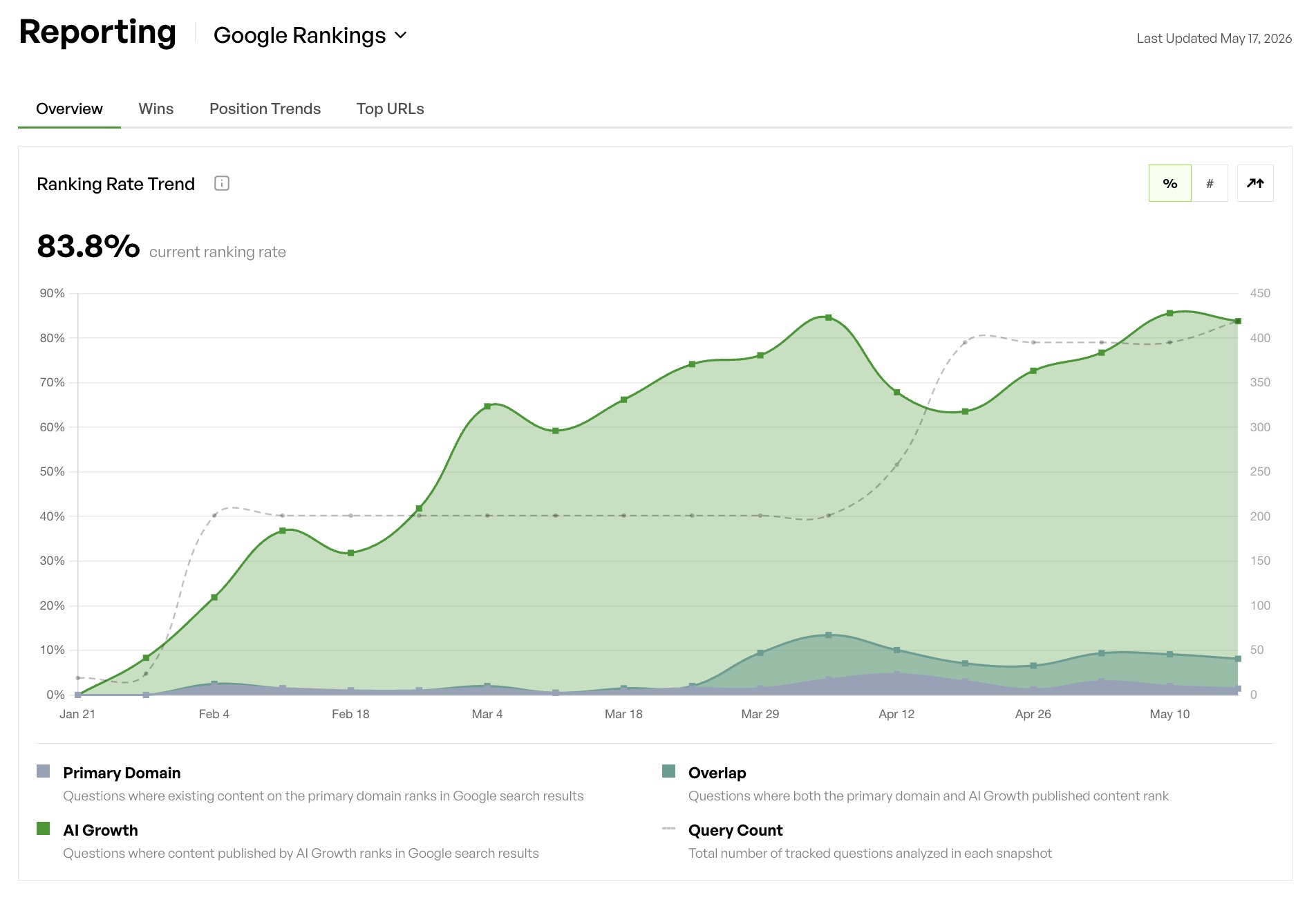
Get found across online search without managing another tool or agency. Launch your agent-ready content with AI Growth Agent in about a week.
A2A vs MCP in Real Workflows
A2A and MCP work together but operate at different layers of the agent stack. Treating them as interchangeable leads to the wrong optimization strategy.
| Dimension | A2A Protocol | MCP (Model Context Protocol) | Source |
|---|---|---|---|
| Primary function | Agent-to-agent task delegation and capability discovery | Agent-to-tool and agent-to-data-source connection | DigitalOcean |
| Interaction model | Peer-to-peer, stateful, lifecycle-managed tasks spanning multiple turns | Host-client-server, stateless function calls with structured inputs and outputs | Zuplo |
| Discovery mechanism | Agent Cards at /.well-known/agent-card.json declaring skills, auth, and capabilities | Agents enumerate a tool list from an MCP server | Zuplo |
| Authorization model | Coarse-grained OAuth 2.0 token scopes with implementation-specific enforcement | OAuth 2.1 with session IDs and capability negotiation for HTTP transports | arXiv |
The practical relationship between the two protocols stays additive. In multi-agent workflows, an orchestrator agent can use A2A to discover and delegate tasks to specialist agents, while those specialist agents use MCP internally to access tools such as CRM systems or policy repositories.
Enterprise workflow multipliers already appear across several sectors. In inventory management, an inventory monitoring agent detects low stock and initiates an A2A task with an order agent to generate replenishment requests, which then coordinates with an external supplier agent to place orders and retrieve shipment details as artifacts. In customer service, a triage agent uses A2A to coordinate with a knowledge agent for internal documentation searches and a system status agent for active incidents, then consolidates results into a unified summary for human representatives. In network operations, an RCA Agent coordinates with Telemetry, Topology, Configuration, and Ticketing agents across seven steps that include data retrieval, artifact creation, change generation, and human approval gates. Each workflow generates multiple A2A interactions per business event, which creates the traffic multiplier that conventional analytics cannot see clearly.
Strategic Outlook for A2A Through 2026
The AI agent protocol ecosystem, including A2A, will continue evolving through 2026 and beyond rather than plateauing. By 2026, organizations will deploy swarms of specialized agents that use A2A patterns to negotiate actions, validate assumptions, and escalate intelligently without human intervention for every decision.
| Indicator | Status (Q2 2026) | Trajectory Through Year-End 2026 | Source |
|---|---|---|---|
| Cloud platform integration | Google Cloud, Azure AI Foundry, AWS Bedrock AgentCore | Expanding enterprise deployment through embedded infrastructure | Linux Foundation / PR Newswire |
| Multi-agent orchestration adoption | A2A as coordination layer alongside MCP for tool access | Growth that tracks expansion of multi-agent orchestration use cases | Digital Applied |
| Agent Payments Protocol (AP2) | 60+ organizations in payments and financial services | Extending A2A into agent-driven commerce transactions | Linux Foundation / PR Newswire |
For site operators, the strategic window has opened now. The agents generating this traffic surge also decide which brands to cite in AI-generated answers. Preparing owned properties for A2A agent traffic requires a specific technical stack rather than another monitoring dashboard.
A2A Site Optimization Checklist
- Publish an Agent Card at /.well-known/agent-card.json. This declares your site’s skills, authentication requirements, and capabilities in machine-readable JSON so A2A client agents can discover and evaluate your property during automated research workflows.
- Deploy llms.txt and llms-full.txt. Once your site is discoverable via an Agent Card, publish these files so AI surfaces can read your brand’s content structure and intent in the format they require, similar to robots.txt but designed for large language model crawlers.
- Implement Blog MCP. With discovery and content structure in place, expose a Model Context Protocol interface that lets AI agents query your content in natural language and retrieve structured answers directly, which increases the probability of citation in agent-generated responses.
- Enable natural language query parameters (/?s={query}). Configure URL-level query handling so that an agent passing a natural language query directly into your URL receives a personalized, internally linked response instead of a 404 or generic page.
- Serve Markdown to agent crawlers. Deliver content in Markdown format to AI agent user agents alongside standard HTML to improve LLM parse quality and citation accuracy.
- Provision full schema markup and OpenAI discovery endpoints. Ensure Article, FAQ, Organization, and Product schema run on every relevant page, and serve OpenAI discovery files via /.well-known/ so your property is addressable by the dominant consumer in the agent ecosystem.
- Implement living, self-healing content. Static content decays as agent training sweeps advance. Establish an automated refresh cycle so the narrative agents encounter on your property reflects your current positioning rather than a stale snapshot.
AI Growth Agent provisions this entire stack automatically, with no technical skill required from the client. Every package includes the full agentic technical SEO infrastructure described in the checklist.
The brands cited in AI search this year are training the next generation of models with their own story. See how to join that group and schedule a demo with AI Growth Agent.
Frequently Asked Questions
What is the A2A protocol and why does it matter for enterprise marketers in 2026?
The Agent2Agent (A2A) protocol is an open standard, now governed by the Linux Foundation, that defines how autonomous AI agents discover each other, delegate tasks, and exchange structured work across organizational and vendor boundaries. It operates over HTTP using JSON-RPC 2.0, with Server-Sent Events for streaming and OAuth 2.0 for authentication. For enterprise marketers, A2A matters because the agents running on this protocol also research, recommend, and cite brands in AI-generated answers. A brand whose properties are not structured for A2A discovery stays absent from the automated workflows that increasingly mediate purchasing decisions. Integration into the three dominant cloud platforms means A2A traffic has moved beyond experimentation and now sits inside core enterprise infrastructure.
How does A2A protocol traffic differ from conventional bot or API traffic?
Conventional bot traffic follows predictable session patterns where a crawler visits pages, follows links, and exits. A2A traffic is stateful, lifecycle-managed, and peer-to-peer. An A2A task progresses through explicit states such as submitted, working, input-required, and completed, and can span multiple turns that require mid-execution input. Long-lived Server-Sent Events streaming connections and bursty task creation change conventional session behavior in ways that standard analytics tools cannot interpret. A single enterprise workflow, such as inventory replenishment or customer service triage, can generate multiple A2A interactions per business event, which produces traffic volumes that look anomalous to legacy monitoring stacks but represent normal agentic operation.
What are the primary security risks in A2A deployments and how are enterprises mitigating them?
The A2A specification leaves authorization as an implementation-specific decision, which creates three primary risk categories. First, session smuggling: many A2A implementations rely on long-lived bearer tokens not bound to a specific session or context, so intercepted credentials can be replayed to impersonate an agent after the original task completes. Second, authorization creep: once a client agent authenticates, the remote agent decides permissions only after accepting a task, which allows agents to accumulate cross-system power without explicit delegated user authorization. Third, recursive delegation: complex authorization chains without clear scope reduction expand the attack surface and obscure accountability. Mitigation approaches in technical literature include issuing tokens with granular scopes per task and context, synchronizing revocation across distributed systems, implementing clear consent flows, enforcing automatic scope reduction in delegation chains, and deploying tools such as Cisco’s A2A Scanner, which validates agent identities using multiple detection engines including behavioral and LLM-based semantic analysis.
How should brands prepare their owned properties to capture citations from A2A-driven agent traffic?
Brands capture citations from A2A-driven traffic by deploying a specific agentic technical SEO stack rather than another monitoring dashboard. The foundational elements include an Agent Card at /.well-known/agent-card.json so A2A client agents can discover your property during automated research, llms.txt and llms-full.txt files so AI surfaces can read your content structure in the format they require, and a Blog MCP interface so agents can query your content in natural language. Natural language query parameters at /?s={query} ensure agents receive structured responses instead of generic pages. Markdown served to agent crawlers improves parse quality, and full schema markup across Article, FAQ, Organization, and Product types clarifies meaning. Beyond the technical stack, content must stay living and self-healing because agent training sweeps advance continuously and static content decays. Brands that establish authoritative, structured content now train the next generation of models with their own narrative.
What is the difference between A2A and MCP, and do brands need to optimize for both?
A2A and MCP operate at different layers of the agent stack and serve complementary functions. A2A standardizes agent-to-agent communication, which covers how autonomous agents discover each other, delegate tasks, and exchange structured work across peer boundaries. MCP standardizes agent-to-tool communication, which covers how an AI application connects to external tools, resources, and data sources through a host-client-server model. In practice, an orchestrator agent uses A2A to delegate to specialist agents, while those specialist agents use MCP internally to access CRM systems, policy repositories, or knowledge bases. Brands need to address both layers. MCP exposure through Blog MCP ensures your content is queryable by agents using the tool-access layer. Agent Card publication and A2A-compatible endpoints ensure your property is discoverable and addressable at the agent-coordination layer. AI Growth Agent provisions both layers automatically, including Blog MCP compatible with Chrome 146+ and other WebMCP-enabled browsers, and Agent Card guidance served via /.well-known/.
Conclusion: Winning the A2A Traffic Era
The A2A protocol has moved from announcement to infrastructure in under twelve months. With more than 150 supporting organizations, production deployments across supply chain, financial services, and IT operations, and deep integration into the three dominant cloud platforms, A2A-driven agent traffic now represents the fastest-growing category of automated interaction on the enterprise web. The brands that control the narrative in this environment are not the ones with the largest monitoring dashboards. They are the ones whose properties are structured for agent discovery, whose content stays living and self-healing, and whose agentic technical SEO stack is already provisioned before the next training sweep.
Agentic technical SEO no longer sits in the future. The leaderboard is being written in 2026. Brands that publish Agent Cards, deploy Blog MCP, serve llms.txt, and maintain living content are training the agents driving this surge with their own story. Brands that wait hand that narrative to whatever the open web happens to contain.
AI Growth Agent is a headless engine that automatically provisions the full agentic technical SEO stack, including agent discovery endpoints, Blog MCP, llms.txt and llms-full.txt, natural language query parameters, Markdown serving for agent crawlers, and living content that self-heals over time. No technical skill is required from the client. The first article typically goes live within a week of kickoff, and content can index in as little as ten days.
Traditional search tools show you where your brand stands. AI Growth Agent makes your brand the answer. Book your kickoff and see your first agent-ready article live within a week.