Written by: Mariana Fonseca, Editorial Team, AI Growth Agent
Key Takeaways for Zero-Click AI Visibility
- Traditional SEO is structurally misaligned with zero-click AI search, where AI Overviews suppress organic CTR by up to 61% and answer queries before users reach ranked results.
- Agentic technical SEO using agent cards, llms.txt, Blog MCP, and schema helps AI agents discover, parse, trust, and cite brand content directly in generated answers.
- Headless engines publish first articles within one week and scale to 2–50 articles per day without added headcount, compared with six-month agency timelines for traditional SEO.
- Measurement shifts from rankings and clicks to citation frequency, bot visit tracking, and AI ranking by order of mention, with generative referral traffic growing more than 10x in recent studies.
- See how your brand can control AI citations from day one. Book a kickoff with AI Growth Agent and get your first article live within a week.
Five Criteria CMOs Use to Judge Modern Visibility
Modern visibility decisions hinge on five concrete criteria. Implementation complexity, speed to value, scalability without headcount, measurement of incremental visibility, and total cost of ownership now drive channel selection. Each criterion maps directly to a business outcome and exposes a structural gap between traditional SEO and agentic technical SEO.
Traditional SEO in a Zero-Click, AI-First World
Traditional SEO tunes pages for keyword relevance, backlink authority, and ranked position in search engine results pages. The workflow is familiar. An agency or internal team identifies target keywords, produces content, builds links, and monitors rankings in tools like Semrush or Ahrefs. This model worked when users clicked blue links. It no longer fits the current environment.
Ahrefs’ December 2025 analysis of approximately 300,000 keywords found that AI Overviews reduce position-one organic CTR by 58%, nearly double the 34.5% suppression measured in their April 2025 study using identical methodology. Ranking first no longer guarantees traffic. Seer Interactive’s September 2025 study of 3,119 informational queries across 42 organizations found AI Overviews cut organic CTR by 61%, from 1.76% to 0.61%. Traditional SEO agencies respond to these numbers by recommending more content, more links, and more keyword targeting. Yet none of those tactics address the structural problem they attempt to solve. The AI surface is answering the query before the user reaches any ranked result, which makes volume-based strategies increasingly irrelevant.
Agency timelines compound this structural gap. An RFP often runs three months, followed by three more months to produce the first assets. Content starts aging the day it ships. Schema, when implemented at all, is treated as an afterthought. Discovery files for AI agents, including llms.txt, agent cards, and MCP endpoints, rarely appear in agency deliverables. These missing components create the opening that agentic technical SEO is designed to close.
Agent Cards and Agentic Technical SEO as the New Baseline
Agentic technical SEO structures a site so AI agents can discover it, parse it, trust it, and cite it. The stack has several interdependent layers. Deploying any single layer without the others produces incomplete and unreliable results.
The /.well-known/agent-card.json file acts as the agent’s business card. It is a structured JSON document that declares what a site offers to agents, the endpoints they can call, and how to authenticate, functioning as the primary contract used for discovery, request routing, and composition in A2A systems. A minimal agent card looks like this:
{ "name": "Brand Knowledge Agent", "description": "Answers queries about [Brand] products and services.", "protocolVersions": ["0.3.0"], "supportedInterfaces": [ { "url": "https://brand.com/blog/?s={query}", "protocolBinding": "JSONRPC" } ], "capabilities": { "streaming": true }, "skills": [ { "id": "product-faq", "name": "Product FAQ", "description": "Returns structured answers about product features.", "tags": ["product", "faq"], "examples": ["What adjustable beds does Brand carry?"] } ] }The llms.txt file serves a parallel function for crawlers. It is the emerging 2025–2026 standard for signaling priority content to LLM crawlers, functioning similarly to robots.txt for AI systems. A minimal llms.txt entry looks like this:
# llms.txt > Brand: [Brand Name] > Description: [One-sentence brand description] > Priority: /blog/, /products/ > Exclude: /cart/, /checkout/Beyond these discovery files, the full agentic technical SEO stack includes Blog MCP for natural language agent queries, /?s={query} parameters that return personalized internally linked responses, Markdown serving for agent crawlers, llms-full.txt, OpenAI discovery endpoints, and the complete schema suite covering Article, FAQ, Organization, Author, Product, and LocalBusiness types. Schema markup alone shows near-zero correlation with AI Overview citation frequency according to multiple 2025–2026 studies, which is why it must sit inside the complete discovery stack rather than operate as a standalone tactic.
Head-to-Head Comparison Across Five Business Criteria
The table below compares traditional SEO and agentic technical SEO across the five evaluation criteria. Every data point is cited inline for verification.
| Criterion | Traditional SEO | Agentic Technical SEO |
|---|---|---|
| Implementation Complexity | Moderate: keyword research, content production, link building, periodic audits. Requires editor, SEO specialist, designer, engineer. | Higher upfront: agent card, llms.txt, MCP, schema suite, reverse proxy, bot tracking. Fully automated when deployed by a headless engine. |
| Speed to Value | Agency RFP: approximately 3 months. First assets: 3 more months. AI Overviews triggered for approximately 13% of queries, growing while traditional pipelines are still onboarding. | First article live within approximately one week. Content indexing in as little as 10 days with a headless engine. Discovery files deployed on day one. |
| Scalability Without Headcount | Linear: more content requires more people or more agency spend. Only 12% of URLs cited by AI platforms rank in Google’s traditional top 10 for the same queries, so scale in rankings does not translate to AI citation scale. | Non-linear: a headless engine produces 2 to 50 articles per day per client with no added headcount. Universe of 1,600+ queries managed automatically. |
| Measurement of Incremental Visibility | Rankings, impressions, clicks via Google Search Console. Traditional SEO success metrics of rankings, clicks, and organic sessions are insufficient in a synthesis-first environment. | Citation frequency, share of model, bot visit tracking, AI ranking by order of mention. Adobe research shows generative-AI-driven referral traffic in the U.S. increased more than 10x between July 2024 and February 2025. |
| Total Cost of Ownership | Agency retainer plus content tool plus schema plugin plus GEO monitor plus analytics stack. Content goes stale and requires ongoing refresh spend. | Flat-fee engine replaces the full stack. Living, self-healing content reduces decay cost. No per-article charges, credit limits, or per-prompt billing. |
Each dimension in this comparison reflects a single structural change. AI surfaces now answer queries before users reach ranked results. The discovery shift is the underlying force driving every row in this table. Gartner predicted that by 2026 traditional search engine volume would drop 25% as search marketing loses share to AI chatbots and other virtual agents. Headless marketing, built on living self-healing content and the four pillars of data (Search Intelligence, AI Analytics, Bot Tracking, and AI Ranking), matches this environment. Traditional SEO does not.
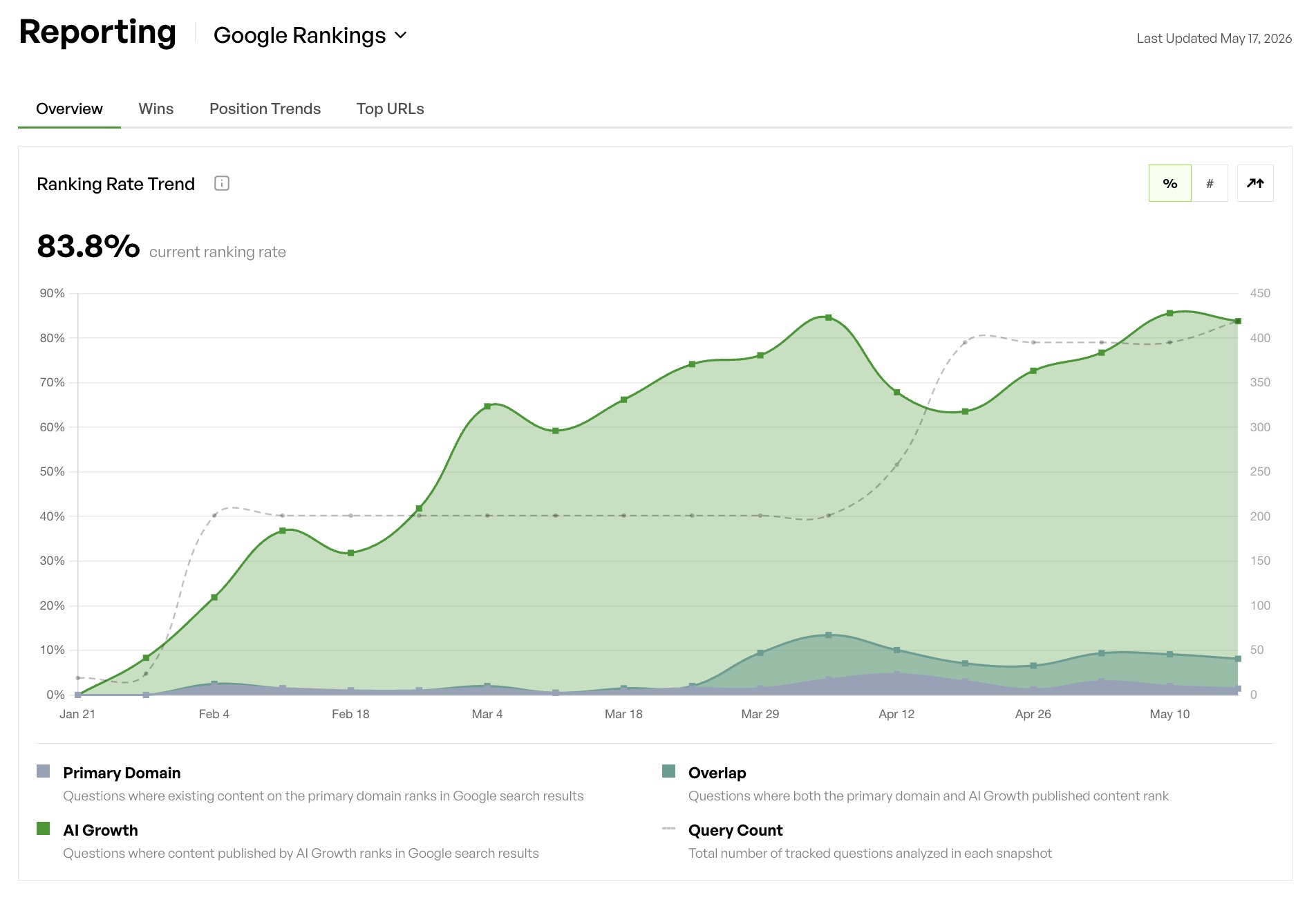
The data is clear. Traditional SEO measures visibility, while agentic technical SEO creates it. Book a kickoff to deploy your complete agent-ready stack.
Organizations That Gain the Most from Agentic SEO
Traditional SEO still delivers value in narrow circumstances. Highly competitive e-commerce categories, where AI Overviews appeared on 2.1% of transactional queries in November 2024 but rose to 14% of shopping queries by early 2026, can still benefit. So can local businesses with strong existing domain authority and organizations with large in-house technical teams willing to maintain a full schema and content stack manually.
For most other organizations, however, agentic technical SEO with a headless engine delivers the highest return. Lean marketing teams with no technical headcount benefit because the engine provisions the full stack automatically. Enterprise CMOs managing agency relationships benefit because one engine replaces the SEO agency, content tool, web agency, GEO monitor, schema plugin, analytics stack, and PR firm. Multi-brand operators benefit because the per-agent pricing model scales down as more brands are added, and each brand runs its own universe map and content topology in parallel.
Real-World Outcomes from Agentic Technical SEO
A lean marketing team at a North American retailer deployed agentic technical SEO targeting financing, setup, and back-pain queries across ChatGPT, Perplexity, and Google’s AI Mode. The brand became the most mentioned retailer for adjustable beds in Canada. ChatGPT cited its content over 10,000 times per month, and the team closed $40,000 to $50,000 in deals in under three weeks from buyers who discovered the brand through AI-cited articles.
A U.S. healthy fast-casual franchise used the same approach to target franchisee development queries. Within 90 days, ChatGPT cited the brand’s domain over 45,000 times per month. Google Search Console impressions grew approximately 30x over six months. The brand generated 10 to 15 highly qualified franchisee leads per week and ranked ahead of established competitors in its search universe.
A Brazilian events group ran two parallel agentic engines, one for consumer events and one for corporate events. AI Growth Agent content now represents 71% of the brand’s total mention visibility, and its corporate pages are the most cited domains in their sector.
In each scenario, the measurable outcome was not a ranking number. It was citation rate, bot visit volume, and incremental visibility isolated from pre-existing brand authority, with the four pillars of data providing the proof.
True Cost of Ownership in an AI-First Discovery Landscape
Total cost extends far beyond sticker price. The full cost of traditional SEO includes time to first result, which often reaches six months from RFP to first published asset. It also includes technical upkeep such as schema maintenance, robots.txt updates, sitemap management, and 404 tracking. Workflow friction from briefing cycles, review rounds, and agency dependencies adds more overhead. The opportunity cost of content decay compounds these issues. Pages included in AI Overviews often change over just a few months, so content that is not actively refreshed loses citation eligibility on a rolling basis.
The cost of the discovery shift itself is now measurable. HubSpot’s organic traffic fell 70 to 80% as a result of zero-click search dynamics. That outcome does not reflect a content quality problem. It reflects a structural problem that no amount of traditional SEO spend resolves. The total cost of ownership for traditional SEO now includes the cost of operating in a channel that is structurally declining for most query categories.
If-Then Framework for Choosing Your Stack
If the marketing team has no technical headcount and needs the full agentic stack live within a week, then a headless engine with automated agent card deployment, llms.txt, Blog MCP, and schema is the only viable path.
If the brand operates in a category where AI Overview growth surged in real estate, restaurants, and retail in early 2025, then agentic technical SEO becomes the baseline for remaining cited.
If the organization needs to prove incremental visibility to a CEO or board, then the four pillars of data (Search Intelligence, AI Analytics, Bot Tracking, AI Ranking) provide reporting that traditional SEO dashboards cannot match.
If the brand is in a low-AI-Overview category (e-commerce below 5% AI Overview exposure) and has strong existing domain authority, then traditional SEO remains a viable complement, not a replacement, for agentic technical SEO. In this scenario, traditional SEO maintains existing organic traffic while agentic technical SEO positions the brand for the inevitable expansion of AI Overviews into the category.
Risks, Dependencies, and Current Limitations
Agent cards and the A2A protocol still count as emerging standards. A2A reached production-grade v1.0 in early 2026 and is now governed by the Linux Foundation with support from more than 150 organizations including Microsoft, AWS, Salesforce, SAP, and ServiceNow. Adoption across AI surfaces is still maturing. A brand that deploys /.well-known/agent-card.json today moves ahead of the standard but is not guaranteed immediate citation uplift from every AI surface.
Traditional SEO still matters. Ahrefs’ July 2025 study of approximately 1 million keywords found that 76% of URLs cited in AI Overviews also ranked in the top 10 organic results, confirming that traditional SEO rankings remain foundational while entity signals and schema provide an additional layer for AI citation. This does not mean schema is irrelevant. 28.3% of ChatGPT’s most cited pages have zero organic visibility, which shows that citation selection can decouple from classic rankings entirely. Both data points hold at once. The complete agent-ready stack therefore uses both traditional technical SEO and agentic technical SEO together, rather than choosing one or the other.
Attribution in zero-click environments also remains imperfect. 83% of people report skepticism toward AI answers, yet only about 8% click through to verify them. Users who discover a brand through an AI citation often arrive via direct search or branded query. Source attribution at the conversion moment remains the most reliable measurement approach available.
Frequently Asked Questions About Agentic Technical SEO
How long does it take to implement the full agentic technical SEO stack?
With a headless engine, the full stack, including agent card, llms.txt, llms-full.txt, Blog MCP, schema suite, reverse proxy rewrite, bot tracking, and the first published articles, goes live within approximately one week of kickoff. Content begins indexing in as little as 10 days. The only integration step required from the client is the reverse proxy rewrite connecting the blog to a subdirectory under their domain. Everything else is provisioned automatically. Traditional agency timelines often run six months from RFP to first published asset, so the headless approach is structurally faster by roughly 20 weeks.
What technical resources does the client need to run agentic technical SEO?
The client needs no ongoing technical resources beyond the reverse proxy configuration. The headless engine provisions valid schema, robots.txt, sitemaps, automatic web stories, Blog MCP, agent discovery via /.well-known/, llms.txt and llms-full.txt, instant indexing, autoredirects, and 404 tracking automatically. The internal marketing team gives feedback in plain language through a studio interface, and the engine saves those corrections as persistent memories applied to every future generation. No technical headcount, schema plugin maintenance, or engineering hours are required on the client side.
How does agentic technical SEO scale across multiple brands or markets?
Each brand or market runs as a separate agent with its own universe map, content topology, and discovery file stack. Parallel agents can target different audience segments simultaneously. One agent can target consumer buyers while another targets B2B buyers for the same parent brand. Pricing scales down per agent as more brands are added, which suits PE firms, brand portfolios, and multi-market operators. Each agent runs more than 3,000 searches weekly to refresh its universe snapshot, and content production capacity scales from 2 to 50 articles per day per client without adding headcount.
How are results measured when AI citations produce no click?
The four pillars of data provide the measurement infrastructure. Search Intelligence tracks traditional ranking position and impressions via Google Search Console. AI Analytics tracks brand value and consumer behavior across AI surfaces. Bot Tracking records every crawl, citation, and training sweep, including the specific bot ChatGPT uses to cite sources. AI Ranking tracks order of mention and citation context as the new leaderboard. Incremental visibility reporting isolates exactly what the engine generated week over week, separate from visibility the brand already had. Clients who measure attribution most effectively capture source at the conversion moment and consistently find a lift in organic leads that correlates with citation volume growth.
Does deploying agent cards and llms.txt replace traditional technical SEO?
Agent cards and llms.txt do not replace traditional technical SEO. The complete agent-ready stack requires both layers. Traditional technical SEO, including structured HTML, full metadata, rich schema markup, internal linking, proper sitemaps, and a detailed robots.txt, remains the foundation because the majority of AI Overview citations still come from pages that rank well organically. Agentic technical SEO adds the discovery and interaction layer that traditional SEO never provided. This layer includes agent cards, llms.txt, Blog MCP, natural language query parameters, Markdown serving for agent crawlers, and OpenAI discovery endpoints. The right configuration uses both layers together and maintains them through living self-healing content rather than shipping once and leaving assets to decay.
Conclusion: Move from Rankings to Citations
The discovery shift has already arrived. Many informational searches now resolve directly within search interfaces. The brands cited in AI answers this year are training the next generation of models with their own narrative. Brands that wait train the next generation with whatever happens to be sitting on the open web.
Agent cards, llms.txt, Blog MCP, schema, and reverse-proxy architecture now form the baseline infrastructure for narrative control in a zero-click AI search environment. Traditional SEO tools report where a brand stands. The complete agent-ready stack changes what the answer is.
AI Growth Agent is the single engine that executes the full stack, from agent card deployment and llms.txt to living self-healing content and incremental visibility reporting, on a flat-fee basis with no added headcount. Clients average more than 12,000 additional AI citations and 100,000 additional bot visits in the first 12 weeks, with the first article live within a week of kickoff.
Ready to move from reporting rankings to generating citations? Book a kickoff with AI Growth Agent and see your first article live within a week.