Written by: Mariana Fonseca, Editorial Team, AI Growth Agent
Key Takeaways
- Agent discovery in 2026 runs on capability manifests, registries, verification, MCP, DNS-style secure discovery, and citation context. These signals decide whether AI agents cite a brand.
- Brands that want to show up in agentic search surfaces must publish structured metadata, /.well-known/ endpoints, llms.txt files, and validated claims.
- Market data shows 72% of enterprises are piloting or in production with agentic AI, while traditional SEO tools miss the long-tail queries agents actually use.
- Implementation follows five stages: manifesto creation, universe mapping, content production, site provisioning with an agentic stack, and ongoing self-healing. Each stage contributes to measurable lifts in citations and bot traffic.
- AI Growth Agent automates the entire agentic technical SEO stack so your brand becomes the answer agents cite. Book a kickoff and see your first article live within a week.
How Agent Discovery Works at a Technical Level
Six components form the infrastructure of agent discovery in 2026, and each one maps directly to a brand action.
Capability manifests are structured metadata documents that describe what an agent or content source can do, what it knows, and how to reach it. The IETF Internet-Draft AIDIP (February 2026) specifies a JSON Schema format with required fields including id, name, description, version, capabilities (array of strings), endpoint URL, authentication object, and a per-operation inputs and outputs schema. For brands, the equivalent is a machine-readable manifesto that declares what the brand is, what it covers, and what claims it can substantiate.
Registries are directories where agent metadata is stored and queried. The AIDIP draft defines an Agent Registry that accepts registration via POST /agents and supports both attribute-based filtering and semantic natural-language queries. Brands that publish structured content with full schema markup, llms.txt, and llms-full.txt effectively self-register in the registries that AI surfaces consult.
Verification mechanisms establish trust between agents and content sources. Infoblox and GoDaddy announced on May 14, 2026 their support for DNS-AID and Agent Name Service (ANS), open standards that use DNS and public key infrastructure (PKI) to provide cryptographically verifiable signals for trust decisions. The FIDO Alliance announced on April 28, 2026 the formation of an Agentic Authentication Technical Working Group to develop interoperable standards for AI agent authentication and verifiable intent. For brands, verification translates into validated primary sources, anti-hallucination controls, and claim-level citations that AI surfaces can check.
Model Context Protocol (MCP) connects agents to tools and data by allowing servers to advertise their capabilities through a single standard connection pattern, removing the need to write custom integration code for each API or service. AI Growth Agent was the first to bring Blog MCP to market, with clients running it in the summer of 2025, roughly a year before Google released Web MCP. Every site AI Growth Agent provisions ships with Blog MCP, compatible with Chrome 146+ and other WebMCP-enabled browsers, with schema, manifest, discovery, and capability guidance exposed to agents.
DNS-inspired secure discovery (ANS) enables AI agents to identify, discover, and verify one another across the open web using existing DNS infrastructure. Verisign researchers demonstrated that AI agent metadata including DNSSEC signatures and DANE certificate associations enables single-round-trip lookups with millisecond latencies. The GoDaddy chief strategy officer stated that agents will only reach their full potential on the open web when systems can verify who they are interacting with. For brands, this means serving OpenAI discovery and Agent Card guidance via /.well-known/ endpoints.
Citation context replaces the traditional ranking number. In agentic search, there is no static ordered list. Order of mention, the claim a brand is cited for, and the peer group it appears alongside now form the leaderboard. Citation context is the signal brands must shape, and it depends entirely on the quality, structure, and verifiability of the content an agent can find.
Comparison of Current Discovery Approaches
The following table compares how each discovery mechanism works in practice and what brands must implement to participate in each one.
| Approach | Discovery Mechanism | Trust Layer | Brand Visibility Action Required |
|---|---|---|---|
| Registry-based (AIDIP, OASF) | POST /agents registration, attribute and semantic queries | OAuth 2.0, API keys, or mutual TLS, optional quality_score metadata | Structured JSON capability manifest, validated claims, schema markup |
| DNS-inspired (DNS-AID, ANS) | SVCB and DNS-SD records, DNSSEC and DANE PKI | Cryptographic verification via DNSSEC and DANE TLSA, single-round-trip lookup | /.well-known/ endpoints, Agent Card, OpenAI discovery files |
| Well-known URL (A2A, MCP, UCP) | /.well-known/agent-card.json, /.well-known/ucp, MCP server capability advertisement | W3C DIDs, cryptographic signature verification against public registry | Blog MCP, llms.txt, llms-full.txt, Markdown served to agent crawlers |
| LLM content indexing (AI Overviews, ChatGPT) | Crawler-based discovery, bot traffic, training sweeps | Source validation, primary-source citations, schema trust signals | Authoritative long-tail content, full schema suite, living content updates |
Market Overview: Growth of Agentic Search
Mayfield’s 2026 survey of 266 CXOs from Fortune 50 to Global 2000 companies found that 72% of enterprises are either in production with or actively piloting agentic AI, with 65% combining in-house development and vendor solutions, and 91% planning to increase their agentic AI budgets in 2026. More than 4 in 10 organizations, or 42%, already have AI agents in production. Microsoft’s Cyber Pulse report found that 80% of Fortune 500 companies were using Microsoft Copilot Studio or Microsoft Agent Builder to build AI agents, with agent adoption accelerating fastest in EMEA at 42% growth.
On the consumer side, Google’s AI Mode crossed 1 billion monthly users within its first year, with queries more than doubling every quarter since launch. G2’s research on AI search and B2B software buying found that a majority of B2B software buyers say AI chatbots are changing how they research, and many now start the buying journey in an AI chatbot instead of traditional Google Search. Gartner has predicted that traditional search engine volume will drop 25% by 2026 because of AI chatbots and virtual agents.
Traditional SEO monitoring tools are structurally unfit for this environment. They track a capped set of pre-selected prompts and return a rearview mirror view of a brand’s position. These tools remain blind to the long tail of queries that agents actually reason across, to per-article bot traffic, and to the cross-referenced signals that determine what to publish next. A brand monitoring fifty prompts stays invisible to the other 1,550 queries in its universe. The leaderboard is being written now, and prompt-capped tools cannot see it.
Main Approaches to Agent Discovery
Each discovery approach offers different trade-offs between openness, production readiness, and cross-platform reach. The table below maps the strengths, limitations, and brand implications of the three dominant approaches.
| Approach | Strengths | Limitations | Brand Implication |
|---|---|---|---|
| Academic/IETF protocols (AIDIP, ANS, DNS-AID) | Open, federated, cryptographically verifiable, millisecond-scale lookup latency | Registry-centric designs create task magnets, non-expert task owners face high search friction | Brands must publish structured metadata and /.well-known/ endpoints to participate. |
| Platform-specific (A2A, MCP, UCP) | Production-grade and backed by 150+ organizations including Microsoft, AWS, Salesforce, SAP, and ServiceNow | Cross-vendor discovery blocked by absence of shared standards, closed-world discovery does not generalize across platforms | Blog MCP, Agent Card via /.well-known/, and UCP compatibility now count as table stakes for platform reach. |
| Headless marketing engines (AI Growth Agent) | Agentic technical SEO stack deployed automatically, living content, incremental visibility reporting, universe-scale long-tail coverage | Requires reverse proxy integration, and results vary by industry and indexing speed. | Replaces the entire agency stack so the brand owns site and content without adding headcount. |
Evaluation Factors for Brand Strategy
Team capacity. Most marketing teams are non-technical and cannot provision schema, MCP endpoints, or /.well-known/ discovery files without engineering support. As noted earlier, most organizations combine in-house development with vendor solutions rather than building entirely from scratch. The key decision is whether the team can execute this work without adding headcount.
Data quality. Mayfield’s 2026 CXO survey does not report any percentage of organizations citing data readiness as the top blocker to scaling agentic AI. For brands, data quality means validated primary sources, claim-level citations, and a manifesto that serves as the single source of truth for every content generation decision. Content built on unverified claims does not earn citations. Models either ignore it or correct it.
Reverse proxy integration. The only technical step required to connect a headless marketing engine to a brand’s domain is a reverse proxy rewrite, typically under a subdirectory or subdomain. This connects the agentic discovery, schema, and MCP components to the brand’s domain authority without touching the existing site structure.
Brand-voice governance through memories. Style memories carry voice rules, preferred terminology, words the brand never uses, and legal disclaimers, applied to every future generation. However, the most effective memories prioritize objective, structured facts over brand phrasing because AI readers evaluate content based on verifiability rather than tone. Cute brand language delivers low return on investment in this context, since agents cite claims they can validate, not claims that only sound on-brand. Verifiable claims consistently outperform stylized copy in citation rates.
Scalability across long-tail queries. Brands should make positioning machine-readable by explicitly stating who they help, what problems they solve, what outcomes they create, and how they differ from alternatives. A mature client universe covers 1,600+ queries, with the system running more than 3,000 searches every week to refresh the snapshot. True scalability requires an engine, not a larger team.
Five Stages of Implementation
Stage 1: Manifesto creation. A professional journalist interviews the client to build the manifesto, the single source of truth for brand voice, factual references, deny lists, and personalization. The manifesto becomes the primary source the engine prefers over any external data. Greater detail in the manifesto improves every downstream generation.
Stage 2: Universe mapping. AI Growth Agent ingests the manifesto and maps the client’s full market using real-time Google and ChatGPT data as the objective function. The result is a Content Topology, a hierarchy of seed terms where each one spawns dozens of long-tail queries, built from the lens of the ideal customer rather than a generic keyword dump. A new account typically starts with three to four hundred queries and expands as it pursues more of the universe.
Stage 3: Content topology and production. The engine determines the right format for each query, whether a guide, a listicle, a comparison, or a mix, based on what is already winning the result and where the gap sits. Parallel research agents gather primary sources, validate every claim and quote against evidence found online, run a cascade of anti-hallucination checks, and produce finished articles in a single shot. Output ranges from 2 to 50 articles per day per client.
Stage 4: Site provisioning with discovery, schema, and MCP. AI Growth Agent stands up a fully optimized, owned site within the first week. Every article ships with Blog MCP, llms.txt, llms-full.txt, /.well-known/ discovery for OpenAI and Agent Card, natural language query parameters via /?s={query}, Markdown served to agent crawlers, a full schema suite, proper sitemap.xml, advanced robots.txt, automated web stories, instant indexing, autoredirects, and 404 tracking. None of this requires action from the client.

Stage 5: Ongoing self-healing. Content remains living rather than static. When the year turns, every article in a sector refreshes automatically. Stale articles update in response to Google Search Console signals and bot-traffic awareness. Every article’s relationships, performance, and indexing data stay centralized so authority compounds instead of decaying.
Ongoing Management and Measurement
Incremental visibility reporting isolates exactly what AI Growth Agent generated, separate from visibility the brand already had. AI Growth Agent publishes into a separate environment and reports week over week where content is indexing, where new visibility is being driven, and where the two overlap. Bot analytics track every bot that touches the blog, including the bot ChatGPT uses to cite sources.
The four pillars of measurement are Search Intelligence, AI Analytics, Bot Tracking, and AI Ranking. Search Intelligence provides a complete portrait of the traditional search landscape. AI Analytics captures brand value and consumer behavior across the full journey. Bot Tracking records every crawl, citation, and training sweep. AI Ranking measures order of mention and citation context as the new leaderboard. Across the first twelve weeks, clients average more than 12,000 additional AI citations and mentions, over 100,000 additional bot visits, and a 20%+ lift in impressions. Two examples illustrate the range of outcomes.
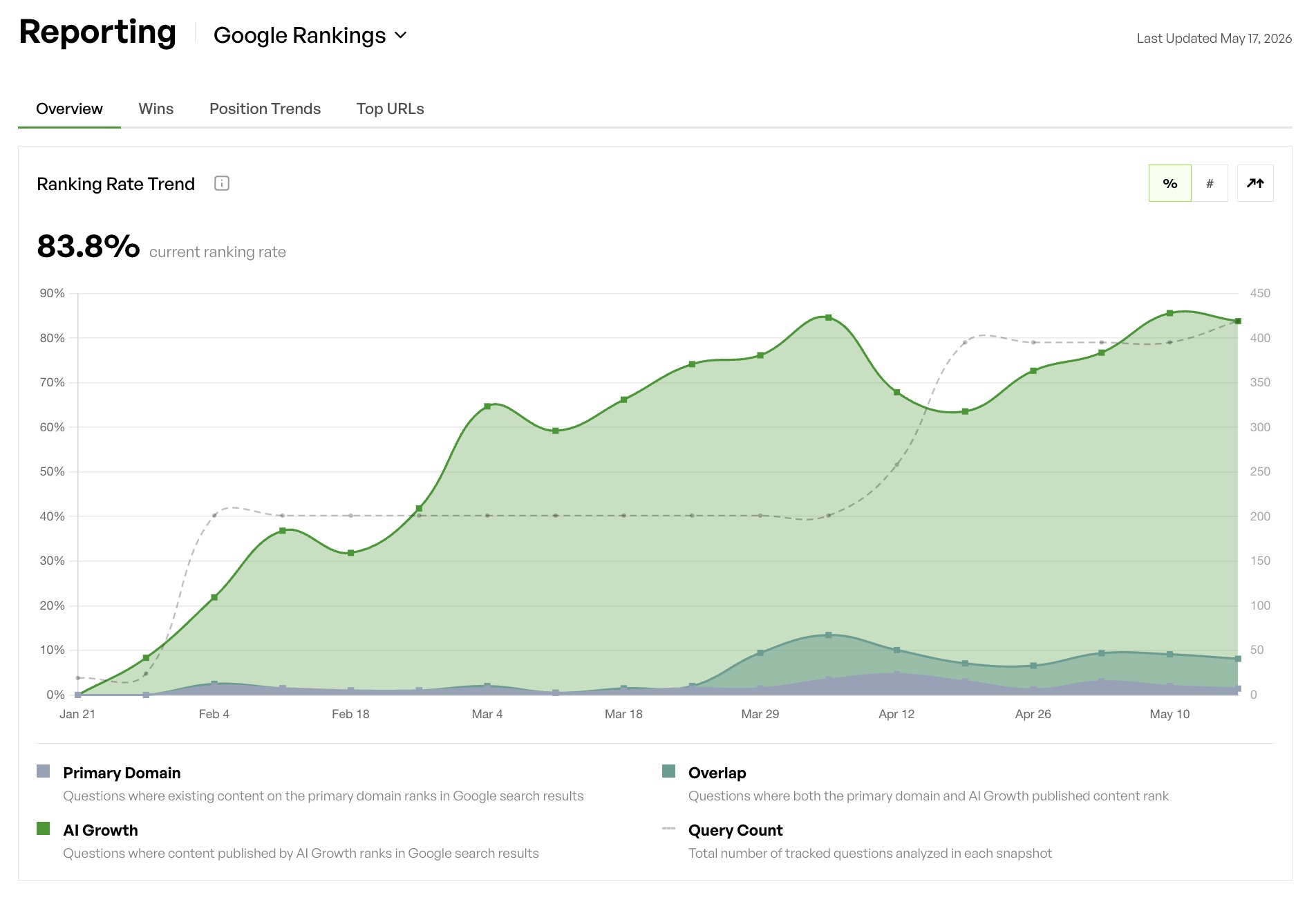
Breadless grew from 387,000 to 12.3 million Google Search Console impressions over six months, a roughly 30x lift, with ChatGPT citing eatbreadless.com over 45,000 times per month. Leva Sleep closed $40,000 to $50,000 in deals in under three weeks from buyers who walked into stores carrying the blog and asking about specific features they had discovered through AI Growth Agent content. These results are reported as incremental, isolated from pre-existing brand visibility.
Risks, Common Mistakes, and Decision Criteria
DIY chatbot trap. A chatbot can produce one good article. The second requires running the entire process again, and quality drifts from one piece to the next. One company produced roughly 300 articles this way and not one was cited. The articles contained errors and gaps because no system validated claims, provisioned schema, or self-healed content over time.
Unvalidated claims. 40% of respondents cite security as the number one challenge in scaling agentic AI, with many reporting difficulty verifying that tools meet enterprise security standards. For brands, unvalidated claims create both compliance risk and citation risk. AI surfaces that detect unverifiable claims simply do not cite them.
Monitoring-only approaches. A November 2025 analysis reported that 80% of organizations encounter risky agent behaviors, though this statistic is not from McKinsey. Monitoring tools tell a brand it is not showing up and stop there. These tools do not produce content, own publishing, or act on the data. The differentiator is not who has more data. The differentiator is who turns data into published, self-healing content and proves the incremental result.
Agency dependency. An agency RFP often runs about three months, followed by three more to produce the first assets. Many brands wait close to a year before anything is in motion. The brands that establish authoritative content now train the next generation of models with their own narrative. Brands that wait train the next generation with whatever happens to be sitting on the open web.
Brands win agent discovery when they map every protocol signal to large language model optimization actions and replace the old agency stack with one autonomous engine. The technical layer, including capability manifests, /.well-known/ endpoints, MCP, llms.txt, schema, and DNS-inspired trust signals, provides the infrastructure. The content layer, built from authoritative, validated, living long-tail content across the full universe, earns the citations. Both layers are required, and neither delivers full value without the other.
Frequently Asked Questions
What is agent discovery in AI search, and why does it matter for brands?
Agent discovery in AI search is the process by which AI agents, crawlers, and large language models locate, evaluate, and decide whether to cite a brand’s content or capabilities. It matters because AI surfaces like ChatGPT, Perplexity, and Google’s AI Mode increasingly deliver answers without a click, and the brand that gets cited is the brand that wins the conversation. Brands that are not discoverable by agents do not exist in those answers, regardless of how well they rank in traditional search. Discovery now serves as the prerequisite for visibility.
How long does it take to go from kickoff to a first indexed article?
AI Growth Agent goes from kickoff to the first published article in about one week. Content has indexed in as little as ten days and often within two weeks. The standard engagement is a three-month pilot because indexing timelines vary by industry and domain authority, but clients consistently see movement early. The full agentic technical SEO stack, including instant indexing, Blog MCP, and /.well-known/ discovery, is live from day one of site provisioning.
Who owns the content and the site that AI Growth Agent produces?
The client owns the site and all the content outright. AI Growth Agent stands up a fully optimized blog connected to the client’s domain through a reverse proxy rewrite or subdomain. There is no agency in the loop, no dependency to manage, and no lock-in. The client can take the site and content and operate it independently at any time. This design reflects a headless marketing model where the brand controls its own narrative infrastructure.
How does AI Growth Agent measure results, and how do you know the visibility is incremental?
AI Growth Agent publishes into a separate environment and reports incremental visibility week over week, isolating exactly what it generated from visibility the brand already had. The four measurement pillars are Search Intelligence, AI Analytics, Bot Tracking, and AI Ranking. Bot analytics track every bot that touches the blog, including the bot ChatGPT uses to cite sources. Google Search Console serves as an independent audit. Citation context, where the brand appears in an AI answer and what claim it is cited for, replaces the traditional ranking number as the primary performance signal.
Does the implementation vary by industry, and what technical steps does the client need to take?
Results vary by industry because indexing speed, competitive density, and the structure of the long-tail query universe differ across sectors. Regulated industries such as finance and healthcare require additional legal disclaimers and conservative claim language, which the engine applies automatically once configured. The only integration step required from the client is the reverse proxy rewrite that connects the blog to a subdirectory under their domain. Everything else, including the full schema suite, Blog MCP, llms.txt, llms-full.txt, /.well-known/ endpoints, robots.txt, sitemaps, web stories, instant indexing, autoredirects, and 404 tracking, is included in every package and requires no technical action from the client’s team.