Written by: Mariana Fonseca, Editorial Team, AI Growth Agent
Key Takeaways
- Agent-enabled sites in 2026 rely on a specific technical stack. That stack includes llms.txt, llms-full.txt, Blog MCP endpoints, Agent Cards, and least-privilege OAuth so autonomous AI agents can discover and act on content.
- Foundational files like llms.txt and llms-full.txt still have very low adoption in 2026. Early implementation gives brands a visibility edge in AI surfaces.
- Security best practices focus on task-scoped OAuth tokens, human confirmation gates, and transactional storage. These controls limit blast radius and keep agent actions auditable.
- Standards such as MCP, A2A Agent Cards, OpenAPI specs, and /.well-known/ discovery files create the interoperability layer. This layer lets agents read, cite, and transact without scraping the DOM.
- AI Growth Agent provisions the full agentic technical SEO stack, including llms.txt, MCP, and Agent Cards, in about one week with no custom engineering. See if the stack fits your roadmap in a live walkthrough.
Agent-Enabled Site Requirements in One View
The table below maps each technical requirement to its standard, placement, purpose, and current maturity. Use it as a checklist to see which pieces you already have and which ones you still need for full agent readiness.
| Requirement | Standard / Protocol | Placement | Primary Purpose | 2026 Status |
|---|---|---|---|---|
| llms.txt | Community spec, markdown | Domain root /llms.txt |
Declare site purpose and structure to AI surfaces | Low adoption (<14% of major domains) |
| llms-full.txt | Community spec, markdown | Domain root /llms-full.txt |
Full content index for deep agent reads | Very low adoption in early 2026 |
| Blog MCP endpoint | MCP (Anthropic / Linux Foundation) | Exposed via plugin or server config | Structured tool and data access for AI agents | Production-ready |
| Agent Card | A2A / Linux Foundation | /.well-known/agent-card.json |
Declare agent capabilities and auth requirements | Production-ready |
| OpenAI discovery | OpenAI agent spec | /.well-known/ |
Surface discovery for OpenAI-based agents | Emerging |
| Least-privilege OAuth | IETF OAuth 2.1 + task-scoped tokens | Auth server / API gateway | Restrict agent access to minimum required scope | Recommended |
| OpenAPI spec | OpenAPI 3.1 | /openapi.json or /.well-known/ |
Machine-readable endpoint schema for agents | Recommended |
| Semantic HTML + schema | W3C / Schema.org JSON-LD | Every page | Structured content for agent parsing and RAG | Table stakes |
| Transactional storage | ACID-compliant DB + async queue | Backend / API layer | Durable state for multi-step agent workflows | Recommended |
| Human confirmation gate | HITL pattern (Microsoft / NIST) | Workflow layer before sensitive actions | Pause execution for explicit human approval | Recommended |
See how AI Growth Agent provisions this full stack in a one-week implementation.
Task-Scoped OAuth That Limits Agent Blast Radius
Access decisions for AI agents should be evaluated in real time based on context such as task type, data sensitivity, and risk signals rather than relying on static roles. The practical pattern uses OAuth 2.1 with task-scoped, time-bound tokens issued per agent session instead of long-lived API keys.
A minimal token request scopes access to a single resource class:
{ "grant_type": "client_credentials", "scope": "blog:read content:publish", "resource": "https://yourdomain.com/api/blog", "expires_in": 900 }Each AI agent should operate under a dedicated service account with tightly scoped IAM roles so that a compromise limits blast radius to only the resources the agent was authorized to access. To enforce that scope in practice, place a wrapper layer in front of production APIs. This wrapper acts as a filter and lets agents call only a minimal set of pre-approved functions instead of broad or high-privilege endpoints.
For higher-risk actions, organizations should require step-up authorization or human approval before execution to ensure sensitive operations remain gated. The security rationale is containment. A compromised agent token with a 15-minute TTL and a single-resource scope cannot move laterally across the system. The measurable outcome is a smaller blast radius and a clean audit trail that ties every agent action to a specific token issuance event.
Review a live example of task-scoped OAuth in AI Growth Agent’s stack.
Root-Level llms.txt Files That Guide Agent Crawlers
Websites should add an llms.txt file, implemented as a simple markdown file at the root, to help AI agents understand the site’s purpose and structure. The placement is https://yourdomain.com/llms.txt for the summary file and https://yourdomain.com/llms-full.txt for the complete content index.
With llms.txt adoption in 2026 remaining below 14% across major domain samples, early implementation creates a visibility advantage. A minimal llms.txt follows this pattern:
# Brand Name > One-sentence description of what this site covers. ## Key Sections - [Blog](/blog/llms.txt): Long-form guides on [topic] - [Products](/products/llms.txt): Product catalog and specifications - [About](/about): Company background and credentials ## Preferred Citation Format Brand Name (year). Article title. https://yourdomain.com/slug The llms-full.txt file extends this pattern with the full text of every indexable page, structured in the same markdown format. AI surfaces use it during citation passes when they need complete content rather than a structural summary.
The security rationale stays simple. llms.txt is a read-only declaration that exposes no credentials, no endpoints, and no writable surface. It tells the agent what exists and where to look, which reduces the chance that an agent will parse unstructured HTML or hallucinate site structure. The measurable outcome is faster citation indexing and higher citation accuracy because the agent reads the brand the way it needs to instead of inferring structure from DOM scraping.
AI Growth Agent publishes both files automatically as part of every site deployment. No client action is required. Once agents can discover your site through llms.txt, they still need structured endpoints to retrieve and act on content, and that is where MCP fits.
MCP and OpenAPI Endpoints That Agents Can Use Directly
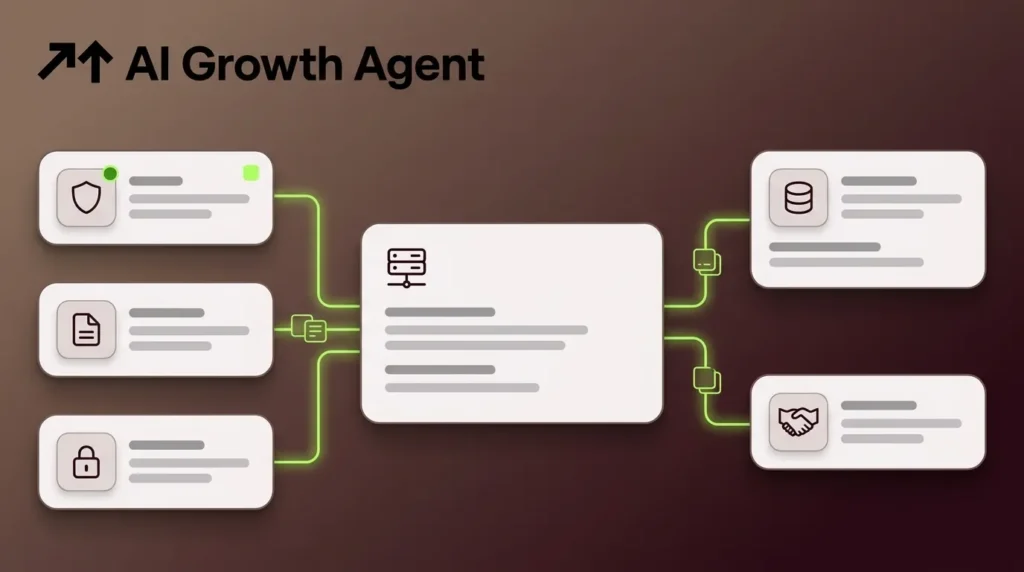
MCP servers expose capabilities such as tools, data resources, and prompts in a structured format using transports including stdio and HTTP with Server-Sent Events, with discovery via a server capability list. For a blog or content site, the MCP endpoint exposes read tools such as fetch article, list posts, and search by query, and can also expose write tools such as submit comment or trigger newsletter signup behind the least-privilege OAuth layer described above.
A minimal MCP capability declaration looks like this:
{ "name": "brand-blog-mcp", "version": "1.0", "transport": "http+sse", "endpoint": "https://yourdomain.com/mcp", "tools": [ { "name": "search_posts", "description": "Search blog posts by natural language query", "requires_approval": false }, { "name": "get_post", "description": "Retrieve full post content by slug", "requires_approval": false }, { "name": "submit_lead", "description": "Submit a contact form entry", "requires_approval": true } ] }MCP tool-level access control enforces least-privilege permissions with explicit allow and deny lists, rate limits, and requires_approval flags for individual tools. The OpenAPI 3.1 spec at /openapi.json or /.well-known/openapi.json provides the machine-readable schema that non-MCP agents use to understand available endpoints, parameter types, and response shapes.
The measurable outcome of a correctly configured MCP endpoint is direct agent interoperability. An agent can query, retrieve, and act on site content without DOM scraping, which reduces latency and improves citation accuracy.
AI Growth Agent brought Blog MCP to market in the summer of 2025, about a year before Google released Web MCP. Blog MCP is compatible with Chrome 146 and later and with other WebMCP-enabled browsers.
Agent Cards and /.well-known/ Files for Agent Discovery
Each agent publishes an Agent Card as a JSON file at a known URL declaring its capabilities, reachability, authentication requirements, and accepted data formats to enable discovery and task delegation between agents. For a content site, the Agent Card describes what the site’s agent surface can do, not what any outbound agent does.
A minimal Agent Card served at /.well-known/agent-card.json looks like this:
{ "name": "Brand Blog Agent", "description": "Provides structured access to brand content, search, and lead capture.", "url": "https://yourdomain.com/mcp", "version": "1.0", "capabilities": { "search": true, "content_retrieval": true, "lead_submission": true }, "authentication": { "type": "oauth2", "scopes": ["blog:read", "content:publish"] }, "accepts": ["text/plain", "application/json"], "skills": [ { "id": "search_posts", "name": "Search blog content" }, { "id": "get_post", "name": "Retrieve article by slug" } ] }OpenAI discovery follows the same /.well-known/ convention with a separate manifest file. Both files are static JSON served over HTTPS with no authentication required for the discovery document itself. The security rationale is that discovery documents are intentionally public. They tell agents what is available and how to authenticate, without exposing any data or writable surface directly. The measurable outcome is inclusion in agent discovery indexes, which determines whether an autonomous agent treats the site as a valid action target.
See AI Growth Agent’s /.well-known/ provisioning and Agent Card templates in a live session.
Transactional Storage and Human Gates for Safe Writes
A production Agent-as-a-Backend architecture requires a job queue or async engine such as Celery, Redis, or RabbitMQ to handle long-running agent tasks asynchronously, with results returned via webhooks or WebSockets. For content sites, any agent-initiated write action such as a lead submission, booking, or purchase should be queued, logged, and confirmed before execution instead of processed inline.
Workflow state, retries, orchestration, and durability should be handled upstream in the backend or gateway layer rather than inside the agent runtime. The practical setup uses an ACID-compliant database for transactional writes, a job queue for async processing, and a session store such as Redis for multi-step workflow state.
Human confirmation gates sit between the agent’s planned action and its execution. Agents must maintain a human-in-the-loop for escalation when high-risk requests, ambiguous user intents, or policy conflicts are detected. Without a gate, an agent could execute irreversible actions such as a purchase or data deletion based on a misinterpreted prompt. The gate pattern prevents this by inserting a decision point where the agent proposes an action, the system evaluates its risk tier, low-risk actions execute automatically, and high-risk actions pause and route to a human approval queue before execution resumes.
Tiered human-in-the-loop authorization mechanisms allow routine agent operations to proceed automatically while requiring explicit human confirmation for sensitive actions such as payments or access to private data. The security rationale is that agents operating on behalf of users must not be able to commit irreversible actions without a verified consent signal. The measurable outcome is a complete audit trail for every agent-initiated transaction and a hard boundary that prevents runaway agent execution from causing unrecoverable state changes.
Walk through how AI Growth Agent’s backend handles transactional safety for agent-initiated actions.
Frequently Asked Questions
What is the correct deployment order for agent enabled site requirements?
Teams should start with the read-only layer before exposing any writable surface. Deploy llms.txt and llms-full.txt first, then semantic HTML and JSON-LD schema, then the OpenAPI spec, then the MCP endpoint with read-only tools, then Agent Cards and well-known discovery files, and finally writable tools behind least-privilege OAuth and human confirmation gates. This order ensures agents can discover and read the site safely before any transactional capability is exposed. AI Growth Agent provisions the full stack in this sequence automatically during the kickoff week, so no client-side deployment sequencing is required.
How do agent enabled site requirements integrate with existing CMS platforms like WordPress?
The integration point is a single reverse proxy rewrite that connects a fully provisioned blog to a subdirectory or subdomain under the brand’s existing domain. The existing CMS stays unchanged. AI Growth Agent’s WordPress plugin handles Blog MCP, advanced robots.txt, sitemap.xml, web stories, instant indexing, autoredirects, 404 tracking, and all agentic technical SEO out of the box. llms.txt, llms-full.txt, Agent Cards, and well-known discovery files are served from the plugin layer. The only action required from the client is configuring the reverse proxy rewrite, with setup documentation generated for Cloudflare, Vercel, or the client’s specific host.
What security boundaries prevent an AI agent from taking unauthorized actions on a production site?
Four boundaries work in combination. First, least-privilege OAuth issues task-scoped, time-bound tokens so a compromised credential cannot access resources outside the declared scope. Second, a wrapper layer in front of production APIs limits agents to a pre-approved function set instead of direct database or API access. Third, requires_approval flags on MCP tools route sensitive actions to a human confirmation gate before execution. Fourth, microsegmentation and network allowlists restrict agent traffic to approved endpoints and protocols. Together these boundaries contain blast radius, enforce auditability, and prevent irreversible actions without explicit consent.
How long does it take for agent-enabled content to be indexed and cited by AI surfaces?
AI Growth Agent clients see content indexed in as little as ten days and typically within two weeks of the first article going live. Bot traffic from AI training and citation agents is tracked per article, so the client can see exactly when ChatGPT, Perplexity, and Google’s AI Mode crawlers first touch each piece of content. The agentic technical SEO stack, including Blog MCP, llms.txt, and well-known discovery, accelerates this timeline by giving agent crawlers a structured entry point instead of forcing them to infer site structure from HTML.
Do agent enabled site requirements apply only to new sites, or can they be retrofitted onto existing properties?
All of the requirements in this checklist can be added to an existing site without restructuring it. llms.txt and llms-full.txt are new files at the domain root. Agent Cards and well-known discovery files are new static JSON files. MCP endpoints are new routes added at the API or plugin layer. Least-privilege OAuth and human confirmation gates are added to the backend without modifying existing page templates. Semantic HTML improvements are incremental. The only structural change is the reverse proxy rewrite that connects AI Growth Agent’s provisioned blog to the existing domain, and that rewrite does not touch the existing site’s pages or CMS configuration.
Conclusion
Agent-enabled site requirements in 2026 define whether autonomous AI agents can find, read, trust, and act on a brand’s web presence. The requirements in this checklist, covering llms.txt placement, Blog MCP endpoints, Agent Cards, well-known discovery, least-privilege OAuth, OpenAPI specs, semantic HTML, transactional storage, and human confirmation gates, form a production-ready specification drawn from MCP, A2A, WebMCP, and current enterprise security guidance.
Brands that do not meet these requirements stay invisible to the agent layer. Brands that meet them become actionable surfaces that agents can discover, cite, and transact with. The gap between those two states does not require months of engineering. AI Growth Agent provisions the entire stack as a single headless engine, with the first article live in about one week, full client ownership of the site and content, and no per-prompt billing.
Go from invisible to agent-ready in one week with an AI Growth Agent implementation session.