Written by: Mariana Fonseca, Editorial Team, AI Growth Agent
Key Takeaways
- AI marketing automation tools in 2026 span from rule-based workflows to fully agentic systems that autonomously plan, execute, and refine campaigns.
- Agentic AI uses the MAPE loop to monitor, analyze, plan, and execute without hard-coded rules, replacing static automation with adaptive, context-aware decisions.
- Most platforms cover only parts of the marketing stack; agentic autonomous engines like AI Growth Agent add full search-universe mapping, content production, and incremental visibility reporting.
- Implementation follows five clear steps, starting with a Company Manifesto that anchors brand voice and ending with weekly proof of AI citations, bot visits, and impressions.
- Ready to replace fragmented stacks with one autonomous engine? See how AI Growth Agent maps your search universe in the first week.
How AI Powers Modern Marketing Automation
AI in marketing automation has moved through four distinct stages. First came rule-based automation with hard-coded if/then logic that required manual rule setup and constant monitoring. Second, predictive automation applied machine learning models inside fixed human-designed workflows. Third, adaptive automation introduced experimentation and performance tuning within predefined structures. The fourth and current stage is agentic AI, where systems grasp context, interpret real-time signals such as customer behavior and channel interactions, and make autonomous decisions without hard-coded rules.
The practical difference is significant. A static workflow for cart abandonment requires a marketer to define segments, write rules, and monitor performance manually. An agentic system eliminates that manual overhead by autonomously handling customer segmentation, rule management, and campaign variation creation. It learns from engagement data and adapts in real time. This same shift from manual configuration to autonomous operation applies to content and search. A static tool produces an article on demand. An agentic engine maps the full search universe, produces authoritative content at scale, self-heals it over time, and proves incremental visibility gains week over week.
Agentic workflows rely on three core components: reasoning (task decomposition and self-correction), tools (APIs, web search, databases), and memory (short-term context and long-term cross-session learning). The governing framework is the MAPE loop, a continuous Monitor, Analyze, Plan, Execute cycle that replaces the linear, deterministic logic of traditional automation.
Marketing teams are adopting agentic AI systems at speed. The shift replaces the old model rather than simply improving it.
Six AI Marketing Tool Categories and What They Miss
The 2026 market organizes into six distinct categories. Each solves a different slice of the problem. None of them, except agentic autonomous engines, solve the whole job. The table below maps each category’s core strength against its main limitation so you can see why most stacks stay fragmented instead of unified.
| Category | Core Capability | Key Limitation | Representative Players |
|---|---|---|---|
| Rule-based workflow platforms | Trigger-based email, SMS, and ad sequences | Static logic, no autonomous optimization or search universe mapping | Klaviyo, Customer.io |
| Predictive personalization suites | ML-driven segmentation, next-best-action, real-time decisioning | Requires rich first-party data infrastructure, no content production | Bloomreach Loomi, Braze |
| Enterprise CRMs with AI content helpers | AI content as one feature inside a large platform | Prompts are self-inputted and capped, monitoring-first rather than results-first | HubSpot Breeze |
| GEO and AI search monitors | Track brand appearance for a capped set of self-inputted prompts | Monitoring only, no site setup, no content production, no self-healing | Profound, Athena, Peec AI, Scrunch AI |
| SEO tools with AI content helpers | Keyword and rank data with on-demand article drafting | One pillar of data, no autonomous publishing, schema, or incremental visibility reporting | Semrush, Ahrefs |
| Agentic autonomous engines | Full search universe mapping, autonomous content production, living self-healing content, four-pillar data infrastructure, incremental visibility reporting | Requires an initial brand interview and documentation review | AI Growth Agent |
The matrix highlights the core gap. Every category except the last one addresses a fragment of the problem. Many organizations plan to expand their martech stacks and focus on better integration, which signals that fragmentation remains the default. An agentic autonomous engine collapses the stack into one engine with one data infrastructure and one proof layer.
Top AI Marketing Platforms and When to Use Them
HubSpot holds a marketing automation share reported between roughly 8% and 22% depending on the source and methodology, with competitors such as MailChimp often leading or close behind. These platforms dominate lifecycle marketing, including nurture flows, lead scoring, and CRM-connected personalization, and they deliver measurable ROI in those lanes. ActiveCampaign had 56,932 detected installations in Q1 2026 and powers complex workflow automation for many mid-market users.
For cross-channel personalization at speed, Bloomreach’s Loomi AI processes first-party behavioral and product data to activate personalization in real time across email, SMS, web, mobile apps, ads, and site search. Klaviyo offers more than 80 prebuilt workflow templates for ecommerce flows with native Shopify integration.
These platforms do not map a search universe, produce authoritative content at scale, stand up an owned blog with full technical SEO, or report incremental visibility in AI citations, bot traffic, and impressions. They function as lifecycle and personalization engines, not narrative control engines. For marketing leaders who need to shape what AI systems say about their brand, a practical hybrid stack pairs a lifecycle platform for owned-channel engagement with AI Growth Agent as the autonomous engine for search universe ownership and digital brand management.
If you are evaluating a hybrid stack, see how AI Growth Agent integrates with your existing CRM to own the narrative layer your current tools cannot address.
How Autonomous Agent Workflows Actually Run
Agentic automation lets AI agents write and adapt the script in real time instead of executing a fixed script, which suits complex marketing processes with changing conditions. The MAPE loop, Monitor, Analyze, Plan, Execute, forms the operational backbone of any agentic workflow.
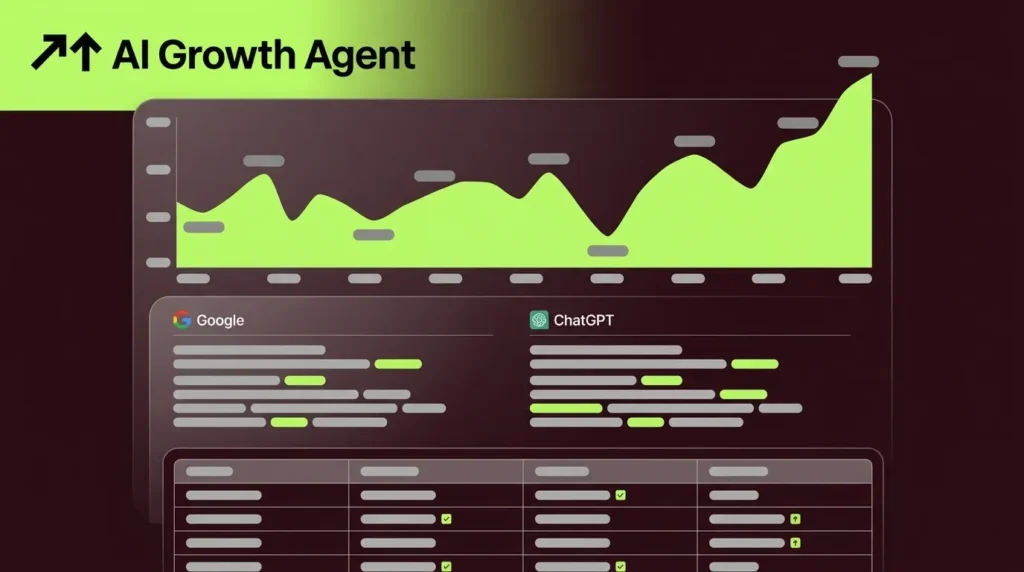
In practice, a well-configured agentic content workflow runs as follows. The system monitors real-time Google and ChatGPT results across hundreds of long-tail queries. It analyzes competitor signals, People Also Ask boxes, forum discussions, and content gaps. It then plans article structure, sourcing, and positioning. Finally, it executes production, publishing, and schema application automatically. When a rule changes, such as a new CTA, legal disclaimer, or blocked competitor link, the engine syncs and updates every affected live article overnight without extra work from the client.
Many organizations are testing AI agents yet struggle to scale beyond early use cases because they lack enterprise context. That context gap is exactly what a Company Manifesto closes. This journalist-led, AI-optimized documentation layer gives every agent in the system a single source of brand truth to reason from.
Successful agent deployments can deliver strong ROI on replaced workflows. Many attempts still get abandoned because teams lack clear success criteria, reliable tool or data access, or brand-voice control. Brand-voice drift is the failure mode that a manifesto-anchored system removes by design.
Stack Selection by Company Size and Constraint
The right tool depends on the specific constraint the organization needs to solve. The matrix below maps company size to the most defensible selection criteria and shows which stack configuration addresses each profile’s primary need and success metric.
| Company Profile | Primary Need | Stack Recommendation | Key Selection Criterion |
|---|---|---|---|
| Mid-market (50–500 employees) | Organic narrative control without adding headcount | AI Growth Agent as autonomous engine; existing CRM for lifecycle | Time to first indexed article; incremental visibility reporting |
| Enterprise (500+ employees) | Full search universe ownership plus lifecycle personalization | AI Growth Agent plus enterprise CRM plus CDP | Four-pillar data infrastructure; predictable pricing; client-owned content |
| Operator-led business (CEO as CMO) | Autonomous system with no internal team dependency | AI Growth Agent as single engine | Kickoff-to-article speed; no technical requirement; weekly proof |
Many CMOs cite lack of time to evaluate new technology and integration complexity as major blockers. A flat-fee autonomous engine that connects through a reverse proxy rewrite and a WordPress plugin, with no custom engineering, removes both barriers at once.
Five Steps to Implement Agentic AI Marketing Automation
A structured implementation reduces the 29% abandonment rate that plagues poorly scoped deployments. The sequence for an agentic content engine follows five steps.
Step 1: Brand documentation. A one-hour journalist-led interview produces the Company Manifesto, an AI-optimized document covering brand positioning, product features, target audiences, and approved sources. This document becomes the context layer every agent uses.
Step 2: Search universe mapping. The Content Topology is derived from the Manifesto using real-time Google and ChatGPT data. A new account typically starts with 9–15 seed terms and 300–400 long-tail queries, which sets a baseline for the brand’s core territory. As the engine identifies adjacent topics and competitor gaps, the universe expands to more than 1,500 queries so the brand can own the full conversation. Prompt count is never a billed metric, so expansion stays unconstrained.
Step 3: Blog infrastructure. A branded, fully optimized WordPress blog goes live within the first week, connected to the client’s domain through a reverse proxy rewrite or subdomain. The WordPress plugin provisions bot tracking, Model Context Protocol for Blog and Web, schemas, robots.txt, and sitemaps automatically.

Step 4: Content review and memory calibration. The client reviews the first batch of articles and provides feedback in plain language. The engine updates articles and saves memories so no instruction is ever repeated. After the first batch, content runs autonomously.
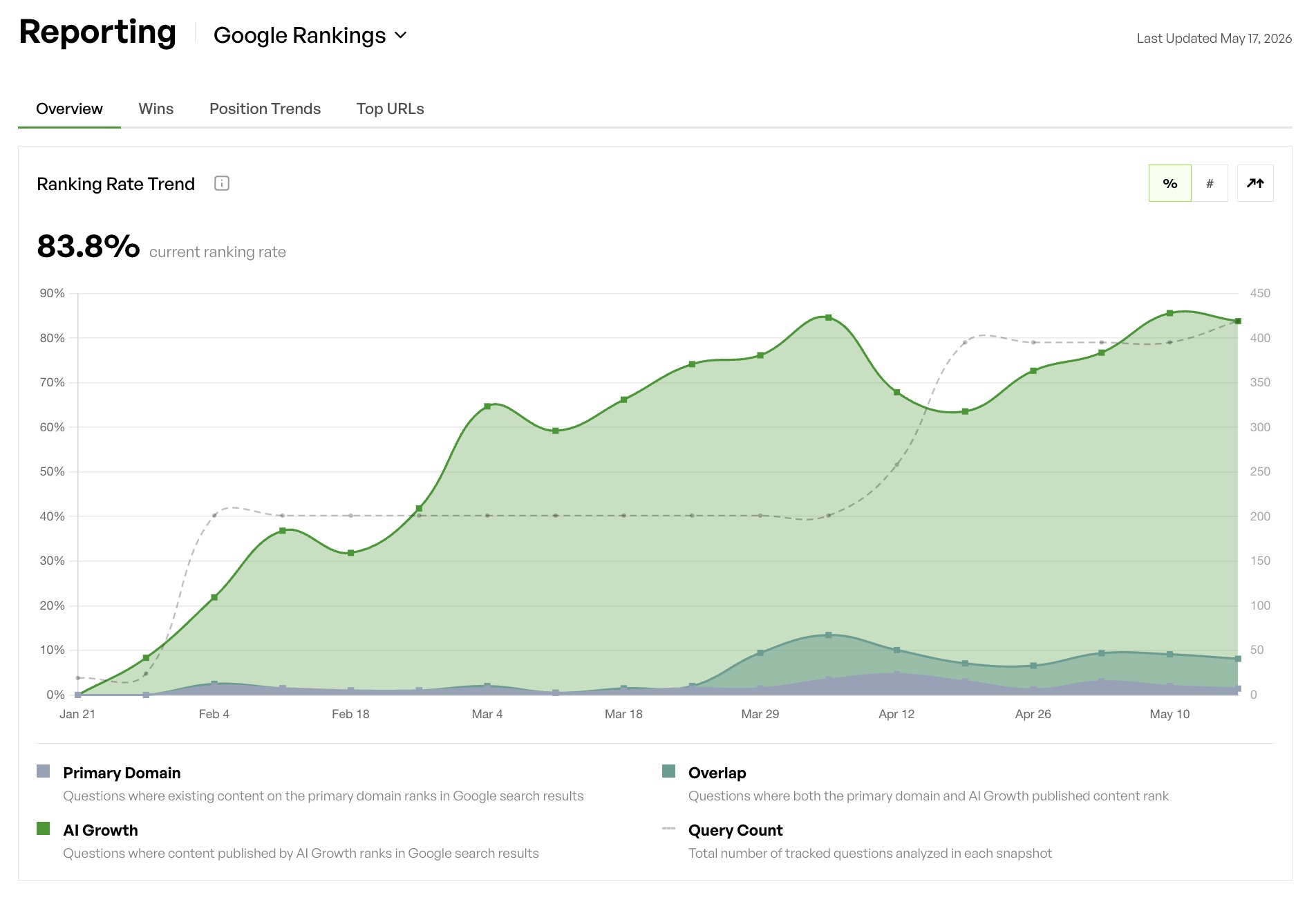
Step 5: Incremental visibility reporting. Every Monday, the dashboard reports new AI citations and mentions, bot visits, and impressions, isolated to what the engine generated rather than visibility the brand already had. Answer Engine Optimization carries high competitive urgency due to CTR reductions from Google AI Overviews that range from approximately 32% to 58% (and higher in some studies). Weekly reporting becomes a strategic necessity instead of a vanity metric.
Common Pitfalls When Adopting AI Marketing Automation Tools
Only 6% of AI leaders say their data infrastructure is ready for AI. Fragmented data is the most common structural failure. Organizations that layer agentic tools on top of disconnected rank trackers, AI-answer monitors, crawler logs, and Search Console end up with four dashboards that do not talk to each other and cannot drive decisions.
Even when data infrastructure is unified, a second pitfall appears: prompt-capped monitoring mistaken for strategy. Monitoring tools show where a brand appears for the prompts the client already thought to ask about. That view acts like a rearview mirror. A search universe contains hundreds of long-tail queries the brand has never explicitly tracked, and competitors often win those queries.
The third pitfall compounds the first two. Content goes stale and loses visibility. Organizations that delayed AEO implementation have seen notable organic traffic declines and needed significant resources to recover. Living, self-healing content prevents that decay by refreshing every article automatically.
The fourth pitfall is agency dependency on the blog itself. When an agency controls the site, every change becomes a dependency. Clients who do not own their blog outright cannot act on search intelligence in real time.
2026 Trends: Agentic AI Adoption and Narrative Control
These pitfalls explain why many early deployments fail, yet organizations that avoid them are seeing transformative results. Adoption data for 2026 shows the market moving decisively toward agentic systems despite the implementation risks.
Gartner projects that agentic AI spending will reach $201.9 billion in 2026 and that 40% of enterprise applications will embed AI agents by the end of 2026. The trajectory already appears in current adoption data.
The average enterprise marketing team currently runs 2.8 distinct autonomous agents, up from 1.1 six months earlier, with Gartner and McKinsey 2027 forecasts projecting 5–7 agents per team. Stack consolidation moves in parallel. Many CMOs plan increases in AI tool spend while consolidating point solutions into platform suites.
On the search side, Semrush data shows 206% year-over-year growth in outbound referral traffic from ChatGPT. Brands that are not actively shaping what LLMs say about them are handing narrative control to outdated training data, competitor content, or hallucinations. The window to establish authority in AI search is open now and closing fast.
Do not wait for competitors to own your search universe. Request a competitive analysis of your current AI citations and bot traffic.
Why AI Growth Agent Replaces Fragmented Stacks
Every alternative in the market solves a fragment. AI Growth Agent replaces the entire stack with one autonomous engine built for narrative control and digital brand management. It addresses the three core failure modes described earlier: fragmented data infrastructure, prompt-capped monitoring, and content decay.
The process starts with the Manifesto established in Step 1, which anchors every production decision and prevents brand-voice drift. From that base, the Content Topology maps the client’s full search universe and keeps it current through more than 3,000 automated searches each week, with no prompt caps or per-prompt billing.
Content production scales from 2 to 50 articles per day per account, capped at 500 per month. Every article is researched against live search results, validated for accuracy across primary and external sources, and decorated with full schema coverage. Articles are then published to the branded blog established in Step 3, with no engineering work required from the client.
The four-pillar data infrastructure, which includes Search Intelligence, AI Analytics, Bot Tracking, and AI Ranking, powers both the proof layer and the production roadmap. The same data that shows where the brand stands also decides what gets produced next. No other platform combines all four pillars inside a single engine that also creates the content.
Living, self-healing content keeps every article fresh. Batched updates refresh articles automatically. When a rule, CTA, or link changes, the engine syncs and updates affected live articles overnight.
Incremental visibility reporting isolates exactly what AI Growth Agent generated by separating primary domain pages, overlapped pages, and AI Growth Agent pages. The CMO receives a defensible answer for the CEO every Monday. Across the first three months, clients see more than 12,000 additional AI citations and mentions on average, over 100,000 additional bot visits, and a lift of more than 20% in impressions in Google Search Console. Leva Sleep closed $40,000–$50,000 in deals within three weeks from buyers who discovered the brand through AI Growth Agent content. Jelly became the top cited solution for “Restaurant Inventory Management in the UK” on ChatGPT. Exceeds.ai moved from invisible to consistently recommended by Perplexity and ChatGPT, with more than 55% of total traffic attributed to AI Growth Agent content. Pricing remains a single predictable fee, and clients own all the content they produce.
AI Growth Agent makes your brand the answer. See your search universe map and projected visibility gains in a 30-minute walkthrough.
Frequently Asked Questions
What is the difference between AI marketing automation tools and agentic AI marketing automation?
Traditional AI marketing automation tools apply machine learning within fixed, human-designed workflows. They automate execution such as sending emails, scoring leads, and adjusting bids, while humans still define the rules and structures. Agentic AI marketing automation goes further. Agents perceive their environment, reason about goals, make autonomous decisions, and adapt in real time without hard-coded rules. In content and search, agentic systems map a brand’s full search universe, produce and publish authoritative content autonomously, self-heal that content over time, and report incremental visibility gains without requiring a marketer to define each step. The distinction matters because agentic systems compound over time, while rule-based tools need ongoing manual configuration to stay effective.
How long does it take to see results from AI marketing automation tools focused on search and content?
Timelines vary by platform and use case. For agentic content and search visibility systems, AI Growth Agent clients often go from kickoff to first published article in about one week, with content indexing in as little as two weeks. The standard engagement runs as a three-month pilot because indexing timelines differ by industry and domain authority. Across that pilot, clients see the visibility gains described earlier, with first citations often appearing within two to three weeks. For lifecycle automation platforms, payback periods on net-new investment average 11 months for mid-market and 7 months for enterprise deployments, with AI-assisted workflows delivering results faster once data integration is complete.
How do AI marketing automation tools handle brand voice consistency and compliance at scale?
Brand voice consistency is the most common failure mode in scaled AI content production and often drives abandoned deployments. The solution is a structured knowledge base that every agent consults before producing output. AI Growth Agent addresses this through the Company Manifesto, a journalist-led document covering brand positioning, approved sources, style rules, legal disclaimers, and claim priorities. The engine saves client feedback as persistent memories so no instruction is ever repeated. Dynamic legal disclaimers, citation style enforcement, and anti-hallucination checks against live primary sources apply to every article automatically. For regulated industries, teams configure compliance requirements once and propagate them to every future generation without manual review cycles.
What metrics should marketing leaders use to evaluate AI marketing automation tools in 2026?
Metrics depend on the tool category. For lifecycle and personalization platforms, leaders track MQL-to-SQL conversion lift, cost per qualified lead, and campaign build time. For agentic content and search visibility engines, the relevant metrics include AI citations and mentions in ChatGPT and Google AI Overviews, bot visits from AI training crawlers such as GPTBot, impressions in Google Search Console, and traditional organic rank against competitors. Incremental reporting is the critical discipline. Teams must isolate what the tool generated from visibility the brand already had. Without that separation, marketing leaders cannot defend the investment to a CEO or board. AI Growth Agent’s incremental visibility reporting provides that separation week over week, cross-referenced across its proprietary dashboard, WordPress plugin bot tracking, and Google Search Console.
Conclusion: Take Control of Your Search Universe
The 2026 marketing automation landscape has split into two camps. One camp includes tools that tell you what is happening. The other camp includes engines that change what is happening. Monitoring tools, fragmented stacks, and rule-based workflows belong to the first camp and act as a rearview mirror. An agentic autonomous engine that maps your full search universe, produces authoritative content at scale, self-heals it continuously, and proves incremental visibility gains week over week functions as the steering wheel.
Mid-market and enterprise marketing leaders who still assemble point solutions, such as a rank tracker, an AI-answer monitor, and a separate content tool, pay for fragmentation with both budget and narrative control. The awareness window in AI search is closing. Competitors with a real system are educating LLMs on your market’s narrative right now.
AI Growth Agent offers one autonomous engine, one data infrastructure, and one proof layer, with predictable pricing and content your brand owns outright. Teams move from first meeting to first indexed article in as early as two weeks. From that point, the engine runs on autopilot.
Make your brand the answer. See how your current search universe compares and whether AI Growth Agent can close the gaps that matter most.